• I must admit that I know very little about deadmau5. Somehow the DJ music of the late ’00s and ’10s just never appealed to me beyond a few catchy songs I heard at the gym just because I heard them over and over again. But when I heard this song today, I had to listen again. The calm House electronica and the melody were pretty catchy. And what was that about being raised by machines, digital families? And lions? It started making me think about something I had read before. But what was it? Was it Hemingway? No. It was based on Ray Bradbury’s short story by the same name, “The Veldt” or originally “What the Children Made.”

    HERE, THE WORLD THAT THE CHILDREN MADE. A few years ago, I binge read Ray Bradbury. I think I became aware of Bradbury from the episodes of Alfred Hitchcock Presents which were adaptations of his short stories. I became enthralled with Bradbury’s description of the double-edged sword that is technology. Though the story “The Veldt” was written at a time of black and white television, Bradbury imagined a time when television would become so vivid that what is real and what is digital would be so close that the digital could even become real. The story can also be a cautionary tale of what can happen when the television becomes the babysitter. And all of this was written before the advent of cable television with 24/7 children’s programming. But when my generation, raised on Nickelodeon, the Disney Chanel, and MTV grows up, we’ve been completely submerged in a “happy life with the machines.”  

    OUTSIDE THE LIONS ROAR, FEEDING ON REMAINS. Ray Bradbury died in 2012, a few weeks before “The Veldt” music video was released. The video is dedicated to Bradbury. Bradbury has made so many contributions to the world of pop culture we live in today. He helped to carry the torch of science fiction writers, taking the flame from authors like H.G. Wells, Jules Verne, and Arthur C. Clark, to inspiring so much of the Sci-fi we have today. Yet, the technology Bradbury warns us of becomes the means by which he told his stories and tools by which his successors have ultimately diminished the reading public. It’s as if to say, “let’s base a children’s television series on my short story talking about the harmfulness of children’s television on childhood development, particularly when children get everything they want.” Perhaps the parents that are eaten by the lions are the authors who helped to build the world that led to television. A world of non-readers. A world where we’re constantly forgetting our past. 

    https://genius.com/Deadmau5-the-veldt-lyrics


  • In many ways Underoath‘s 2018 release has seen the band’s climb to new levels of success, yet the album and the band have become controversial with longtime fans and critics. Not only were the fans debating the band’s expansion to mainstream-sounding rock, but also the band’s denouncing of organized religion. However, spiritual themes on this record are undeniable, and the lyrics come from an honest place that the Christian Rock gatekeepers don’t allow to make it to the Family Christian shelves. At a time when the Christian bookstores that used to hold the power over if an artist was sold or banned have gone out of business, bands like Underoath can start the honest conversations many would rather sleep through.

    I HOLD MY TONGUE. For years Underoath toured and recorded music keeping the secret of lead singer Spencer Chamberlain’s drug addiction. On an old episode of Labeled tells the story of when the band tried to confront Chamberlain in the summer of ’06 on the Warped Tour and almost broke up the band. The band had already gone through one lead singer, and it was Chamberlain who had brought the band to their two most successful albums. Admitting that there were problems would only lose fans from the Christian market, which they desperately needed to keep the machine going. Warped Tour, debuting at number 2 on the Billboard Hot 100, a gold record–much of this was built on the Christian hardcore fanbase. So just like most problems in the church it was covered up and it grew in silence.

    OPEN UP MY EYES AND SHOW ME SALVATION. Chamberlain stated in an interview with Music Feeds before the release of Erase Me, the album from which this song comes: “I’m not saying religion is wrong for everyone, but for me it was wrong. It ruined my life, turned me into a drug addict and people were awful to me the whole time. I never felt more alone in my life than when I was Christian.” In a video, also released in 2018, drummer and clean vocalist Aaron Gillespie and Chamberlain talk about the problems with modern-day Christianity. From following Gillespie’s career from Underoath to The Almost to his solo worship records, he seems to cling to many aspects of faith, whereas Chamberlain feels that it is too toxic to deal with. The metaphor of “Wake Me” compares Christianity with Chamberlain’s drug addiction. Things might just be simpler to fall into line with a 20th century-cultivated faith, in which all answers are provided and your job is not to dig at them; however, just like it is important not to be “asleep” or numbed by the drugs, Chamberlain felt he had to wake up to the realities that Christianity was about judgment and keeping up appearances rather than healing and community. 

    Read the Lyrics.

  •  

    For all of my fantasies about an alternate reality in which I decided to peruse music after high school, the state of the music industry during COVID is certainly something I’m glad I never had to deal with. Imagine being a new band in 2019, releasing your first EP which has earned enough hype to put you on a big tour with a veteran band, only to have that tour canceled. That’s what happened to Welsh brothers Sam and Ben Taylor and their friend Nathan Beaton of Paradise Now. The tour with Disciple may have been canceled, but depending on the state of Covid, they will return to the States with the Juliana Theory.

    IT’S GETTING OLD. A listen to Paradise Now’s Supernatural is a bit confusing. Sometimes it’s hard rock that gets a little soft with poppy electronic elements like the title track and “Anvmals.” Their hit single “Baptist” plays with a Steve-Milleresque synth intro before taking a hard rock turn. “WildOnes” sounds like a Hillsong track until the chorus turns up the electric guitars and the bass. Perhaps the most generic track on the EP is this one, which makes me think of a typical active rock band in the early ‘00s like Trapt. All in all, I wonder, if this band survives the COVID odds, what to expect from them. They seem like they are doing Christian rock, which has been out of vogue since the mid ’00s. Yet, with their Christian rock radio hits, they seem to bee a step ahead of promising young artist that appear on Tooth & Nail with a promising EP or LP, only to disappear from the roster. Another possibility of this band is to go the way of Thousand Foot Krutch and gain support in mainstream rock. Only time will tell.

    WE’RE BETTER NOW. I’m still 50-50 on whether this EP or even this band is good. But “Machines” is a track that I started listening to on my playlists last year. It may not be catchy the first time you listen to it, but after a few days of it appearing in my playlist, I found myself humming it on my walk back from work. The more I listen to it, the more I like it. The lyrics about being wrong and rethinking your position combined with Sam Taylor’s earnest vocals meeting a well produced modern rock track make this song stand out to me. As Taylor pleads for the listener to reserve their judgment on coming up with a better answer, I feel like that’s the journey culture has been on as we come to understand equality. This may be putting words in the band’s mouth as I have no idea about their affiliations. But still, I like this song because it talks about processing and admitting that you were wrong about something.


  •  

    Olly Alexander grew up next to a church, and as a boy he was fascinated by the what he heard and saw from his home. His parents were not religious, but his impressions of the rituals that took place, during particular liturgical holidays sparked his interest in organized religion. However, as Alexander grew up in his sexuality, he came to realize that the church next door was not a place for him. He was still captivated by the symbolism of ritual. He sought community in gay clubs, which became like a church to him. If you listen to Years & Years two albums, the themes of religion may almost trick you that you are listing to a Christian album.

    I DON’T REALLY WANT TO BE FINE. The opening track to their debut album, Years & Years start their brand of Pet-Shop-Shop-Boys inspired electronica with an atmospheric, lyrically minimal track. However, it doesn’t take a lot of words to convey the complex emotions in this song. And if you take the track with the highly symbolic music video, you’ll have something to think about for a while. The video depicts Olly Alexander’s funeral with a hypnotized audience. There are so many symbols calling back to nineteenth century spiritualism. The song itself sounds like the calm before a storm on a late spring or summer day. It gives me the feeling the time when a sunny day starts turning ominous, just as the cloud start rolling in–angry clouds. Standing in a field when the first bolt of lighting strikes from out of nowhere. And just as the hail starts to fall you make a run for it. This is what the atmosphere of this song reminds me about.
    IF I TRIUMPH, ARE YOU WATCHING? Lyrically this song makes me think about feeling unworthy of happiness. In my own life, I’ve tried to take the righteous path because I thought it would keep me holy. I felt that pursuing my happiness would lead me away from God. That’s why I  chose to go to Seventh-day Adventist university, rather than a cheaper state school. I avoided people I thought would take me off the straight and narrow. However, in 2014 I couldn’t put off my own happiness anymore. That year opened up my eyes and made me question the systems put in place to make me feel like I was afraid of the world. I often wish I had learned my lessons earlier. It would have saved me a few thousand dollars and maybe I would be on a different career trajectory. Then again, I want to think that I’m on the right path now, and I should just learn as much as I can. Love is possible. Success shouldn’t be avoided. 

  • I first heard The Cranberries‘ “Zombie” when I was at a 4-H state presentation. All the different counties of North Carolina sent their qualifiers in different categories to Charlotte to compete with other counties. My presentation was about coin collecting, which was something I was kinda-sorta into, and I’m pretty sure I qualified for State only because I was the only one in the category in that section. It was a good experience with public speaking; however, I realized that there was a talent show which was far more interesting than anything I could have presented. The only talent I remember was the gothic people, members of a 4-H group from another county. They performed “Zombie,” and may have won the talent show.


    IT’S NOT ME; IT’S NOT MY FAMILY. Today is St. Patrick’s Day. I like to pick Irish artists; however, this song is not a cheery song about drinking in the pub and dying the river green. Instead, this song delves into the issues in Irish history. Although the sectarian violence was formally resolved in 1997, I don’t remember hearing about the conflicts until I listened to U2’s War in the early ’00s. Later in college I took a course on English history, but the course is kind of a blur, covering over 1000 years of history in a semester. Other semesters, I read the poems of William Buttler Yeats, who writes about the 1916 Easter Rising, referenced in this song. Religion and nationalism both played a large role in these events, and the conflict that “Zombie” is based on took place in Northern England. Singer Delores O’Riordan, stated: “It’s not Ireland; it’s some idiots living in the past.”

    AND THE VIOLENCE CAUSED SUCH SILENCE. I wish I didn’t have to keep bringing everything back to America, but something about this sporadic, yet organized violence makes me think of the attacks that happen almost daily in Anytown, USA. Just today a man was arrested for shooting and killing eight Asian Americans. The more and more I hear about hate crimes, I think of the “idiots living in the past.” All too often I hear about another racially motivated shooting in America, all targeting a group of people white people think are a threat to their existence. When O’Riordan says “it’s not me; it’s not my family,” that becomes a mantra of people in the United States and continues to perpetuate the problems as no one takes responsibility for the violence. Silence equals compliance, and things get worse. It may not be fair to compare American problems to the fighting in Ireland, but there are certainly lessons we can learn. Love is love as hate is hate.


  • In keeping with a recurring theme of emotions, I elect this song as a song of the day. Songs like “Blue” and “Rose-colored Boy” explored sadder emotions, but “Float On” by Modest Mouse takes on a cheery disposition. If it’s bad, thank God it’s not worse. It’s the lyrics of this song that would have Paramore’s Haley Williams upset, as Issac Brooks’s lyrics certainly are rosy. While bad things happen, they could be worse. If it didn’t kill you, you can get over it. Just float on, man. After all, isn’t it the hardships ending that make the good times better?


    I BACKED MY CAR IN TO A COP CAR THE OTHER DAY. An upbeat guitar rhythmically starts this indie-rock classic. Singer Isaac Brock’s vocal style works out great for this track and only a few other Mouse tracks. The lyrics are funny, but not so Weird Al to make you stop singing along out of laughter. Sometimes bad things happen to us. Other times they happen out of an accident. And other times we bring them on by our own actions. The song talks about losing money in a scam, talking smack about someone, and getting fired with a friend. Sometimes the singer is let off the hook. The police man just drove away. A true friend knows when you’re just B.S.ing and laughs it off. Losing money was worth it, because he learned from his mistake. And being fired from a job you hate can lead to a better career. The optimism in this song gets a little too extreme, but these are pretty hard times that need optimism. We need people to believe that they can make a difference and that things can improve.

    ALRIGHT, ALREADY. However, I want to interject with Copeland’s “Chin Up,” though. Aaron Marsh sings, “If we only tip the bottle back to keep us filled up,” meaning we can lie to ourselves about being half empty/half filled, or possibly it leads to getting drunk. In the chorus he warns, “You break your neck to keep your chin up.” The 2021 School Year is certainly much better than 2020. We’ve learned a lot and we don’t make the same mistakes. We’re floating on. However, Copeland is reminding me that we shouldn’t sweep the issues under the rug. There are still problems to address. If you were complaining about something in 2016 and it got worse and in 2021 it goes back to the same as 2016, is the problem solved? No, new problems were solved, but the underlying symptoms are unaddressed. Sometimes there’s a time when all we can do is float. Sometimes we can fight for something better.


  • March 15th is the Ides of March, the day when Julius Cesar was stabbed. I realized that I didn’t celebrate Casimir Pulaski Day (March 1st, also a Sufjan Stevens song), nor did I celebrate Pi Day with a song about circles yesterday, but I thought that it would be fun to analyze Stevens’s most ironic song of all, in which he states to his fans that he doesn’t want to be their “Julius Caesar… [nor their] personal Jesus.” The pairing of the two figures I found fascinating because in Dante’s Inferno we meet Judas (betrayer of Christ), and Brutus and Cassius (betrayers of Caesar) in the deepest layer of hell, tortured by Satan himself. Beware indeed the Ides of March.

    I DON’T WANT TO BE THE CENTER OF THE UNIVERSE. Just when we thought we firmly established Sufjan Stevens as a folk singer, perhaps an heir to Woody Guthrie or Gordan Lightfoot, he goes and makes an electronic album. While the singer-songwriter had incorporating synths into his folk sound prior to 2010’s Age of Ads, the album was polarizing to his fans. He did it again for his 2017 Planetarium album, but because the album was largely instrumental, I mostly wrote off the album. But 2020’s The Ascension was what happens when a folk musician record an album in the middle of a move, while all the instruments are in storage. The song “Video Game” uses the metaphor of something popular controlling the masses, yet the singer doesn’t want to partake; however, in the end, he realizes the necessity as a “procedure.” Is it the rules of society? The music industry? social media? 

    I DON’T CARE IF EVERYBODY ELSE IS INTO IT. Every year we gain a few new social media platforms. In the early ’00s, MySpace was so instrumental in building the modern music industry because it was the first time that people could not just follow, but friend their favorite bands and musicians. MySpace wasn’t the first social networking site that musicians used, but it became a preferred medium because band members could share status updates, inform followers of upcoming tours, and even preview their upcoming albums, all between your status updates and photos of your high school friends. MySpace virtually replaced its band predecessors like MP3.com and PureVolume. And although the bands’ MySpace hay-day didn’t last long at all, music’s relationship with social media was just beginning. I remember hearing an interview on a podcast talking about how social media is not optional for musicians today. The example given was that a band could be cryptic and insular between rare insights from interviews gleaned from Rolling Stone articles, but now, fans would feel neglected if they are ignored. Sufjan Stevens has maintained his privacy in this digital age. The rumors of his song meanings have listeners guessing what he really thinks. Yet, while refraining from social media, the star of “Video Game” is viral TikToker Jalaiah, dancing throughout the entire video. “Video Game” is Sufjan’s most pop song in his discography. He’s using pop music to scrutinize the dangers of pop culture. And he’s using a TikToker to help spread his message of non-conformity. Beware the Ides of March, ya’ll.

  •  

    Some people listen to music casually. It’s on in the car, you dance to it at the club, you sing it at church. Maybe there was a song you love from high school. Then there’s those for whom music is a Multi-sensory Aesthetic Experience. If words on a page can evoke every sense, can’t music do the same? Throughout history people have reported seeing colors when they listen to music. In 2003, a group of musicians from Norfolk, Virginia debuted on Tooth & Nail Records with Destination:Beautiful. After their second release, the band’s success scored them a deal Capitol Records, but the band landed in the purgatory of distancing themselves from Christian radio but being too Christian and too indie to be marketed to the pop or rock markets. After the release of the independent eps (m)orning, (a)fternoon, and (e)vening, the band took a break and came back to Tooth & Nail Records releasing their second* Self-titled record.

    IT’S A LOSING GAME. Unfortunately, Mae’s passion doesn’t always translate into great albums, according to critics, and as a listener-turned critic, something about the band prevents me from experiencing the full aesthetic. Sometimes it’s clunky lyrics like this song. Other times the song isn’t quite catchy enough. And then there is the bands accessibility. Is it pop? Is it rock? Is it emo? The band members aren’t particularly cool dudes or charismatic, flamboyant, or visibly crazy artist types. Rather than being pulled in by the deep concept, I believe this band had I find myself just listening to the singles. Still, the band has a cult following, and as a cult follower of other bands I understand that outsiders of the cult may never be convinced.

    WITH BRAND NEW EYES. If you love something let it go. Let it die, and it will resurrect. A seed has to die to grow a tree. Hold on loosely because if you cling too tightly, you might lose control. This song talks about forgiveness, but in an interesting way. Rather than working so hard to repair it, you let it die and then rebuild it. I have to wonder if this is a metaphor for the band’s own career. Most of the members of Mae split to work in music in other capacities, but the cult following of Mae drew three members, including lead singer Dave Elkins, back to restart the band in 2018. It’s my hope that this band will do well–better than their modest success. I hope that they write an album that makes their music click for me. I truly want to be blown away by a multi-sensory aesthetic experience, and I believe this band is talented enough to deliver it. But if our particular aesthetics never align, I can never accuse this band of not being true to themselves, which in and of itself is what music should be all about.


    *Although the band has never released an album called Mae, they released (m)(a)(e), a compilation of (m)orning, (a)fternoon, and (e)vening and Multisensory Aesthetic Experience, which is what the letters M.A.E. stand for, much like P.O.D. released the album Payable on Death.

  • Kye Kye released two albums in the early 2010s. My earliest memory with this indie-electronic band was their single “Broke” on RadioU, which took a while to grow on their listenership, failing to beat the other singles of the week on their “Battle of the Buzz” program. However, when the single was finally released to regular rotation, it quickly topped their “TMW” (Ten Most Wanted) program. That summer, I saw the band perform at Cornerstone in the Come & Live tent before or after Showbread. Lead singer, Olga Yagolnikov Phelan, seemed a little shy when talking to the audience, but the band sounded great when performing. The band’s strength lies in their atmospheric sound rather than their spiritually cryptic lyrics. 


    TAKE YOUR TIME; I ALREADY SEE IT. One Saturday night in college some of my friends and I were invited to one of our professor’s homes. That night the professor taught us a game involving classic issues of National Geographic and a roll of Christmas wrapping paper. This game you had to learn by observation and once you learn the rules, you demonstrate but never say the rules out loud. I watched as my friends started catching on little by little, some catching on quickly, while others were just as frustrated as me. I was the very last one to figure out the game, so my frustration must have given so much joy to everyone in the know. The story of that Saturday night has come to be a metaphor for my old ways of thinking. I used to think that I had the world figured out. I had made some connections when looking at the enigma of classic National Geographic magazines lying on the floor. My religion had helped me interpret the Bible correctly and there was a long history of literature, philosophy, and culture that was just reacting to false religions. If only we could put the parts together. If only we could put aside the human problem with religion, we could solve the puzzle and be at one with the divine.

    IT DOESN’T COME AT ONCE. I grew up with the teaching of progressive revelation. This is a Christian idea in many denominations and a central doctrine of the Seventh-day Adventist church that teaches that God doesn’t reveal truth all at once. For Adventists, this explains a clean lineage from Martin Luther to the teachings of Ellen White, collecting only the legalistic aspects of John Calvin. Other churches use progressive revelation to excuse the church’s historical defense of slavery. However, as we are now living in a time of rapid changes in beliefs about wealth inequality, race, gender, and sexuality, the Church continues to be a bulwark behind what those in power hide. Rather than saying that revelation and truth is progressive, the church should rather say, those with white hair will soon be dead. The ones whom the older bigots haven’t run away will have slightly more progressive ideas as times and circumstances allow and will come to power as their hair is turning white. And over time, the church can pretend its atrocities never even happened because the old guard has died off. The most shocking example is the Adventist church in Nazi Germany siding with Hitler. History is carefully forgotten. The organized Church, no matter how you put the pieces together comes up with the same results. And while times seem chaotic, I keep coming back to what I think the central message of this song is: “Love is accepted.” Despite whatever the wrongs “the haters” do, love is about accepting someone no matter what journey they go on. Love is not about subjecting others to your wills. It’s about the journey together.
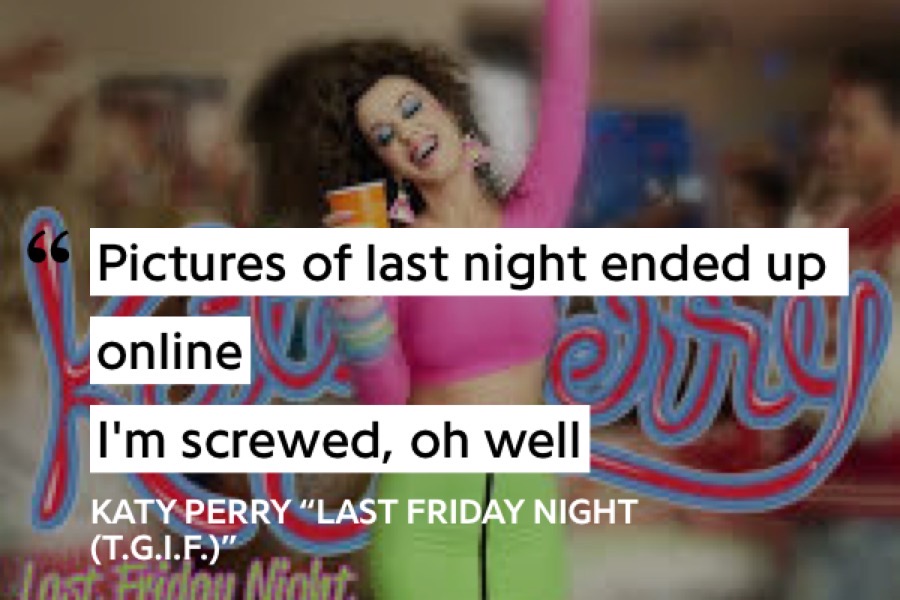
  • When I sat down to write, I was going to pick Katy Perry’s “Hot ‘N’ Cold,” which is kind of become a mantra at school along with the old song “Fever,” as it’s hot in the classrooms until the central office turns of the heat, then it’s freezing. I’m sweating and then freezing. That being said, I watched the “Hot ‘N’ Cold” music video and was starting my research, when the “Last Friday Night” video autoplayed. This was another song that was one of my college jams, but this one was more of a guilty pleasure for two reasons: one, I was an anti-pop hipster who only liked cool bands, and two, Katy Perry, and this song in particular, stood against everything I believed in.

    THINK WE KISSED, BUT I FORGOT. Growing up Seventh-day Adventist, my mom taught my sisters and I to keep the Sabbath. Seventh-day Adventists worship on Saturday rather than Sunday, like most Christians. The church teaches the Old Testament practices of not doing any work from sundown on Friday to sundown on Saturday. That translated to millions of Adventists not watching television on Friday night and no Saturday morning cartoons. As I grew up, I learned that Adventists believed that keeping the Sabbath was a covenant of salvation, and that the end times would be triggered by forcing members to work on Saturdays and go to church on Sundays. That being said, there were very few times when I was allowed “to break the Sabbath” when I was growing up. That meant no sports. That meant no hanging out with friends who weren’t Adventist because they would tempt you to do something to break the Sabbath like watch movies or play games that didn’t make you think of God. So, Katy Perry’s “Last Friday Night” describes a phenomena I could only judge as sin. But it sure looked fun. 

    IT’S A BLACKED OUT BLUR, BUT I’M PRETTY SURE IT RULED. Teenage Dream is Katy Perry’s best album, and maybe really only good one. I talked about the title track last month, but I didn’t talk much about my experience listening to this album. It was my summer of ’10 album. I listened to it track by track, which I hadn’t done with Perry’s previous album. I was in the middle of a literature degree and slowly expanding my musical horizons to include pop music again. I started listening to Lady Gaga, Ke$ha, and Katy Perry and was trying to pass moral judgment from my Christian school with the tools I learned in Bible and literature course for evaluating “whatever is noble, whatever is right, whatever is pure, whatever is lovely, whatever is admirable” (Philippians 4:8). I could enjoy this album as long as I reminded myself that everything about it was wrong. But I was wrong, too. In college I really felt I was on the path to figuring out the world. But I overlooked something crucial: human relationships and love and how I fit into that, not just theoretically. When I understood that in my late 20s, I watched as Teenage Dream judged me, rather than me judging it. Damn.

    https://genius.com/Katy-perry-last-friday-night-tgif-lyrics