Last month when I wrote about Sam Tsui, Max, and Kurt Hugo Schneider’s cover of Neyo’s “So Sick,” I talked about how Tyler Ward was my gateway drug to the world of YouTube cover artists who eventually branch out and write and produce their own music. I discovered Tyler Ward when I was bored in my dorm room and watching pop music videos–ironically of course–and saw that Ward was covering artists like Katy Perry, Far East Movement, Ke$ha, and even oldies like Oasis and Goo Goo Dolls. Starting in 2007, Ward released original music, but was mostly covering songs by the end of the ’00s into the early ’10s. Ward’s first album stylistically flirts with rock and piano rock; however, when Ward started recording original music again, his sound was solidified as a pop singer with a penchant for non-twangy country. “Teenage Summer” is pretty typical of Tyler Ward’s sound–uplifting and light.
‘CAUSE WE WERE RAISED ON THESE REAL GOOD, FEEL GOOD SOUL SONGS. I remember somehow Ward came up in a conversation about music with my roommate. I said in pseudo-disgust, “I hate this guy. He plays guitar and produces his own music on YouTube. He makes pop music sound so cool and respectable. He’s a cool, good looking guy. And he even has my name!” I was jealous and enchanted. I even purchased some of his covers, downloaded a few others from YouTube, and bought his album Vol. 1. Yes, some of the songs were a little cringy, and sometimes the production sounded awkward, but I couldn’t get enough of the guy. His somewhat mysterious/ambiguous connections to CCM including collaborations with long-forgotten singer Rachel Lampa, his air of confidence and smile when he sang, making it feel like he was your best friend, his dirty blond/light brown hair, his past as a football player. I couldn’t vocalize it then. It was like a ’90s sitcom crush with the punchline being, “I’m not gay!” In fact, I wouldn’t dwell on it much, but yeah, my obsession with Tyler Ward in college makes a lot more sense given what I know about myself now.
GOT TEN WEEKS TO DO WHAT WE WANNA. “Teenage Summer” is a nice nostalgic track for youth. Today, Memorial Day, is often called the unofficial start of summer, and for Americans, it seems that summer, though cancelled last year, is back, baby! For South Koreans, however, summer vacation is short, lasting from mid July to mid August. Winter vacation is much longer in Korea. Still, when the weather gets warmer, I’m reminded of my teenage summers–11th grade and the summer after graduating. I remember getting my driver’s license and working, teaching guitar lessons/gigs and other odd jobs and taking community college classes. A few times, I made a few mixtapes for driving, but my car’s CD player was old and hated burned CDs. But my teenage summers were pretty mild. I had an old car and a guitar, and no girlfriend. I thought my teenage years were pretty lonely. However, I was hoping to start a musical career, maybe getting into session work as a guitarist or keyboardist. I could make money on playing wedding gigs as a classical guitarist, teach lessons, and my career as a musician would make up for not having a normal “teenage summer.” Well, that didn’t work out.
Electronic Dance Music (EDM) is the disco of the day. These days, pop charts are filled with DJs and features; however, in the age of disco, the featured singers often went uncredited. Today, though, in the age of powerful pop singers, a feature for a DJ can be mutually beneficial. It can either boost an up-and-coming DJ or boost and up-and-coming singer. Today’s song is not one of the most popular DJs or features. The song hit number 20 on the US Hot Dance/Electronic Songs in 2019. It was featured on the second To All the Boys Netflix film. ILLENIUM and Bahari are not household names, but there is something intoxicating about this smooth, repetitive pop jam, problematic lyrics and all.
IT’S LIKE CHAMPAGNE/ FEEL IT POURING IN MY VEINS. When I came to Korea, I found a very conservative environment with the other missionary teachers. Just like when I chose “the most conservative (accredited) Adventist university,” I had taken a leap of faith in coming to Korea. It was God’s calling for my life at that point I believed. In Korea, I was a bit of a liberal with my love of rock music, Christopher Nolan movies, and Thomas Hardy. I believed that it was important to understand the people of the world by understanding their culture. The group of missionaries whom I worked with were more about personal holiness and shielding yourself from temptations. If they were significantly older, I would call it an age divide, but they were around my age. I had noticed Adventist youth and young adults getting more radical in their devotion, attending events like GYC (Generation of Youth for Christ) and listening to a new wave of Adventist speakers who recycled the old legalistic messages of Adventism with an end-times urgency, specific for millennials. I had avoided people like this before coming to Korea, but it was the reality when I came to my small town in Gangwon-do.
FEELING OUT OF CONTROL WITH YOU CHEMICALS. I remember one conversation with my friend at the time, Abram. It was a conversation after a Sabbath school (like Sunday school, only on Saturday). The lesson study had been about a verse, possibly Titus 2:11-12. Andrew said, “The problem with most people today is they aren’t sober-minded. They may not drink, but they are so caught up in their daily life that they can’t listen to God.” He went on to talk about all the ways that the church, and specifically other church members were caught up in the trivial things that distract us from God, whether it was smart phone notifications, noraebangs, church social events, shopping–often necessary things distract us from our higher calling, spreading the Gospel. Conversations like this reminded me that being a Christian, being a real Christian that is, is hard work. Sabbath afternoon conversations with a wiser, older spiritual brother eventually wouldn’t cut it a year and a half later, but if I could only commit myself to a sober, Christ-like existence, if only I could be more perfect, I would be fulfilled. But perfect was never perfect enough.
After several members of the Christian Rock band Something Like Silas dissolved, some of the members came together to start a new indie rock project. The band’s name was taken from a C.S. Lewis poem of the same name. Debuting in 2007, Future of Forestry has gained acclaim from music critics and the group has a modest following. They have not been hit producers; however, their music has shown up in numerous TV shows and movies. Fronted by classically-trained composer and multi-instrumentalist Eric Owyoung, who now operates the band as a solo project, Future of Forestry’s music is layered and undeniably artistic. However, I just wish they would learn the rules of where to put apostrophes.
YOUR HEART HAS BROUGHT YOU TO THIS LAND WHERE YOUR LOVE IS STRONG AND BOLD. “So, you’re about to graduate. What are you doing next?” I asked a friend in college. My being a super-senior made me have this conversation every semester with classmates who were going on to brighter days before me. “I don’t know. I’d like to travel. Maybe go to Korea and teach English for a year. I want to connect with my father’s side of the family,” River said. Recruiters for the missionary academy came to my college every year. Another friend said he wanted to teach in Taiwan so that he could learn some Mandarin. I knew from my time in Yap that hot places weren’t for me. I get so sluggish when I’m in the heat. River was the girl I traveled to Yap with, and I had stayed with her family for a few days before going to Yap. Her parents had met in Korea. Her mother had been taught for a year and her father had been one of her mother’s business English students. He wrote to her years later when she had returned to America, and the two eventually got married.
THE DAY THAT YOU ARRIVED YOU KNEW THAT YOU COULD RIDE ON A GIANT’S SHOULDERS. The year after asking River what she was going to do after graduation, I was in the same predicament; figuring out what to do. River ended up getting married and working for Adventist publication. Korea stuck in my head. “I’m not sure about going there to work as a missionary because I heard that they make you teach Sabbath School, and I don’t think I could teach school and teach on Sabbath, too,” River said. When my student teaching experience soured, I reached out to a friend who was teaching there. She said be very cautious. The institute hours were long. But the adventure of it intrigued me. Going away to another country where I could be anyone I wanted. Another colleague was teaching with EPIK (English Program In Korea) in public school. I saw the Facebook pictures of drinking and barbecue, and I realized that I had to work for the church. It would keep me safe. How could I fall away from the relationship with God I had cultivated? I could be free to be anyone I wanted, and yet I chose the most restrictive path. Dear past self, it’s okay to be yourself.
In 2017 Season 2 of the highly successful Produce 101, a reality show to make a Kpop group, premiered on South Korean broadcasting channel Mnet. Music competition shows have been popular for ages, but only on rare occasions does the group or artist translate to real-world success. Season One of Produce 101 took 101 female contestants and whiddled the candidates down to eleven group members of the highly successful girl group I.O.I. For the second season, the concept changed. This time 101 male Kpop trainees would compete to be part of Wanna One. The result was not only a more successful season two but the creation of the third most successful Kpop act of the 2010s and the band only lasted for 2 years.
THE MOMENT OUR EYES MATCH, UNBELIEVABLE THINGS HAPPEN. One of the stipulations of Wanna One’s contract was that the band would record for a year and a half and play shows for two years. In January of 2019, Wanna One played their final show, freeing all 11 members from their exclusive obligations with Wanna One. The group was formed as a temporary band, fanfare to the reality show they were a part of, and though Season 3 didn’t produce a group as successful as I.O.I or Wanna One, keeping all iterations of the show going might have crowded the Kpop scene. Still, the money that could have been made! With 11 cute young men to choose from, Wanna One earned middle school girl’s allowance money, and could have continued collecting it, just as older acts like EXO and BTS are still selling albums, posters, and special editions.
I’M WAITING FOR THE DAY WE’LL MEET AGAIN. Located in the center of the group’s final album, today’s song, has infectious early ‘90s soft rock harmonies. Cheesy? Yes, but the soft rock sound makes me nostalgic for my childhood, like playing legos on a rainy day and listening to the radio. I’ve been looking for that nostalgic sound a lot lately. It reminds me of when I could just coast through life. It makes me think about going back and doing it again with what I know now, growing up without wasting time trying to live for people who don’t even matter now. I makes me wonder what other possibilities I could have chosen. This, of course, is pretty pointless because we can’t hit the rewind button. The best I can do is focus on making the right decisions moving forward and teaching the next generation to live without regrets, if such a thing is possible. The kid sitting on the floor playing legos while listening to the radio will grow up alright. Life won’t be exactly as he pictured it, but he find love.
Tim Be Told was an indie CCM band made up of mostly Asian Americans. The band toured, released singles, and got some acclaim. Founded by keyboardist and singer Timothy Ouyang, the band now is a solo act with Tim being the only remaining member. After the other musicians split in 2015, Ouyang came out as gay and Ouyang uses his project, Tim Be Told, to write songs about faith, love, and telling his stories about discovering his sexuality. Last year, Tim released his most authentic, autobiographical album under the Tim Be Told moniker, Love & Happiness and he told his story on Matthias Roberts’ podcast, Queerology.
YOU NEED KNOW IF I BELIEVE IN ME AND YOU. “Me to You” starts out feeling like a praise & worship song. It seems like the formula I heard on CCM stations when I listened to that genre, and of course, Ouyang is well versed in that writing style. However, when says “Felt a little rush / Then our fingers touched,” that line hit me. This song is about falling in love in all of its innocence. That human moment about falling in love, gay or straight or anywhere on the spectrum, is so relatable: when you realize that your feelings are reciprocated. Many will have this happen in their teenage years, the subtle moments leading up to an awkward laugh or maybe a kiss, when you’re not quite sure logically what is happening, but you let yourself fall into it. Some of us it happens much, much later. Some of us it’s a Tinder match or a message on a dating site.
I TRIED TO FOLLOW EVERY RULE. I certainly didn’t want to end up chopped up in the back of someone’s car and that was one of the reasons I would make profile and quickly delete it. I would make a profile and say I lived in another part of the country and then set search parameters for closer to home. Once I even made an OKCupid account and said I was an American ex-pat living in Spain. But then I’d get worried about being a victim of serial killer or freak out that someone might recognize me or I’d start to feel guilty about it because of my relationship with God. Then I thought about the places I could drive to. Teens and young adults are supposed to rebel and take the car, staying out all night. The places I could have meet interesting strangers. The places good Christian boys don’t go. Then there was the cold that ran through my body when I thought about what it might if I saw my fantasy to completion. I called it the Holy Spirit. Softly and tenderly it called all the sinners home to a cold shower and off to bed. But the nights were lonely drowning in the blueness of the screen. I was the hypocrite and my sins would certainly find me out. “Me to You” offers a much less lonely path to love.
On February 7, 2021, the 55th NFL Super Bowl sent mixed signals from a divided nation. You all know the story of March and April and May of 2020. There was a virus. There was a lockdown. There was a brutal murder that everyone saw. There were riots. There was a demand for change. And there was push back. As many ordinary white Americans became aware of the realties of the hardships of people of color, companies scrambled to be on the right side of history. The revolution of 2020 brought light to the realities of racism, but in many cases it seemed to be an attempt to pass the buck. Cancel culture aimed to scrub pop culture of its racist history, while companies that had first targeted white audiences started to think about incorporating diversity.
I’M GOING THROUGH WITHDRAWALS. Abel Makkonen Tesfaye is one of the biggest artists today. Better known as The Weeknd, Tesfaye has been called as the Michael Jackson of this generation. He is the most streamed artists on Spotify. While his latest album, After Hours, was snubbed by the Grammys, he was otherwise decorated with Billboard Music Awards and MTV Video Awards, including video of the year for “Blinding Lights” (and the video is incredible). While he may not have been the music playing on adult contemporary radio stations by white soccer moms, The Weeknd’s streaming success and overall feel-good (with sad lyrics) pop-R&B-indie-emo-’80s nostalgia was a great choice for the halftime show, particularly a show that has been historically tone deaf. Maroon 5 sparked controversy in 2019 when artists boycotted the league for their condemnation of Colin Kaepernick. In the midst of a pandemic and a movement for social justice and despite a highly controversial election, The Weeknd gave a stellar performance. Synth pop, choirs, imagery of Sin City, and some surrealist dancers made his medley of hits feel like they were being canonized in a post modern American Songbook.
I’M DROWNING IN THE NIGHT. But one performance isn’t enough. An episode of Straight White American Jesus broke down the hidden message behind Super Bowl 55. The host Brad Onishi argues that messages of unity in this year’s Super Bowl were about uniting behind the establishment, rather than forging ahead in human rights. One particular message that Onishi talks about at length is a commercial in which Bruce Springsteen talks about a chapel that invites all to join. The argument that Onishi has with this Jeep commercial is that Springsteen is imposing a Christian unity. In other words, being American means being Christian. This does nothing for the person of another faith or of non-faith. As an American, it’s time to challenge our notion of what is American. It should be a diverse picture where everyone regardless of color, race, religion or non-religion, sexuality, or gender is free to pursue life, liberty, and the pursuit of happiness. It’s a land where the police don’t hunt a certain race of people. It’s a land where all can mix and mingle. It’s a land that we can see representation of everyone in the media and in society in every walk of life. It’s a land where we don’t forget our racist past, but we certainly don’t glorify it. We learn from it. We know that Black Lives Matter. We proclaim that Black Lives Matter. We live out the true meaning of the American Creed.
“Weird Al” Yankovic is the king of the parody. From his early self-produced tune in of the late ’70s hits on Doctor Demento to topping the Billboard albums sales chart with his 2006 masterpiece Straight Outta Lynnwood, Weird Al has stayed relevant for over 40 years, evolving with the sounds of the decades, whether it was Michael Jackson parodies in the ’80s, grunge and alternative parodies in the ’90s and the pop parodies of every generation. But arguably, it’s Yankovic’s hilarious takes on Hip-Hop that have kept the 60 year old artist up with the times. “Gangsta’s Paradise”? Nah, let’s rap about the Amish. “Ridin’ Dirty” becomes “White N’ Nerdy.” And the hedonism of T.I.’s 2008 hit “Whatever You Like” keeps its title, but instead, it gets a 2008 recession lyrical modification.
THRIFT STORE JEANS FOR SALE, HALF PRICE. Let’s first look at the piece that Yankovic based this song on. The T.I music video, you see a waitress’s fantasy of meeting the singer. He buys everything for her as if she’s a princess. The look on her face as money solves all of her problems and makes her wildest dreams come true left me waiting for the catch. Indeed, if T.I’s only condition is “I want yo’ body / I need yo’ body / Long as you got me you won’t need nobody.” Just like when you party with the Gatsbys, someone ends up dead in the pool, it seems that this fairytale will come to an end–maybe a bitter divorce when the rich prince finds another princess. Still, some of us want to play with Jay Gatsby if we have a chance. There’s a reason why people watch Keeping Up with the Kardashians and other gross displays of wealth. We’d like to fantasize about solving all of our problems with a platinum card. But what if “Whatever you like” is a choice between Mac & Cheese for dinner or ordering out for pizza? What if your choice of entertainment is watching the clothes spinning in the laundromat or playing board games? What if you could visit your cousin next Sunday in your boyfriend’s Hyundai?
YOU KNOW OUR ECONOMY’S IN THE TOILET.When I first heard this song, I was laughing through my tears. A writing exercise I sometimes have my student do is to write a letter to someone saying that they love that person (or hate that person). The only rule is they can’t use the words, “I love you.” This forces them to think about other ways to describe their feelings. In a similar vein, “Whatever You Like” is a brilliant way of saying I’m practically broke, without ever saying it. But, if I must be honest, I relate to this song on a bit of a deeper, somewhat painful level. When I was growing up, my family was on food stamps until my dad became a truck driver. We ate from the church’s food pantry as a supplement to the government programs. My sisters and I wore secondhand clothes, but never underwear like in this song! I used to envy the kids who could have “whatever they liked,” which at the time was a world not much bigger than the options listed in Weird Al’s parody. I envied kids whose parents didn’t buy the generic brands or whose parents could take them out to Burger King or McDonald’s whenever they wanted to go. But in the end, what did it matter? I grew up healthy. I didn’t need to wear brand new clothes or eat the non-store brand potato chips. Now, I can pay a few cents more for the name-brand if I must, but really, aren’t you just paying for a more attractive bag with virtually the same salty treats inside?
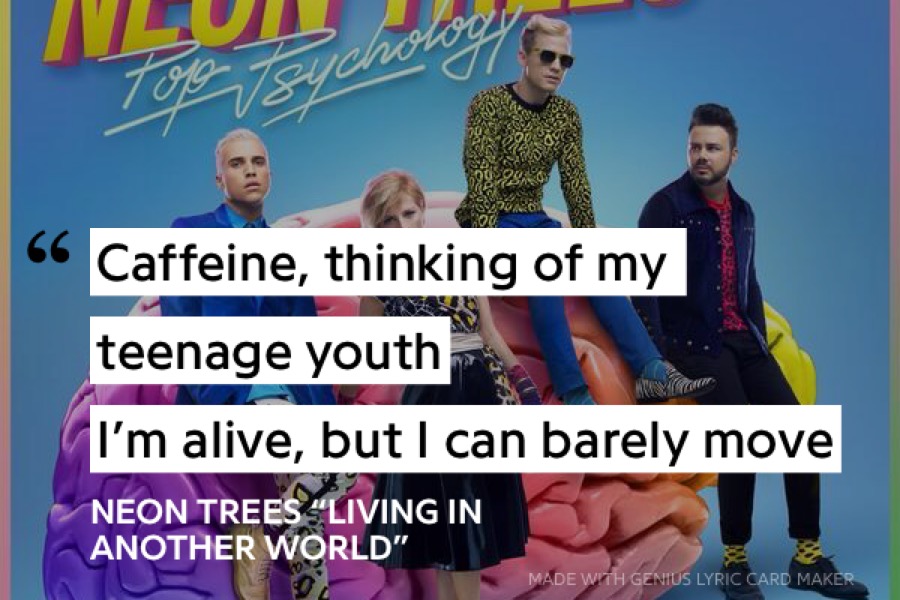
Tyler Glenn, lead vocalist and songwriter for Neon Trees came out as gay in a Rolling Stoneissue on April 10, 2014. This may not have been shocking as the flamboyant singer echoed the styles of Elton John or queer New Wave bands, but he could not reconcile his sexuality with the religion of his upbringing, Mormonism. Prior to coming out to his friends, family, and later the public, Glenn considered suicide. Coming out for Glenn allowed him to be his true self, and songs on their third album, Pop Psychology, talk about love, identity, and faith in the 2010s. However, in the following years, Mormonism has doubled down on its rejection of same sex marriage, prompting Glenn to no longer identify as Mormon, even releasing a solo album, Excommunication in 2016.
TV’S TELLING ME TO BE MYSELF. When I was student teaching, I began watching the first season of Glee, which was a little too campy to admit to. I stopped and started the show many times, but I started watching it again when I came to Korea. I finished the fourth season and started the particularly awful fifth season, which divided the original cast in New York and a new cast that no one cared about in Ohio. There were a few good numbers, including Tegan and Sara’s “Closer” and Neon Tree’s “Everyone Talks.” As awful as it was, Glee was one of the shows that humanized gay couples for me. I think I stopped watching the show because I felt that it was leading me astray. In my breakthrough year of 2014, I caught the flu after a workshop weekend in April. Still teaching at the institute (학원), I came home on my break time completely exhausted once my flu meds stopped working. I laid on the couch and watched Glee Season 5, seeing Kurt and Blaine’s relationship. It was one of the most healthy relationships I had ever seen on TV. It challenged my faith. How could it be wrong? And what did it say about me?
I GUESS I’VE ALWAYS BEEN THIS WAY. I remember hearing about Glenn’s coming out in 2014, although I wasn’t particularly familiar with Neon Trees beyond hearing some of their hits. While I was in America, Alternative radio caught on to their first record. This was at the time when Mumford & Sons, Phoenix, and poppy alternative bands started to dominate the radio. They kind of created a trinity of Mormon bands alongside The Killers and Imagine Dragons on Alternative radio. Their song “Everybody Talks” was a fun single, and then when they released “Sleeping with a Friend,” which was Glenn’s admission to the rumors about his sexuality and the blurry lines between love and friendship between a gay man and his straight friend. The song set apart the band as not for everyone. Remember that in 2014 it may have been cool for a female singer to be Bi-curious, but openly gay musicians were not universally celebrated. However, Glenn didn’t publicly come out until the eve of releasing Pop Psychology. While Neon Tree’s career may have become less popular, Glenn’s coming out prompted Imagine Dragon’s Dan Reynolds to take a stance in support of LGBT rights, especially regarding the Mormon faith. While I’m not Mormon, people of faith coming out had a big impact on my life as I questioned who I was. Starting in 2010, when folk-CCM singer Jennifer Knapp came out as lesbian to 2016 when Everyday Sunday’s lead singer, Trey Pearson, came out as gay and seeing the support and positive messages that fans have shown has been encouraging. But back to that sofa in 2014 when I realized that maybe my theology was wrong: If Kurt exists, and he does, he is the way God made him. The desires God gave him are not to marry a woman, but he found love with another man. And Kurt isn’t just an unreal character. Kurts and Blaines and Santanas and Brittneys exist. God made them that way. Is my hypothetical religion true or is it overlooking something?
Adam Dutch is a DJ from Ocean City, Maryland, who specializes in blending pop, rock, hip-hop, and EDM. In 2018, he took two very sad songs, the current hit at that time by Bastille and Marshmello, “Happier,” and set it to Anberlin‘s 2005 fan favorite, “Paperthin Hymn.” What the track gains is a harder, more passionate vocal line from Bastille’s lyrics, along with Stephen Christian‘s occasional line, adding “I thought you said forever over and over.” Anberlin’s lyrics, though, are mostly buried in the musical layers, making the song about a breakup and not about death. But, by choosing this mashup, I believe I have disqualified myself from writing about “Paperthin Hymn” on another “Sunday morning” or on an “August evening,” so I will bring the original songs into the conversation as well.
I THOUGHT YOU SAID FOREVER OVER AND OVER… Anberlin’s “Paperthin Hymn” is an excellent example of how a rock song can be melancholy and rock too. The band released other songs about loss and depression. They released many other songs in minor keys, but the elegiac lyrics, the Deon Rexroat D minor bass riff build, and Joseph Milligan’s guitar riffs build this song into a simultaneously hauntingly tragic and kick-ass song. Certainly, as the song became the band’s greatest hit in their early career, it must have lost some meaning when played live. According to Stephen Christian’s Tumblr explaining Anberlin’s songs, “Paperthin Hymn” is reportedly about the death of Stephen Christian’s grandmother and the death of Joseph Milligan‘s sister to cancer. Lyrically, the song is a reminder to show your affection for the people you love because we cannot know how long they will be with us. The song also laments the cost of the band’s heavy touring schedule as the loss of loved ones happened to the band as they were out on the road. There’s an inevitable guilt that comes from pursuing a dream that keeps you away from loved ones.
I WANNA RAISE YOUR SPIRITS. Unlike Anberlin, the British pop-rock band Bastille had what it took to survive the changing landscape of rock music. Prior to “Happier,” a collaboration with anonymous DJ/producer Marshmello, the band had already explored EDM and had cultivated a rather radio-friendly pop sound. “Happier”’ is a song about a relationship nearing its expiration date. Being together doesn’t make each partner as happy as they could be, and the singer feels that if he leaves, his partner will be able to recover and find true happiness, whether with another person or pursuing a dream. I wrote about this feeling last week. And although in hindsight I don’t have regrets about ending that relationship, I’ve had similar feelings in my current relationship, but love and communication along with relationship reassessment got us healthy again. I’m certainly not one to say that all relationships should last forever. I believe in divorce, but I also think that love that’s not worth fighting for is never love.
Like Stephen Kellogg and the Sixers, Matthew Perryman Jones was part of 2012’s 25 Love Songs: A Special Gift from NoiseTrade. I had downloaded the album to hear the new Paper Route single as the band was taking an incredibly long time to release their sophomore The Peace of Wild Things. What I discovered was a bunch of indie folk artists like Kellogg, Jones, Leagues, Cary Brothers, and so many others. Matthew Perryman Jones has contributed music to television soundtracks for shows like Kyle XY and Love, Death & Robots. He gave away much of his music for free on NoiseTrade. I remember downloading the Jars of Clay Spring Tour 2012 sampler, on which featured two songs from Jones who also supported the band on tour. Jones’ “Land of the Living” was covered by progressive Christian band Gungor on their album One Wild Life: Soul.
I’VE BEEN DRIVING ON THE HIGHWAY THAT LEADS TO MY HOMETOWN. In “Echoes of Eden,” the singer uses religious language to convince himself that just as his past was secure and full of wonder, his future “lead . . . to that City glorified.” Jones is not a mainstream CCM singer, but, like so many folk and country singers, he shows how Christian faith have shaped his life and art. Likewise, I find that there are certain comforts to take in the Christian message and my memories of a strict religious upbringing. The singer listens for “the echoes of Eden,” reflecting on where he and where all of humankind has been. According to an interview with blogger Katie Gustafson, Jones revealed that he suffered from panic attacks and crippling depression in his teens, even dropping out of school by his senior year. He says that despite his Christian upbringing, he felt distant from God, except when he played music. “My song was my salvation,” he stated. And music helped heal him and made him into a successful singer songwriter today.
A CHANGE IS CALLING OUT. Matthew Perryman Jones is kind of a perfect example of a somewhat secular folk-rock singer-songwriter who writes on Christian themes. Unlike U2, he doesn’t seem to say anything too controversial that makes the Christian market question cancel him. His story about how music and faith help to treat his depression resonates well with the readers of Christianity Today and Relevant Magazine. But these publications under represent artists who have been hurt by the church structure. So many people who grew up Christian have been hurt by the church, so when they hear “the echoes of Eden,” they don’t feel the “old timey religion” hometown feel that others feel. Instead they feel judgement and point out the hypocrisy of the state-sanctioned religion that has done damage in their past. These two drastically different reactions make sense based on how prominent Christianity is in Western culture. For me, I’m kind of somewhere between the two. I find that Christianity and the message of Jesus is comforting, but I also feel like I gave it too much power over me. Maybe most of us are just trying to separate the good from the bad.




 Mixtapemotions