-
Tears for Fear’s debut, The Hurting, caused the pop-rock duo composed of Roland Orzabel and Curt Smith to look to their darker emotions to produce honest lines that were rare in popular music at that time. By their sophomore album, Song from the Big Chair, Orzabel and Smith expanded their sights on bigger issues, but the lyrics still come off as personal.The band’s most recognizable song “Everybody Wants to Rule the World” looks at greed on a personal level, which ultimately expands to an intricate, Cold War era of problems contemporary to the band’s hit. The layered sounds of the Big Chair are quintessentially ’80s, and if it weren’t for the ’80s renaissance that started in pop music c. 2004 which hasn’t ended yet, Tears for Fears might have sounded dated. Today’s song “Shout” doesn’t sound old, though. It sounds retro.I’M TALKIN’ TO YOU. I didn’t realize “Shout” is six and a half minutes long when I listened to it today. The radio single was whittled down to 4 minutes. The opening track on Songs from the Big Chair and the second single has a kind of “Canon in D” quality to it. It keeps the same chord progression in verse and chorus, but it adds layers of sound as it progresses, even turning into a round by the end of the song with Orzabel and Smith singing different parts. According to Orzabel, the song isn’t about merely letting out emotion. Listeners mistake this song for being about primal scream theory, as the band talked about “Mad World” being influenced by the work of Arthur Janov, author of The Primal Scream. Orzebel stated that the song “is actually more concerned with political protest.” Smith stated that the song “encourages people not to do things without actually questioning them.” As Tears for Fears is perhaps one of the best textbook cases of a New Wave band, it’s important to remember that New Wave is sometimes called post-punk. Punk rock, in its original form didn’t translate well to American audiences who didn’t get the anarchy message aimed at British politics. New Wave was a British export sound with a more commercial sound. Rockers of the ’80s looked to international issues, the fear of nuclear war, corporate greed, and inequality, and laced them subtly into hit songs. “Shout” is a song about standing up for your rights.LET IT ALL OUT. I think that the music of Tears for Fears has become timeless, especially after how much the sound has been appropriated by the emo bands of the ’00s. The band didn’t survive well into the ’90s, though. The duo broke up in 1991, and Orzabel kept recording music as Tears for Fears until 1995. After the ’80s, though, Tears for Fears fell out of fashion. New Wave gave way to grunge and hip-hop/r&b. Perhaps Tears for Fears could have lasted, but there was one factor about their music that left a bad taste in listeners’ mouths–the visual aspect. Tears for Fears videos are cringy and laughable. The two English lads with their big hair and big teeth, dancing at the British seashore doesn’t do justice to the song. Released in 1985, during the height of MTV, every successful band had to make a music video. This trend continues even today. And as budgets increased, videos became more artistic. But before a bad music video could end a career, because there were so many bad videos, there was Tears for Fears giving us all of what would become cliche about the ’80s. The ’90s and early ’00s fashions on TV, which in retrospect were also pretty awful, had conditioned me to feel very uncomfortable, almost nauseous, when I saw something from the ’80s, whether it was big hair, short shorts on with terribly hairy legs, glasses with big rims, tight, straight-leg Levi’s that covered the belly button, or big hair and perms. Today, the culture has normalized, even created a nostalgia for the ’80s. We have many of those fashions in our current culture, minus the big hair. And still, Tears for Fears’ music videos are still cringy and wouldn’t be shot today.Official Music Video:“Shout 2000” cover by Disturbed
-
In 2008, Tooth & Nail Records was looking for their next big band after their mid-’00 lineup had signed to major labels. In several episodes of Labeled, Brandon Ebel talks about this time, without specifically naming a band, as a time when the label signed acts that no one on staff particularly liked, but in hopes that there would be a band that could generate the income of the label’s heyday. Capital Lights was one of the bands to release their debut during an eclectic year for the label. Formed in 2002 under the name afterEight, the Tulsa, Oklahoma natives who would become Capital Lights started out as a screamo band with lead singer Jacob Dement. But when Dement left the band, bassist Bryce Phillips took over vocal duties, and the band’s sound changed into a power pop-punk sound. With big dreams to follow in the footsteps the Golden Age of Tooth & Nail bands from just three years prior to them, they hoped to build a Warped-Tour career, but that never happened.
ROCK STAR, SWAGGERS LIKE A HOT SHOT. To put This Is an Outrage in the context of 2008 Tooth & Nail releases, there were only a few memorable records that year. There was The Classic Crime’s sophomore record, The Silver Cord, Family Force 5 moved to Tooth & Nail and released their polarizing Dance or Die, changing the “Kountry Gentlemen” into a dance-pop group. Copeland released their fourth record, You Are My Sunshine, Showbread released their ambitious double LPs Anorexia and Nervosa. Starflyer 59, Joy Electric, Emery, Haste the Day, and Underoath all released albums, and none of the them were the stand out records in their discography. Then there were a lot of debut albums that would get a sophomore record before a break up. Active rock group Since October, overtly Christian band Ivoryline, power metal group Secret & Whisper, pop-punk band Search the City, country singer-songwriter Corey Crowder, and gothic emo group The Becoming all had debut albums this year, but ultimately failed to spark a lasting recording career. Children 18:3 released their first of three records. After releasing their sophomore record, Cruel to Be Young, Jonezetta called it quits after failing to reach the success the label had hoped for. Capital Lights appeared at a time when it stopped being cool to be listening to Tooth & Nail. This Is an Outrage! was catchy, though. The mile-a-minute singer Bryce Phillips, the synth, and the tempo helped make every song sound the same, which was pretty repulsive when I first heard the album. Seeing the band perform live on the Creation Fest tour, a friend I went with started listening to the CD in his car, and it grew on me. Today, I wouldn’t say that it’s good music, but it reminds me of a particular time.EGOTISTICAL, IN HER PERFECT WORLD. “Caroline” comes from the band’s follow-up record, 2012’s Rhythm ‘N’ Moves. The story behind this album doesn’t make sense to me. A year after touring with Outrage! Capital Lights broke up. Guitarist Johnathan Williams said on The Bible Belt Bros podcast that Capital Lights had been pigeon-hold in touring with Christian bands, though they wanted to do club tours. A year after breaking up, the band got back together to write music. Tooth & Nail’s CEO Brandon Ebel agreed to release another Capital Lights record, produced by the band rather than Aaron Sprinkle whose schedule didn’t match the band’s. The release of Rhythm gave singles to Christian rock radio, but it wasn’t a huge record, and the band didn’t tour to promote it. Of all of the bands that just faded out of the late ’00s, why was Capital Lights the one that got their album of closure? Rhythm delves more into pop music and sounds like a 2012 record, full of autotune and sound effects. Though catchy as ever, Rhythm seems to have even less lasting power in the scene. The confident-to what I perceive as arrogant lead singer sings about a girl “who fell in love with herself.” The lyrics are tongue-in-cheek, a little cheesy, and maybe a little sexist. They make me think about a girl I knew who was my sister’s rival, but that’s a story for another day. The autotune job reminds me of The Gregory Brothers autotuning the news. “Caroline” isn’t a great song, but I couldn’t get it out of my head after hearing it today. -
There’s an urgency in Eat, Sleep, Repeat unlike Copeland’s first two records. The small-town feel of Beneath Medicine Tree, though the record deals with death and sickness, feels warmer than Copeland’s third record. The band’s follow up In Motion was a ’90s rock album six years too late. As for packaging, the first two Copeland albums, and the fourth one, used earth tones to convey a slightly melancholy, but somewhat hopeful message. Eat, Sleep, Repeat‘s artwork looks like it was partially inspired by Gustav Dore and garden gnomes. The grey pencil drawings match with the minimalist sound of grey, electronic melodies interwoven with guitar-tracks hinting at some continuity in the band’s work. Fans of Copeland expressed their dislike for the album, but it was a signal toward the musical experimentation that the band would travel toward.
MAYBE YOU SHOULD WRITE A LIST FOR ME. Opening with an acoustic guitar, “Careful Now” sets itself up to be one of the most straight-forward acoustic rock tracks Copeland plays. “Careful Now” is the fourth track on the record, following keyboard-driven album opener and second track and piano-driven “Control Freak,” the album’s only single. While “Careful Now” starts out as a straight-forward acoustic rock track, it takes a turn at the bridge to almost musical-theater material. The frantic lyrics of “Careful Now” show a young man searching for meaning, wanting anything to make sense. The lyrics are not dissimilar with the previous songs, nor with the proceeding. “Careful Now” shows a mental breakdown by the bridge, in which the singer realizes that it’s impossible to categorize his worldview neatly. The bridge’s keyboard production, the electric guitar, and Aaron Marsh’s vocals lead the album into what Marsh calls the “Burt Bacharach” moment of the album, “Love Affair.” But listeners hear these artistic moments in the bridges throughout the album. “Careful Now” also sets the tone for “By My Side” and the final two tracks. All of these tracks are dreary, so a particular dreary Monday after daylight savings time when the rain threatens to wash away the final leaves on the trees might be the mood for listening to Copeland’s third album. Since we don’t particularly care for these kind of days, we might write off this album as just dreary. But dreary needs a soundtrack, too.I DON’T KNOW HOW TO FEEL. In some ways, this song sounds like a young person waking up to the fact that the world is broken and that it no longer makes sense to him. When Marsh frantically declares: “I threw everything out that doesn’t make sense / to find a thousand more things that don’t make sense” the singer is showing a desperate frustration at a world that he thought he knew. Maybe it’s a relationship that went by the book, but fell apart. Maybe it’s an academic dilemma. Maybe it’s the problem of evil. Maybe it’s another theological problem. We’ve all been there, in our bedrooms, having mentally worked out the puzzle pieces. We fit them together, but the next day, we look at it and we notice the picture doesn’t quite align and the pieces feel forced. We think, “If only I didn’t have to rely on others. If only I could do it myself,” and you’d solve the world’s problems. But those frustrating days when the boss tells you that you’ve overlooked a key detail, your girlfriend tells you that she’s not feeling it right now, or some horrible disaster happens on the news or a political movement inexplicably turned its back on logic, you have to go back to that puzzle and rework it. It the picture even designed or is it just random? -
Red‘s debut album, End of Silence, comes in the middle of a maximalist orchestral rock era on the alternative/active rock stations. The lead single, “Breathe Into Me” is a heavily produced single that involves screaming, a Middle-eastern sounding guitar solo, and a string section that sounds like it’s being tuned in on an FM radio. As novel as that sounds, a DJ today might be able to recreate that sound if he picked up a hundred other active rock records from 2003-2009. The sound effects and heavy guitars could be found on any Linkin Park record, the strings on an Evanescence record, the screaming on almost any other record. But in 2006, Red’s End of Silence was a fun, aggressive radio-rock record, and I had every hope that they would go on to have a career of unique heavy music.FALLING FASTER. Released the summer after I graduated from high school, I didn’t really start listening to Red’s debut record until the Fall, when I was driving to morning classes at community college. The misty September, October, and November mornings when the temperature started dropping and the sun started coming up later and later needed something aggressive to kick the coffee in tumbler into action. The album opens with an eerie introduction track which leads into “Breathe Into Me.” The second track “Let Go” takes the screaming up a notch, as well as the rage. The album slows down from there. “Already Over” is a piano driven tune that begins with some distant-sounding, extremely produced screaming. It’s not a calm, soothing piano ballad, but rather singer Michael Barnes sings passionately about surrender. The album is downhill from there. The band keeps their aesthetic of dark rock music but adds calmer tracks here and there. Some of the songs sound like they should be B-sides, others sound like worship tracks. “Breathe Into Me” was the first of more than 20 of the band’s singles to top Christian Rock radio and it peaked at #15 on Billboard’s Modern Rock chart. They appeared on rock tours with Three Days Grace and Breaking Benjamin, whom Red’s former guitarist Jasen Rauch would later join, as well Christian festivals and tours with Skillet and other hard Christian rock acts. I saw their 2010 sub-headlining spot at Asheville’s The Orange Peel in 2010 along with headliner P.O.D. and opening acts Brian “Head” Welch of Korn fame’s band Love and Death and Icon for Hire as well as at Ichthus and Cornerstone.BREATHE YOUR LIFE INTO ME. These days, I’m not always in the mood for angry, aggressive music. I don’t know when it happened. Maybe when I started listening to more pop music. I couldn’t stick around with Red’s career. However, they’re still around with a million monthly Spotify listeners. It seems what has been Red’s strong suit, which is why I’ve dropped off the Red bandwagon, is their consistency. Every Red album is stylized a certain way, from the cover art to the song composition. The band keeps a very serious demeanor in music videos, on stage, and in photographs. It kind of reminds me of what Ryan Clark said about the Demon Hunter image he has created, when he talked about Demon Hunter’s image on the Labeled Podcast. Of course, Demon Hunter isn’t the only hard rock/metal band create and stay on brand. Red’s aesthetic includes a minimalist album cover, using two or three colors, usually red and black, except for 2013’s Release the Panic, which was dark blue and black. The band has worked with producer Rob Graves on every album, except for Release the Panic and this consistency makes most of the albums sound the same. There’s usually something unique about each album, but their sophomore album sounded exactly like weaker moments on their debut record. Their third record tightened up the dirtier screaming vocals. Release the Panic, though working with a different producer, Howard Benson, offered very little new to the band’s sound. Of Beauty and Rage was lyrically their darkest, even making Plugged In concerned about the content. It’s always fun to read a negative Christian Rock review from Plugged In. Gone was an experiment with electronic sounds. Their most recent album Declaration sounds just like the same band we’ve heard before. “Breathe Into Me” is a nice throwback track for a time when I liked this kind of music a lot. Today, it’s more about nostalgia. I might find myself listening to a Red track here or there when I want to be angry. But it’s not really what I want to do these days.
-
My generation has had a few sobering news days, but in 1999 very little struck more fear into the hearts of American students and parents than turning on the news on April 20, seeing the horrifying scenes of the massacre at Columbine High School. In the way that September 11 changed aviation forever, Columbine changed education. There had been school shootings in the U.S. before, but none had the scope of planning of Columbine. So much information came out about the victims and perpetrators after the shooting for years to come. There were several distinct responses I remember growing up immersed in the evangelical South. First, it was that shooters Eric Harris and Dylan Klebold were into the gothic scene, wearing all black, keeping nihilistic journals, and listening to music like Marylin Manson, Korn, and The Insane Clown Posse. This music was clearly satanic and could lead teens to commit mass shootings. Second, the testimony of Cassie Burnell, the girl whom, years later, was misreported to been asked, “Do you believe in God?” and was killed because she said, “Yes” was preached as a message of religious martyrdom. There was also a third view that grew in popularity. But it was seen as too unAmerican in the evangelical South.
DADDY WORKS A LONG DAY. In 2011 when “Pumped Up Kicks” hit number 3 on the Hot 100 and topped the Alternative Rock chart, a few listeners started to have some reservations about the song. Written by former commercial jingle writer Mark Foster, “Pumped Up Kicks” is a dancy track sounding like it’s from the ’60s or ’70s. The song was released online as a free download and started getting virally famous. Foster played all the instruments on the song, but formed a band in order to play live when “Pumped Up Kicks” gained popularity enough to sign him to Startime Records, an imprint of Columbia Records. Foster at first explained the lyrics as a “‘Fuck you’ to hipsters.” Essentially, he created the equivalent of what the Mel Brooks did in The Producers when Max Bialystock and Leo Bloom produce a should-be-doomed musical titled Springtime for Hitler. There had been songs about school shootings before. P.O.D.‘s “Youth of the Nation,” Flyleaf‘s “Cassie,” Michael W. Smith‘s “This Is Your Time,” and Rebecca St. James‘ “Yes, I Believe in God” all were somber religious songs about the what did or what could happen in a school shooting. But “Pumped Up Kicks” was similar to a 1979 song by an Irish group The Boomtown Rats, singing about a school school shooting earlier that year in their major U.K. minor U.S. hit “I Don’t Like Mondays.” Foster claims that the story in “Kicks” is completely fictional, but it does make you wonder about if you should be dancing to a song about a shooting, real or imagined.YOU’D BETTER RUN, BETTER RUN, FASTER THAN MY GUN. Foster told Billboard in 2019 that the song never mentioned a school, but that listeners had “filled in the blanks.” The song was inspired by hearing about a shooting on TV. He told Billboard, “I remember that week [that I wrote the song], there was some shooting that happened, and it really bothered me, because I recognized that it was going to continue to get worse. And that nothing was going to change.” He’s also told USA Today that the song “isn’t about condoning violence at all. . . . The song is an amazing platform to have a conversation with your kids about something that shouldn’t be ignored.” When Foster the People became a band, bassist Jacob “Cubbie” Fink (future husband of the aforementioned CCM singer Rebecca St. James) said that his cousin was a survivor of the Columbine Shooting. He saw the songs as a platform to talk about violence. In 2002, controversial film director Michael Moore made a film called Bowling for Columbine in which he argued that American gun lobbyist group The National Riffle Association (NRA) was responsible for keeping guns easily accessible to those with malicious intent. Many dismissed Moore’s claims as being too far left and even attacked his research. However, mass shootings, both in and out of the classroom continue to escalate in scope and scale in the United States. After Columbine, Virginia Tech, Sandy Hook, the Amish shooting, church shootings, synagogue shootings, mosque shootings, the Colorado theater shooting, the Las Vegas concert shooting, the Pulse night club shooting, are just the ones off the top of my head. I remember watching the episode “Thoughts and Prayers” of Bojack Horseman’s fourth season the day before the Las Vegas concert shooting. That episode darkly parodies the American’s inability to do anything to prevent shootings. What we can do is offer “thoughts and prayers” constantly. The reaction to the Vegas shooting by the NRA was “It’s not the time to talk about gun control” when people are extremely upset about it. This isn’t new, and they say this all the time. As if the NRA is waiting around for the perfect time to broach the subject when people are calm, cool, and collected. I used to think that a dancey indie track wasn’t the best platform to talk about gun violence, but it’s become so common in American society, that I start to wonder why not? Gun violence can happen at anytime or place these days. Why not talk about it.Middle8’s commentary on the song:Live on the Late Late Show:
Hildagard von Blingin’s Bardcore version: -
Like yesterday’s song, today’s song also comes from 2007, but that’s maybe the only similarity. Composed by Kenzie, the professional name for SM Entertainment‘s songwriter Kim Yeon-jeong, the debut single of one of the biggest K-pop groups set the tone for a ten-year career of fun, bubble-gummy, uplifting songs. Composed of nine young women all born between 1989 and 1991, Girls’ Generation has been been called “the Nation’s Girl Group,” in South Korea due to their popularity between 2007-2017. Beginning with a sample of Don Henley‘s 1984 classic “The Boys of Summer,” (covered in August by The Ataris) the song builds on the nostalgic piano and synth sample. Rather than calling back with longing for the past, this song propels listeners forward into the future.
I LEAVE BEHIND THIS WORLD’S UNENDING SADNESS. I’ve been pretty critical of K-pop in the past for being a-political. I used to think that music in America was too political, especially when I was a Republican teenager (cringe). I was annoyed when Coldplay’s Chris Martin said at the 2004 Grammy‘s “May John Kerry be your president someday.” Of course there were also right-wing musicians, too, but being found have Republican tendencies could end a rock band’s career in some cases. In South Korea, because the government subsidizes the industry, idol groups are to be politically neutral. There are very few songs that are overt protest songs which can be found in rock and pop and even country in America. However, today’s song, with its hopeful message of stepping into the unknown future, has become a famous protest song in South Korea, starting in 2015, when students led a peaceful protest against Ewha University in Seoul. Both Tiffany and Yuri of SNSD expressed their appreciation to their fans for using the song to rally for change. Tiffany said, “Right now is the generation for feminists, and it’s an era where messages of women empowering other women are important. I feel like our song played that role, so my heart was happy.” A year later, the song was sung at protest rallies against President Park Geun-Hye. The massive protests against the leader accused of corruption had the people singing a song of hope, demanding more from their leaders. Fans also sang the song on April 11, 2019, when criminalization of abortion was recognized as unconstitutional in South Korea. Finally, in 2020, the song was sung in anti-governmental protests in Thailand, fans translating the message of the song to spread hope in Thailand.LOOKING INTO YOUR EYES, NO WORDS ARE NEEDED. I don’t think that “Into the New World” credits its sampling of “The Boys of Summer,” as it’s never mentioned in most sources. In September, I talked about how Olivia Rodrigo was inspired by “Misery Business” and eventually gave writing credit to Haley Williams and Josh Farro. Musicians get into trouble all the time for borrowing too heavily from their sources. There are several video compilations of similar sounding songs. Whether it’s Sam Smith listening to Tom Petty or Lana Del Rey listening to Radiohead, we can hear musical similarities if we keep our ears open. I could make a list of songs that I think sound the same or songs that I’ve mashed up, even disguised as church songs when I played for church (“He Is Exalted” and the guitar from “Don’t Stop Believing“). Some groups like The Verve had their career paralyzed by the litigious Rolling Stones‘ manager. And as much fun as it would be to make a playlist of similar sounding songs or funny mash-ups like “Creep but It’s All I Want for Christmas” it seems like the project could get out of control. There’s a reason why I only pick one song a day. Tom Petty said it best when he decided not to sue Red Hot Chili Peppers for the similarity between his song “Dani California” and “Mary Jane’s Last Dance“: “A lot of rock & roll sounds alike.” And that similarity can draw parallels in theme in listeners minds. “Into the New World” and “The Boys of Summer” may build off of the same arpeggio, but one looks back without any hope for the future, the other uses the past to build a brighter future.Lyric video: -
We take another song from a band who took their name from Webster’s Dictionary’s second definition for the word fold, “a group of people working together for a common goal,” as the song of the day. The band’s sophomore album has been called a “sonic journal for frontman Daniel Castady to chronicle the last few years of his life.” compared to the band’s debut record, the album contains “unfiltered lyrics,”
which are raw and are very personal to Castady. Taking the title of the record from a sentence graffitied on a truck stop bathroom stall, Secrets Make You Sick deserves a few listens. I was perhaps overly harsh on “Younger Than Our Years,” a hooking melody that draws listeners in, but still that song and “New Skeptic” reek of youthful arrogance.REMEMBERING THAT NIGHT WHEN THE POLICE PHONED MY HOUSE. If you can get past the arrogance, though, there are some very deep moments on the album. Castady talked with Jesusfreakhideout in 2007 in the middle of the Tooth & Nail Tour when MxPx had triumphantly returned to the label and headlined a semi-annual tour of the label’s flagship bands. The story behind the songs are very personal, from the passing of Castady’s mother and the grieving and healing of his father to a light-hearted song of encouragement to his sister. However, the most striking are the songs about his cousin, Andrew. These songs are “Faster Still” in the middle of the record, and “Revisited,” the album closer. Castady revealed that his cousin was bi-polar and suffered from schizophrenia before he took his life. In “Faster Still,” Castady recalls their childhood memories together, but laments about how quickly he deteriorated. The song is written about a time when Andrew was still alive. Castady recalls the year he “nearly lost” Andrew with a few vague, but poignant details about the police phoning his house. Daniel wonders if “covered in love” or “the lack thereof” is enough. “Revisited” imagines his cousin as a ghost, and Daniel raises questions about suicide, mental health, and salvation. He wonders if his cousin is “safely in God’s arms or in eternal insurrection.”LISTEN TO ME WHEN I TELL YOU, YOU HAVE NO CONTROL. Punctuated with the late ’80s/early ’90s keyboard, “Faster Still” helped to paint a nostalgic picture for me. The production on this song sounds a little under-developed, especially for the recording technology of the time that it was recorded, but that keyboard really drew me into the song, making me think about those cold, late falls when the freeze begins in upstate New York. I remember one year that it snowed on Halloween–we had to cut short trick- or-treating to get home before the roads were impassible–and the snow stayed on the ground until March. I think about the people who I once knew, the unexpected deaths of former classmates I never kept in touch with. One classmate was training to be an Olympic swimmer, but drowned swimming in the river. Then I think about the year of suicides that struck my local church community when I was in high school. The calling committee ruining a beautiful fall afternoon with a message about calling hours for the man who had just given a sermon-length testimony about how God was freeing him from the chains of depression. Or the elder’s son who slowly spiraled into drug addiction and hung himself on a chilly November afternoon. How quickly the narrative in church changes to love and compassion, even searching the scriptures to justify how he must have been out of his mind, so therefore, it must have been an incurable sickness that God would forgive. In our quiet moments, memories may haunt us like ghosts. But death is the ultimate reminder that we are not in control. We do not control the narrative of how we’ll be remembered. We do not control our loved one’s destiny. And ultimately we have little control over our own destiny. Whatever afterlife, or lack thereof, we have to trust or believe in a religion or something we ourselves have created. And that can be terrifying. -
Paramore‘s second album Riot! made the pop-punk emo band of late millennial famous with the summer Alternative Rock and pop radio hit “Misery Business,” which is still arguably the band’s signature hit. Usually, though, a band’s signature hit is either their highest charting song or their located within the era of the band’s commercial peak. However, seven years after the summer of “Misery Business,” Paramore charted the highest with their 2014 final single from their eponymous record, “Ain’t It Fun.” This shift from emo to more conventional pop was in line with fellow bands Fall Out Boy and Panic! at the Disco did as well. Just as the scene kids were growing up as every generation of rebellious rock ‘n’ roll had, “Ain’t It Fun” is a song about growing up and realizing that the world isn’t as easy as you once thought it was. It may not be punk-rock, but it’s certainly still got some emo sentimentality.WHERE YOU’RE FROM, YOU MIGHT BE THE ONE WHO’S RUNNIN’ THINGS. Every Paramore record comes with its share of drama. In fact, the formation of the band was unorthodox. Haley Williams signed a record deal with Atlantic Records at the age of 14, the label wanted her to be a pop star. Williams, however, wanted to be a rock singer. Williams formed Paramore with friend Zac Farro, who had played together in a group called The Factory. the band was signed to a niche, subsidiary label Fueled by Ramen, while Williams was signed to Atlantic Records. This uneven record deal was one of the controversies that kept changing band members over and over throughout the band’s tenure. Issues between band members and resolutions made band membership like a revolving door. At the time of the band’s self-titled album, drummer Zac Farro had departed when his brother Josh was ousted for writing a homophobic blog-post. This is the time that Underoath and The Almost’s Aaron Gillespie stepped in as the band’s touring drummer. The video for “Ain’t It Fun” features Williams, guitarist Taylor York, and bassist Jeremiah Davis. Davis would leave the group due to a lawsuit for collecting royalties to “Ain’t It Fun,” which was based on a loop recorded by Taylor York. The drama from this album’s touring cycle along with Williams’ divorce from New Found Glory‘s lead vocalist Chad Gilbert would lead to the lyrical content of the band’s 2017 record After Laughter.IT’S EASY TO IGNORE TROUBLE, WHEN YOU’RE LIVIN’ IN A BUBBLE. “Ain’t It Fun” is a sarcastic song Williams wrote about herself. She called it a “kick in the butt” when she was missing her hometown of Franklin, Tennessee, after moving to Los Angeles. At first, I thought the song sounded a little mean spirited when it says: “Don’t go cryin’ to your momma, ’cause you’re all alone in the big world” and it doesn’t help that a gospel choir is amplifying the bridge, almost mocking the listener of the song.” However, the song takes on a different meaning knowing that Williams was writing to herself in the second person. We’re often hardest on ourselves, and our inner second person dialogue can be pretty harsh. Williams was 28 at the time of the move, and she felt that it was time to live away from the safety of her hometown. Even though she was a star, coming home to family can be difficult when you’re away for such a long time. And even though you are making your own money, you feel that family is a safety net in case something doesn’t work out. So many in generation are relying on family much longer than the previous generation. The effect of the instability of the economy on the millennial work force will have dire consequences on our future stability. There are so many millennials, even older than me, still relying on their parents. I feel anxious whenever I think about what if Korea doesn’t work out or something happens that makes me go back to rely on my parents for a bit. I think about how I should be saving for retirement. I think about my parents who haven’t saved for retirement just as many baby boomers haven’t because they supported their millennial children for longer than their parents had supported them. And while it’s kind of nice knowing that you can go and buy a cake and eat it for breakfast and not make your bed if you don’t want to, growing up, you start to see the effects of your choices. And that ain’t fun.
-
Muna’s 2019 album, Saves the World, holds an 86 percent on Metacritic, being hailed with “Universal Acclaim.” The sad lyrics often, masked under upbeat electronic hooks, create a break-up album that hits in ways that are simultaneously depressing and empowering. The sadness felt on the album is in stark contrast to their follow up single “Silk Chiffon,” an ode to the early stages of infatuation. But before the singer Katie Gavin can bring listeners to the Phoebe Bridgers-featured song, essentially a “getting back out there” anthem, she has to bring her audience to experience the heartbreak in Saves the World.
IF I PLAY OUR SONG, I THINK I’LL LOSE IT. The annotator of the genius lyrics for this song said it best: “Muna creates the breakup edition of If You Give a Mouse a Cookie with ‘Stayaway.’” The third track on Saves the World and the the third single released before the album was released, ‘Stayaway” talks about the difficulty breaking up with someone. It’s easy to say goodbye on a whim because you got fed up with a particular or a sum of behaviors. But “Stayaway” deals with the afterthoughts. Do you really want to give up someone? The reminders of that person are with “old friends,” “music,” and “bars” and “drinking.” You start to miss your old friends, your old patterns. You think the easiest thing would be to get back together with this person, to forget the arguments and the legitimate reasons you have for breaking up. Trade your conviction for comfort and security. The breakup takes a toll on you, and you withdraw, sometimes to an unhealthy place. But you have to weigh how healthy it is compared to the relationship. Were you ever happy? Could it be repaired? Are you being honest with yourself?NOW I’VE GOTTA DO WHAT’S HARD. After releasing their debut album in 2017 and opening for Harry Styles’ 2017-2018 tour, the band went on hiatus until Katie Gavin started writing songs for 2019’s Saves the World. Gavin calls the band her soulmates in an article in GQ and that she’s never had a relationship as intense as the band. Saves the World is partly about the break up of the band as they went on hiatus. However, Gavin’s relationship with the bandmates doesn’t seem to be what “Stayaway” is about. For Katie, the relationship in this song is negative, and giving in would make the singer less of herself. She would come to regret the decision if she stayed. She stated on Twitter about the song: “Staying away for good requires a careful dismantling and reconstruction of the whole root system, down to the way we think. For us, today, this song is a reminder of how hard it once was. We listen to it and feel free, proud, and grateful.” It may be hard to not meet up with friends who would drag you back to the old lifestyle, maybe even lead you to a romantic relationship with the same or virtually the same person. You have to put some pictures in a box and not look at them for years. You have to stop listening to some songs. You have to draw a bath, wash your hair, and go some place new. -
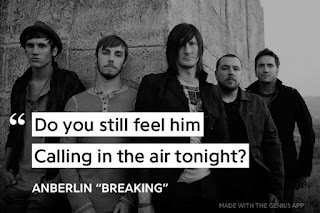
Anberlin’s second single from New Surrender, originally titled “Bitter Sweet Memory” treads familiar territory for the band: the emo break-up song. Their major label debut refined, perhaps over-produced, the sound that they had been curating since their sophomore record Never Take Friendship Personal. “Breaking” was overshadowed by the sleeper success of “Feel Good Drag,” which at the time, was the longest a single had ever taken to top the Alternative Radio charts. Aside from hearing it on Christian radio and a McDonald’s, I never heard “Breaking” on Alternative radio. The music video for the song was also canceled, and the label went on to promote the non-album track, a cover of New Order’s “True Faith” as the band’s follow up. “True Faith,” also didn’t do well on the radio, but the band would score another top 5 hit with “Impossible.”
YOU MAKE BREAKING HEARTS LOOK SO EASY. In 2010 I decided not to go to Cornerstone simply because Anberlin wasn’t playing. They were, however, set to perform at Ichthus, a Christian festival in Kentucky. A couple of friends who liked Anberlin and some of the other bands decided to go to that festival instead. We found that Ichthus was a far more sanitized version of Cornerstone. While many of the bands played both festivals, the main stages at both events were quite different. Ichthus’s main stage was all about the who’s who of CCM, whereas Cornerstone was about the more alternative and edgier groups. The atmosphere seemed to be more church camps and less about music enthusiasts. At both festivals, you might find drugs, but for completely different reasons. At Cornerstone, while against the rules of the festival, you might have the Christian hippie crowd who were “liberated.” At Ichthus, you might have rebellious campers. At Ichthus, there were side stages with the heavier bands, but the shows were less intimate than the tents at Cornerstone. Maybe one of the worst parts of the festival was the evening Christian film festival, with terrible comedies that people just laughed to be polite. On Saturday night, we had endured the sweaty, dusty festival only to find out that Anberlin had canceled the show. They said their bus had broken down. To me, it was like karma for when Anberlin had replaced Relient K as headliner at Cornerstone. But one person said of this situation, “You make breaking hearts look so easy.”A MACHINE WHERE YOUR HEART ONCE WAS, SLOWLY TAKES THE PLACE OF YOU. I am rewriting this part on November 2nd because my heart wasn’t in it yesterday, but I was reminded about the work stress from last year. I was reminded about all of the micromanaging at work, the boss(es) who tell me how to do my job as if they know how my classroom works. With a little perspective and some cooling down, I can articulate my thoughts a little better. It’s easy to be a critic. I believe that New Surrender could have had a better track listing. Maybe some of the songs could have kept some of the obscure titles. Maybe it should have been cut for length. There are many other things I could say about this record, but the fact is, I couldn’t have made it. Sometimes there are albums I don’t enjoy, but the same is true: who am I to judge? Some days work feels like an egomaniacal Collin Mochrie playing the role of director in a ridiculous Whose Line Is It Anyway? sketch. No matter how you do it, it’s never right. But as discouraging as those days at work are, fortunately the micromanagers get tired. I also have to remember why I got into education in the first place. I wanted to do my best to be encouraging to my students, giving them positive feedback to make the criticism easier to swallow. I have to think about that when I take my red pen to an both essays which shows me an area that I need to explain and to the student who didn’t listen to the instructions. Breaking is easy. We can always see something that doesn’t make the mark. But I want to be a builder. But I must say: I’m finding less and less time for the demolition crew.