In 2006, Pitchfork announced that Sufjan Stevens and Rosie Thomas were having a baby together. This announcement was later retracted and clarified as an April Fool’s prank. While Stevens and Thomas may not have human children, the two musicians worked together throughout their careers and even shared a Brooklyn apartment with fellow musician Denison Witmer. Stevens and Thomas recorded Rosie’s 2006 record These Friends of Mine over two years in that apartment. The album contained ten tracks, three of them covers, roommate Denison Witmer’s “Paper Doll,” Fleetwood Mac‘s “Song Bird” and R.E.M.‘s “The One I Love.” The songs reflect the singer on a journey to make it in the big city. The vibe this short album gives is the romantic notion of not having much money but living in one of the greatest cities on earth and creating art.
HOW I WISH I COULD GO BACK IN TIME. Rosie Thomas comes from Michigan but attended Calvary Chapel Bible College for a year. She started playing with a Tooth & Nail band called Valor 100 before recording her solo record, released in 2001. Thomas hasn’t enjoyed the success of her musical friend Sufjan Stevens, as Rosie took a break from music after releasing her 2012 record to deal with health problems and later motherhood, just as Stevens’ career was blossoming; however, Rosie Thomas is a highly connected musician. Along with her association with Sufjan Stevens and Denison Witmer, she has worked with Dave Bazan on many of her records, including These Friends of Mine. Other notable collaborators include Leigh Nash of Sixpence None the Richer, Damien Jurado, Jeremy Enigk, William Fitzsimmons, Iron & Wine, and the Shins. Her most recent effort, announced on her website is a “multimedia series of series of resources, entertainment, and encouragement for parents of all ages featuring music, podcasts, videos, essays, assorted content and community that promotes finding common ground, connection, and comfort.”
I TOOK THE TRAIN ALL THE WAY TO BROOKLYN HEIGHTS. New York is one of the most romanticized cities, if not the most romanticized city ever. There are countless movies about young men and women who cast away the potential for a stable, yet boring, life in hopes of being something great in New York. We see the scary “murder” apartments. We see the rats and the squalor. We feel the need to clutch our bags a little bit closer as we see our young protagonist go on the filthy subway. We all have heard of the muggings and the killings late at night. Always taken too young before his or her breakthrough, the would-be-star is attacked commuting one night from a dissatisfying job that leaves him or her short of money. If not murdered, he or she was almost to the point of coming down with a stress-induced auto-immune disease that wreaked havoc on sleeping patterns. Of course, murder on the New York subway isn’t what this song is about. Instead, the wistful scenes of the snow-covered sidewalks in a bustling city talk about a love who is no longer with the speaker. Like every struggling New York creative, Thomas sings that she “has much farther to go.” Literally trudging through the snow makes her feel like striving for greatness, though she feels a loss that her love isn’t with her. Isn’t that life, though? We strive and strive to make our mark until one day we realize that we’ve done as much as we can. I still have much further to go as a writer. I want to learn more next year. But at some point, can’t we ever take a breath and enjoy the fact that we’re in the middle of the dream and that the process of moving towards the dream is also part of the dream?
Earlier this year, I talked about Carly Rae Jepsen‘s E-MO-TIONas an album I could listen to without skipping a track, which is quite a feat for a 12-track regular edition, 15-track deluxe edition. However, when I first started listening to the album, I couldn’t stand one track. A lot of listeners really, really, really couldn’t stand the lead single, “I Really Like You” but I found the track enduring and quite in-line with the singer’s debut single, “Call Me Maybe.” Tracks in the middle of Jepsen’s third record changed things up with maximalist ’80s nostalgia: funky bass-lines, larger-than-life drums, and synths to fill in the atmosphere surrounding Jepsen’s crisp vocals.
SO TIRED OF HEARIN’ ALL YOUR BOY PROBLEMS. Enlisting a slew of Swedish songwriters and producers; listening to Robyn, Cyndi Lauper, Prince, and Kylie Minogue for inspiration; and collaborating with the HAIM sisters, Sia, her band, and long-term collaborator Tavish Crowe, E-MO-TION took shape. Like M83‘s Hurry Up, We’re Dreaming, E-MO-TION has a calculated nostalgia to it. It feels almost as if listeners are hearing what Paula Abdul would sound like with better recording technology. The album holds a 77 percent rating on Meta Critic and made many top ten album lists of 2015, despite the album’s commercial underperformance. I thought the album was perfect, except for one song that went too far. Opening with Sia talking on a phone, the lyrical content of “Boy Problems” is self-absorbed and immature. This is coming from an artist who is the queen of immature pop songs; however, songs on Emotion start to address more mature themes, so “Boy Problems” felt like a regression. But after several listens, I started to understand the song. While the production of the song and the lyrics seem regressive at first, I started to realize how self aware the song is. Carly admits that the friend on the phone has a point, but the singer is too emotional at that point to admit it to her friend. Exasperated, Sia says, “Do whatever you want. I’m just done for tonight!” Jepsen starts to question as she sings the song, “Is it better to lose a lover or a best friend?” The song is a slow realization for any age, whether 15 or 35, that a boy, or girl, who emotionally alienates you from your friends, is probably not a good lover.
I KNOW WHAT IT LOOKS LIKE FROM THE OUTSIDE. “Boy Problems” perhaps flirts with dubstep in ways that none of the other songs on Emotion do, particularly on the chorus. This makes “Boy Problems” unique on the album. But the funky bass sounds similar to the regular edition’s closer “When I Needed You.” The music video for “Boy Problems” imagines Jepsen sitting at home alone while the other girls are at a slumber party. Jepsen is wearing a tiara, sitting on her bed with an iPad. Visually, the video looks like an ’80s teen classic with newer gadgets. The visuals blend Gen X, Millennials, and Gen Z, making the clip transcend the age gap in pop music. And while I wanted to scoff this track as a grown up, thinking that “Boy Problems” was too childish, in the context of the album, I realized that Emotion was mostly a pop album for adults who miss their childhoods. And that made me think about some of the awkward situations from my young adulthood. Though I can’t fully relate to Jepsen’s female experience, it reminded me of a time when there was so much awkwardness between the sexes. It made me think about my teenage awkwardness, which carried into my twenties after being a home-schooled, small-Christian-school- educated, Christian-college alumni who knew nothing about anything social. I thought about being obsessed with someone I thought I liked. I thought about the problems that can cause between friends. I shivered and thought about how much better things are now. Then I thought about Sia saying, “Seriously Carly, I don’t want to hear about your boyfriend anymore!”
Just 21 miles south of the Canadian border is Bellingham, Washington, where Ben Gibbard formed the band Death Cab for Cutie. The band became an indie rock legend as their success grew. Bellingham being north of Seattle, Gibbard contributed to a vibrant indie scene. For a short time, he played bass in Pedro the Lion, and musicians in Seattle often name-drop the Death Cab founder when talking about the development of the Seattle sound. The platinum-selling Plans put Death Cab for Cutie on the map, with the single “I’ll Follow You Into the Dark” being their most recognizable song in the band’s career.
WITH YOUR ARMS STRETCHED OUT TRYING TO TAKE FLIGHT. Listening to Plans is great all year, and it may be a year for your existential crisis. The love songs on the album are often tinged with something else: death, getting older, or in this case, a loss of passion, maybe apathy. When Jonah Bayer called the album “cinematic” in his Alternative Press review, he was probably referring to how all the songs on the album capture a scene in life. At the beginning of the album, the songs are lighter, “fun and games” side— with an indie, art film spin. But by the end of the album, songs like “What Sarah Said” take on mature themes of death and loss. “Brothers on a Hotel Bed” is a comparison between a love that has lost its spark. But in this simile, there is a deeper love between the couple. The love may no longer be physical, in fact the comparison is to something so non-sexual that mentioning sex seems creepy and revolting. But the lovers weren’t always this repulsed by the idea. The song looks back at the couple’s younger days, if the song is literal, or at the very least, the early phases of their relationship. The speaker talks about a “youthful boy” beneath wrinkle. The song talks about adventure “on the back of a motorbike.” How did lack of desire lead to apathy?
NO LONGER EASY ON THE EYES. I remember reading somewhere, and I hope to find the article to cite, that after a certain amount of time, a surprisingly short amount of time if I recall correctly, romantic love turns into a familiar kind of love. The article made claims that, on a chemical level, our brains couldn’t tell the difference between a romantic or partner and a close family member. I think the article mentions an aunt. Certainly there would be certain dopamine-releasing activities that would look chemically different, such as when your aunt makes that chocolate that your weird uncle jokes is “orgasmic.” I think the article is talking about the overall experience with a close loved one. After all, it’s only a very few people who have seen you with matted hair, eating cereal. Somewhere between the first weekend trip as a couple and the introduction to sweatpants in the relationship, the passion usually starts to fade. That’s why relationship experts recommend being very intentional with relationships as they transition into being less sexual, prioritizing each other’s needs.
The fourth track on Kye Kye‘s sophomore record, Fantasize, “Glass” continues to build the atmosphere on this Chad Howat-produced record. Back in 2014, there was still hope that Kye Kye could be the next big Christian band. Their 2011 debut, Young Love landed them a feature interview in Relevant Magazine and their follow up was well-reviewed in several Christian publications, including CCM Magazine. The band’s story was fascinating for the Christian market. Siblings Tim and Olga Yagolnikov grew up in a conservative Russian churches in Estonia before moving to the United States. In the Relevant article, Tim explains that the siblings’ religious upbringing wasn’t “really grace-centered, it’s really kind of more legalistic.” Tim explains that their religious culture was “not for salvation, it’s for blessing or right-standing with God.”
TO HOLD ONTO AN IMAGE OF SHADOWS YOU REMEMBER. According to my Apple Music’s “Replay ’21” playlist, the remix for Kye Kye’s “Glass” was the 42nd most played song in my library this year. And while the remix is pretty great, the instrumentals and atmosphere of the original are all the more beautiful, particularly the brass section between the chorus and the bridge. Rather than being Paper Route’s Chad Howat, this song sounds like it was produced by Aaron Marsh. Like most of Kye Kye’s songs, “Glass” is opaque in meaning. The lyrics play around with the dichotomies between cleanliness and impurity, clarity and opaqueness, and faith and doubt. Earlier this year, Kye Kye released their third record, Arya. Listeners noticed a departure in the band’s positive lyrics and the now just-sibling duo’s darker tones. In a question and answer session for the new album on the Kye Kye’s Instagram, the band explained that their new album was inspired by “the gift of awareness, life, death, friendship, trust, love, and hate.” When the band was asked about their Christian music background, they replied: “Our music was written for everyone–living the creative life [–] that’s all.” This response is quite different from the Relevant article.
DESIRE, HIT ME SO SWEET. The cold winter sun peaking between the apartment buildings in the late afternoon is the image that comes to mind whenever I hear Kye Kye’s first record and its remix companion EP. Moments on Fantasize bring back that feeling of listening to band’s full album for the first time in the late fall to early winter of 2013. Kye Kye’s music was an intangible spiritual experience bridging the end of the Sabbath, sunset on Saturday night, to the apartment gym near my house. The tones of Kye Kye’s synth and slight guitar on songs like “Walking This,” “Knowing This,” “Seasons,” “I Already See It,” and “Glass” remind me of sunset, of the fading blue around the orange-red saturated sky. There’s a feeling of cold atmosphere surrounding me, but a warm center. Subconsciously I would equate that with the Christian experience: the called and the chosen sent out into a darkening, cold world, but the love of Christ in our hearts. Kye Kye was cool, ambiguously Christian music, and I was trying to be a cool, ambiguously Christian “missionary.” Kye Kye went MIA after 2014, which coincidently was the year that I burned out. Kye Kye’s 2021 album doesn’t have the same feeling I described. It’s cold and bitter.
Following up the band’s 2003 album How to Dismantle an Atomic Bomb, U2 released their 2009 album, No Line on the Horizon. Critics liked U2’s 2009 effort, and it holds a 72% rating on Meta-critic. The band’s next record, 2011’s Songs of Innocence would make the band one of the most hated musical acts after they gave the record away for free in iTunes libraries. For a band that has been around for over forty years, in a world of constant changing musical landscapes, U2 has had hits and misses, yet somehow their anthemic sounds force their way into relevance, whether it’s because they are catchy or frontman Bono’s rock star activism.
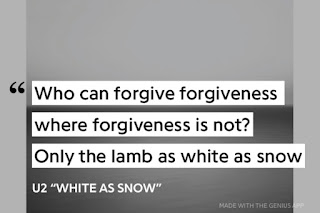
EVERY FACE WE CANNOT KNOW.No Line for the Horizon was a U2 album I passed on. I hadn’t like the track listing of How to Dismantle an Atomic Bomb, but at least I liked some of the songs to get me to listen to the album. The lead single from Line was “Get on Your Boots” and it sounded like U2 was trying too hard to relive their ’90s era of music that nobody wanted to come back. I listened to bits and pieces of the album last year thanks to Apple Music, but only one track stood out to me, “White as Snow.” However, today when re-listened to the album to prepare for this post, I was caught up in a rock ‘n’ roll baptism of equal parts arctic blast and the blaring, experimental sounds of “Get on Your Boots.” That feeling aside, I was taken by the storytelling Bono uses in “White as Snow.” The concept for No Line is Bono writing characters, something he hadn’t done before this record. Inspired by seeing the warplanes flying over France bound for Iraq when he was on vacation in France just before recording of No Line, one of Bono’s characters is a soldier. “White as Snow” is intended to be the soldier’s dying thoughts when he is killed in an explosion. Sung to the tune of “Bone Jesu dulcis cunctic,” a 15th century hymn better known today as “O Come, O Come Emmanuel,” the song is cinematic in scope. The familiar Christmas hymn brings the listener to examine different points in the speaker’s life, like a flashback in a film. The horrific death is tied in with a message about the darkness of humanity–humanity that could allow the slaying of the innocent in war.
AND THE WATER, IT WAS ICY AS IT WASHED OVER ME. The latin hymn “Veni, veni, Emmanuel” was combined with the melody “Bone Jesu dulcis cunctic” and the text was translated by John Mason Neale for his 1851 Hymns Ancient and Modern. The hymn was sung at vespers seven days before Christmas Eve, which happens to be today. The hymn is based on the twenty-third verse of the Gospel of Matthew. U2 only musically references the connotations of the Christmas hymn. Instead, Bono draws reference to the first chapter of Isaiah, in which the God of Israel tells his people: “Though your sins are like scarlet, they shall be as white as snow; though they are red as crimson, they shall be like wool” (verse 18, NIV). The solider is caught up in a war that many believe is unjust. Even though many evangelical Christians supported the war in Iraq, Bono challenges Christians and non-Christians to examine the motives for this war. The lyrics remind us that all humanity is tainted and that “only the lamb [is] as white as snow.” As the dust is settling on my own unholy war, it is important for me to remember that not everyone’s intentions are completely pure, certainly not even my own. Like a soldier, we can be caught up in the war; fighting it is our job. Yet, sometimes we’re reminded of the compromises we have made to keep propitiating the oppressive systems we are enslaved to and ones that enslave others. Sometimes all we can see are shades of red and redder. We have to take some time to reevaluate where we stand on right and wrong. Only then can we see the “lamb. . . white as snow.”
Muna‘s 2017 record About Utakes listeners on a rollercoaster of emotion. Unlike their 2019 Saves the Worldrecord, About U focuses on the positive and negative of being in love and breaking up. About U doesn’t enjoy the near universal acclaim that their follow up has, but album helped to establish the three-piece band of queer musicians on the scene of Alternative dark synth pop. Today the sadness, desperation, and loneliness of “If U Love Me Now” resonated with the bleak December day. The song explores the theme of mental illness and suicide. The singer explores options before telling someone that that person should “just let [her] leave.”
IT’S JUST A HYPOTHESIS I TEST THAT I SHOULD NOT EXIST. A large proportion of the LGBTQ+ community struggle with thoughts of suicide. When singer Katie Gavin sings on this melancholy track, her voice sounds weak and wounded, as if the singer of this song has resigned after her last hope has been dashed. The feeling in this song isn’t exclusive to queer life and certainly could be cried over by anyone of any sexuality; however, there’s a special level of connection this song can have with queer angst. Many have grown up around religions that condemn our sexualities, and this causes us to feel alienated from our loved ones and, more scarily, from God. Others grow up in supporting families, but struggle with society’s acceptance of us. Sometimes societal pressure causes queer people to feel that they need to hit the same milestones at the same time as straights in society. Other times, queer people struggle to get on the same page with other queer people who are also struggling with religious or societal expectations and one partner’s struggle drags the other into it. We all want to be the subject of a single-layered love song, but in reality, we don’t want to listen to that kind of song.
I COULD BIDE MY TIME HOPING I FIX IT. Today I feel sad. Not suicidal sad, but just disappointed. I can’t really get into it, but today is the culmination of a very disappointing situation in a place that I thought was safe. I was used by someone in a manipulative plot against someone I care about. While it makes me feel very sad, it devastated this other person. I should put my feelings aside and focus on healing the relationships. I realize this all seems too vague. Is this a high school drama? Kind of. It happened at work, so I can’t give concrete details. What I can say concretely is that working for Christian school has inoculated me against organized religion. I am growing more and more fearful that my own job is on the line as I no longer go to church or profess a particular religious view, but I’m starting to care much less about keeping it if the alternative is living open and honest. How could something that used to give me so much joy be used as a weapon to inflict so much hurt? My younger self wants to argue, “That’s because it’s false religion that everyone is practicing. If only they couldsee the true source, everyone’s life would be better.” There’s certainly an argument for the improper execution of faith, but 1) faith is subjective to every person’s reading of the Bible and 2) certain groups of people seem to always be on the outskirts of the kingdom.
What do you do after you record one of the best-selling albums of all time? Following the massive success of their 1973 album, Dark Side of the Moon, Pink Floyd struggled in the studio with their follow up. Music executives pressured them to have another hit album. The band couldn’t get along during these sessions. This theme of the music industry’s pressure can be heard on the tracks “Welcome to the Machine” and “Have a Cigar.” However, it was as the band was enjoying the peak of their success, their lyrical themes turned to their friend and former band leader, Syd Barrett, whose mental health had led to his departure in 1968. Pink Floyd had gone from a top-5 charting psychedelic pop group to an experimental rock group whose music became too obscure for radio. But following Dark Side, the band an era of critical acclaim and millions of albums sales. And Wish You Were Here lamented the loss of a friend who couldn’t share in the band’s success.
YOU WERE CAUGHT IN THE CROSSFIRE OF CHILDHOOD AND STARDOM. “Shine on You Crazy Diamond” is the longest track that has made my song of the day list by far, and I have the guitar riff being stuck in my head all day from watching Nick Canovas’ “Deep Discog Dive: Pink Floyd” on his YouTube channel Mic the Snare this morning. As many kids who have a Pink Floyd phase in middle and high school, I’ve done some reading on the band over the years, so many of the details in the video weren’t new to me. I’ve listened to songs from Dark Side of the Moon to The Wall and have had theories about which songs were about the band’s former frontman. In Canovas’ opinion about today’s song, he says:
[‘Shine on You Crazy Diamond’] feels like a dedication to a person…I mean a full person. Your
experiences with them, the great times with them, the low points where they frustrated you, their
strengths, their flaws, and the cumulative looking back on all the time you shared together.
Just as “Lucy in the Sky with Diamonds,” encrypted the title with a hidden message of LSD, Pink Floyd hid Syd’s name in the titled (Shine on You crazy Diamond).
COME ON YOU PAINTER, YOU PIPER, YOU PRISONER, AND SHINE! After recording three songs on their upcoming album about their friend whom they hadn’t seen in years, a mysterious man showed up in the studio during the mixing and mastering of Wish You Were Here. No one recognized him. He had a shaved head, shaved eyebrows, wore all white, and was fat. Later on the band realized that Syd Barrett had visited the band in the studio. He was unrecognizable and he was continuing to lose his sanity. This was the last time the band would be together when they saw their old friend, although Barrett lived until 2006. “Shine on You Crazy Diamond” bookending the record references Barrett’s life and the band’s career, referencing the band’s early work including their first album Piper at the Gates of Dawn, which was a collection of singles during the band’s psychedelic pop days. The song also references their top 3 hit, “See Emily Play,” which was only released as a single. If Dark Side of the Moon explores how a person degenerates into “insanity”, Wish You Were Here tells the story from a different perspective. “Shine on You Crazy Diamond” is a beautiful tribute to an unwell friends, and together with “Wish You Were Here,” we get a picture of helplessness as a loved one drifts further and further away from reality. And although Waters sings faster and more adamantly on “Shine on,” Barrett needs the kind of help that professionals can offer, not just a friend.
In 2014, I wasn’t listening for what was next in Alternative music. Rock music in the early ’10s was disappointing me with all of the Imagine Dragons and Coldplay knock offs. When my friend, fellow music blogger Stephen Barry told me I should check out Bastille, I reluctantly did, but I didn’t really listen to them. I just listened to them in passing. My music tastes at that time were: rock should be rock (i.e. Linkin Park and Anberlin), not trying to disguise itself behind big, bright production. I don’t think that way anymore. Bastille became a hit in America because of today’s song. After reaching #2 on the UK pop charts, the song became a #5 hit on the Billboard Hot 100, and it topped the Alternative Songs chart. While I would love to bring you another Christmas song, today we take a break from Christmas.
BUT IF YOU CLOSE YOUR EYES… “Pompeii” is a strange pop song. It literally describes the conversation between two people about to be killed in the ancient Italian city as the ash from Mt. Vesuvius consumes everything around them. The band’s lead singer and songwriter Dan Smith described the eerie events leading up to the destruction. The song begins with what many listeners might think is just a random phrase sung for effect; however, the ehoh is Latin, meaning alas. Descriptions of the shaking ground and the billowing ash make the singer question “How am I going to be an optimist about this?” Meanwhile, he questions “If you close your eyes, does it feel like nothing’s changed at all?” The people of Pompeii had experienced earthquakes and even small eruptions in the years before AD 79. The people with their lavish lifestyles hoped to appease the gods with human sacrifices at the volcano; however, they closed their eyes to the portentous doom that awaited them. The strongest metaphors in poetry and music do not have a key for interpretation within the work. “Pompeii” can literally be a song about the doomed Southern Italian city, or it can have implications for today. What are the red flags you are closing your eyes to?
DOES IT FEEL LIKE NOTHING CHANGED AT ALL? Many had attempted to excavate the city throughout history, however, starting in the 1960s, archaeologists started taking greater care to preserve the ruins of Pompeii. In 1972, Pink Floyd filed a concert without an audience in the ancient city. The band performed their older psychedelic, but some footage shows the band recording their 1973 masterpiece Dark Side of the Moon. Director Adrian Maben found, after losing his passport in the ancient city, was that the excavated amphitheater had extraordinary acoustics, as did the bombed Coventry cathedral from yesterday. The Floydian concept would have been an interesting take for Bastille’s music video; however, instead the “Pompeii” director, Jesse John Jenkins, sets the concept of the music video in present day Los Angeles and Palm Springs, California. Singer Dan Smith appears in a post-apocalyptic world in which the people’s eyes grow dark, possibly turning to ash. The video mimics several scenes from Stanley Kubrick‘s The Shining. The doom of the video shows that we all have the potential to become soul-less in the fight for what we believe in. It may be easier to “close your eyes” and pretend “like nothing’s changed at all,” but if we don’t, we might be able to leave the doomed city. We might be able to make a difference when everyone else is complacent.
A little over a month after their self-titled album was released, Deas Vail released a Christmas EP, titled For Shepherds & Kings. The EP contains four Christmas classic hymns, performed in a way true to Deas Vail’s sound. Of the four Christmas songs included, I was least familiar with “Coventry Carol.” I had heard it by other artists and it was on some of the Christmas CDs I grew up with, but it wasn’t immediately identifiable. It wasn’t in the Seventh-day Adventist hymnal like “O Come O Come Immanuel” or “What Child Is This?” and it hadn’t been recorded by enough artists to make it recognizable.
HEROD, THE KING IS RAGING. “Coventry Carol” wasn’t a standard Christmas Carol until 1940. From November 14 to 15, the Germans reigned terror upon the city, and during the blitz, Coventry Cathedral was destroyed (pictured to the left). But on Christmas day, the BBC broadcasted a message from Coventry. Ending the broadcast, singers from the church assembled and sang “Coventry Carol,” a hymn not common outside of the small English town. This message brought hope of resurrection for the war-torn nation. “Coventry Carol” is an old song coming from the early 16th century. It was sung as part of a “mystery play”–an old evangelistic drama for illiterate peasants in the Middle Ages to teach them parts of the Bible they could not read. The song is based on a dark story in the second chapter of the Gospel of Matthew, in which Herod orders the “Massacre of the Innocents.” After hearing from the Magi that the Messiah was to be born in Bethlehem, the jealous king ordered all male children two years or younger to be slain.
ALL CHILDREN YOUNG, TO SLAY. The BBC podcast Soul Music tells several stories about musicians’ experiences with this carol, but musician Ian Pittaway tells one particularly poignant story of his experience watching a recreation of the mystery play the hymn came from in the ruins of Coventry cathedral forty years after the bombing. After witnessing “The Massacre of the Innocents” depicted with baby dolls being stabbed with swords and red ribbons coming out of the dolls, the lighting goes dark and one female voice, representing one mother, begins singing a lullaby for her murdered child. Other voices join and the lights slowly begin to turn on again, the whole chapel fully lit by the end of the carol. This horrific Bible story is one I haven’t spent much meditation on. The important point was always that the angel Gabriel came to Joseph in a dream, telling him to take Mary and their son Jesus to Egypt. And while it makes us feel good to think about the baby Jesus growing up safe and sound, for some of us Christmas can be a hard time. My heart is broken for the people who lost their lives, friends, families, and homes in the unseasonable tornado this weekend. Many are still getting sick and dying of Covid this year. Some are losing jobs due to the continuous downturn of the economy. Christmas won’t be a joyous time for all. This morose lullaby may not offer us peace as it attempts to both recognize the grief of the mothers’ losses. However, the major chord that the melody ends on aims to give us hope even when our situation seems most dire.
It’s important during the creative process to get feedback and look at your work from every possible angle. Jim Adkins reportedly hates his band name, Jimmy Eat World, especially because of the band’s acronym, J-E- you get the point. Today’s song was released in 1950 and was inspired by the sound of the Salvation Army Santa Clauses ringing their tinkling bells. But when songwriter Ray Evans brought his work home, his wife said, “Are you out of your mind? Do you know what the word tinkle is?” And just like that, the song changed to “Silver Bells” and it wasn’t the first Christmas song about pee. We’d have to wait for that, apparently. Google if you dare.
CITY SIDEWALKS, BUSY SIDEWALKS. First recorded by William Frawley and popularized in the film The Lemon Drop Kidsung by Bob Hope and Marylin Maxwell, “Silver Bells,” like most Christmas standards has so many recordings, it’s hard to choose a favorite. The song was recorded by Bing Crosby, Dean Martin, The Judds, Sleeping at Last, Steven Curtis Chapman, among others. The version that appears in most movies today is the Kate Smith version. I don’t have a particular favorite version, but this morning I happened to hear Michael Bublé’s version, an artist I can take in small doses these days. But when Bublé released his 2003 debut album, I was in the middle of learning the standards on guitar. Bublé revitalized Sinatra for a new generation, and his eponymous album was very good. The Canadian singer began his career as an independent musician, releasing three albums prior to being signed. He was raised on his grandfather’s jazz records and dreamed of one day becoming a jazz singer himself. The fresh-faced 30 year old Canadian singer was featured in a Starbucks commercial featuring the song “Come Fly With Me” from his 2003 album, which helped break the artist into the American market just as his 2005 follow up It’s Time was released. Singer-songwriter Norah Jones was also popular at this time, bringing back jazz for the early ’00s. Bublé’s albums after his major label debut in 2003 weren’t different enough to keep me interested. He started writing original songs, starting with 2005’s “Home.” The last Bublé album I bought and listened to was his 2007 Call Me Irresponsible, which included more of an R&B take on the standards. Occasionally, Bublé is welcome in my playlist. It’s nice to hear a rendering of a classic and it’s nice to see his pretty face on the album cover.
SOON IT WILL BE CHRISTMAS DAY. If I think about “Silver Bells,” I have to think about my mom singing this song, at least the “It’s Christmas time in the city” part. “But we’re in the country,” I’d reminded my mom, annoyed. Growing up close to a small town, Christmas was pretty when we’d drive down the hill into the village, seeing all the pretty lights on the trees and houses. Sometimes in the winter, we’d drive to the bigger cities, passing the car exhaust-covered snow banks on our way to Binghamton or Syracuse where we would go to the mall and see all the boughs of holly and ribbons and gingerbread houses and Christmas trees and Santa Claus ringing a bell for donations. But “Christmas time in the city” finally made sense the year that we took a charter tour to Manhattan. This was either ’96 or ’97, the last or penultimate winter in New York. The bus ride took a long time–maybe four hours–but we didn’t notice because we watched Christmas movies the whole way there and the whole way back. We watched movies my mom never let us watch like Chevy Chase‘s Christmas Vacationand the remake of Miracle on 34th Street. When we arrived in the city everything seemed decorated. We went to Macy’s, Time Square, and FAO Schwartz. This was the first time I had been in New York City and the city was much bigger than Orlando, the biggest city I had ever spent time in. For Christmas everything was blinking Christmas lights, crowds dressed in winter coats, hot dogs and pretzel stands. The daylight didn’t last long that day. The sun sank behind the buildings early in the winter, but what was left was the glow of large billboards and Rockefeller tree. While I love a family Christmas, there is something magical about being enraptured in the spirit of the holiday in a city with millions of people.




 Mixtapemotions