•   Jonezetta‘s Popularity brings back memories of being 21. Although the album had come out the year before, I had been hesitant to buy it. But after tours with Anberlin and MuteMath, I decided to buy the album and put it into the CD player of my 2001 midnight blue Toyota Corolla S, my second car, and the car I had paid for with my own money. This album is one that is forever linked to the hot black interior, the red night-driving display, the drivers licenses-less friends and the friends of my little sister that I had to tote around. It was also the summer that I decided it was time to go to Cornerstone.

    I’VE BEEN DRIVING ALL NIGHT. My friends don’t always vibe with my musical tastes and that’s ok. I’m a little scared of people who like the same music as me. It makes me wonder when someone’s going to hand us a big cup of Kool-Aid. However, Popularity was quite a hit among my friends. It’s dancey and just ’80s retro enough to be put in your playlist sandwiched between Journey‘s “Separate Ways” and Def Leopard‘s “Pour Some Sure on Me.” I saw them at Cornerstone twice in 2007. They had a set in one of the bigger tents. Then miracle of all miracles happened. Relient K‘s band burned down, pushing Skillet and Anberlin to close the night, and a slot opened up for Jonezetta to play main stage. When they played “Communicate” they dedicated the song to Anberlin, their good friends who took them out on the Cities tour and helped them achieve they success they had so far in their career.

    WILL IT EVER FEEL THE SAME? I talked a little about the demise of Jonezetta when I talked about Corey Crowder last year. In November, after Cornerstone, some friends decided to drive to Charolette to see Family Force 5‘s Halloween themed tour with openers The Secret Handshake and Jonezetta. Going to the concert was more fun than the concert. It was a small club venue and we were used to the the bands having more space for their show/theatrics (think FF5). Main stage at Cornerstone earned them another on main stage. It didn’t go so well. It seems that the crowd was not into their new songs and the band didn’t have the energy they once had. Something was off.  As all good things must come to an end, so do most bands after 1 or 2 albums. The music industry imploded with the housing crisis of 2008/2009.  Just as the bands of young adulthood break up, we too move on. I sold my car to my dad when I came to Korea for student loan payments. Friend groups have splintered–some moved away, some have stopped being friends. Cornerstone ended in 2012. Life is full of sad goodbyes, but it’s better to have the sad goodbye than to never have had it in the first place. What’s left is a few Apple Music shuffles and memories of being 21 with keys to car and driving to Illinois for a dusty concert.

  • When a rock band gets as big as Linkin Park got, it becomes trendy to hate the band. I must admit that during their career, I wasn’t in line with every step the band took–mainly because of the band’s usage of profanity from their third album throughout the rest of their career. However, I could never understand critics and listeners who casually compared the band to butt rocks like Nickelback. Yes, Linkin Park’s music is formulaic at times, and the band knew how to write a song to get on the radio. The comparison between Linkin Park and any other rock band seems like comparing Nickelback to Nike because Linkin Park was a brand more than band, complete with a consistent audio and visual aesthetic. The band didn’t simply create records, but told stories.

    I’M SWIMMING IN THE SMOKE OF THE BRIDGES I HAVE BURNED. Linkin Park’s fourth record, A Thousand Suns, is a multifaceted concept record. The band intended for album to be listened to in one sitting, inviting listeners into the post-apocalyptic world of the record. Although, A Thousand Suns is not a direct sequel to their third record, Minutes to Midnight, both records reference the doom of the human race. Minutes to Midnight is a reference to the Doomsday Clock, which calculates the impact of human action that could bring the end of civilization, midnight being the end. A Thousand Suns refers to the blast of nuclear weapons that could end humanity. The album explores the darkness of human nature which could cause the bombs to drop. Short interludes build classical or operatic themes throughout the work, drawing most attention to the penultimate track “The Catalyst,” the album’s optimistic theme “Waiting for the End,” and today’s song, the album’s true opener “Burning in the Skies.” The album opens with two tracks that function as an overture: “The Requiem,” which is the hook of “The Catalyst”sung by a heavily autotuned childish female voice and “The Radiance” which is a sampled recording of J Robert Oppenheimer describing the first test of the nuclear bomb. 
    I’M LOSING WHAT I DON’T DESERVE.  Both tracks set an eerie tone for the record, despite the somewhat serene “Burning in the Skies.” A Thousand Burning Suns certainly has a hierarchy of catchy songs with “Waiting for the End” and “The Catalyst” being polar opposite in mood. The third most memorable track would be “Burning,” which follows a Linkin Park formula: both Mike Shinoda and Chester Bennington sharing vocal duties, electronic sampling loops, and a guitar solo based on the melody of the chorus. It’s the lyrics that bring this song to life, especially in the context to the rest of the album. The song describes when the bombs fell, which given the speaker’s ability to editorialize the event, seems to have happened long before this song is sung. There’s an acceptance to the fault–is it Bennington who caused the bomb to drop? Is that the guilt born by one soul? Or is it a realization that all humanity could have made that decision? The music video further visualizes the events, which seem to have happened on night when people gathered together for small parties, it kind of reminds me a small New Year’s celebration. In 2011, a song like “Burning in the Skies” sounded like bad Emo, like a church kid who grew up with terrible self esteem and never got past the “I’m a piece of shit” theology. Eleven years later, the album starts to feel more and more relevant as the fears of climate change seem ever present and world leaders have itchy fingers when reaching for their nuclear weapons. The question is will humanity “lo[se] what [they] don’t deserve”?


  • Hippo Campus‘ debut record landmark comes five years into their career. A solid, unpretentious indie release, landmark is the perfect soundtrack to spring and summer. Musically, lead singer Jake Luppen in a hyper-aware, somewhat ironic lyric in the album’s first full song “way it goes” describes the album as “easy going shit” in which the lead singer “just grab[s] a guitar and moan[s] and shit[s].” But while the “easy going” songs on landmark sound effortless, the lyrics certainly are not just nonsensical “moaning.” Rich with imagery of time, color, and place, the songs on landmark start to become quite vibrant, showing the band’s keen erudition in lyric writing.

    IT SHOULD’VE BEEN ME.  In the middle of the “easy going” record, Hippo Campus shares a somber moment on the track “monsoon,” which sounds a bit like it could fit in in the middle of Death Cab for Cutie‘s Plans Rather than a driving drum and bass on the upbeat tracks, the song opens with tones of a slide guitar, drum brushes, sustained notes on the trumpet, and notes on a piano giving the song its distinguishing sound.  The lyrics on this song are a little more opaque and poetic on this track, though this album has a big vocabulary throughout. On a first listen, it’s clear that the song is about loss, with the refrain sending a chill down the listener’s spine “It should’ve been me.” Guitarist Nathan Stocker talks about writing this song about the day his older sister, Makenzie, was killed in a car accident in June of 2009. The elegy-like lyrics encapsulate a grief for a young life taken too soon. Like the members of Hippo Campus, Makenzie had professional aspirations to pursue the arts, in her case, in Russian ballet. 

    JULY HAS ALWAYS BEEN SHY OF JUNE. The title of this song seems odd given that Hippo Campus generally stick to their geographical location of the northern mid-west on landmark. Although South Asia typically comes to mind when we talk about a monsoon, other parts of the world experience a rainy season. South Korea has (supposedly) entered its rainy season, though this year is a bit more splotchy. Vietnam experiences a monsoon season from April to October. The southwestern United States is said to have a rainy season, but there is no monsoon in the midwest. A song like monsoon demands a little bit of a pause. It’s a summer storm in an otherwise sunny record. It’s a sad song and its weight is felt, but the album doesn’t stop there. The clouds clear and sunshine returns. The rain the lyrics talk about is certainly a cliché symbol for tears, but it’s cliché because nothing else can effectively show that level of grief, much like how film makers have to set a funeral on a rainy day. A sunny day would make the tone inappropriate.  The events about which this song had happened nearly ten years prior to the song’s recording. The song is sad, sentimental, but articulate and well-reflected. Just as Stocker plays the slide guitar as a kind of requiem for his sister, we get a chance to grieve. But then we realize that life moves forward and we take our grief with us. We move on in our own way. That person is still with us, but every day, we are able to cope just a little better.

    Read the lyrics on Genius.
     

    Lyric video:

    Live:

  • It’s been 20 years since the post-grunge “Hanging By a Moment” was the number 1 song of the year. Although the Christian Rock band Lifehouse never actually topped the weekly charts, the song had so much statistical force via radio play and record sales that the song became one of rare cases when a single that peaked at number 2 could actually claim the number 1 position for the year. No Name Face featured three singles, but none were as big as “Hanging By a Moment.” For the band’s follow up, Lifehouse signed a Christian music marketing deal with Sparrow Records. Stanley Climbfall was no where near as successful as the No Name Face, but a sophomore slump didn’t plunge the band into obscurity. In 2005, the band released their self-titled album which boasted their number one hit which was appearing in every TV show that year, the prom/wedding favorite, “You and Me.” 


    I WAS YOUNG BUT I WASN’T NAIVE. Blind,” the band’s second single, was overshadowed by the massive first hit, just as the other singles from No Name Face. But while the wedding and prom industry needs new songs every year and “You and Me” is a rather fine choice, the brooding “Blind” delves into lead singer Jason Wade‘s childhood and his parents’ divorce. The music video stars actress Tina Majorino, best known for her role as Deb in Napoleon Dynamite, who acts as a goth chick browbeaten by her womanizing father. Majorino’s character seems to act as a foil to Wade. When the band is playing in the goth chick’s room, Wade and the girl make knowing eye contact for a moment. Interestingly, the normally no-frills Jason Wade is seen in this video wearing eye liner, or sometimes called guy-liner, a trend that punk and emo groups rocked at this time. Some examples were Green Day and My Chemical Romance. Lifehouse was far from being the dark emo band, but “Blind” was one of their darker songs. Furthermore, Lifehouse in the video seems to represent the role that music plays in escaping childhood/teenage trauma. For one of their biggest Christian Rock hits, Lifehouse didn’t make a moralizing video, but rather when the father is out on his infidelity escapades, the daughter throws a party where everyone dances to Lifehouse and she kisses a boy. And from this party she comes to the clarity that it’s time to leave her father’s house. 

    I WOULD FALL ASLEEP ONLY IN HOPES OF DREAMING THAT EVERYTHING WOULD BE LIKE IT WAS BEFORE. My mom always scolded me for watching music videos, so as soon as she went out, I’d watch TVU, Fuse, and whatever other music channel wasn’t playing reality TV. Every time this video came on my sister and I would yell “It’s Deb!” When I was growing up my parents fought constantly. I remember going to bed to the sound of their fighting some nights. My parents told us that they made a commitment to marriage so they would not get a divorce. My mom’s parents had divorced, and it probably left a lot of emotional scars. But I secretly wanted my parents to divorce. Maybe it would solve the bitter arguments. For years I blamed my parents for distorting marriage. I told myself, if this is marriage, I don’t want it. My parents are still married, but live very separate lives. They live in the same house but on opposite sides. They work different schedules. They spend time together, but too much time sets them off on each other. I’ve let a lot of it go since I’ve been away from my family. I think that my parents let go of their childhood trauma in a similar way once they moved away from it. Maybe we’re not really over it, but at least there was the music to help me through it.


  • I first started listening to MGMT in the spring of 2009. Their debut album Ocular Spectacular had been released at the end of 2007, but tracks like “Kids” had hit the alternative radio stations by 2009. My roommate in college loved the opening track “Time to Pretend,” which is a fun song about moving to Paris and marrying models, and when things get difficult, just get a divorce. After enjoying OS, the next year the band released their follow up, Congratulations, which boasted more experimental electronica. After reading the review about how the band refused to release radio singles, I never tried the band and felt that they were venturing into a musical realm that wasn’t for me. However, in 2019 when I heard their single, “Me and Michael” in a book store and when I started listening to “Little Dark Age,” I realized that the MGMT that I loved in college was back. 

    THE MORE I STRAIGHTEN OUT, THE LESS IT WANTS TO TRY. The political climate in 2018 was bad. Democracy around the world had been on a decline. America was in the second year of Donald Trump’s presidency. The rise of political and religious extremism against minorities was at an all-time high. All the progress the hippie side of the boomer generation had fought for was starting to come undone. What was worse was how irrational dialogue had become. How easy it was to say that the other side was “dead to me.” But with the Internet feeding “Alternative Facts” and Fake News, no wonder we all felt a little gaslit. But as I’m writing this post, I’m straining to remember anything that actually happened in 2018. I had to search for “US Politics 2018” and get a list from CNN. There were three mass shootings listed on the list, though Wikipedia lists 323 in the U.S. with 387 deaths. But in comparison, as of June 3 (the 182nd day of the year) the Washington Post reported that there had already been 250 mass shootings. In 2018, there was the Kavanaugh confirmation hearings, marred slightly by the sexual assault allegations against the now Supreme Court Justice. In the middle of the #MeToo movement, women watched the hearings as the next Justice smirked off justifications of his past behaviors as childhood follies. 

    I GRIEVE IN STEREO. MGMT’s Little Dark Age hides anxiety in plain sight in a totally danceable beat. Today’s song is political. This weekend is political. We can’t escape what’s happened, no matter where you stand on the issue at hand. “Little Dark Age” indirectly references police brutality, specifically toward minorities, but every issue is entangled. It’s BLM, it’s gay rights, it’s trans rights, it’s the right to choice, it’s the right to affordable healthcare, it’s the right to go to school or the mall without being shot by an AK-47. It’s our Draconian voter-suppressed Republic that is starting to look more and more like the latter days of the Weimar Republic. And without the rights we once counted on, we reenter the dark ages. We hope that they are “little dark ages” until the dinosaurs die off, but they leave their money to a new generation crazies–crazies our own age who will die off when we die off if we’re not shot by an AK-47 or starve to death serving the oligarchy. I went to high school taught by people who longed for this day to come, yet they would say that the law hasn’t gone far enough. I grew up believing that birth started at conception, but that’s not what I was taught at home, only at Evangelical Christian school. I grew up with some strong women in my life who believed that bringing up a child is a choice–perhaps the most noble one. To bring up an unloved child, to my mother, was one of the greatest sins, and no family should be forced to provide for children far beyond their means. I’ve watched my sisters achieve levels of success in their careers and model alternative styles of relationships than the ones deemed righteous in Southern Baptist Bible class. But the truth is, in the 21st century everyone is poor working their asses off and that righteous model of traditional marriage hasn’t worked for some time. I realize that this post is turning into a rant no better than my opponent, but I think the best way to combat things that don’t make sense is with a question. After all, in the 2019 film Bombshell I watched yesterday, the women at Fox News, a simple question about being allowed to wear pants on air caused the workers to realize what kind of system they were in. My question of this weekend is, what is plan b? Even if we can establish that life begins at conception, what does the government have in place to provide for that life, especially at a much higher birth capacity than now?


  • The third record from The Classic Crime, Vagabonds, was the last record of the band on Tooth & Nail Records. The Classic Crime has had ups and downs in their success. Their first album, Albatros was mis-marketed on iTunes in the genre of Christian Rock, something that the band and their A&R team had fought prior to the album’s release. However, the band was ultimately associated with the genre because of their record label. Furthermore, the first record’s reviews were mixed to poor. But the band’s follow up, The Silver Cord, was well-received, especially as a Christian Rock album.


    I’M COUNTING ON GRACE. Vagabonds didn’t have the same CCM appeal that The Silver Cord had. Though the album had three singles on Christian Rock radio, the last of which was today’s song “A Perfect Voice,” the album’s opener, the album didn’t appeal much to the band’s target secular Warped Tour scene. With the apparent commercial failure and the changes in the music industry, the band went independent following Vagabonds, with lead singer Matt MacDonald taking the tighter reins on the band’s creative direction and the bandmates focusing on limited
    tour and performing on the records. The result was a crowd-funded fourth record,
        Phoenix complete with an instrumental version of the album. The band has
        continued to follow a DIY model to this day. And while they may not have sustained
        the level of success they had back in 2008 with their sophomore record,
        MacDonald’s adaptation in the long haul is admirable.

    I MAY NOT EVER SEE A DIME, BUT I’LL BE FINE. The lyrics on Vagabonds talk about the vagrant state of the poor–scoundrels, knaves, and vagabonds who have either sworn off society or have been condemned by society to wander the cities either panhandling or begging “on the corner with a cup somewhere.” For MacDonald on this record, it’s a romantic notion that the artist starves for his craft. And in the post-2008 fall out of the financial crisis, many bands were in dire financial need. MacDonald sees himself as a potential vagabond in the future–a future that seems eerily familiar to a post-Covid world. “A Perfect Voice” opens the album with a sunny optimism that despite the lead singer’s lack of the best voice in the world, he will “sing at the top of [his] lungs / ’till [his] days are done.” This song is encouraging me to look at the opportunities I have and take a chance. So often I’m paralyzed by the fear of what might happen and I fear what will change if I’m actually successful. I’m reminded of the “hustling” intensity that Stephen Christian talks about in interviews and how he “shut up and actually tr[ied].” Maybe the worst decision I ever made and will always regret was not pursuing music professionally. But I’ve got to move on from that.
  •  

    The smoothest, easiest, most chill record by Anchor & Braille is titled Tension. The album was written and recorded before the pandemic but released in May 2020 in a time when the U.S. was still under the shock of job loss, fear, and illness both physical and mental. According to a podcast I listened to today, lead singer Stephen Christian thinks of a scene from a movie when writing his Anchor & Braille albums. Whereas Songs for the Late Night Drive Home literally described the dark yet enchanting movie scene in the title, Christian said that Tension was about those quiet moments in your room by yourself or with a loved one.

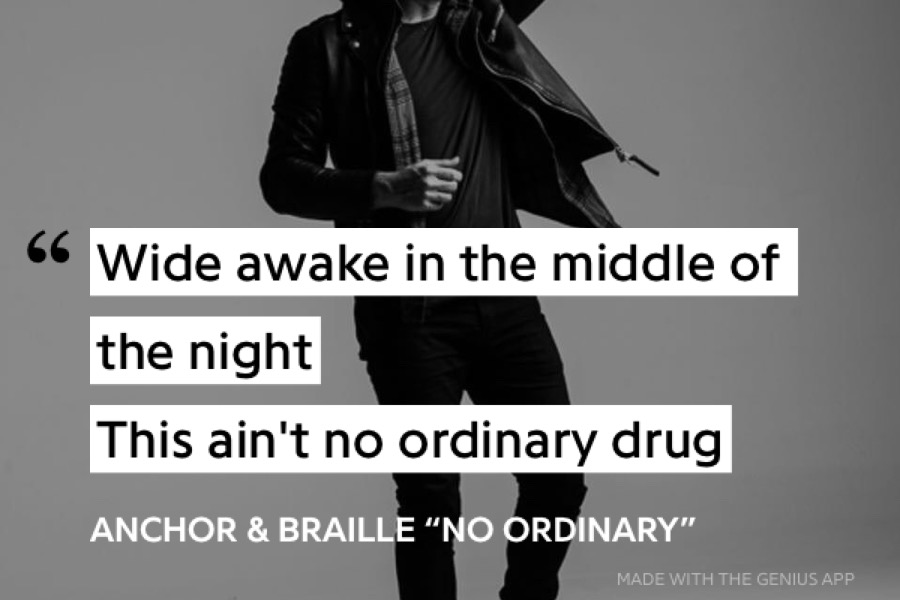
    BY MYSELF, EYES WIDE CLOSED. The opening track to Tension claims “This ain’t no ordinary love song.” The song alludes to the early days of a romantic relationship, when late-night conversations with that person can keep you awake all night just fantasizing of all the possibilities of where that relationship can go. When Stephen Christian was promoting the album on RadioU in 2020, he claimed that, although the album doesn’t make the listener feel tension or leave the listener in a tense state, each song includes tension. I’ve talked about how Aaron Marsh uses tension to make sappy love songs capture the attention of even the most skeptical listener. It’s a technique that many pop stars fail to employ when they are in happy, stable relationships, and why the divorce or break up record is so much better received than the happy, stable-relationship record. The love song must have enough tension to keep the listener’s attention. 

    YOU ILLUMINATE THIS ROOM. But the tension in “No Ordinary” isn’t only lyrical. The song opens with what kind of sounds like a cheesy ’90s VHS tape introduction which leads into electronic drums. The drums in the song in the verse so irregular in the verse, almost fighting against the music.  While the song is probably modeled after Sade‘s 1992 album Love‘s opener “No Ordinary Love,” to me, the end of the chorus sounds like Toby Mac‘s groovy song by the same name “No Ordinary Love” from his 2008 Black Eyed Peas-inspired Portable Sounds. By the ending chorus on today’s song,  horns and a very early ’90s sounding lead guitar adds a delicious longing to the song, and we want more as the guitar fades out at the end of the 4:17 song. Listeners could commit to another 30 seconds for the guitar to jam, and in a live setting we might get that satisfaction, but the tension of the album leaves us with longing and satisfaction. If we want more guitar solo, we’re just going to have to listen to the song again, but we should listen to the rest of the record first. So, with the romantic, probably sexual tension, of the first song, we go on to experience more tensions within a relationship. 

    Read the lyrics on Genius.

  • Your writing teacher probably told you to “avoid clichés like the plague.” Writers and content creators constantly have to draw attention to their work, and anything trite or overtly formulaic might give the reader, viewer, listener, etc. that you as an artist don’t care enough about your subject to make it fresh. The truth is, you graduate from high school or college, you write informally and you write a lot, you tend to start developing plague-like symptoms. You start working in an office, and everyone’s listening to light rock. The music in your 30s is different from the cool and edgy music of your 20s, and all you want to do is to listen to something that won’t make you think too much. Something that uses way too many clichés. But then, every once in a while a new group will come along to distract you from that monotony, even if their lyrics are basically turning clichés on their head. 
    SAID THE RIGHT WORDS, PLAYED THE WRONG CHORDS. With nary a song over 4:30, Hidden Hospitals is a unique progressive hard rock band. As I noted with “Typecast,” last year, the band has a tendency to write addictive song structures that seem to end too quickly, leaving the listener wanting more. Like many rock groups, their lyrics can be easily missed on first listens, but listeners start to notice fragments of the song’s main idea and the use of clichés juxtaposed with a strange image or comparison raises more curiosity into the song’s meaning. Unfortunately, with 2020’s release of Headstones, a four-song EP following up their 2018 record Liars, streaming platforms didn’t include the lyrics nor were they published on the major lyrics publishing websites.  Unable to find the lyrics, I decided to try to transcribe them, which is difficult under normal circumstances, but with “Here Lies,” the distorted guitars covering lead singer David Raymond‘s often unclear voice, along with the the overdubs on the second verse, I was quite unsure of the actual lyrics. But then I found that the band had published their lyrics on their Soundcloud page.
    A BLINDED SONGBIRD SCARED OF HEIGHTS. “Here Lies” is the second track on Headstones and is the song that references the title in the chorus. Raymonds sings: “I’d bury all the headstones.” I’ve been wrestling with the meaning of this song all day, like a good song should make you think; however, without much writing or online interpretation of this band or their songs, it was hard to connect it autobiographical details that the song could be about. In other words, I was on my own. Many of Hidden Hospitals’ songs are clever and have a dark sarcasm to them. “Here Lies” uses funeral imagery which is consistent with the rest of the EP in tone. Several questions come up when it comes to the chorus. First, why does the speaker want to bury “Here lies”? And second, why does he “want to bury the headstones”? Why bury a phrase? Stop using it? Is it against death? Or is the phrase a person who died or is dead to him? What if “Here lies” was a disguise for “Her lies,” meaning a friend or lover or even a boss who the speaker wishes were dead to him? Whatever the meaning, there’s always something interesting to glean from a listen to Hidden Hospitals.


  • For as legendary as New Order and the band’s predeceasing band Joy Division are today, it’s interesting to see how long it took for the the band to enjoy the fruits of their labor. While Joy Division’s “Love Will Tear Us Apart” has been featured in so many period pieces leading us who weren’t alive back then to think that Joy Division was omnipresent, it seems that Joy Division is actually way more popular today than back then. That being said, Joy Division wasn’t an obscure band, with the song being a #13 hit in the UK and charting on the dance chart in the States. So why was New Order’s success slow?
    I FEEL FINE AND I FEEL GOOD. Reforming as a New Order following the suicide of Joy Division frontman Ian Curtis, New Order’s early discography was far less commercial than their later work. New Order was a jam band, and in the ’80s, synthesizers were all the rage. But while many New Wavers started to kowtow to the pop radio–cutting their songs to radio format and writing accessible lyrics, New Order was mostly enjoyed in the clubs across Europe. In fact, the radio singles that the band had prior to their third record, Low-Lifewere not on their first two records but rather only issued as singles. Today’s song, “Bizarre Love Triangle” comes from the band’s fourth album, Brotherhood, and seems much catchier than the songs on the band’s earlier records. The 1986 album perhaps helped to usher the band into their golden age of beginning in 1987 with the re-issuing of their singles in a compilation called Substance 1987. The golden age of New Order from 1987 to 1993 cemented the band’s legacy as the band’s band that influenced the indie bands of today. Listening to New Order’s discography, there seems to be a difference between their singles and the early albums. And while 1983’s “Blue Monday” does display hit potential, it’s “Bizarre Love Triangle” that refines the band’s sound of layered keyboards, grooving bass, electronic drums, and sparse guitar to a radio-friendly format. The instruments are conversational–not too complicated, not too fast, making the song easy to digest. 

    YOU SAY THE WORDS THAT I CAN’T SAY. Being a digital music listener, I experienced “Bizarre Love Triangle” connecting the title with the song, but from podcasts I listened to today, it seems that listeners both fail to connect song and the title and fail to understand the meaning of the lyrics, even after reading them. This has made some make a huge mistake of playing it at their wedding. While the focus of the song is on the instruments, the lyrics do raise questions about who’s involved in this love triangle and what are the final words that the speaker can’t say? With love triangles being a major plot point in stories both fact and fiction since the dawn of time, I wonder what makes a love triangle bizarre? In the ’80s, the band had ties with gay clubs–their songs were played in gay clubs, and, lead singer Bernard Sumner told Out Magazine that the band spent time in gay clubs after recording “Blue Monday” because “Straight clubs were stiff –you couldn’t get in wearing jeans, trainers, or a T-shirt. And when you were in, it wasn’t worth it because the music was shit.” The idea of a “bizarre love triangle” certainly could resonate with queer and straight audiences alike. But why is there so much praying to be with the other person? Is it about an affair? That doesn’t sound bizarre. But what does sound bizarre is playing this song at a wedding.

  • Adoy is a Korean Indie group that formed in 2017 with members from other indie groups, including former From the Airport‘s Zee. Adoy was founded as a musical project to produce “commercial indie,” an oxymoron that reminds me of the early 2000s when bands like Modest Mouse and The Strokes went mainstream. In Korea, too, the growing indie sound is flooding cafes, television, and movies. The Korean indie wave is much smaller than K-pop and K-dramas, but within Korea and in some underground scenes, Korean indie music is a cooler alternative to the bubblegum pop, the cute boys and and girls stickers slapped onto a binder. 

    WE RAN AWAY FROM THE TOWN. In Korea, though, a K-pop act’s visibility helps to contribute to their sales. Much like seeing the image of a giant McDonald’s M or a Nike check mark, seeing the K-pop posters helps to attract young fans. Korean indie, however, usually doesn’t have the visual component of handsome/beautiful musicians. However, an article published last year in The Korean Times looks into a growing trend in Korean digital music. The author observes: “As more think the cover design reflects the artists’ identity and the concept that they want to create, more artists started to put more effort into them, moving away from simple portrait-style images and introducing new artistic designs such as retro-inspired artwork and illustrations that help audiences understand the album concepts. More importantly, as more people choose to listen to new songs based on thumbnail images uploaded on streaming services, more eye-catching designs are emerging.” Certainly, this is similar to the vinyl age with Pink Floyd records or the ’90s and early ’00s, where graphic designers like Ryan Clark helped to make Tooth & Nail packaging iconic. The Korea Times goes on to attribute the band Adoy’s success with their usage of artist Ok Seung-Cheol‘s vivid, cartoon designs to help bolster the band’s success.  

    WE HID AWAY TO THE MOONLIGHT, BEHIND THE MERRY-GO-ROUND. Musically, Adoy falls into a Newtro style, a word coined in Korean, but very applicable to trends current trends. Newtro means “New” + “Retro” and, if you’ve listened to any pop song in the last 20 years, you could find an example of newtro. Newtro culture doesn’t just apply to music, but art, food and drink as well. The South Korean coffee shop, A Twosome Place, has a Newtro drink menu, taking a modern approach to traditional Korean drinks. “Bike” is a middle track on the band’s second EP, Love. Released in 2018, the synth pop vibes sound almost minor key on this trackBut, like other songs on the EP, rather than sadness, the music creates a deep sense of nostalgia, which would translate across cultures even if the song were sung in Korean. However, Adoy, like From the Airport, chooses to set most of their songs in English. The musical tone of “Bike” suggests an overcast summer day or the memory of a summer day thought back on sitting inside during a November rain shower. However, given how many summer days in Korea are overcast, anticipating a heavy rainstorm–monsoon or typhoon–that often doesn’t come, “Bike” is a perfect cloudy day Korean summer track that speaks of new love.

    Read the lyrics on Genius.

    Studio version: