Muna‘s 2017 record About U takes listeners on a rollercoaster of emotion. Unlike their 2019 Saves the Worldrecord, About U focuses on the positive and negative of being in love and breaking up. About U doesn’t enjoy the near-universal acclaim that their follow-up has, but the album helped to establish the three-piece band of queer musicians on the scene of Alternative dark synth-pop. Today the sadness, desperation, and loneliness of “If U Love Me Now” resonated with the sadness felt by the nation of South Korea after the tragic events of Saturday night in which at least 153 people lost their lives, crushed in a stampede during Halloween festivities. While today’s song doesn’t deal with the topic of tragedy, it is a very sad song, so I think it reflects my feelings about an otherwise beautiful Halloween day.
IT’S JUST A HYPOTHESIS I TEST. “If U Love Me Now” explores the theme of mental illness and suicide. The singer explores options before telling someone that that person should “just let [her] leave.” A large proportion of the LGBTQ+ community struggles with thoughts of suicide. When singer Katie Gavin sings on this melancholy track, her voice sounds weak and wounded, as if the singer of this song has resigned after her last hope has been dashed. The feeling in this song isn’t exclusive to queer life and certainly could be cried over by anyone of any sexuality; however, there’s a special level of connection this song can have with queer angst. Many have grown up around religions that condemn our sexualities, and this causes us to feel alienated from our loved ones and, more scarily, from God. Others grow up in supporting families but struggle with society’s acceptance of us. Sometimes societal pressure causes queer people to feel that they need to hit the same milestones at the same time as straights in society. Other times, queer people struggle to get on the same page with other queer people who are also struggling with religious or societal expectations and one partner’s struggle drags the other into it. We all want to be the subject of a single-layered love song, but in reality, we don’t want to listen to that kind of song.
I COULD BIDE MY TIME HOPING I FIX IT. Yesterday President Yoon Suk-yeol (윤석열) declared a national mourning period for South Korea until November 5th. Still, many of the details about what started the stampede are unknown. But judging from the pictures from Saturday night when ten times the expected cliental showed up, music blared in the alleyway, and people became trapped in the maze-like old buildings blocking in partiers, I wonder why this hasn’t happened before as Itaewon has been a party hub for a while. But with thousands of people descending upon the street, the smallest movement which would be anodyne on a normal day could cause panic in the streets when others are so close that you are practically wearing them as clothes. Just a senseless tragedy that killed mostly younger people–teens and twenties–and yet it makes many of us feel a deep grief as Itaewon is a place many Koreans and foreign nationals feel as a safe place. Okay, many will say that there’s a lot of drunken incidents in Itaewon, and it’s where foreign nationals often misbehave in Korea–the media is littered with examples of this. But Itaewon is a place where, at least during the day, everyone plays nice. And at night it’s one of the few places where the LGBTQ+ community can meet up in Korea. As an American who knows that you have to put your guard up in big cities, Itaewon always felt just a little dangerous, like you could get into trouble, but only if you were seeking it out. You can mostly avoid the sleazy parts or the loud drunken parts and gravitate toward your scene, whether that was International Food Street, Homo or Hooker Hill. I feel bad for all those who came to celebrate Halloween thinking that they had a safe place to enjoy a night out after Covid restrictions had kept everyone at home for so long. I wish their families peace as they grieve.
Big TVis White Lie’s first concept record. Every song on the record is part of a story in which a woman in the U.K. decides that her current relationship is not fulfilling, so she decides to wander around Europe in order to find herself. The fourth track, after the instrumental “Space i,” helps to begin this journey. Whereas “Big TV” was the story’s status quo, “There Goes Our Love Again” was the rising action in which the female protagonist wanders away from stability into something more adventurous, leaving her stable partner, and finding a life of her own.
WE GO LIVE IN A HEARTBEAT. I remember radio call in shows. If you were the 20th caller or something like that, if you could answer the trivia question, you could win tickets to a concert, go on an all-expense-paid trip to Disney world, or $1000. The pop radio station out of Charlotte was giving away money as they always did, but suddenly my mom tuned in and started trying to call. It was like bizarro world. One of the church members was a frequent listener to the KISS radio station and I guess she had told my mom about the contest. So she enlisted us to listen and call in. While waiting for the call-in opportunities, my mom complained about the worldly music—the hip-hop, the muddled lyrics, the sexual lyrics if she happened to catch the lyrics. Of course we didn’t win. We didn’t even get ahold of the station, just a busy signal. It turns out that people buy special phone dialing computers to jump in front of all the rest of us who have to physically press buttons. So I’ve never won a radio contest and never dedicated a love song to someone while listening to Delilah, but my sister did get her voice message on TVU’s Ten Most Wanted.
I WANT YOU TO LOVE ME MORE THAN I LOVE YOU. How much the music world has changed since I grew up stuck in the car with the staticky light rock radio stations playing either John Tesh or Delilah. In between ‘80s soft rock, Tesh read knowledge now easily found in a Buzzfeed article or Delilah would feature callers confessing their love with a cheesy song. When I first heard these radio shows, I thought Delilah was a local DJ. She even announced at the top of the hour, “You’re listening to Light 10x.x Greenville, Spartanburg, Anderson.” But when we traveled to another part of the country, Delilah was also dreamily reading her script. I imagine her either enjoying a bottle of wine or a joint, which keeps her chiller than chill. The station fades out and we plead with mom to change the station. She acquiesces only to find another station playing the same songs with a different DJ.
Ashley Nicolette Frangipane, or Halsey, released If I Can’t Have Love, I Want Power in 2021, recording with Nine Inch Nails members Trent Reznor and Atticus Ross. The production leans into Nine Inch Nails’ industrial sound, making Halsey both a rocker and a dark pop artist on her latest album. The emotions are high in the singer’s latest record; Halsey called the album “a concept record about the horrors of pregnancy and childbirth.”
EVERY MORNING GOT A HOLLOW WHERE MY HEART GOES. The album’s cover features Halsey sitting on a throne with a bare breast exposed and holding a baby, inspired by various artistic depictions of the Madonna and Child, Mary and the Christ child, a kind of crèche scene, though the focus seems completely on the “god” herself, not the child. Some of the themes on the record deal with the singer’s bisexuality and non-binary gender identity. As of last March, Halsey claims both “she/her” and “they/them” pronouns. Wrapped into the fabric of Halsey’s music is also the singer’s struggles with being bipolar. “I am not a woman, I’m a god” is a song that explores several thematic dichotomies: love from others vs. love from self, love vs. vengeance, self-doubt vs. arrogance, and of course, humanity vs. divinity. The album’s first single makes a claim of arrogance, but quickly undermines its message, at least in a Judeo-Christian understanding of a god. Instead, we’re left with a flawed matriarchal goddess with prolactin hormones pulsing through her body and who will not accept anything less than pure worship. If she doesn’t receive it, that person is dead to her.
SO KEEP YOUR HEART ‘CAUSE I ALREADY GOT ONE. The almost hip-hop claim to be “a god,” in truth, troubles me because of my Christian upbringing. One of the first things we learned in Sabbath School was memorizing the Ten Commandments, and you don’t have to get very far to realize the claims of this song. As I read the Old Testament, I always wondered why the Israelites always wound up worshiping other gods. Did they actually see results from their religious infidelity? I didn’t even know that there were people who weren’t Christian when I was really young, so I thought that worshipping something else other than an all-knowing, all-present god was kind of dumb. But then later we were taught about how worship is really just devotion to something and that’s why we shouldn’t get too attached to worldly things. I’m sure there were a few jabs at American Idol, though I can’t remember. I do remember talking about idols like loving your car too much or why we shouldn’t get too much into a certain Christian Rock band because those things can become your idols. Years later, I was disturbed (and a little intrigued) to find out that there were sexual fetishes like “foot worship” and “muscle worship.” In an episode of Song ExploderDan Reynolds of Imagine Dragons says that he “worships” his now ex-wife. I guess I have more of an issue with “worship” as a Christian humanist, in which I believe all people are equal, and if there is a God he (she, they, it, etc.) is above us. But I know that this is a weak argument.
In Season One of The Big Bang Theory, Leonard is moping after his love interest, Penny, starts seeing another man. He comes into the apartment singingAugustana‘s “Boston,” quite horribly. “Boston” is Augustana’s biggest hit. It placed on the Billboard Hot 100, it was a Top 40 hit, and a top 10 Adult (light rock) hit. The band formed at Greenville University, a conservative Christian college where Jars of Clay formed before them and Paper Route after them. While the two other bands were comfortable with the Christian circuit, Augustana’s lead singer, Dan Layus, talks about breaking free from the strict rules of Christian college and choosing not to be a Christian band.
BOSTON, WHERE NO ONE KNOWS MY NAME. “Boston” is not only a breakup with a lover, but a place too. If you’ve never moved to a city where no one knows you, it’s freeing. You possess the ability to rebuild your reputation and become whomever you want to be. I’ve done this several times in my life, sometimes by choice and sometimes out of circumstance. When my family moved to North Carolina in 1998, my parents only knew one family there. They ended up moving a year later. My mom was tired of the New York weather and she wanted to be closer to herfamily in Florida. So we moved between the two sides of my family. Then there was high school. My parents wanted my sister and I to go to a Christian school, but they chose one outside of our denomination because it was much cheaper. Then it was time for college. I decided to go to a Seventh-day Adventist university in Tennessee where I only had a few acquaintances. And then there was Korea. But in all of this moving to a city where no one knows my name, I was still stuck in the rut of the person I thought I should be.
I’LL GET OUT OF CALIFORNIA, I’M TIRED OF THE WEATHER. This line struck me today. No one moves to the Northeast for the weather. My family moved away from it. In music and literature, California often symbolizes the land of Canaan for humanity. Going to California means you’ve made it or are closer to making it. You have shed off the Puritan ways of the East Coast. Yet this song shows and interesting regression, as if to says, I’ve had all of the new and it’s left me empty. I’m going back to enjoy the tradition of a city that used bricks and cobblestone rather than asphalt. This image is especially strong today because, as the new school year has started, new students always ask where I’m from. I have to educate them about American geography. Before I tell my students where I am from, I ask if any students have been to America and where they visited. From there, I’m able to compare what places look like. Certainly the feeling of Boston is a stark contrast from California. LA feels different from San Francisco. Florida isdifferent from North Carolina. Place matters, and if you have a choice, it’s important to find the right city for you.
Heavy metal music is quite scary to many people even without the visuals. But add the visuals and the backstory along with titles like “Raining Blood,” you’ve got a genre of music that’s pretty great for Halloween. But then you add the macabre images of classic acts like Alice Cooper and Ozzy Osbourne or Nu Metal giants like Rammstein or Rob Zombie, metal is horrifying. Stone Sour isn’t a shock metal group, but cofounder and lead singer Corey Taylor left the band in 1997 to replace Slipknot‘s original frontman, and became known for an outrageous, downright brutal stage image. DON’T KNOW HOW MUCH TIME HAS PAST. In 2000, Stone Sour reunited, and Corey Taylor fronted both Stone Sour and Slipknot concurrently. While Slipknot released some of their heaviest music, Stone Sour had radio rock singles. The band released their debut self-titled album in 2002 with the single “Bother,” which was on the Spider-Mansoundtrack, though Corey Taylor was the credited artist on the soundtrack. In 2006, Stone Sour released their sophomore record, Come What(ever) May.Like the band’s first record, Come What(ever) May was a hard rock/ alternative metal album, featuring baleful bass-lines, gravel vocals, and angry explicit lyrics. But there were some quieter, albeit moody moments on the band’s sophomore record. “Sillyworld” is a sardonic acoustic-driven, politically-motivated track that earned the band a number 2 hit on the Rock charts. The final track, “Zzyzx Rd.” is a love song to Taylor’s wife and mentions overcoming addiction and getting out of a place of depression. But track 8, “Through Glass,” is Stone Sour’s biggest hit, reaching number 1 on the rock charts. The acoustic rock track is unlike anything else on the record, and because of this song that I had heard on the radio, I checked out the brutal rest of the record.
IT’S THE STARS THAT LIE TO YOU. Corey Taylor wrote “Through Glass” when he was in Sweden. More specifically, he wrote the song about his thoughts when he experienced an inability to change the European MTV station because he was suffering from food poisoning. Taylor told The Gauntlet:
I was sitting in a European hotel room watching a music video channel, seeing act
after act after act of this insane, innocuous, plastic music. They were plastic,
bubbly, gossamer-thin groups where it was really more about the clothes they
wore and the length of their cheekbones than it was about the content of the song
they were singing. It really made me mad. I was like, “Is this it? Have we just gone
full circle? Did the singer/songwriter revolution never happen? Is it just the same
drivel from the same replicate over and over again?
The video also takes a jab at big music production, showing how artificial modern music has become. Taylor suggests that the music industry has just become cameras and props, all of which disappear after reporters leave. I doubt that Taylor would have positive things to say about the state of pop music in 2022, but thanks to streaming platforms, music is more individualized to the listener’s particular tastes today. There are many artists who are taking back the reins, though the music industry has cut costs as new music doesn’t make much money. But does artists driving their own sound make music more authentic? Or are artists just chasing algorithms?
Stephen Kelloggparted with his band,The Sixers, in 2012. Though the band doesn’t consider themselves right-wing, they were named the “Armed Forces Entertainer of the Year” in 2010. Kellogg continues to play for the troops and raises money for St. Jude’s every holiday season. His last album with the Sixers,Gift Horse is a treasure of Northeastern folk rock tunes, delving into topics of family, love, religion, and existential dread.
HIS RANTS COULD BE CONTAGIOUS. In a concert clip, Stephen Kellogg describes “Charlie and Annie” as his memories from middle school during a time he didn’t feel very safe. The song talks about an ill-fated romance between alcoholic Charlie, who shows his kindness just enough to partially redeem himself through the singer. He’s a victim of his addictions, though the singer doesn’t let him off the hook. Annie is a beautiful woman who had quite the past before she got tied down by “Charlie and motherhood.” Charlie is emotionally abusive and Annie is tied to her husband who is holding her back from greatness. The speaker isn’t very present in the song, but rather tells about his observations of this toxic marriage. The speaker places distance between himself and the main subjects. To me the speaker seems to be older now thinking about friends of his parents. Perhaps he was friends with Charlie and Annie’s kids and witnessed the emotional abuse in the marriage when over visiting his friends. And the kids who were friends with Charlie and Annie’s kids didn’t want to be around Charlie when he was drunk because he would shout at them and manipulate them to think that they had done something wrong.
WE WERE ALL AFRAID HE WAS DESCRIBING US. I think that the way that Stephen Kellogg wrote “Charlie and Annie” is both specific enough to make the story feel real, yet vague enough to make you feel like it’s describing someone you knew. We’ve all been around unhappy marriages when we grew up. We’ve been around adults who fight constantly. When I was growing up, I constantly heard adults talking about staying together for their children. It was on TV, in church, and in conversations I overheard from my parents talking about their adult friends. Never were the families ever happy for sticking it out when there were fundamental problems. But when I was growing up, I always wondered what was so bad about divorce? If something could stop the screaming at night, if something could stop the resentment, if something could stop the emotional harm done, wouldn’t it be worth it. Kids start to wonder if they are doomed to repeat their parents mistakes, finding partners just as maligned. And some of us grow up feeling like we’ll never get married. I remember when I was in elementary school, there was a special pull out time called “Banana Splits” for children whose parents divorced. I think they were given snacks and, maybe banana splits. One day I asked my mom if I was ever going to get to attend. She said, “Your dad and I are never going to get divorced.” And I believed her, even though it seemed that they should have.
Let’s take a look at one of my favorite fall albums, Copeland‘s 2005 sophomore record In Motion. I consumed the first three Copeland albums around the spring and summer between senior year and college.
I think that Beneath Medicine Treewas on sale at Best Buy so I picked it up maybe around April. Then I picked up In Motion in the summer and Eat, Sleep, Repeatin the late autumn. I always associate Copeland albums with the seasons in which I listened to them. And like the brown leaves on the album cover of In Motion, I’d like to talk about a short memory with each song.
1. “No One Really Wins.” The album opens with grungy guitars, a sound that Copeland would soon abandon in later albums. The song also sets the album up with a spiritual theme–the fight between “heart and mind” and “grace and pride.” The message of the song is to “change if you want, but don’t . . . change for me” which was something very different from the sermons I grew up with.
2. “Choose the One Who Loves You More.” I thought that this was a Jars of Clay moment on a Copeland record. The “rainy,” relaxed pace of this song slows down the moment of In Motion and the track feels a little long. It would often be the song that I would skip in the car.
3 “Pin Your Wings.” I remember watching the music video to this song on TVU. I thought the song was catchy like the song for their first video, “Walking Downtown” on Beneath Medicine Tree, but I didn’t think it “Pin Your Wings” was anything special. The song returns the album to it’s post grunge ’90s rock musical theme. Lyrically, “Pin Your Wings” feels like the most immature, high school emo song that Copeland has written, not that that’s a bad thing.
4. “Sleep.” I included this track a few months ago in my Dreaming playlist. I think that this is one of the first times that we can see Copeland turning to experimental
sounds rather than simply organic instrumentation. The hypnotic piano riff makes the song a little bit sleepy even along with Aaron Marsh‘s calming vocals.
5. “Kite.” Probably one of the most bizarre Copeland songs, “Kite” feels like a European folk song from an old recording.
6. “Don’t Slow Down.” The chorus is one of the most beautiful moments on the record. Marsh’s harmonies are flawless. The dissonance in the melody of the verse is completely resolved with the chorus and the guitar fill.
7. “Love Is a Fast Song.” I think this is the heaviest Copeland song. Last week, Marsh said on social media that they wanted to start including their heavier songs in their set lists again.
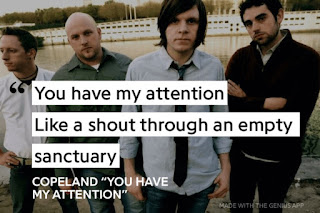
8. “You Have My Attention.” After the heavy guitar solo of “Love Is a Fast Song,” the quiet moments of “You Have My Attention” begin with Marsh’s calm vocals backed by an acoustic guitar and some kind of light percussion like a cymbal. This song feels like it was recorded in a church. Aaron Marsh has talked about his relationship to Christian music and faith, saying that there are “no Christian Copeland songs,” and the only times that Copeland gets spiritual is when Marsh is singing about his grandmother. But to me, In Motion feels like a very spiritual record, and “You Have My Attention” is perhaps some kind of spiritual thesis to the album. Whether that thesis is spiritual or secular, the album clearly uses religious imagery to convey its point.
9. “You Love to Sing.” In Eat, Sleep, Repeat, Copeland started to tackle a Burt Bacharach sound along with old timey Hollywood musical sounds. “You Love to Sing” feels like a predecessor to their later more elaborate work, only in the form of a slow moving rock song. “You Love to Sing” is a perfect roadtrip song for me. It keeps me focused on the road, and the time just slips away.
10. “Hold Nothing Back.” The final track on In Motion is a little underwhelming. It sounds like it was recorded in either a park or a busy food court. A simple acoustic guitar is the basis of the song, but eventually other instrumentation is added. The message of the song is the dichotomy between freedom and security in a relationship. The speaker tells the listener “Do what you want” and “Go where you want, but I won’t be too far.” He leaves us with this thought: “If you fall in love . . . hold nothing back.”
Listening to Michael Stripe and Peter Buck talk, I couldn’t place R.E.M. as southerners from Georgia. The NetflixSong Exploder‘s episode on “Losing My Religion” wasn’t the first time I had heard R.E.M. talk about their music; however, I was both intrigued and put off by Michael Stripe in the extended interview. He is perhaps one of the most articulate rock stars I’ve ever heard speak; however, I picked up on an underlying arrogance when he talked about this song. According to most accounts, the band recorded Out of Time using the mandolin as kind of a throw-away record before they returned to more conventional writing approaches. The band chose “Losing My Religion” as the lead single, thinking that it wouldn’t chart or that it would just be a minor hit. The band would quickly record more material and go on charting in the lower regions of the Rock Charts. However, “Losing My Religion,” despite its unconventionality became a number 4 Hot 100 hit, a number 1 rock chart hit, and it went to number one in several countries. Michael Stripe seems smug when he talks about the band’s underdog success. Occasionally, the music charts reflect effort and poetry and musical effort. Occasionally, the band who all the bands are drawing inspiration from also becomes popular. And that time was 1991.
I’M CHOOSING MY CONFESSIONS. Michael Stripe was raised in a religious background in the Methodist tradition. Borrowing a Southern cliché, “Losing My Religion,” brilliantly dances around the actually meaning in the lyrics. Stripe said that it’s about the awkwardness one feels around someone they love. However, the imagery in the music video and some of the lyrics in the song evoke existential meanings, often bating the devout as the lyrics pick apart problems with devotion. One of the reasons that the song was so successful internationally was the response to the sex scandals in the Catholic church around the world. In some contexts, the song is a protest against religion. In a somewhat of counter-argument, the alternative Christian rock culture in the 2000s also “lost their religion.” The mantra many bands and radio stations said was, “It’s not about religion, it’s about a relationship.” Multi-platinum CCM crossover artist Lauren Daigle blithely touted this new cliché on her 2018 album Look Up Child, titling a track “Losing My Religion.” This song was not a cover of R.E.M.’s hit, but rather a song about “losing [her] religion, in order to find you.” The listener can fill in the blank, but it’s pretty obvious from Daigle’s context that it’s about God.
THAT’S ME IN THE CORNER, THAT’S ME ON THE STAGE. But “Losing My Religion” also has served as a rejection of faith or a reshaping of it. In the last decade, a trend emerged in Christianity in which once prominent leaders and followers, mostly in evangelical persuasions, began to ask questions about what faith meant in the 21st century. When confronted with certain questions, especially regarding gender roles, politics, race, homosexuality, gender identity, and whether or not the scriptures were meant to be taken literally today. The deconstructionists, as they are called, didn’t find the traditional answers in mainstream Christianity satisfactory. Of course mainstream Christianity pushes back and often proves itself the culprit the deconstructionists rail against. For me, growing up being taught that I belonged to only true religion and that all the other religions lied to manipulate their followers, “losing my religion” was a scary notion. It was 2014 in the middle of my missionary days when I decided to finish watching Ryan Murphy‘s Glee. The show often tackled religion, mainly Christianity. Religion is one point of identity for the characters in the small Ohio town. One episode in Season 2, “Grilled Cheesus,” dealt with religious idolatry, the prosperity gospel, atheism, and crisis. Finn (Cory Monteith) sings the song “Losing My Religion,” and this is the episode’s catharsis. It was campy, and I thought it was sacrilegious, but it raised a question that was too often ignored in my religion: how should we deal with homosexuality? The show depicts real gay people in ways I’d never seen them on TV or in real life, and it bothered me that Christianity had made gay people seem like imaginary, sinful beings that could easily “pray away the gay” and change. It wasn’t just a theoretical English major debate from university, though. There was something more to this question.
A short lived indie-rock band from Dallas, Texas, The New Frontiers released one full-length album on The Militia Group in 2008 before calling it quits the following year. Their album Mendingwas produced by Matt Goldman, the Atlanta-based producer known for heavy-hitting bands, like Underoath, The Chariot, As Cities Burn. Goldman, however, isn’t exclusively a hard rocker. Working as the drummer of the Christian Rock band Smalltown Poets, Goldman’s early production credits include Luxury, Copeland, and Casting Crowns. The New Frontiers’ mellow folk-rock album,Mending drew critical acclaim from Paste and Daytrotter. The band contributed the track “Mirrors” to the the 2008 Cornerstone Festival digital mixtape along with many other indie rock acts who performed at the festival. “Mirrors” deals with coming to terms with an inescapable realization of who one is by “mak[ing] peace with the world.”
TURNED 22 WHEN YOU WERE FOUND. Today’s song brings me back to my childhood when the constant cycle of snow, salting, melting, and spring flooding, made driving a new car in Chenango County pointless. So everyone drove old GM-affiliated rust buckets that broke down in the winter, stranding you in the snow. It was only a matter of time that the 1970s Chevy would die and you’d have to fork out money to buy a 1980s Buick or Oldsmobile. When you got into the car and drove the roads in Chenango County, you’d be driving for a while between farms and fields and forests until you descended the hill into town–Oxford or Norwich, right or left. My first home was off the highway before my family moved deeper into the hills, where the “family commune” was located, where so many of my aunts and uncles lived. The first home was much better than the second, at least in my memory. When my family moved to my aunt’s old trailer, I was sick every winter, which, in New York was practically six months out of the year. But reflections in my memory of the cabin–pristinely kept, glazed wood, neat and tidy interior–probably never was as pristine as my memory. My parents insisted that the dilapidated shack they saw from the road was, in fact, just as my parents remembered it. The colors much paler, the roof much less stable, the porch much more rotten. “I never let the lawn get this bad, though,” my father assured him. “I wonder who Uncle Nathan has living there now.” “Do you think we can ask him to go inside?” I reverted to my boyhood, pleading with my parents like when he asked them to stop at the ice cream shop in town. “No,”my dad said taking my old cap off and scratching my head. “I don’t think that will be possible. Uncle Nathan hasn’t gotten along with our family for years. Him and your grandfather got into a big argument at the family reunion last year. But there’s always an argument. That’s why we had to move away in the first place.”
WE ARE ALL MIRRORS IN DISGUISE. Last October, after I wrote about “Mirrors” and spent a lot of time thinking about my childhood in an attempt to get in touch with my writing style, I saw a message on Facebook from my dad that the house I lived in from birth to five had burned down. He sent pictures:
The first picture is me about three years old in front of the cabin and the second is the morning after the fire. I don’t think anyone was hurt, but it’s still sad to me. I fantasized about being able to go back into the house. Of course, I don’t want to be one of those “we used to live here” people, but somehow I wanted to walk the floors that I could hardly remember. Today I finished watching the final episodes of This Is Us. Without spoiling the sad wrap up, I thought that Jack’s (played by Milo Ventimiglia) words to his children when his sons started to shave summed up the theme of my blog: “When you’re young, you’re always trying to be older. Then when you get old, you’re always trying to go back.” But we can never go back. We can’t go home, not really. Even if everyone is alive and even if your family has never moved, everyone is not the same. So in this nostalgic season–the fall as it gets colder, we stay inside more, the evenings get longer–let’s remember to enjoy today and capture it because it will be gone soon.
In 2015, Sufjan Stevens released his saddest album. The songs on Carrie & Lowellgive listeners insight into the folk singer’s upbringing and his process of dealing with the grief of losing an abusive parent. Stevens’ mother Carrie had passed away in 2012 from cancer, and “Death with Dignity,” the album opener, finds the lyricist struggling for the words to tell the story. He says “I don’t know where begin,” showing how something deeply personal is hardest to talk about. The song structure is unique in that there is no chorus, but rather five verses–this is a fact I never noticed in all the times I listened to the song before I wrote about it last year. “Death with Dignity” is best in the context of the entire album, but if you don’t have the time to dive into the depths of sorrow like a mourner’s kaddish, the song is a sweet twinge of sadness to throw into an otherwise happy playlist.
AMETHYST AND FLOWERS ON THE TABLE. I was on the fence about the 2016 pilot of This Is Us. The time-jumping drama was just confusing. Mandy Moore and Milo Ventimiglia in the past and Smallville‘s Green Arrow in the present. However, the big reveal at the end of the episode where you learn (spoiler alert) that the third triplet had died, and Rebecca and Jack decide to adopt Randall who had been left at the fire station, and the doctor saying some cliche line about “life handing you the sourest of lemons and using them to make lemonade” all deliveredto the tune of “Death with Dignity,” I was sold on the drama. As for the song, Stevens, for being as he is in his lyrics, shies away from celebrity spotlight. He offers little details into his personal life with the exception of this record. We know that his mother Carrie was a substance abuser and struggled with schizophrenia. We know that Lowell Brams was her second husband, and he was present during Stevens’ formative years. Lowell would go on to do some musical projects with Stevens after this album, but it was the death of his mother and the need for closure that drives this album. The second track on Carrie & Lowell get explicit about the abuse, but “Death with Dignity” merely paints the setting–Stevens’ life in Oregon, the death, the abuse, and the forgiveness.
WHAT IS THAT SONG YOU SING FOR THE DEAD? Forgiveness is somewhat of a dirty word. I grew up with a fear of not forgiving. The pastor said in a sermon that if there is anyone you’ve not forgiven, you can’t go to heavenwith the bitterness in your heart. At that time, I wondered if we should forgive the person who is unremorseful? How do we make sure that we’re not taken advantage of again? Thinking back on that, I realize how many vulnerable people were in the congregation; people suffering from truly evil things done to them. Forgiveness is a process, and it can’t be forced. Carrie & Lowell is a beautiful portrayal of forgiveness as it naturally happens. Learning to forgive your parents for the mistakes they made when raising you is always a process, and when there is clear signs of abuse, forgiveness may be impossible. I’m in no position to say that a victim must confront his or her abuser with forgiveness. I think that anyone who forces forgiveness on a victim adds another layer to the abuse. Music, church, scripture, and poetry are no substitute for mental health professionals, and it’s criminal how pastors have assumed that role. However, just as an album like Carrie & Lowell helped Stevens deal with his grief, so can art and religion be a supplement to our healing.




 Mixtapemotions