It’s beginning to look a lot like Christmas today. The first snow of the season fell in the city where I live, though it fell the first weekend of the month when I was up in Seoul. Starting at 7 a.m. and continuing until about 11, thick flakes descended covering the ground, making the morning commute a little more perilous than the usual idiots, though my carpool driver is skilled in New England winter driving. School started a little late with some traffic preventing the buses from being on time, and when they got in, the students played in the snow, coming late to class–good for them!
THEY KNOW THAT SANTA’S ON HIS WAY. I talked to my parents this morning when I couldn’t sleep. It was hot in my place, and I went to bed early for two nights before that, so my body felt caught up on sleep. Nothing urgent at home, just mom wanting to make plans for when I go next month near the end of the month. I got to see the Christmas tree, and my mom dressed up in a Santa hat and some red and white blanket. She said that the family would save Christmas for me. She said it would be a simple time–just a time to share a meal together and open a few presents. She doesn’t want to get me anything that is too much because of weight restrictions. Of course, no one believes or remembers when I tell them that in South Korea, workers just get one day off for Christmas, and then it’s back to work, or in my case school. It’s okay, though, this year because my school finishes three days after Christmas and we’re off until March 2nd. Christmas in my family has had to be a carefully- coordinated event, since my mom, and later my sister, became a nurse and my youngest sister works for a news station. I’ve missed a lot of Christmases because of Korea. But somehow, Christmas never loses its magic. And every year, it’s less and less about the things you get but the magic that happens when loved ones are together.
FOR KIDS FROM ONE TO NINETY-TWO. “The Christmas Song” (Chestnuts Roasting on an Open Fire) was written by The Velvet Fog, Mel Tormé, but we probably know Nat King Cole‘s version best. It’s been covered by everyone, and today’s version by Michael Bublé is a good one. In the days of the crooners, the songs were passed around and Bublé keeps that crooner tradition alive today. I don’t have a favorite version of this one like I do other carols, but Bublé’s crisp vocals felt like a good fit today. I don’t like the taste of chestnuts. Maybe “Eskimos” is not politically correct these days. I’d prefer to have lasagna on Christmas because if you have turkey on Christmas and Thanksgiving, the bird gets old. I was never taught about Santa Claus other than that some children actually believed in him. Nat King Cole’s version, in particular, makes me sleepy. And yet this sleepy song puts me in the mood for holiday cheer. Although so many elements of Christmas songs feel so irrelevant to us, they create magical moments unique to us. Perhaps you’re celebrating Christmas in California, Hawaii, Florida, or another tropical area where the seasons don’t change. “Let It Snow” might not be for you, but maybe it is. I don’t know much about “The Feast of Stephen” or who “Good King Wenceslas” was, but the melody, sung right, makes me feel a Christmas sensation. I’ve been teaching my students a lot of Christmas vocabulary. In South Korea, Christmas is a couple’s day mostly, something not alien to the US with Hallmark movies and Wham‘s “Last Christmas” or Mariah Carey’s “All I Want for Christmas Is You.” Some of them have experienced a non-Korean Christmas, but many have not. And while they’re not so young, I feel like there’s still a magic to teach kids about Christmas–a feeling of deep appreciation for friends and family and building memories together. And that’s what The Christmas magic is all about.
“Wonderful Christmastime” was rated as the worst Christmas song byUltimate Classic Rock. Recorded when 37-year-old rock legendPaul McCartneywas recording his polarizing second solo record, just before the disbanding of his second band,Wings,McCartney II was a synth-pop, new wave record in a time when formerBeatlesfans were yelling, “stick to the classics.” Recently, critics have come to understand and even praiseMcCartney II for its pioneering in electronic music. The intentionally simple lyrics help to draw attention to the synths and the overall Christmasy atmosphere of the song.
THE CHILDREN’S CHOIR SINGS A SONG. “Wonderful Christmastime” has been covered by many artists, including Diana Ross, Demi Lovato, Hillary Duff, Jump5, Chicago and Dolly Parton, Pentatonix, Family Force 5, Jars of Clay, Eleventyseven, and so many other artists. In 2000, the Christian Rock band Earthsuit recorded the track for Tooth & Nail Record‘s holiday collection Happy Christmas, Vol. 3. Composed of members of what would become MuteMath, Earthsuit interpreted McCartney’s synth-pop with a faster tempo. Singer Adam LaClave‘s vocals grow more radical as the song speeds up. I always thought that Family Force 5’s 2009 Christmas Pageantversion of this cover took inspiration from Earthsuit’s version. The version that makes our playlist, though, is by indie rock gods, The Shins. I heard this song this morning listening to “A Very Tooth & Nail Christmas” on Apple Music. Along with their “Summer Vibes” playlist, I was shocked to see so many non-Tooth & Nail (and secular) artists on their playlists, especially when Tooth & Nail put out many Christmas collections. What is the connection between Tooth & Nail and The Shins?
WE’RE HERE TONIGHT, AND THAT’S ENOUGH. Formed in Albuquerque, New Mexico, in the late ’90s, The Shins relocated to Portland, Oregon, became friends with Modest Mouse, and landed on an indie film soundtrack by Zach Braff and starring Braff and Natalie Portman. The movie, of course, is Garden State. While not every band on the soundtrack became Coldplay (who was also on the soundtrack), The Shins forged a lasting career with albums like Wincing the Night Awayand Chutes Too Narrow. In 2012, the band contributed to a Christmas album, Holidays Rule, which also contained Paul McCartney singing a cover of “The Christmas Song.” The Shins show their Beach Boys influence in this cover and don’t play up the synth sound of this song. So, why is it a Tooth & Nail favorite? The Shins were a somewhat local band to the Seattle-based label, and Aaron Sprinkle has stated that he was inspired to create Jonezetta‘s second album, taking influence from Wincing the Night Away. But one extra connection to the scene is the keyboardist/producer of this track, the late Richard Swift. Getting a start as the keyboardist for Starflyer 59, Swift went on to play with the Shins from 2011-2016 and toured with the Black Keys in 2014. Sadly, Swift passed away in 2018 at the age of 41. Whichever version you choose to enjoy this holiday season, focus on the simple message. And while Christmas may not be great this year, the merriness of Christmases past can live on in our minds. And that’s enough.
It’s very difficult to find the band KIDS on streaming platforms or online. The Ft. Lauderdale-based Indie band released their sophomore record, Lost Cities, on Tooth & Nail in 2020 and the label and the band seems not to have generated much hype. And it’s a shame. The band has an interesting take on synth pop and organic sounds, often including trumpet and saxophone in their songs. Today’s song, the Christmas classic “War Is Over,” offers a saxophone line that I find simultaneously comforting and eerie.
WAR IS OVER, IF YOU WANT IT. “War Is Over” is the band’s cover of John Lennon and Yoko Ono‘s 1971 holiday hit, which was written in protest of America’s involvement in the Vietnam War. My inclusion of this song comes with a prejudice that I’m currently reexamining. When I was young and influenced by far-right Christian rhetoric, I believed that this song was dangerous, as was his hit “Imagine,” also released in ’71. I was taught that war is a last resort, but often necessary, and Lennon’s Marx-lifted lyrics in “Imagine” were driving people away from the very foundations of freedom: God, guns, and gold. “Happy Xmas” was a song that removed “Christ” from the title, and that was what the “War on Christmas” looked like in the ’90s and probably earlier. The song wishes Lennon’s son and Ono’s daughter a merry Christmas at the beginning of the track, and the song never says “X,” but always “Christmas.” The lyrics of “War is over, if you want it” strike me as hopeful, idealistic, and naive depending on my mood. Not knowing much about the Christian influence or backgrounds of The Beatles (which would be a fascinating study), I’m assuming that Lennon would have been well-acquainted with popular notions of faith and virtues typically attributed to Christianity. Lennon and the Beatles strayed from state religion of their homeland, venturing into the realm of Hinduism, Hare Krishna, and other eastern religions; however, to me, today, “Happy Xmas” seems to be pleading with theChristian country of the United States, even using someChristianese, using Christmas as a platform of peace and ending the war. If you’re in America and an evangelical, though, Lennon just sounds like a babbling heretic. After years of blatant racism and looking back at wars with no end game, it may be time to listen a little closer to the babbling, especially in a year filled with a completely unjustified war.
LET’S HOPE IT’S A GOOD ONE. When the lyrics of “Happy Xmas” begin with the question, “And what have you done?” I begin thinking about my meager achievements for the year. What do I have to celebrate other than survival? Am I closer to becoming the person I should be? And what will 2023 hold? It’s a question that feels scary to ask as we mark another year closer to the inevitable. But Lennon and Ono’s song offers us hope. It doesn’t seem realistic that wars will end and everyone will join hands around the Christmas tree. However, we can choose to have a spirit of peace on earth. That seems very Christian. After all, didn’t Jesus say, “Blessed are the peacemakers for they will be Children of God”? (Matthew 5:9) So rather than putting tons of presents under the tree this year, especially because we’re all broke from the inflation caused by the war!, let’s think about what we can do for the ones we care about. How can we better tolerate the ones we don’t like? How can we be a positive force to those in our lives. So have a cup of cheer, even if it’s a small one, and hope that we can move toward a world of peace on earth, good will to men.
“In the Bleak Midwinter” is another Christmas Hymn that I like particularly because of how infrequently we hear it. The lyrics were penned by Victorian poet Christina Rossetti and published with the title “A Christmas Carol” in the January 1872 issue of Scribner Monthlyand later compiled with other poems in Goblin Market, The Prince’s Progress and Other Poems.
IF I WERE A WISEMAN, I WOULD DO MY PART. Christina Rossetti was a devout Catholic living in Protestant England. “In the Bleak Midwinter” shows Rossetti’s style of vivid description of scene and sentimental religious feelings. In fact, the lyrics of “In the Bleak Midwinter” touch on a more personal note than other impersonal Christmas hymns as the speaker in the hymn, and us when we sing the hymn, makes a commitment to give the babe in straw her heart. The poem was later set to music and there are two popular versions. Harold Drake composed music for the hymn to be sung by a choir, as did Gustav Holst, who penned the most popular version of the hymn. Unlike Rossetti, the faith of composer Gustav Holst, on the other hand, was not as straightforward. He was a veracious reader and many of his compositions were inspired by Victorian writers. Part of his inspiration for this version was the church in Cranham, which he titled the piece that took the resemblance to a Christian hymn.
WHAT CAN I GIVE HIM? Today’s version of “In the Bleak Midwinter” is performed byPaul Colman Trio. I chose this version because it’s the first time I remember hearing it. Although it is in the Seventh-day Adventist hymnal, I don’t remember singing it in church. My first experience with the song is on the City on a Hill Christmas compilation album It’s Christmas Time. This was the third project from the Essential Records collective of acoustic, poetic Contemporary Christian artists such as Jars of Clay, Sixpence None the Richer, Caedmon’s Call, Third Day, and Jennifer Knapp. Hailing from Australia, Paul Coleman and his band got a slot on the record as they had several number one hits from their breakthrough album, Turn, and a Grammy nomination in the Gospel category. The piece was also an exercise in my classical guitar method I studied, but what solidifies this song as one of my favorites was when Paper Route included the hymn on their digital holiday EP, Thank God the Year Is Finally Over. There are so many myths about Christmas reinforced through song because northern Europeans blended local religions with medieval Christianity. Christ, if he were born as the Bible tells us, probably wasn’t born on Christmas day and there definitely wasn’t “snow on snow.” But the liturgy of seasons changing and celebrating holidays during the dark and depressing winter months can give us hope when we need it the most. I think that’s why Paper Route included the track on Thank God. And as things look pretty bleak this time of year–finances, deaths, uncertainty–we know that spring will eventually lift us out of the depression.
I’m at the time of year when I start assessing my new year’s goals. And I got to an existential crisis for the blog. I wondered what I’ve achieved with it other than keeping it going. Sure, there have been improvements in font, links, story, and research, but I thought about if a daily post is really sustainable in the coming year. I’m mulling a few ideas over. I’m considering changing the focus of the blog.
YOU CAN ALWAYS COME HOME. I thought about all the things the blog is, but I thought it was actually more helpful to think about what it is not. First, it’s not a reputable music blog. The amount of time I have and my lack of formal music writing training and lack of connections in the music business make this a purely fan blog as I report about my daily obsessions and Wikipedia reading. Second, it isn’t a novel or even a memoir. I shot down that ideas last year after experimenting with the idea, in favor of the story of the song, but I think that may have been the direction I should have gone. I often think of the “song a day” format as a lesson plan–the amount of information I give my students about something before I have them go experience it for themselves. But I didn’t want to turn this into an ESL blog. So what has this blog become? I’m telling the same stories over and over again, adding more information, but there’s only so much time in the day. I considered ending it this afternoon when I had chosen Tyler Burkum‘s “Hummingbird” as the song of the day, but the lyrics weren’t on Genius and I was racking my brain how to retell the same stories about the former Audio Adrenaline, Leagues, Mat Kearney, and current NEEDTOBREATHE guitarist. But walking home in the cold sparked a few new ideas.
YOU HAVE A QUIET WISDOM. I thought of my writing as my child. I don’t think I’ll have children of my own, something that I’ve come to realize. And realizing that I have to leave something behind. I feel compelled to do something so that my life isn’t just like brushing shellac onto a wood chair that someday rots and no one remembers the chair. Everything I’ve written remains in fragments. I’d like to believe that one day before my death, as part of “getting my affairs in order,” I will compile everything I’ve written and somehow I can write a connecting story and produce something like Proust’s In Search of Lost Time.So what then is my blog but recommending to others my taste in music. How is that valuable? What my blog is really is an experiment. It’s playtime to practice skills of writing, designing, filming–whatever I want it to be. I want to create something beyond literature, something beyond social media, beyond a musical playlist. I want to create a mixed-media novel/movie/drama for my ADHD generation and the even more ADHD generations coming up. So, I will be pushing myself to be open to new possibilities.
This week, Copelandannounced that they would be touring to celebrate the twentieth anniversary for their debut record, Beneath Medicine Tree. Copeland’s sound has changed a lot from the indie nineties-rock inspired band to digging deeper music school band mates (particularly frontman Aaron Marsh‘s) classical, jazz, and broadway influences. Before all of that, though, we have a song cycle about a young man affected by his grandmother’s death, pinning over a girlfriend–Paula–even named on the record. Some consider Beneath Medicine Tree an indie classic, while others consider it an immature effort for a band with much greater potential.
THERE ARE BIRDS SINGING ON LAMPPOSTS. My sister and I fall on different sides of this debate. Back when I was going through my Copeland binge on their first three records, I liked their first two records best, while my sister liked their second two better. She admired the musical theater experimentation on Eat, Sleep, Repeat, while I was keen to the small-town America sound of Beneath Medicine Tree. We both loved “Coffee,” though. The sappy pre-Owl City opener, which declares, “She said that I was the brightest little firefly in her jar” may have listeners rolling their eyes, but they should know that they are in for the sappiest, unapologetic teenage emo record. Then the the album breaks into electric as it plays a religious trope about how pain “tests the strong ones” leaving the “beautiful.” This is a song about the hospitalization of both Marsh’s grandmother and his ex-girlfriend Paula. Many songs play on the sentimental, and today’s song, “Walking Downtown,” is one of them.
THEY DON’T KNOW WHAT ALL YOUR CRYING’S FOR. “Walking Downtown” is kind of the anthem of young. It’s the song that my sister and I debated about the album, mainly because “Walking Downtown” was the hit. The song calls on the experience of being a young person being drawn to the sights of an ordinary downtown area–the movie theater, the restaurants, the coffee shops. It’s like cruising in American Graffiti,teenage energy in the feeling of attraction to the opposite (or same) sex as you wander among your friends downtown. You seem to have found a new revelation in the streetlights and signboards, and everything about this night seemhes right. “Walking Downtown’ is about this feeling of youth. You feel invisible, though you’re not. Many fall in these moments to drunken stupor, but tonight you’re invincible. The Christmas lights downtown add to this feeling of being forever young. Someday you’ll feel old, raising children looking at this marvelous sight, but tonight you are young. That’s what “Walking Downtown” is all about, that night that you are young just for one more night.
This fall was when I got into folklore. Is this winter the one that I get into evermore? Today, I made the jump into the record again after more cursory listens in 2020. I have a few thoughts from this afternoon’s listen, but remember that I am by no means a Taylor Swift export the president of a local chapter of her fan club. I am merely offering my opinions on some damn good music. I’m hoping to have some deeper insights next year when I will probably dig deeper into this record.
THE WARMEST BED I’VE EVER KNOWN. A initial thought from when I listened to evermore, I found that the record was even less cohesive than folklore. In my time with folklore, I began to realize that there was a cohesion to it, and I think the same is true with evermore. The next thing I noticed is that many of the tracks felt like b-sides to folklore, although the record was written and produced quickly after releasing folklore. I first listened to evermore with my AirPods Pro when they were buzzing, so the bass was distorted, but it made me wonder what evermore or any Taylor Swift record produced by Aaron Marsh, Aaron Sprinkle, or JT Daly would sound like because the instrumentation would compete with Taylor’s voice. Finally, I found that some of the songs on evermore were immediately catchy compared to folklore which took me deeper listens to get into the record, yet with evermore the tracks that I didn’t find as catchy have yet to come to life. Today, my biggest take away from my re-listen is that evermore is Taylor Swift’s true return to country. Sure, the twang is mostly absent and country often uses less profanity, but the storytelling songs in “gold rush,” “no body, no crime,” and even today’s song “‘tis the damn season” feel like country hits that I would have heard at the grocery store or at work on summer vacation in the south.
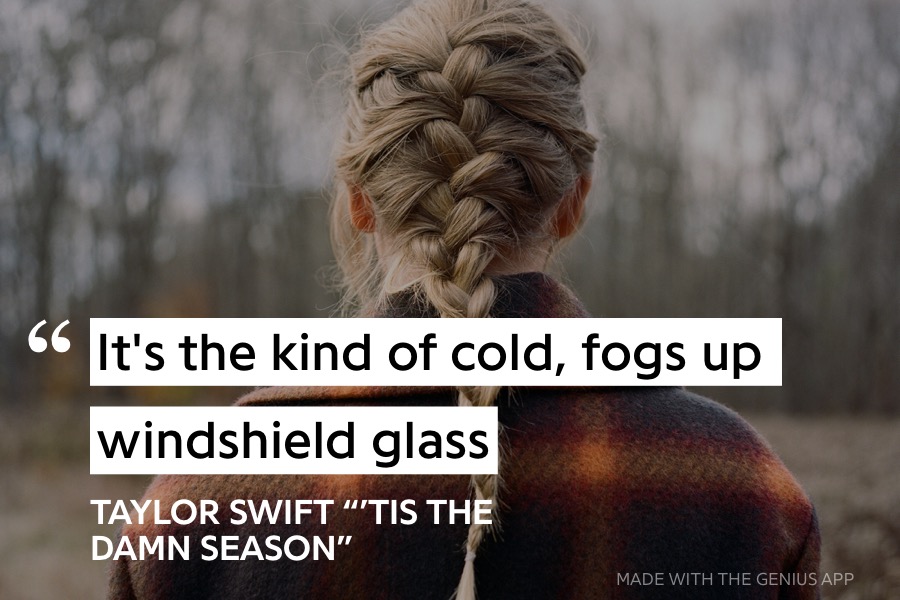
THE ROAD NOT TAKEN LOOKS REAL GOOD NOW. Likefolklore, Taylor Swift employs the tools of fiction to create the songs on evermore. In today’s song, “’tis the damn season,” the protagonist, likely Dorothea who gets a song about her later on the record, returns to her hometown for the holidays, “stayin’ at [her] parents’ home.” The protagonist has come home from L.A. where she hopes to be famous. At home, over the weekend, she bumps into an old fling and the two reminisce about “the road not taken” and have a weekend fling. In this beautiful guitar-driven fantasy, listeners think about the “roads not taken,” and who would co-star if their lives were made into the Hallmark movie premise of “’tis the damn season.” But as much as this “big city movie star goes back to see the cute boy with mud on his tires” the universe rarely will set the two back on the same path. There’s a reason greater than Hollywood and the distance between the small town that the romance didn’t work out. It was fun for a weekend and maybe regrettable that it ended, but what does the small town hold for you these days? For me, I’m thinking about the feelings I get every time I go home, not that there’s some fling waiting for me there. It feels so right to be around family that I realize that it’s just a fantasy. I’ve found my purpose far away. I’ve built my life far away. I’ve found love far away. It’s just nice when the universe aligns and I can cross back to my old life even if it’s just for a few weekends.
Many boys go into the woods and play soldiers or cops and robbers. I did that when I played with other boys, but when I was by myself, I went into the woods and pretended to be someone else. I fantasized about being Michael W. Smith. I’d sing in the forest and dance around like the stones were my audience, pretending to play piano and sometimes guitar making up my own songs. Michael W. Smith is probably the closest Christian music ever got to having a bona fide male sex symbol, if you exclude Carman for just being creepy. Sure, there were other handsome CCM singers, but no of them played off the scratchy voice and five o’clock shadow the way that Smith’s marketing team did.
OF THE JOY OF CHRISTMAS. My fandom of Michael W. Smith lasted the span of three records starting with 1998’s Live the Life and ending with 1999’s This Is Your Timewith his second Christmas record, Christmastimebetween them. Smith’s music prior toLive the Life felt too dated and a little too cheesy at the time other than some of his biggest hits “Friends,” “Place in This World,” and “Secret Ambition.”In 2001 Smith released Worship, a record of worship songs mostly written by other artists or written by Smith and originally recorded by others and Worship Again the following year, and I was on to rock music. But in those two years or so when I was listening to Michael W. Smith, I was proselytizing for him to my anti-rock music mom. After he released This Is Your Time which included several instrumentals songs with bagpipes, she started listening to Michael W. Smith. I even bought her Christmastime that year for Christmas and the CD became one of our Christmas standards. Michael W. Smith’s music from this middle golden age showed his mastery for composition. The singer often included musical moments not typical in rock and pop music, especially Christian music.
SING WE NOEL. I could reminisce for days about the musical odyssey Michael W. Smith brings his listeners on at the beginning of “Missing Person,” the first track of Live the Life, about his reaction to the Columbine tragedy with the touching tribute “This Is Your Time,” about the disappointment I felt with “Healing Rain,” about how he was my musical role model growing up and only later did I realize that he was actually good looking, or analyze the professional partnership with Amy Grant despite her being somewhat boycotted from the Christian market. Michael W. Smith is a giant of Christian music and I feel like my introduction to his music was at the best time. Christmastime broke rules that I was discovering about albums: at least ten distinct tracks with singing, unless you’re Pink Floyd. An instrumental could be on the record if there were at least ten tracks with lyrics. Songs had choruses. But Christmastime was more of a Christmas fantasia weaving songs together with long instrumental sections. And this was okay because it was a Christmas record. The version of today’s song “Emmanuel” paired with “Sing We Now of Christmas” was first recorded on Amy Grant’s 1983 A Christmas Album. Smith recorded it for another project as well, but the 1998 version is the most refined sounding version of the song, particularly with the introduction with The American Boyhood Choir. So as we approach Christmas, I hope to share more of these Christmas memories. Enjoy!
After releasing their fourth album, Fangs!Falling Up went independent, releasing their albums without a label and crowd-funding to produce them, starting with 2011’s Your Sparkling Death Cometh. The album was further departure from their former Christian Radio rock sound, the band expounding upon strange space aesthetics and experimenting with longer song formats and delving deeper into science fiction lyrical themes.
THERE’S A STAR IN THE SKY. In 2013, Falling Up announced the follow up to Your Sparkling Death Cometh would be two records aimed to satisfy two different types of fans the band had gathered. First came Hours, a rock concept album for which lead singer Jessy Ribordy wrote and read an accompanying audiobook. The second record, Midnight on Earthship also had science fiction elements but ultimately the band pushed into their Christian Rock roots to create a spiritually-themed record. But also in 2013, the band released a Christmas record, Silver City. The Christmas record included traditional songs done in the style of post-BEC Recordings Falling Up and an original song. The glittery, electronic sounds of a Falling Up Christmas record feels a bit late in the band’s career as their music became less relevant after exiting BEC, but the band manages to take songs that they mostly didn’t write themselves and weave them into a what seems like a concept record that has something to do with Christmas and possibly the birth of Christ.
THERE’S A MOTHER’S DEEP PRAYER. “Song in the Air” is a Christmas hymn written by Josiah G. Holland. A novelist and poet, Holland helped and founded a literary magazine called Scribner’s Monthly, which was renamed Century Magazine. Holland’s work was more popular in his day as he is seldom read today. Even his Methodist Christmas hymn “There’s a Song in the Air,” is unfamiliar. It is the Seventh-day Adventist hymnal, and I remember it being sung at least once around Christmas time. My sister made a wisecrack about it, saying something like “this is the most boring Christmas song” or “there’s a reason we don’t know this one.” Falling Up having become an more and more obscure band over the course of their career covering an obscure hymn certainly didn’t revive any fandom for this oft forgotten Christmas hymn. The hymn is a mediation on the birth of Christ at the nativity scene. It’s not particularly the best mediation, but I have a real soft spot for Christmas worship–the tradition of feeling awe and wonder at the mystery of the incarnation. And it might just be the four-part harmonies of the old hymns that sound more unique on Christmas hymns than general ones. And so today, I present this imperfect Christmas hymn as an offering. Embrace the mystery of Christmas–the mystical emblems and symbols–or don’t. I’m certainly not here to force you into religion.
HOW MUCH YOU’VE TOUCHED MY LIFE. Last month when I was researching Relient K, I found out that there’s a fan podcast titled Sadie Hawkins Pod in which two Relient K fans dig into the band’s history, discography, and fandom, delivering their insights to their listeners. I’m not sure if their facts check out because one of the insights they had was that Relient K’s slower tracks came on the re-released record and the punk rock tracks were on the original record. Today’s song, “I Celebrate the Day,” though was included on Deck the Halls along with the melancholy “I Hate Christmas Parties,” though that track is credited to the group Matt Thiessen and the Earthquakes, a side project Thiessen started to express more than just the punk rock sound of Relient K before Relient K became an alternative band in the later releases. What is interesting that the podcast brought up is that every Christmas season Relient K’s Spotify numbers spike, and their Christmas songs begin taking up their top 5 most played songs along with “Be My Escape.” These Christmas songs were not only a staple in youth group culture but also could be heard in stories like Abercrombie and Fitch and Hollister around the Christmas season along with other punk rock Christmas tracks.
WE’RE LESS THAN HALF AS CLOSE AS I WANT TO BE. Speaking of the two eras of Relient K, the band started to incorporate an introspective sound by their third record, Two Lefts Don’t Make a Right. . . But Three Do on songs like “Am I Understood?” and “Getting Into You.” Both tracks slow the band down with an acoustic guitar on an otherwise punk rock record. Matt Theissen sings in earnest about his spiritual thoughts and fears, much like he does on today’s song, “I Celebrate the Day.” Relient K would take that confessional song to another level on their seminal record MMHMMon tracks like “Who I Am Hates Who I’ve Been” and “Be My Escape” and would continue this kind of song throughout the rest of their career. Relient K’s early albums followed a formula: goofy, energetic, pop culture reference-heavy lyrics and maudlin tracks about not being a good enough Christian. Today’s song is the latter, only it’s a Christmas song. Following Relient K’s career as an example of a band that has mostly strayed from their original sound and even message, listeners can still hear the regret songs on their latest record Air for Freebut the regret is more existential than related to Christian spirituality. While the message of today’s song is about regret about not being in a deep enough relationship with Jesus this time of year, something only specific to Christians, I still think that the spirit of the song translates to everyone who has regret. The years are slipping by, and I’m asking myself “Am I any closer to my goal than I was on New Year’s Eve last year?” It’s time to start making your New Year’s Resolutions.