• In 1996, Welsh singer-songwriter Donna Lewis released her debut single “I Love You Always Forever.” The understated, delicate pop song became an international hit. In the United States, it hit number 2 on the Billboard Hot 100, unable to take the top spot because of multiple versions that counted as Los Del Rio‘s version of  “Macarena,” the dance track that plagued ’96. Lewis never matched the success of her debut single.


    SECRET MOMENTS SHUT IN THE HEAT OF THE AFTERNOON. Donna Lewis wrote the song “I Love You Always Forever” basing it on a 1953 novel, Love for Lydia by Herbert Ernest Bates. The lines from the chorus “I love you always forever, near and far closer together” appear in the novel, and Lewis’ original title for the song was “Lydia.” While Lewis had a few other minor hits, such as “At the Beginning,” a duet with Richard Marx on the 1997 song for the Anastasia original soundtrack, “I Love You Always Forever” is the singer’s signature song.  The lush imagery in “I Love You Forever and Always” transports the listener to a “cloud of heavenly scent,” to a “windless summer night” to “the heat of the afternoon” or simply to look into “the most unbelievable eyes [you’ve] ever seen.” The success of the sentimental ballad shows that music despite whatever musical trends do, soft rock ballads with sappy lyrics can always pierce through the hipster trends. And because of musical trends, “I Love You Always Forever” has been covered several times in recent years. Today, I’ll talk about two covers from artists I have written about several times: Mike Mains and the Branches and Betty Who.

    YOU’VE GOT THE MOST UNBELIEVABLE BLUE EYES I’VE EVER SEEN. Mike Mains & the Branches released their cover last year and is their most recent single. After an emotionally taxing record, When We Were in Love in 2019, “I Love You Always Forever” is a nice check-in with the couple whose marriage was tested by events mentioned in the record. Betty Who’s version was released as a single between her debut record, Take Me When You Goand her sophomore record, The ValleyThe single was so successful, though, that Who decided to promote the song as the lead single from The Valley and include it as the fourteenth track of the record. Who’s version topped Australia’s airplay chart, reached the Top 4o in New Zealand, and topped Billboard’s US Dance Club Songs. Who told Spin about why she chose to record the song. She said, “It’s one of those songs that you don’t know, and when you hear it you go, ‘Ah I know this song.’” She went on to say in Vogue that she remembers the song being “everywhere” when she was 5 years old in ’96.  Mike Mains’ version adds masculinity to the track, but Who’s version adds sensuality absent from the other two versions. The harmonized a cappella starts with soft, yet sharp vocals piercing the song combined with the music video in which Who is part of a throuple adds a bit of naughty with the nostalgia. Not there’s anything wrong with that. However, if you prefer to spend your always and forever, with Lewis, Mains, or Who, you’re bound to have this song stuck in your head and only pleasant thoughts of summer afternoons flooding your thoughts.

    Donna Lewis version:

    Betty Who version:


    Dance version from To All the Boys I Loved: 
    Mike Mains & Branches version: 



  • Almost a year after releasing her second album Beatopia, beabadoobee released a new single called “Glue Song.” The song became a hit on TikTok and a month later a remixed version was released with Clairo. Bea had toured with Clairo on her Immunity Tour in 2019. The two artists are two years apart in age—Claire Elizabeth Cottrill (Clairo) being the older—and occupy a similar genre of lo-fi bedroom pop. “Glue Song” reminds me doing crafts in grade school—that kid that played with the paste, getting glue stuck in long hair, that sugary taste of non-toxic horse product. But I digress. Today, I’m bringing yesterday’s Fresh playlist to AppleMusic, with a few modifications. Check it out in the link below!


  • Quotes from Movies has only about 5,000 monthly listeners on Spotify, but their inclusion on playlists like Fresh Finds and Soda have the song “Super Mall Mannequin” seeing a lot of success earlier this year. Since there’s not a lot of information from the band other than their Instagram account and the music they posted on streaming services, I decided to make a playlist of some of the songs that I’ve been listening to lately that I haven’t written about yet. Is there any Fresh Finds I should be listening to? I’ll add to this playlist from time to time. Enjoy!


  •  

    The list of albums turning 20 this year makes me feel really, really old. Earlier this week, I covered the youth group classic The Beautiful Letdown. Anberlin released their debut record Blueprints for the Black Market, which also made a huge impact on my teenage life. But then some albums came out that year that I didn’t listen to until later. I had known Copeland from their first low-budget video “Walking Downtown,” but it wasn’t until their third record, Eat, Sleep, Repeat, that I started listening to the band. In the spring of ‘06 when I was about to graduate from high school I started buying Copeland’s CDs, picking them up on discount if I could from Best Buy. The first two records were perfect for late spring/summer listening. 


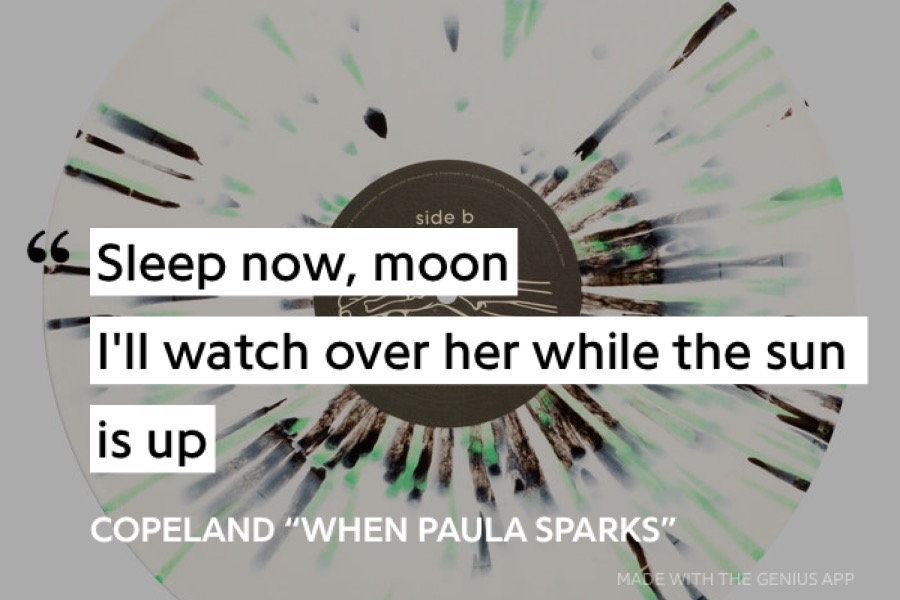
    I AM STARVED FOR HER ATTENTION. Copeland’s Beneath Medicine Tree has the most delicate lyrics of all Copeland records. The loose concept of the album deals with the death of lead singer Aaron Marsh’s grandmother and the hospitalization of his girlfriend at the time, Paula Sparks. In an interview on the Labeled Podcast, Marsh told host Matt Carter that writing and releasing the album “set [himself] up to not write anything that intensely personal ever again.” Songs like the sappy pre-Owl City “Brightest” are more abstract, but songs like today’s song “When Paula Sparks” reference very specific situations and people. Marsh broke up with Paula Sparks and recorded the song, posting it to MP3.com, and later recording it for Beneath Medicine Tree. One of Copeland’s early influences was the ‘90s alternative rock band Gin Blossoms. Marsh tells the story in the interview about a girl he knew named Allison Roads, who had a similar name to one of Gin Blossoms’ hits, “Allison Road.” Marsh tells Carter his thoughts at the time: “What if I put Paula’s full name in a song? She’ll feel so great. She’ll never forget me. . . It didn’t have the desired effect.” What started as trying to get the girl back turned into an awkward conversation.

    THERE’S A BRILLIANT SKY UP ABOVE. In her, somewhat disorganized book on writing Bird By Bird, Ann Lamott writes a hilarious chapter on avoiding libel. One of the first rules is, of course, never using a real person’s name. Using someone’s real name in art opens artists up to lawsuits, but other specific details can leave them liable as well. While “When Paula Sparks” doesn’t have many other damning details in the song—having a girlfriend who was hospitalized is universal enough—it would have been good for Marsh to have read this 1994 book. Lamott writes in the chapter titled “The Last Class”:

    Lamott goes on to cite (possibly coin before Dinitia Smith wrote about it in the New York Times and is credited for coining the rule) the “small penis rule”: 
    Of course, Lamott’s advice isn’t exactly full-proof as Michael Conklin writes in the Nebraska Law Review when examining when author Michael Crichton disguised one of this critics into a pedophile with a tiny penis. Conklin writes that the rule “does not require the plaintiff to admit that he has a small penis in order to sue for damages. A potential plaintiff could simply list the small penis accusation as an additional defamatory statement from which to seek compensation, thus explicitly stating that the small penis accusation is false.” And that’s what happened to Crichton. This didn’t happen to Aaron Marsh and he didn’t write anything defaming Paula, but writing in such a way that he wrote left him too raw. And those raw emotions are the exact thing that made Emo such an uncomfortable trend. Harder Emo disguises the emotions with music, but with Copeland—especially on Beneath Medicine Tree—all emotions are left naked, exposed like a weird skinny kid in the locker room among the jocks. The vulnerability is uncomfortable, but it also connected with so many early Copeland fans. And some of these listeners were also Sufjan Stevens fans. Authenticity is both a strength and a weakness. 

    Beneath Medicine Tree version:

    Alternate version:


  • Last month, Niall Horan released his third record, The Show. The album topped sales and streaming charts in eight countries. In America, though, the record peaked at number 2 on Billboard’s 200 Albums chart. That’s still an impressive feat for a record without a major hit. That’s not to say that The Show lacks the catchiness required for a hit. The lead single “Heaven” peaked at  #62 and no other track has charted yet. It’s still possible that “Meltdown” or “Science” may catch on, but in today’s TikTok-driven music industry, Horan’s success is not a guarantee.


    I WILL FOLLOW YOU TILL THERE’S NO TOMORROW. The production on The Show is exceptional and Horan’s vocals and the harmonies on many of the songs are good. The critics on the podcast Every Album Ever point out that Niall Horan’s writing process for his music is more like the writing process of One Direction songwriting sessions than his fellow band mates whereas the other members tried to distance themselves from the boy band. The critics also point out a growth in Horan’s voice—stronger than his One Direction days—and artistry, particularly in the acoustic ballads. Today’s song, “You Could Start a Cult” is like a campfire tune, featuring Horan playing a nylon strung guitar and taking a very simple harmonica solo. The song certainly stands out among love songs lyrically comparing his love to a potential cult leader. The speaker’s affection for the listener is obsessive and his devotion to her is no less than worship. While the line “you could start a war or two” harkens back to many love songs that may even reference beautiful women like Helen of Troy or Joan of Arc, the notion of following a beautiful woman to the point of Jonestown-level sacrifice is not a common love song theme. The song could easily turn comical, but Niall delivers the lines calm and wistful. 

    THEY SAY THAT WE’RE CRAZY. Niall Horan has stated that The Show is a collection of songs written over the course of the pandemic. Some of the themes of seem to permeate the record, including “You Could Start a Cult.” True crime and cult survivor stories have had a huge following since the pandemic with a new Docu-Series arriving weekly. Today’s song, though, makes me think about a former coworker who has ghosted everyone (friends, family, acquaintances) after meeting a girl in Korea. Since the start of the pandemic, Korean cults, particularly the Shincheonji cult (신천지) had been blamed for spreading Covid after members of the elusive religious sect defied rules of gathering limits and spread the virus in the workplace. Shincheonji members were encouraged to lie and say that they didn’t belong to that church when asked. However, recently, the group started openly proselytizing in public. “We’re Shincheonji. Hear our message,” they said to me outside of the subway station. I said to my friend beside me under my breath but a little loudly as we avoided eye contact, “Thanks for the pandemic.” Of course there is a nuanced argument to have about freedom of assembly and freedom of religion, but seriously, the church members of Shincheonji were certainly culpable, so much so that their founder tried to gift the South Korean government money to pay for their wrongs. The South Korean government, however, did not accept  Lee Man-hee (이만희)’s donation and returned the 12 billion won ($10.1 million). So why has Shincheonji labeled a cult? A big part of that label is from how leadership recruits and isolates members from their friends and family, sometimes even moving members internationally. After being cut off from a former coworker after he met the love of his life, my friends and I speculated that the girl may be Shincheonji. The group has been infamous for recruiting foreign nationals in South Korea, often leeching onto Hallyu enthusiasts. Whether or not it was Shincheonji, another cult, or just a possessive relationship, an idolatrous relationship as suggested in today’s song and as executed in my former coworker’s devotion to the girl is alarming. Having grown up in a religion that many Christians call a cult, I’ve never actually experienced the “cutting of ties” in the way that I’ve experienced it with this person. Because of the serious nature of the topic, I’ll link some resources in case you are in a cult or an abusive relationship. Get out and get help. 


    Official audio:
    Live performance:


  •  

    In 1998, a promising young band appeared in Christian music. Burlap to Cashmere was certainly a product of their day: late ’90s folk rock in a similar vein as Dave Matthews Band and fellow Christian folk rockers Caedmon’s Call. But in the true spirit of folk rock, Burlap to Cashmere was influenced by what the ’90s called “World Music,” otherwise known as folk music not popular in the United States. Founded by Brooklyn-based Greek-American cousins John Philippidis and Steven Delopoulos, Burlap to Cashmere takes influences from flamenco, Afro-Cuban rhythms, and Greek folk music. 

    THROUGH THE WINTER AND THROUGH THE SUMMER. Burlap to Cashmere was a hit on Christian radio. “Basic Instructions” was a straightforward theological statement about the importance of reading the Bible, but musically the song took a rhythmic turn into flamenco that no other Christian artist was doing in ’98. “Treasures in Heaven” echos what Jesus instructed his followers in the sermon on the mount in Matthew 6:19-21. “Digee Dime” and the title track to their debut record Anybody Out There? also received radio play. I remember the rhythmic songs more on Christian radio. I don’t remember hearing today’s song, the second track on the album “Eileen’s Song,” on the radio, but the band did shoot a video for the song which played on the Christian satellite network Praise TV in heavy rotation. It was the most melancholy of the songs I had heard from the band, and honestly, the only song I liked of theirs. I didn’t like the voice that lead singer Steven Delopoulos put on in the other hits. And maybe I felt that the jamming songs felt inappropriate for their subject matter. I didn’t want to hear preachy music but rather just get into the music.

    LIKE ONE ANGEL, WE’LL FLY AWAY. “Eileen’s Song” feels of its day, but the song’s message has aged a lot better than the bands that actively helped to start the current culture war. The music video for the song captures both a timeless New York and a dated one only in that the video opens with “Welcome to Brooklyn / Mayor Rudolph W. Giuliani” sign and the band performs in a building with a view of the World Trade Centers. The video shows an iconic view of Brooklyn: multi-ethnic, a working class neighborhood. The video deals with snapshots of happy and sad moments in various Brooklyn resident’s lives. Children play in an open fire hydrant in the summer. Cuban Americans play cards outside of a small tienda. It was more like what I saw in movies where people live or go to New York City rather than most pasty white Christian music videos of the time. And the lyrics of the song offered more nuance than most Christian songs ever help. “You have one wing, I have another” Delopoulous sings. At the end of the verse, he sings “Like one angel we’ll fly away.” In other words, the singer is saying that we need each other. We need our differences, and it will be the thing that saves us. 
    Burlap to Cashmere feels like they are actually carrying out the words of Jesus by showing empathy to the poor and marginalized. They are showing their neighborhood and that Christianity and humanity looks different than what the cooperate CCM machine generated. And as we get more and more polarized, it’s important to realize that the other side isn’t a demon. But we actually rely on each other more than we know. And our polarization is killing us. Putting aside our differences may be the only way to save us.


  • Twenty years ago, Switchfoot released their seminal, breakthrough album, The Beautiful Letdown. The Christian Rock band had recorded three records on veteran CCM singer-songwriter Charlie Peakcock‘s re:think records. Like Steve Taylor had planned for the likes of Chevelle and Sixpence None the Richer, Peacock had hoped to market the band outside of the Christian market. But just before Switchfoot released The Legend of Chin, their debut album, re:think was bought by one of the largest Christian labels of the time, Sparrow Records. Re:think still released Switchfoot’s records, but distribution was almost exclusively in Christian retailers. 

    I DARE YOU TO LIFT YOURSELF OFF THE FLOOR. While The Beautiful Letdown is Switchfoot’s biggest record, the band’s sophomore record New Way to Be Human, and third record, Learning to Breathe, laid the groundwork for their success. The “noise pop” punk-pop adjacent sounds gained television spots on WB shows back when tons of nameless songs were blared during emotionally charged moments in young adult dramas. But the band’s true success came in the least rock ‘n’ roll way possible, being featured on the soundtrack to the film adaptation of a Nicholas Sparks novel, A Walk to Remember. The agent of the film’s star, pop teen idol Mandy Moore, Jon Leshay, who also produced the film’s soundtrack, heard Switchfoot and became bent on the band’s inclusion in the film. Switchfoot had four songs on the soundtrack, including a duet with Moore, “Someday We’ll Know.” Moore also covered Switchfoot’s “Only Hope.” The 2002 film brought Switchfoot into pop stardom, and with Leshay as the band’s new manager, they were set with the release of The Beautiful Letdown in 2003. Except success for their fourth album wasn’t immediate. 

    SALVATION IS HERE. Switchfoot’s fourth record, The Beautiful Letdown was an immediate hit in the Christian market, spawning singles in the Christian Hit Radio (CHR) and Christian Rock formats. The first single “More Than Fine” was marketed to Christian Pop (CHR) and “Meant to Live” was marketed to Christian Rock and later mainstream Active and Alternative radio. Other Christian singles followed, topping the charts, but “Meant to Live” slowly rose up the various radio formats even after Christian radio had moved on. This made the song inescapable for youth group kids. In fact, The Beautiful Letdown, thanks to “Meant to Live” and the follow-up Alternative Rock and Top 40 single, “Dare You to Move,” today’s song, was the second highest-selling Christian Rock album of the ’00s after P.O.D.‘s Satellite. “Dare You to Move” first opened the band’s third record Learning to Breathe. That version was featured in A Walk to Remember. The version on The Beautiful Letdown was much more refined version with an acoustic guitar slowly building into lead singer Jon Foreman‘s anthemic chorus. But with “Meant to Live” reaching the band’s career heights, none of the tracks matched the post-grunge new direction of the band or the philosophical themes raised in “Meant to Live.” So rather than releasing a heavier song from the record or a song that would sound vastly different from “Meant to Live,” Switchfoot released an alternative version with a heavier guitar intro. “Dare You to Move” was a big song for Switchfoot. It may have taken the boyfriends a while to come around to Switchfoot after suffering through the weepy A Walk to Remember to see Switchfoot as a rock band. But once “Meant to Live” did the work of piercing the charts, “Dare You to Move” replicated the lead single’s success. And this is strange because lyrically, I don’t know of any other pop song that has a lyric about redemption or salvation for that matter. While Switchfoot has had some charting alternative songs since, they remain solidly in Christian Rock, and will always be a staple of youth group culture. 


  • Fleurie is just shy of 3 million monthly listeners on Spotify. The Nashville-based singer-songwriter’s majority of listeners, though, come from outside the United States from India, Turkey, Brazil, and Germany to be precise. Last year I talked about about her cover of Sufjan Steven‘s   “To Be Alone with You,” which appears in the Looking for Alaska mini-series. While Fleurie has released many covers including a haunting version Linkin Park‘s “In the End” and Gary Jules‘ arrangement of Tears for Fears‘ “Mad World,” the singer also writes original songs and released her fourth LP earlier this year titled Supertropicali

    CALIFORNIA GIRLS DON’T LOOK LIKE ME. How to describe Fleurie’s latest album, Supertropicali? Fleurie describes it on her Spotify page as “a world, an era, a story unfolding, all stitched together in ’90s nostalgia, romance, youthful hope, and belonging.” Taking inspiration from Mary Poppins, Alice in Wonderland, and Marie Antoinette, Supertropicali transplants a Michigan girl via Nashville into Los Angeles. Listeners who have followed Fleurie before this album will probably notice the difference in tone, noting how upbeat this record is. Still taking elements of sad-girl, hip hop, and occasional trap lyricism (note the chorus on today’s song “I! Only! Wanna! Live! Forever!) make Supertropicali a smooth summertime listen. The rhythmic nature of the songs perhaps can be at least partially credited to co-writer and producer JT Daly, formerly of the band Paper Route. Recall that he was instrumental in changing Pvris‘ new sound.  Listening to Supertropicali and Prvis’ Use Me and the singles from the upcoming album with JT Daly collaborations there are certainly sonic parallels to be found in these recordings, namely in electronics and rhythms. 

    SURF ROCK, I LOVE YOU WITH A FIRE. While there are sonic similarities between Fleurie and Pvris, there is certainly a difference between the artists. Whereas Pvris has moved from alternative to dark pop, Fluerie has moved from singer-songwriter to indie pop. The dark, atheistic and sometimes witchy lyrics of Lyndsey Gunnulfsen are very different from the clean-cut former CCM singer Lauren Strahm. But while Strahm’s lyrics are very clean, I’d bet money that Supertropicali was influenced by tracks on Lana Del Rey‘s Born to Die. In fact, the lyrics of tracks like “Millennial  Angel” and “I! Only! Wanna! Live! Forever!” are all about the California dreams and not about the dark realities or the bad boys that color and sometimes poison Del Rey’s songs. Lana may have offered us “Diet Mt. Dew,” but Fleurie feels like Diet Lana Del Rey, and honestly sometimes we need that diet. Like Del Rey, there’s a touch of the dramatic in Fleurie’s aesthetic, though rather than a girl who gets kicked out of private school for drinking in the dorm room, Fleurie maintains a kind of grown-up church girl aesthetic. The video for today’s song has a melodramatic monologue about a “dark winter of the soul” before Fleurie begins singing the song. There’s a little cringe in it, but that melodrama is part of the nostalgia. Maybe the two albums serve as a kind of
    Songs of Innocence and Songs of Experience. You may have a preference, but in Fleurie’s defense, it’s
     comforting to think about the world in terms of how we saw it when we were young: full of potential. 


  • Last summer, Anberlin released their hiatus-breaking EP, Silverline. The five-song EP was written during the band’s time off due to the pandemic when they had planned to return to touring. But like many touring bands out of work, Anberlin decided to take to the Internet and started a livestream session, eventually deciding to perform every one of their albums live. With all the nostalgia of revisiting the classic seven albums, many listeners thought that their first release back would be influenced by their older work; perhaps an album track that the band never performed much.


    I’LL STILL LOVE YOU TILL MY VERY COFFIN DROPS. Last month, I made a case that Silverline was the least Anberlin-sounding spot in the band’s discography, but I would like to counter that argument today by looking at the latter-part of the band’s career that makes Silverline make sense. Because if we don’t do that, the band’s most recent release, last Friday’s EP Convinced, of which Stephen Christian referenced last year on Lead Singer Syndrome as the second part of Silverline. One of the biggest criticisms of Silverline is that it lacks cohesion and that styles of each song are too different. But compared to Convinced, Silverline makes more sense in the Anberlin canon, especially looking at Devotion and Lowborn as the jumping off point and considering the last two Anchor & Braille records for reference. I want to say that today’s song, “Nothing Lost,” is the thread that keeps Silverline from unravelling. Starting with a dirty bass line and indistinguishable lo-fi voice that sounds like “fuck up” –a little off brand for Anberlin’s recordings in the past, the song then moves into a Dark Is the Way, Light Is a Placestyled mysterious guitar riff and autotune vocals on Stephen’s vocals.  The song’s chorus is an Anberlin-cannon banger that could be anywhere from Never Take Friendship Personal to New Surrender. The anthemic guitars and gang vocals actually make the song one of the least-processed sounding tracks on the record. 

    WE DIDN’T COME THIS FAR TO ONLY COME THIS FAR. Elsewhere on the record, after sitting with it for while, listeners might start make connections. “Two Graves” and “Dissenter“; “Circles” and “Armageddon“; “Body Language” and “Asking” and “IJSW” make the Silverline make sense. Some critics and listeners accuse Anberlin of following an album format, which partially true for their seven LPs. Silverline and Convinced still feel like they are following the formula, but switching up their sound. The band which used keys minimally on their first five records, now fully embraces the electronic sound, and not just on the slow songs. The band that was known to uses post hardcore as an attention-grabbing effect, now leans into it. Nothing about the band’s formula seems sacred on Silverline and much less on Convinced–but that’s for another month. The lyrics of “Nothing Lost” are a bit confusing, especially given Stephen Christian’s statements about his faith from The Bad Christian Podcast, various interviews, and his sermons as a music pastor over the last half decade. While not explicitly stated like in Lowborn, the details about the band’s re-formation seem to lie in the lyrics of Silverline and Convinced.  Today’s song seems to be about the band. Stephen seems to be reflecting on several things. First referencing the “fallen woman” trope of “The Feel Good Drag,” the speaker of the song seems to be dealing with the shame of that comes after fornication. Maybe this is a stretch, but just as Stephen has talked about his regret of having sex before marriage, he also talked about feeling purposeless with the band, particularly when their success plateaued.The second part seems to be addressing Stephen’s wife, Julia. He’s trying to convince her that his love for her and his love for the band are not conflicting. Finally, back with the band, Stephen yells, “we didn’t come this far to only come this far.” In the chorus he tells them not to “go gently down the right path, wrong road.” This phrase stuck with me from first hearing it, and probably Stephen would have a sermon illustration to explain it. I wonder if this was a dig at the music industry in the ’00s and ’10s that started upstreaming indie acts, but in order for those acts to stick around they had to compromise what the band was in order stay relevant? And would the indie route that bands are taking these days be the right path on the right road? There certainly is a lot to analyze with the new Anberlin EPs, but I think “Nothing Lost” might be a key into understanding why the band is back.

  • On December 4, 2015, Troye Sivan released his wildly successful first LP, Blue    Neighbourhood.  Building a large Internet fanbase, Blue Neighbourhood    peaked at #7 on the Billboard 200 album chart. The standard edition of Blue Neighbourhood   contained 3 of the 10 songs from the previously released Wild EP. The LP, though, gave Sivan his first US Top 40 single, “Youth.” Four of the ten songs on Blue were singles, starting with “Wild,” a remix of which was rereleased with guest vocals by Alessia Cara as Sivan’s fourth single from the album, which was a major hit in South Korea.   

    TRUTH RUNS WILD. The final single, “Heaven,” was released on October 17, 2016. The Jack Antonoff-produced single features a second verse from fellow Australian pop star, Betty Who. After Sivan came out in a YouTube video in August of 2013, he became an LGBTQ+ icon, as he processed his sexuality in the lyrics of his music. Part of the promotion for Blue Neighbourhood was a trilogy of videos imagining the themes of two young gay lovers as they deal with the social and relational implications of their love. For the album’s final single, though, Sivan digs into his religious background. Raised Orthodox Jewish, Sivan had an early crisis of faith when he thought he might be gay. He revealed to We the Unicorns that he began to ask “really, really terrifying questions. Am I ever going to find someone? Am I ever going to be able to have a family? If there is a God, does that God hate? If there is a heaven, am I ever going to make it to heaven?” Taking these thoughts into the studio with co-writers Antonoff, Alex Hope, and Grimes (Clair Boucher), Sivan concludes: “If I’m losing a piece of me/ Maybe I don’t want heaven.” 

    WITHOUT LOSING A PIECE OF ME. The lyrics of “Heaven” deal with a personal crisis, but the video shows historic pride marches and footage of LGBTQ+ Rights activist, Harvey Milk. The queer-themed music video was meant to be released on January 20, 2016, the day that Donald Trump was inaugurated as the 45th president of the United States, but the video was released on the 19th because of fans’ responses to the video’s teaser. When I first heard “Heaven” back in 2016, my Adventist-raised brain was triggered. In many Protestant denominations, there’s this delicate dance between grace and works. Adventists preached against more permissive denominations that didn’t take the rules from the Old Testament seriously. Becoming an Adventist meant giving up a list of things the world thinks are normal: 1) unclean meats 2) jewelry 3) smoking 4) alcohol 5) working on Saturdays, and that was just the beginning. I remember manipulative sermons that analyzed why ______ was sinful, and if you loved _____ more than God, you’d be sure to be left out of heaven. Adventists claimed to be more biblical than other Christians, and that grace leads to a reformed life. Of course, ask any denomination, and they would draw a line on something. And all denominations that I knew of when I was growing up,  the very basic thing was, don’t be gay. Sivan’s response is that if he has to change, he doesn’t want heaven. To an Adventist, this could be just as much for someone who doesn’t want to give up bacon as someone who is gay. They would say it’s all sin and a war with the flesh. Growing up in that religion it made perfect sense until I realized I couldn’t not be gay.


    Read the lyrics on Genius.