• There might be one song that defines the ‘90s and reshaped music and the rock star for Generation X and future generations of music listeners. That song, of course, was the lead single from the 1991 sophomore record by Nirvana, Nevermind. Smells Like Teen Spirit,” Nirvana, and Nevermind didn’t invent Grunge. Alice in Chains, arguably, brought the sound mainstream before Nirvana did. The song “Man in the Box,” a hopeless rocker when the sounds of hair rockers were much more optimistic and hedonistic, reached number 18 on Billboard’s Modern Rock tracks.  But Alice in Chains didn’t lead the revolution, nor did Nirvana’s other contemporaries Soundgarden or Pearl Jam.
     

    HERE WE ARE NOW, ENTERTAIN US. Just as how F. Scott Fitzgerald set out to write a satire of the trivial lives and parties of the New York upper crust and subsequently gave literature and history the most condensed account of what the “Jazz Age” was in The Great Gatsby, Nirvana wrote “Smells Like Teen Spirit,” which resonated with teenage rebellion which had been closely connected with rock music since the ‘50s. While frontman Kurt Cobain and Nirvana were surprised of the band’s impact on the charts and eventually culture, it was the satire of teen rebellion anthems throughout the four prior decades of rock music from The Beatles to Mötley Crüe that reinvented rock music for the ‘90s. But Nirvana and Cobain weren’t the flamboyant stars rock musicians had been expected to be. Cobain was introverted and suffered from depression. Rather than masking his pain on stage, Kurt used his music to channel his feelings, delivering some of the most honest portrayals of himself in the absence of a stage persona. Today artists like Lana Del Rey and Billie Eilish credit Cobain’s stage authenticity as inspiration to show their audiences their truths. 

    I FEEL STUPID AND CONTAGIOUS. While Kurt Cobain’s “public display of depression” was a craved missing ingredient in the rock star persona, it was the singer’s views on social issues that keep him relevant even almost thirty years after his death by suicide in 1994. Cobain considered himself a feminist and spoke out against racism, sexism, and homophobia whenever he could. At one show, Cobain told his audience, “I would like to get rid of homophobes, sexists, and racists from our audience.” On another occasion, Kurt told his audience, “If you’re a sexist, racist, homophobe or basically an asshole, don’t buy this CD. I don’t care if you like me, I hate you.” He believed in counter- culture, the spirit in which rock music had been founded in the ‘50s and ‘60s, which had been forgotten in the ‘80s when the psychedelic Jefferson Airplane became the “corporate targetStarship and you could find a “DeadHead sticker on a Cadillac.” Cobain’s views were not shared with everyone in Grunge. In fact, post grunge tended to be libertarian at best and far-right at worst–think Aaron Lewis’ “Am I the Only One?” But Cobain was never concerned about fitting in with a movement. But thirty years later, other than a lawsuit surrounding the cover art, the music holds up, and artists still look to Cobain as a sort of prophet of inclusivity. Of all the forms of teen rebellion, isn’t that a much better vision for the future?

  • In 2003, one of the biggest Christian Rock albums wasn’t actually sold in Christian book stores. It was by a band with occasional profanity in their lyrics and often criticized Bush-era American politics. While not every member of the band Thrice is a Christian, lead singer Dustin Kensrue became more and more vocal about his faith throughout the years of the band, heavily alluding to the Bible and C. S. Lewis in the band’s lyrics.


    I STUDIED SAINTS AND SCHOLARS BOTH AND NO PERFECT PLAN UNFURLS. Thrice’s second record, The Artist in the Ambulance, is often called the band’s best record by their avid fans. The album merges the band’s post-hardcore sound from their debut record, The Illusion of Safety, and more ambient sounds that the band would explore throughout their career. The band’s second record has influenced a number of bands from Bring Me the Horizon to Pierce the Veil. The record was the band’s first release on a major record label, Island Records.  With a major label, the band was able to up their production, though as the podcasters on Church Jams Now point out, The Artist in the Ambulance suffers from some tuning problems and low quality mixing which may have been a result of the band being on a lower budget on the major label or the then limited technology in recording heavier music. In 2003, Thrice wasn’t played on Christian Rock radio. If I remember correctly, the band started being played on Radiou around their seventh record, Beggars. 

    ‘TILL I UNDERSTAND OR GO BLIND. The fifth track on Artist in the Ambulance, “Stare at the Sun,” takes the album’s energy down, though the song is by no a slow ballad. The song was the third and final single from the album. While the song is more of a moody pop song than post-hardcore one, the lyrics are desperate and Dustin Kensrue delivers them so that the listener can feel the stakes of “waiting for a miracle.” The speaker who has read “saints and scholars both” looking for a sign presents us with the human condition. We cannot know the secret knowledge as it pertains to our lives so the wise spend their years in scholarship in search of someone who has figured this life out. But in the search for wisdom, many grifters throughout history claim to be able to sell the answer. Ultimately, the speaker resolves to “stare at the sun . . . ‘till [he] understand[s] or go[es] blind.” It’s the tenacity of Jacob wrestling the angel. It’s the promise of secret knowledge when Gilgamesh meets Utnapishtim, yet never bestowed upon the readers. It’s that brief understanding Psyche knows before her death at the end of Till We Have Faces. It’s that flash of light at the end of a life that we’ll never be able to access. And we may stare at the sun looking for the answer, but eventually self-preservation will kick in and the revelation will have to be postponed for another day.


    Read the lyrics on Genius.


  • Eric Nam released his first English mini album, Before We Begin on January 18, 2019. The Atlanta-born, Seoul-based singer-songwriter was beginning a new phase in his career. Prior to Before We Begin, Nam had been busy as an entertainer in South Korea, starting with finishing in the top 5 of a Korean singing competition show and debuted his first single “Ooh, Ooh” in 2014. Nam has talked extensively about his experience as a first-generation Korean American who was not fluent in his parents’ language, yet became a pop star singing in Korean. Learning Korean on the fly, he was featured frequently on Korean television both promoting his music and later interviewing celebrities who came to Korea for press tours.
     

    THE GRASS IS GREEN, BUT I WISH IT WAS GREENER. Eric Nam’s dream was to be a pop star in America, yet with almost no Asians on the pop charts from his youth in the ‘90s and the ‘00s to his young adulthood in the ‘10s, he felt he couldn’t achieve his dream so he went to school and began work as business analyst in New York. Nam decided to try music in South Korea, and he happened to get very popular. But with his popularity, he got really busy with roles that diminished him as a musical artist. He was so successful as an interviewer, he even named his 2016 EP, Interview. Being an interviewer had become his identity, but he wanted to focus on his music. Recording and releasing music in English was a splintering from the K-pop Idol world. His musical choices echo the trends in America rather than the trends with K-pop Idols. In 2021, Nam fulfilled his contract with CJ E&M. It was then that Nam decided to be a fully independent artist.

    WHAT IF BEING HAPPY ISN’T WHAT I THOUGHT? In addition to Eric Nam’s music career and television appearances, the singer has also become a podcast personality. Unlike the Korean TV show panel appearances and interviews shows, Nam’s Dive Studios are more of the singer’s creative output as he interviews K-pop celebrities on the Daebak Show, often focusing on fellow English-speaking K-pop celebrities. On several podcasts, Eric collaborated with his two younger brothers Eddie and Brian, giving fans an insight into the brothers’ upbringing and family dynamic. Somehow, these podcasts cast a light on his brothers and his family life, yet Eric, always the interviewer, allows us into his brothers’ lives but we don’t see much of his personal life. But earlier this month, Eric released his second LP, House on a Hill. The title track deals with the problem of chasing fame. The song speaks truth in clichés, and feels like the closest we’ve ever been to Eric as an artist. The album builds on these confessional themes, as if Nam is finding his voice after singing others’ songs for so long and after interviewing and reflecting others’ thoughts. “House on a Hill” is a song for everyone chasing success, but is afraid that it might actually happen. Nam suggests that happiness isn’t in the achievement and that he, and we, need to find other measurements to gauge our own fulfillment.

  • Nineteen years ago, Hoobastank killed rock music when they released their only ballad, “The Reason.” The song rose to number 2 on Billboard’s Hot 100 and is the only song remembered by the band, despite the group having several Alternative radio hits. The band formed in 1994 and played local gigs with Incubus and Linkin Park before those bands were popular. Like Incubus and Linkin Park, Hoobastank were known for an eclectic hard rock sound–something listeners of their 2004 hit probably wouldn’t get if all they knew was their biggest song. And no, it wasn’t the band that ruined rock music, but it was certainly an indicator of the changing of times when music A&R pressured rock bands to follow the Hoobastank model.


    IT’S SOMETHING I MUST LIVE WITH EVERY DAY. Howard Benson produced Hoobastank’s sophomore record, The Reason. We’ve talked about Benson as a rock producer of bands like P.O.D., Mae, and The Starting Line. While Hoobastank’s second record feels more in the direction of pop punk than Linkin Park and Incubus, only the title track sticks out for pop radio. And without a second pop hit, the band faded into obscurity. The pop-rock ballad proved a double-edged sword for Alternative bands. The songs were catchy and belonged on their emo parent records, showing off the range of emotions the band was capable of. However, the song often propelled the band to a short-lived success. They had that song that everyone could hum, but the biggest problem was that they rarely became household names. This was partly because of their strange names: Yellowcard, Bowling for Soup, Fountains of Wayne, Jimmy Eat World, and what the hell does Hoobastank mean? The 2000s weren’t like the ’90s when a rock band could equally straddle both pop and rock radio with a few exceptions–Green Day, blink-182, Paramore, My Chemical Romance. And of course, the rock bands were competing on the charts with pop-rock bands: The Fray, Coldplay, OneRepublic, Maroon 5.

    ALL THE PAIN I PUT YOU THROUGH. Similar to the Indie Rock bubble of that burst by 2007, rock music in general on the charts started disappearing by the beginning of the 2010s in favor of female pop singers, EDM, hip hop, and a resurgence of boy bands. But even in 2005 when Columbia Records tried to replicate the Hoobastank model on their new signee Acceptance, even bringing in Howard Benson to produce their proposed hit “Different”–a version that has never been released as Aaron Sprinkle’s album cut was released with a video and very limited airplay, but that’s a story for another day. Hoobastank–despite their nonsensical name which is often ranked as one of the worst band names ever–had a lot to offer the music scene: a punk sound with a frontman, Doug Robb, with a pop-radio-ready voice. Furthermore, being half-Japanese was needed diversity in rock music, a genre predominately by and for white males. But pop and rock alike seemed to forget Hoobastank as soon as “The Reason” left the Hot 100. And to be fair, the pining of the song may have not been everyone’s jam, especially hardened rockers, even the emo ones. While the bands like Jimmy Eat World and Yellowcard had thriving careers beyond pop radio, who remembers Hoobastank? I guess Zach Galifianakis will never forget them after he famously misnamed Hoobastank as Saturday Night Lives musical guest the week that he hosted in 2011; it was really Vampire Weekend. So rock fans, today your mission is to dig back into Hoobastank. Enjoy a band that could have been a household name. 

    Acoustic:

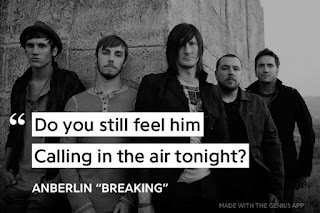
  • Anberlin’s second single from New Surrender,  originally titled “Bitter Sweet Memory” treads familiar territory for the band: the emo break-up song. Their major label debut refined, perhaps over-produced, the sound that they had been curating since their sophomore record Never Take Friendship Personal. “Breaking” was overshadowed by the sleeper success of “Feel Good Drag,” which at the time, was the longest a single had ever taken to top the Alternative Radio charts. Aside from hearing it on Christian radio and a McDonald’s, I never heard “Breaking” on Alternative radio. The music video for the song was also canceled, and the label went on to promote the non-album track, a cover of New Order’s “True Faith” as the band’s follow up. “True Faith,” also didn’t do well on the radio, but the band would score another top 5 hit with “Impossible.”


    YOU MAKE BREAKING HEARTS LOOK SO EASY. In 2010 I decided not to go to Cornerstone simply because Anberlin wasn’t playing. They were, however, set to perform at Ichthus, a Christian festival in Kentucky. A couple of friends who liked Anberlin and some of the other bands decided to go to that festival instead. We found that Ichthus was a far more sanitized version of Cornerstone. While many of the bands played both festivals, the main stages at both events were quite different. Ichthus’s main stage was all about the who’s who of CCM, whereas Cornerstone was about the more alternative and edgier groups. The atmosphere seemed to be more church camps and less about music enthusiasts. At both festivals, you might find drugs, but for completely different reasons. At Cornerstone, while against the rules of the festival, you might have the Christian hippie crowd who were “liberated.” At Ichthus, you might have rebellious campers. At Ichthus, there were side stages with the heavier bands, but the shows were less intimate than the tents at Cornerstone. Maybe one of the worst parts of the festival was the evening Christian film festival, with terrible comedies that people just laughed to be polite. On Saturday night, we had endured the sweaty, dusty festival only to find out that Anberlin had canceled the show. They said their bus had broken down. To me, it was like karma for when Anberlin had replaced Relient K as headliner at Cornerstone. But one person said of this situation, “You make breaking hearts look so easy.”

    A MACHINE WHERE YOUR HEART ONCE WAS, SLOWLY TAKES THE PLACE OF YOU. It’s easy to be a critic. I believe that New Surrender could have had a better track listing. Maybe some of the songs could have kept some of the obscure titles. Maybe it should have been cut for length. There are many other things I could say about this record, but the fact is, I couldn’t have made it. Sometimes there are albums I don’t enjoy, but the same is true: who am I to judge? Some days work feels like an egomaniacal Collin Mochrie playing the role of director in a ridiculous Whose Line Is It Anywaysketch. No matter how you do it, it’s never right. But as discouraging as those days at work are, fortunately the micromanagers get tired. I also have to remember why I got into education in the first place. I wanted to do my best to be encouraging to my students, giving them positive feedback to make the criticism easier to swallow. I have to think about that when I take my red pen to an both essays which shows me an area that I need to explain and to the student who didn’t listen to the instructions. Breaking is easy. We can always see something that doesn’t make the mark. But I want to be a builder. But I must say: I’m finding less and less time for the demolition crew.
     

  • Netflix’s Song Exploder tells the story of the first single from The Killers‘ second album, Sam’s TownToward the end of touring for their debut record, Hot FussThe Killers started work on their second recordThe band changed their musical direction slightly for Sam’s Town, incorporating influences of Americana into their New Wave sound. Taking musical and lyrical influence from the Asbury Park superstar, Bruce Springsteen, The Killers set out to tell the stories about the West and Las Vegas, a town they call home. From the opening guitar riff, inspired by the feeling of driving in the desert, to the spiritual conations in the lyrics, “When You Were Young” is an early track that shows the themes of the band in more recent years.


    WAITING ON SOME BEAUTIFUL BOY TO SAVE YOU FROM YOUR OLD WAYS. I mostly skipped over The Killers’ sophomore release, Sam’s Town. Critics and fans, too, were mixed on the album. The band who had named themselves after a fictional band from a 2001 New Order music video and whose lead singer channeled The Cure‘s Robert Smith, The Killers’ first album, Hot Fuss was steeped in New Wave, ’80s Brit-pop influences. However, their follow-up was more influenced by Southwest Americana, Bruce Springsteen, and U2 than New Wave acts. In college, I revisited Hot Fuss and their B-Sides, Sawdust and I listened to their newly released third record, Day & Agebut Sam’s Town was too “Mr. Brightside” and not enough “Jenny Was a Friend of Mine.” The exceptions are “For Reasons Unknown” and today’s song, “When You Were Young.” Lead singer Brandon Flowers explains the lyrics of this song, saying, “A savior can come in different forms” and that the song is really him as a 24-year-old writing about “the man that I wanted to become.” A man who “doesn’t look a thing like Jesus, but talks like a gentleman.”

    YOU SIT THERE IN YOUR HEARTACHE.  The expectations about your life when you are young and the reality of who you are when you grow up are usually vastly different. I know if high school me could see who I am now, I’d probably be shocked and a little horrified. I’m happy with who I am now, and I’m thankful for the baby steps I took to improve my life. But we don’t magically grow up. It’s a series of steps, negotiations, decisions, compromises, and people who get us where we are going. On certain occasions, we look back at those steps. For me, 2014 was a pivotal year. When I came to Korea, I threw myself into being a Christian teacher. I came to Korea to shine the light of the gospel. However, the longer I worked for an institution owned by the church, I started to realize little by little that my piety was being used mostly to promote the institution. And more and more sacrifice was required “to keep the lights on.” The church connected to the private institute I worked for was dying. There was talk of the glory days in the early 2000s when students would enter the academy and get baptized and join the church. Now (2014) students only came to learn English. My team had had some success with the religious programs, attracting students, but when we got tired and didn’t promote the snot out of the programs and students didn’t come, the church members would call into question our faithfulness. The extra programs were on top of a 30-40-hour week of insane 7am-10pm hours, by the way. What was the final straw for me was when I had a disagreement with the director who kept admitting students throughout the term and expecting us to pass the students who had only attended for 2 days when it was clearly against corporate policy. I realized that it didn’t matter how much I sacrificed for the messed up church-company, it would never be enough. I became disillusioned with the religion I had devoted to myself when I was young. I had thrown myself into my job and my religion, and I never felt more used. I resolved to invest in myself from that point on. 


  • As the music industry changes, many vestiges from when pop music was based on radio mono-culture don’t make sense anymore. Still, every pop critic feels the need to discuss “The Song of the Summer,” a made-up title given to often a high-energy pop song that usually peaks in popularity during the summer months. Billboard started tracking the song of the summer from 2010, naming Katy Perry and Snoop Dogg’s “California Gurls” for that year and retroactively dubbing a hit from each proceeding year until 1985. Later, they went back to 1975 and even listed the top tens from every summer since the chart’s inception in 1958.

    YOU DON’T EVEN KNOW MY NAME. “California Gurls” made sense as a song of summer. It was about sex on the beach, girls in bikinis, and all things summer. “Call Me Maybe,” “Despecito,” and “Old Town Road” were all listed as songs of the summer for the year they peaked in popularity. Psy’s “Gangnam Style” wasn’t a contender because it didn’t chart because Billboard hadn’t accounted for YouTube views at the time of the song’s peak popularity; however, many non-Billboard critics threw that song in as a contender for song of the summer of 2012. YouTube and streaming were the beginning of the breakdown of monoculture. Perhaps the pandemic was the other blow to musical monoculture, as we can see in the divide between pop and country displayed on the chart this year. But we’re getting ahead of ourselves. In 2021, Billboard named “good 4 u,” Olivia Rodrigo’s teen angst-ridden pop-punk track as the song of the summer. No longer did the song of the summer have to be light and carefree. Last year’s song of the summer, “As It Was” is one in which Harry Styles fails to mask his anxieties under a retro ‘80s tune.

    SOMETHING ODD ABOUT YOU. Billboard’s 2023 “Song of the Summer” chart wrapped up last week with Morgan Wallen’s “Last Night” topping the chart and Luke Combs’ cover of Tracy Chapman’s “Fast Car” as the second biggest song. Pop critics have called these two songs “sleepers,” as they aren’t particularly summery or even memorable. This has led the critics at Switched on Pop, The New York TimesPopcast, and others to craft their own lists and propose an alternate “Song of the Summer.” Some songs listed this year have been Taylor Swift’s “Cruel Summer”;  Dua Lipa’s “Dance the Night Away” or Billie Eilish’s “What Was I Made For?” both from the Barbie soundtrack–one news outlet even declared the Ryan Gosling-lead “Just Ken” as the song of summer; Jung Kook’s “Seven”;  and even New Jeans’ “Super Shy.” Today’s song was released in February. It’s a simple song that’s very “back to school,” which was released just in time for the new school year in March. Maybe “Super Shy” isn’t the song of the summer by Billboard metrics, but from the Powerpuff Girls artwork collaboration to the driving rhythm, critics are loving the song. It’s bubblegum pop at a time when the pop charts would rather focus on racist-coded country songs. It’s a song for the kids when Country would much rather focus on the same narrative of getting drunk and taking back the nation. “Super Shy” may not be as deep as a Taylor Swift track, but it encapsulates the emotion of falling for someone, taking listeners back to their own awkward adolescence, trying to develop the moxie to talk to that special person. 


  • After pursuing a music career together as founding members of NEEDTOBREATHE beginning in 2001, guitarist Nathaniel Bryant “Bo” Rinehart departed from his band. The band’s biggest hit, “Brother,” dealt with the tension of being family members in a band and their follow record, H A R D L O V E  furthered that theme. In 2020, the band released Out of Body, their first record without Bo. Replacing Bo on the record was future band member Tyler Burkum, a working Nashville musician who first cut his teeth in the ’90s Christian Rock band Audio Adrenaline and had been a part of bands such as Leagues and a touring musician for Mat Kearney


    I WANNA HEAR YOUR VOICE IN THE WIND AND RAIN.  Today, we’re loading up our iPods and heading back to school. The tracks included are some new and old tracks that deal with elementary, middle, high school, or college. These songs are for study and play. Enjoy!


  • Fall makes me revisit songs from my childhood. There’s something about hearing the electronic drums and the acoustic guitar of a ’90s pop rock song that put me in Pumpkin Spice mood. Maybe that’s just me. But today, I started to collect all of the gutter flowers from the ’90s, ’00s, and beyond to make a Autumn mix. Of course, we’re playing by the rules of one song per artist. Sometimes lyrics count toward the Autumn mood, but it’s mostly vibes here. Enjoy!


  • Years ago, I was singing karaoke and my friend started giggling. I was singing “Lost Stars” by Adam Levine and the line “Yesterday I saw a lion kiss a deer” got this friend rolling on the dirty 노래방 floor. Admittedly, it’s a funny line for a pop song. And besides colorful Taylor Swift revenge lyrics, pop music has been mostly scrubbed of quirkiness by the late ‘10s. Back in the ‘90s and even into the ‘00s, the pop charts were littered with head-scratching lines. However, that eye-rolling line in Begin Again wasn’t written by Levine or co-star Keira Knightly. That line came from the lead singer of a one-hit wonder in the ‘90s, Gregg Alexander or New Radicals

    FOUR A.M., WE RAN A MIRACLE MILE. New Radicals broke up the year after releasing their debut record, Maybe You’ve Been Brainwashed Too. The album contained two singles, “You Get What You Give” and “Someday We’ll Know.” Musically, the two hits sound like typical ‘90s pop rock. Listeners can mistake the band for The Verve or even R.E.M. The non-hit tracks on the record feel less refined and may be better identifiers of the band. However, it’s probably the lyrics of the band that stick out in ‘90s nostalgia. To get a hit, Gregg Alexander wrote about pressing issues of the late ‘90s in “You Get What You Give,” including cloning, population growth, Y2K, consumerism and wealth disparity; and celebrity gossip. The result is one of the least coherent songs of the ‘90s. He mentions many issues without ever developing the thought as a theme in the song. Then almost at the end of the meandering 5-minute track, Alexander adds a bridge name-dropping some of the biggest musicians of the late ’90s–Beck, Hanson, Courtney Love, and Marylin Manson.  

    FAKE COMPUTER CRASHES DINING. Gregg Alexander claimed that he wrote the name-dropping bridge of “You Get What You Give” to test whether the media would look at the societal issues mentioned in the song or focus on interpreting why the celebrities were mentioned in the song. Even though the speaker of “You Get What You Give” calls the celebrities listed as “fake” and that he will “kick [their] ass[es] in,” Alexander claimed to have no personal issue with the celebrities. Alexander even apologized to Beck. Marylin Manson, however, threatened to “kick [Alexander’s] skull in” if he ever met him. He was upset not that “he said he’d kick my ass. I just don’t want to be used in the same sentence as Courtney Love.” The celebrity chatter in the song may have made the song number 1 in Canada and a top 40 hit in America. The band’s follow-up single, “Someday We’ll Know,” was also played on the radio. The quirky lyrics of that song certainly bring back to mind the “Lion kiss[ing] a deer” of Alexander’s later career. But those Begin Again lyrical elements are certainly present in today’s song.