• Since Larry Norman asked in 1972, “Why Should the Devil Have All the Good Music?” Christian music was taking shape into what would eventually become a multi-million dollar industry.  A big part of the industry became the testimony of the bands and artists who participated in the genre. The Christian musician was a poster child of what the evangelical message taught. The mostly clean-cut musicians didn’t smoke, drink, or use bad language. Because CCM doesn’t have a particular denomination, a Christian star neededn’t talk about belonging to a certain faith tradition–the less specific, the better. Inevitably, scandals befell the industry, but musicians would disappear from radio rather than having the scandal addressed. This created a kind of idolatry surrounding the faithful in the industry.

    CASTING A SHADOW TEN FEET TALL. Tooth & Nail Records was always on the rougher end of Christian music, but the bands signed to the label were to a lesser extent, subject to morality policing. In 2017, Aaron Sprinkle released his final record with Tooth & Nail Records, Real Life before becoming a fully independent artist. The singer has talked about his journey into deconstruction on many podcasts, but perhaps most succinctly on the Growing Up Christian podcast. He talks about the results of the 2016 presidential election being the reason for him no longer attending church after so many evangelicals voted for Donald Trump and justified their vote as the Christian thing to do, and this created a church environment that was too different from Sprinkle’s already diverging spiritual journey. Real Life is an album written during the time of Sprinkle’s departure from church. On the Christian Rock 20 radio show, Sprinkle talked about the song “Invincible,” the album’s first track on the album. He explains that the song is about realizing that his heroes were ordinary people with flaws. Someone that the speaker thinks is bigger than any scandal suddenly becomes the center of one. And for Sprinkle’s deconstruction, this was especially true of both the mega-church pastor’s fall from grace as it was the fellow deconstructor who renounced Christianity vocally. 


    JUST WHEN YOU THOUGHT IT WAS UNDER CONTROL, IT ALL FALLS APART.  Though Aaron Sprinkle started talking about his change in beliefs only after releasing Real Life, he had been on a journey for many years. And as Sprinkle was at the center of many of the bands on Tooth & Nail Records, fans of the label and its roster wondered how many other groups were not believers.
    According to Sprinkle, many. One of the interviewers on Growing Up Christian asked Sprinkle when his studio became a safe space for bands to start talking about their beliefs and non-beliefs. Sprinkle says that it “evolved over time.” He goes on to give a few examples: “It started with gossip. Did you know that he’s not even a Christian? He’s in the band, and [the band] know[s] it, and they still let him stay in the band.” Then musicians would start to tell Aaron that they weren’t Christian. Some of the artists could play along with the Christian component of the label. Some artists had to pretend to be Christian. Others simply had to “nod their head and go along with it.” Sprinkle goes on to talk about how he had a fear of facing reality, which caused his self-destructive behavior–alcoholism being a battle that he’s come forward with. He was working to produce Christian albums by some groups who didn’t believe the message of the industry they were part of, and he was also part of that as well. It could be quite the fall from grace if deconstruction didn’t become the trend hit had in the mid-‘10s. In “Invincible,” Poema’s Elle Puckett brings grace and redemption when she sings the bridge: “You didn’t have to be invincible / You got your shadow and a place to go.”
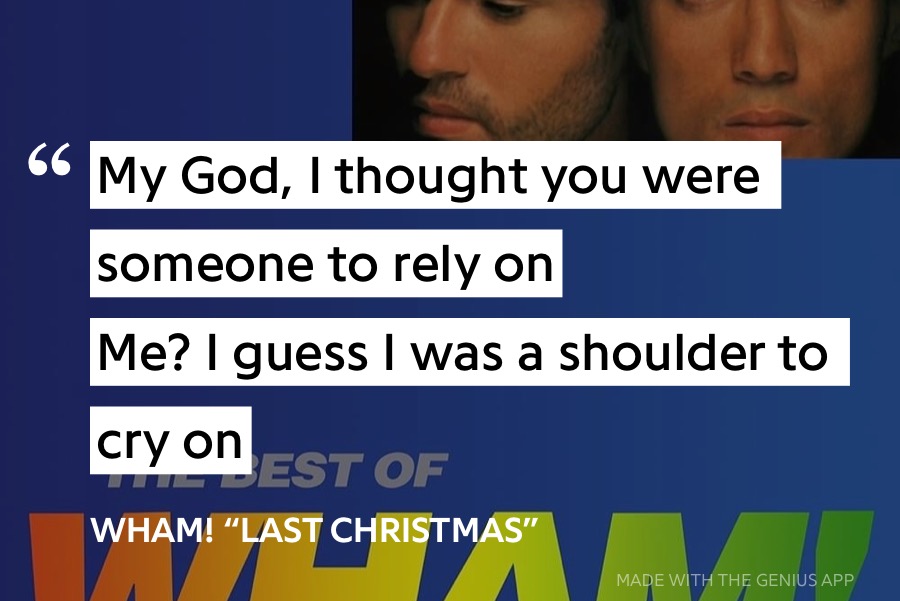

  •  Today our representative song is Wham!’s “Last Christmas.” Maybe it’s overplayed, but it’s a synth-pop classic. It’s the kind of song that gets stuck in your head for days, and it’s okay because it’s Christmastime. It’s one of the signature songs of Wham!  and one of the most played songs of Christmas. It’s been covered by many artists from Jimmy Eat World to Carly Rae Jepsen to Hawk Nelson and each cover has its merit. But today, my Christmas mix begins with the original, the band that was somewhere between cringe and critical darlings. Enjoy the mix!


    Listen to the mix on Apple Music.

  •  

    OneRepublic had finished recording their second album, Waking Up, but had two more days with the studio. But the band’s bassist/cellist Brent Kutzle told lead singer Ryan Tedder that he wanted to stay in the studio to flesh out an idea he had. That night, Kutzle wrote the band’s biggest hit from the album, “Good Life.” Waking Up’s singles paled in the shadow of OneRepublic’s first hit “Apologize,” which reached number 2 on Billboard’s Hot 100. “Good Life,” the album’s third U.S. single, reached number 8 on the Hot 100. The album’s first two singles, “All the Right Moves” and “Secrets” failed to reach the top 10.  Besides radio play, “Good Life” was played in many television shows and commercials. This upbeat song has optimistic, sincere lyrics, making it refreshing among often negative or trite optimism in pop music.


    SOMETIMES THERE’S BULLSHIT THAT DON’T WORK NOW. I remember a time in the early ‘00s when so many bands and artists on the radio were Christian or Christian-adjacent. There was a practical reason for this: young musicians could easily get in their 10,000 hours playing in churches. However, this permeation of pop culture created a dilemma for Christian radio stations. Christian radio could capitalize on bands like Lifehouse and P.O.D. The former crossed over to Christian radio, one of the first groups to do this. In 2003, Christian radio was shaken when Evanescence pulled their single “Bring Me to Life” from Christian Rock radio and their album Fallen from Christian retailers. Then in 2005, Christian radio started playing The Fray’s “How to Save a Life,” after the song became an overnight sensation due to its placement on Grey’s Anatomy. The next year, Christian radio played Daughtry’s “Home.” Despite both artists including mild profanity— hell and damn—, which was unheard of in the Christian Adult Contemporary genre before, the artists’ testimony of being raised in the church and on CCM seemed to give them an entry. But by the time OneRepublic debuted in 2007, the age of Christian crossover seemed to be over, despite the members of the band talking about their CCM influence and personal faith. Then in 2009, the band released their first explicit track, “Good Life.” This song perhaps put more separation between the band and their Christian fans. “I guess Ryan Tedder’s no longer Christian” some speculated. This was before the time of progressive Christianity and deconstruction podcasts taking the mainstream of Christianity. OneRepublic, like U2 had done in the ‘90s, made the discussion of what could be Christian music a bit murky. 

    WOKE UP IN LONDON YESTERDAY. Listening to Ryan Tedder talk about the whirlwind at the beginning of his career on the And the Writer Is podcast and how he balances his life between his different businesses and family is inspiring to me. This year has been all about building a routine in which I can balance work, exercise, writing, my personal life, and my relationship. It’s been one of the busiest years, but I’m proud of how much I was able to fit in 24 hours. But unlike Tedder’s routine, “Good Life” talks about a time when routine doesn’t work—at least routine as we tend to understand it. The song talks about touring, waking up in different cities, and meeting new people. The speaker also talks about the friends who are left behind due to the band being on the road. Tedder built his career in Los Angeles but decided to move back to Colorado to focus on his family life (pun not intended) when he wasn’t touring or writing/ producing pop stars. “Good Life” is an anthem for the busy. Even when things don’t work out, we can still say it’s going to be a good life. 


  • Time has named Taylor Swift as Person of the Year. She is the first musician to ever hold the title. The musician has certainly permeated into all facets of culture in 2023 as part of what many have called her “Imperial Phase” or maybe Imperial Era?  The biggest artists reach the “Imperial Phase” of their careers before another star rises. There is a part of the American psyche that roots for Taylor Swift–the teen star from Pennsylvania who treated her fans well to a billionaire jet-setting pop star. A big part of how Taylor won the hearts of America–and the world–has to do with fans and music lovers siding with her side of her feud with Scooter Braun. But another part of Swift’s appeal was shattering the glass ceiling which had limited female musicians in the past. Today, though, we’re not talking about Swift but rather another Era-defining musician who pioneered the idea of a female-led portion of the music industry.

    LORD, MAKE ME AN INSTRUMENT OF THY PEACE. In 1997, Sarah McLauchlin was in her “Imperial Phase.” Four years after releasing her third record, Fumbling Towards Ecstasy, McLauchlin released Surfacing. A hectic two-and-a-half-year touring cycle for Fumbling had both built her career and exhausted the singer to the point that she later claimed that she wanted to quit releasing music after her breakthrough record. But Surfacing was highly successful with its massive hits “Angel,” “Adia,” and “Building a Mystery,” which won a Grammy for Best Female Pop Vocal Performance. But McLauchlin was also building a legacy. The same year she released Surfacing, Sarah founded the all-female music festival lineup Lilith Fair. McLauchlin founded the concert because she was frustrated with radio stations and concert promoters refusing to play two female artists in a row. The tour ran for three years with a revival in 2010. The tour grossed $16 million in 1997, and in the festival’s three main years (the revival was a financial disaster) the organizers donated over $10 million to various charities. McLauchlin laid the groundwork for female musicians to take control of what they could in the music industry, and we’re still seeing the impact today.

    IT IS IN DYING THAT WE ARE BORN TO ETERNAL LIFE. Sarah McLauchlin first released her version of “Prayer of St. Francis” as a bonus track on early versions of Surfacing. Later it was included on her Rarities, B-Sides, and Other Stuff, Volume 2. Although the text of the prayer has been attributed to St. Francis of Assisi (c. 1182-1226), it’s not in any of his writings and only appeared no further back than 1912, when it appeared in a French Catholic magazine called La Clochette, or The Little Bell. The prayer gained popularity during the First and Second World Wars. It was adapted into a song in 1967 by South African songwriter, Sebastian Temple. Sinéad O’Connor performed the song at Princess Diana’s funeral in 1997. Today, we’re listening to Sarah McLauchlin’s version. The singer-songwriter has used religious imagery in many of her songs and has even performed for Pope John Paul II, she does not consider herself religious. She has said, “I don’t follow any organized religion, but I do believe in the idea of god as a verb–being love and light. And that we are part of everything as everything is a part of us.” “Prayer of St. Francis” is the prayer of a servant’s heart, and you don’t have to be religious to want to serve others. 

  • In 1958, Ross Bagdasarian experimented with tape speeds in the recording studio. He learned that if he sped up the tape, the vocal performance would sound high-pitched and would play at a faster tempo. He used the effect he had learned on a novelty single, “The Witch Doctor,” under the name David Seville. The song reached number 1 on Billboard Hot 100 and laid the groundwork for Bagdasarian’s next single, in which he used the effect more than just for a “witch doctor voice.” Ross thought that the voices of the sped-up tape sounded like chipmunks, and with some tweaking of the tempo, requiring him to sing at about half speed, he was able to make his chipmunks sing along with a human, a fictionalized manager of the mischievous rodents, David Seville. Bagdasarian founded the fictional band David Seville and the Chipmunks when he released his second single titled “The Chipmunk Song” (Christmas Don’t Be Late). The song topped the newly created Billboard Hot 100 chart and would be the first of only three Christmas songs that topped Billboard’s flagship chart. The others are Mariah Carey’s “All I Want for Christmas Is You” and Brenda Lee’s “Rockin’ Around the Christmas Tree,” which topped the chart just this week for the first time. Today, we will listen to Kacey Musgraves’ version and it will be the basis for my 2023 Christmas Mix. Hope you enjoy it!


  • Twenty One Pilots released “Level of Concern” in April 2020 in response to the early months of COVID lockdowns. The song was written and produced in quarantine and lyrically documents the uncertainty of the times in 2020. The song was the group’s fourth-biggest hit. The song was co-produced by MUTEMATH’s Paul Meany, who collaborated with the band on their previous album, Trench. The music video for the song documents the process of making the song in quarantine–sending tracks between the two bandmates Tyler Joseph and Josh Dun. The song received mostly positive reviews reviews. Entertainment Weekly called it the “first quarantine anthem.” We’re almost four years away from the unprecedented times, but the level of concern has not waned. Today, we’re returning to quarantine with a mix that would have been nice to have back then. 


  •  

    Last year, I ranked The Weeknd’s Dawn FM as my fourth-best album of the year, right behind Underoath’s Voyeurist. While I’d probably re-rank the list and add a few albums I missed like Lizzy McAlpine’s five seconds flat, I still admire my fifth and fourth-placed records. Although I ranked The Weeknd and Underoath highly last year, I didn’t listen to either artist’s album very much for similar reasons. Voyeurist was a dark album dealing with drug addiction, suicide, and hopelessness. Unlike Underoath’s Christian albums, the darkness had the reprieve of light somewhere within a song or the album. However, the post-Christian Underoath offered an album so dark that I couldn’t listen to it, especially with some of the stuff that I was going through last year. Similarly, The Weeknd’s Dawn FM was a beautifully crafted album, but it was too dark for me to enjoy for my mental state last year.

    I REMEMBER WHEN I HELD YOU. On paper, Dawn FM should have been my album of the year last year. It’s a sequel to 2020’s After Hours, and both records work with the concept of a lonely addict who is chasing a high yet always feels empty, taking greater hits that bring him closer to the edge of his life. Dawn FM is a concept record about the end of life–a purgatory-like state in which the protagonist has overdosed and is awaiting his fate, though it seems there is still hope that he could be revived if someone finds him. As he awaits his fate, the protagonist is listening to Dawn FM, a light-rock station hosted by a soothing voice. The DJ is played by actor Jim Carrey, who is Abel Tesfaye’s real-life neighbor. The songs on Dawn FM are very good, but perhaps not as memorable as The Weeknd’s mega hits or the songs on the preceding album. Dawn FM’s format is sometimes New Wave sometimes disco-flavored R&B. Like “Blinding Lights,” The Weeknd and producer Max Martin make a believable late ‘80s/early ‘90s album on Dawn FM.

    IF HE MESS UP JUST A LITTLE, BABY YOU KNOW MY LINE. It’s the subject matter that permeates through The Weeknd’s lyrics and is reinforced by the radio DJ (Jim Carrey), making Dawn FM an album that I don’t want to return to very often. Maybe it’s an album that feels better as a string of decontextualized singles because contextualized brings existential dread. But if we could just listen to today’s song, “Out of Time” without the reminder from the DJ that the protagonist is out of time and reminding us that our time too is running out, it’s a nice song that you could enjoy when shopping for groceries. That grocery-store flute sound comes from a sample from a 1983 Japanese song by Tomoko Aran, “Midnight Rider.” The music video for the song co-stars South Korean model/actress HoYeon Jung (정호연) best known for her breakthrough role on Squid Game. The video features Abel and HoYeon singing karaoke and was inspired by the Sofia Coppola film Lost in Translation. It’s a nice song but as it ends, Jim Carrey reminds the protagonist that he is thirty minutes away from his fate, but warns the listener “Don’t you dare touch that dial.” It’s a radio trope that feels threatening given the atmosphere of the album. Hopefully, none of my readers are thirty minutes away from their destiny; however, we are all less than thirty days until the end of the year. We’re running out of time, yet we don’t know when that time is up. At least there’s good music along the way.


  • The ‘90s in rock music started quietly. Hair metal was still around, but vibey New Wave tracks had gained traction in the late ‘80s. It was an eclectic time without a clear direction for a musical style. Of course that all changed in the fall of 1991 when Nirvana burst onto the scene and Alternative and mainstream rock listeners determined that grunge would be the collective musical trend. Just as disco didn’t die in 1979, the New Romantics sound of the late ‘80s carried over into the early ‘90s. In fact, in the early ‘90s, New Order, The SmithsMorrisey, and Depeche Mode enjoyed their peak success. For Depeche Mode, that success came from a dark pop song, which crossed the Alternative Rock band over to the pop charts with the single from their seventh album Violator, “Enjoy the Silence.”

    ALL I EVER WANTED, ALL I EVER NEEDED IS HERE IN MY ARMS. Produced by the now legendary Mark Ellis, better known as Flood, Violator was years of dark electronica in the making. Flood’s first credits begin as an assistant engineer in 1981 on New Order’s first record, Movement. By 1983 he engineered Ministry’s debut With SympathyIn 1985, Flood produced two singles for the synth-pop group Erasure, whose Vince Clarke had been the lead vocalist of Depeche Mode before leaving and being replaced by Dave Gahan. Flood began working with Depeche Mode in 1985 as an engineer on several of their singles. Then in 1987, he worked as the engineer on the Brian Eno-produced U2 classic The Joshua Tree. Flood closed out the ‘80s, producing co-producing Nine Inch NailsPretty Hate Machine with Trent Reznor. After Depeche Mode’s seventh album, Flood went on to be a massive producer in the ‘90s and ‘00s, producing albums such as The Downward Spiral, U2’s Zooropa, The KillersSam’s Town, and Thirty Seconds to MarsThis Is War.

    WORDS ARE VERY UNNECESSARY.“Enjoy the Silence” reached number 8 on Billboard’s Hot 100, the highest-charting pop song of Depeche Mode. The song focuses on the unspoken rather than the explicitly stated. Like yesterday’s song, “There Is a Light That Never Goes Out,” “Enjoy the Silence” is open to multiple interpretations. What vows is the speaker speaking about? And what “is here in [his] arms”? Another similarity with yesterday’s song besides both groups’ queer-coded associations is that Anberlin also covered “Enjoy the Silence.” The band recorded a cover of songs that influenced them for their first four records, starting with The Cure’s “Lovesong” on Blueprints for the Black Market. In the recording sessions for their sophomore record, Never Take Friendship Personal, the band recorded “Enjoy the Silence” but left it off the record because they had already released a cover on their first album. Lead singer Stephen Christian said that they didn’t want to be the band that had a cover on every album. The band did end up releasing the track as part of the 2006 compilation Punk Goes ‘90s. The theme of silence appears on Anberlin’s third record, Cities on the fourth track, “A Whisper & a Clamour,” the bridge of which gives an emotional answer to the verse and the Psalm 47:1 reference: “It’s not the lies that you say, but what the silence will scream.” Of course, Anberlin covered “There Is a Light That Never Goes Out” along with the When In Rome hit “Promise” during the Cities sessions, and the band released a cover of New Order’s “True Faith” on the deluxe edition of their fourth album, New Surrender. Anberlin was an example of a band that displayed their New Romantic influences for everyone to see, but many other bands in the ‘00s emo scene cited the ‘80s melancholy rockers as influences. It took me a while to get into my favorite bands’ influences, but with more exposure to them, I might think that the original might be better in many cases. But certainly, the recording technology improved in the ‘00s.

  •  

    In 1986, The Smiths released their provocatively titled album, The Queen Is Dead. The band, led by Steven Morrisey’s dark, often dryly comedic, lyrics and Johnny Marr’s jangly guitar parts had been no strangers to controversy. The post-punk band raised in the “Madchester” sound of Manchester, England, was defined by Morrisey’s countercultural convictions. Just as The Smiths gained attention, their lead singer Morrissey became a polarizing pop-culture prophet, speaking out against British politics, advocating vegetarianism, condemning corporal punishment, and admonishing stereotypes of sexual identity. The band pushed for a vision of anti-masculine rock and a return to non-synth, guitar-driven rock to counter the rise in popularity of the signature ‘80s sound.


    TAKE ME OUT TONIGHT. The Smiths broke up in 1987 before their fourth album Strangeways, Here We Come was released. The four members of the band could no longer stand their narcissistic lead singer. Morrissey seems to be the type of contrarian who has no concern for how he is perceived by other people. Fiercely private, his personal life has been the speculation of the press and biographers. In 2013, though, he roped off a few sections of his highly guarded private life and offered a guided tour in his Autobiography, giving greater detail to when The Smiths were together and the royalty battles that ensued following their break up. Despite Morrisey’s public persona, his solo career and lyrics from his time in The Smiths are a kind of Rorschach Test for a diverse fan base. Morrisey famously had an extended period of his life in which he claimed to be celibate. He also claimed to be a “lapsed Catholic.” He criticized popular music focusing too much on sex, yet insisted on using a homoerotic photograph on the band’s debut self-titled album. However you classify Morrisey if you dare—perhaps a sexually-confused spiritual social activist—the singer’s lyrics are prophetic for fans who hold some to all of Morrisey’s convictions. 


    THE PLEASURE, THE PRIVILEGE IS MINE. By The Smith’s third album, The Queen Is Dead, the band had eased up on the guitar-driven sound, allowing keyboards and even the flute on “There Is a Light That Never Goes Out.” It’s the song I first heard from The Smiths thanks to Anberlin covering the song on their deluxe edition of Cities. I had probably heard the song before I heard Anberlin’s cover. Anberlin is an example of The Smith’s Rorschach Test. Lead singer Stephen Christian has listed Morrisey as one of his greatest musical influences, which is a contradiction that makes perfect sense. Like The Smiths, Anberlin was part of a non-masculine Emo rock movement. And like Morrissey, though to a much lesser extent, Stephen Christian’s recent conservative leanings in the Contemporary Christian industry seem to contradict the social activism of the band’s early days. Today’s song, “There Is a Light That Never Goes Out” is another Rorschach Test: it’s a song about _____. Is it about: 

    1. Nightlife in London

    2. Being in love

    3. Suicidal ideations

    4. Heaven

    5. Satirizing (English) society or politics

    6. Something else

    7. All of the above

    8. Some of the above

    9. None of the above

    Is it depressing or optimistic? And what is that light that never goes out and why does it suddenly appear at the end of the song? 

    Read the lyrics on Genius.

  •  

    Years ago, I started listening to the 2004 compilation, Frank Sinatra‘s The Christmas Collection. I still can’t tell you Ol’ Blue Eyes’ signature Christmas songs because so many of Sinatra’s generation of singers covered each other’s songs. Besides the amount of songs I knew in the collection, I also noticed that there were several tracks that I had never heard before. I’m always looking for a hidden chestnut— a Christmas track that has been overlooked, waiting to be repackaged for a new generation of Christmas music listeners. We are certainly getting sick of the same hundred-something songs played over and over by different recording artists. 


    THE CHRISTMAS TIME WHEN I WAS YOUNG. When I heard “A Baby Just Like You,” though, I thought it was one of the worst Christmas songs and the worst Sinatra song I had ever heard. But as I listened to the album over and over, the song started to become a “so bad it’s good” song, which made me consider writing about it last year. It turns out that the song is actually a lot more interesting than it is classic. “A Baby Just Like You” was written and first performed by John Denver on his 1975 Christmas album, Rocky Mountain Christmas. The album was released during the height of the singer-songwriter’s fame. Denver penned the song “A Baby Just Like You” for his adopted son, Zachary. Shortly after Denver released the song, “the king of the holidays” released his own version of the song. Over the course of his career, Frank Sinatra released four Christmas albums between 1948 and 1968. In December 1975, he released two holiday singles, “A Baby Just Like You” and “Christmas Memories.” John Denver had released his Christmas album Rocky Mountain Christmas in September of that year. 

    YOU’VE SET MY SOUL TO DREAMING. “A Baby Just Like You” was later released on a novelty album with The Muppets, the 1979 album A Christmas Together, one of several collaborations between John Denver and Jim Henson. I’m pretty sure that I had some awareness of this album, which is a mix of holiday classics peppered with a few originals.  “A Baby Just Like You” is the only song without the cute, furry voices provided by Jim Henson, Frank Oz, and friends. Most of the songs on the John Denver/Muppets album are comical or use comedic devices, with Denver singing somewhat serious. As a novelty album, A Christmas Together fails to be remembered except for maybe kids who connected with it in 1979. What we end up with is a lackluster failure to commit to comedy or musicality, which feels strange over 45 years later. We’ve come to expect the weirder of artists—from David Bowie to Lady Gaga to make avant-garde collaborations, and a Muppet connection is not surprising. And while John Denver did do comedy, he’s not weird enough of an artist to make a classic Muppets record, and yet he did. But then I think about all of the serious acts that performed on The Muppet Show. The most memorable performances were when the singers let the Muppets get carried away, but that didn’t lead to Muppet albums to my memory. But again, that seems like a different time that doesn’t translate to what would work today. 

    Read the lyrics on Genius.