• Back in 2010, we learned that yes, a pickle can get more likes than Nickelback, a band that had become the most hated “butt rock” band in the mid-’00s. In fact, the conclusions of the social media study found that a pickle had more likes than Oprah Winfrey or other beloved figures. It turns out that internet users’ hate outweighs Internet love, or the terrible outweighs the good. In 2014, the most hated rock band would become U2 after their release of Songs of Innocence was forced into every iTunes user’s library. People tried everything to scrub the songs from their shuffle. Today, people have mostly forgotten about Nickelback, and Apple Music no longer comes standard with that U2 album, so people have other musical axes to grind. Justin Bieber has grown up and is no longer blaring in our cultural continuousness. So who is the most hated band these days? After the 2019 Super Bowl, Maroon 5, for taking to the stage when the NFL was in the middle of racial controversy around Colin Kaepernick’s taking a knee during the National Anthem, and many other musical acts refused to play that year. Or is it the “rock groups” who take the name of rock ‘n’ roll in vain? Imagine Dragons or Coldplay, who has garnered a lot of hate due to their pop sound and supposed generic sound?  

    THIS JOY IS ELECTRIC. “There’s not much to hate about Coldplay. But every time I hear one of their songs I kind of don’t realize I’m listening to anything,” my coworker once said. Many listeners have also come to this conclusion. In the video “Where Coldplay Went Wrong,” critic Frank Furtado, of the YouTube channel Middle 8, argues that Coldplay is the commercialized version of more talented, authentic bands more hidden in the scene. He also argues that lead vocalist Chris Martin’s avoidance of personal details in his lyrics makes their songs mediocre at best. Finally, he argues that by singing Viva La Vida, Or Death and All His Friendsthe band has been virtually producing the same record over and over again, watering down their lyrical and musical depth in the process with the exception of 2019’s Everyday LifeOne thing Furtado doesn’t talk about, though, is the danger of working with the same producers’ album after album. Perhaps Coldplay’s relationship with producers Brian Eno and Rik Simpson is to blame. Essentially, Coldplay is using the same ingredients and mixing them differently. 

    GOT ME SINGIN’ EVERY SECOND, DANCIN’ EVERY HOUR. Still, I admire Coldplay for their use of the recording studio as a musical instrument. Bigger than Coldplay is the production of Brian Eno, the producer who created three of U2’s most iconic albums The Joshua Tree, Achtung Babyand All That You Can’t Leave Behind,  worked with GenesisDevoToto, and David Bowie, and scored The Lovely Bonesthe soundtrack making the movie watchable. But for their latest single, Coldplay turns to a producer with a  “Higher Power,” Max Martin, the producer, who at the time, had the second most Hot 100 number 1 hits under his belt, second to The Beatles’ 
    producer George Martin. Starting with Ace of Base in the early ’90s and then writing and producing for the Backstreet Boys, Martin would score his first number-one hit with Britney Spears in 1998 and then again with “It’s Gonna Be May,” I meant, “It’s Gonna Be Me” for *NSYNC. He cultivated Katy Perry to become a hit producer, then took P!nk to the top of the charts. He replaced the banjos for EDM with Taylor Swift taking her from the top of the country charts to the top of the pop charts. He introduced the pop charts to dark R&B singer The Weeknd. However, Martin’s production doesn’t always mean success these days. Carly Rae Jepsen‘s Max Martin production on E-MO-TION and Dedicated and Jennifer Lopez‘s “First Love” were minor hits. “Higher Power” was a moderate comeback hit for Coldplay, but it was the other Max Martin track featuring BTS, “My Universe” that would take Coldplay to the top of the charts again.  
    Performance Video:

    Official Dance Video:
    Official Music Video:
  •  

    In 2021 Girls5eva premiered on Peacock. The premise of the show was a ridiculous one-hit-wonder girl group from the early ‘00s gets sampled by an up-and-coming rapper, Lil Stinker, which causes the disbanded Girls5eva to reunite for their now middle-aged fans. The show; created by the writer and co-producer of The Unbreakable Kimmy Schmidt Meredith Scardino, and comedy mogel Tina Fey; reexamines fictionalized relics of the new millennium in the light of the ‘20s cultural climate. In the show’s first season, the remaining members of Girls5eva–ironical the group is now four members after singer Ashley died in an infinity pool accident–reconcile the problematic lyrics of their early songs. For a one-hit-wonders, it turns out they had many songs and videos, which are revealed over the show’s now three seasons. 


    A LOVE THAT’S ARTIFICIAL, BUT HIS WALLET MAKES US HAPPY. In the second season of Girls5eva,  the group writes new material and tries to break back into cultural relevance. Showrunner and songwriter Sara Bareilles plays Dawn, who takes on the role of the primary songwriter for the group. The group almost achieves a true second wave, but stalls when it comes to their US tour in season 3. Each season explores the balance of recognizing and appreciating the past while moving in a new direction. It’s about creating art, even if that art is just joke songs about female empowerment or overcoming arthritis. But no matter how Dawn, Wickie (Renée Elise Goldsberry), Summer (Busy Philipps), and Gloria (Paula Pell) try to move in a new direction fans always pull them back to the old days. Today’s song, “Sweet’N Low Daddy” is an example of the girls pulled into the past. In the fourth episode of Season 3, “Orlando,” the girls have been whisked off to play a private birthday party for an extremely wealthy woman who has married an elderly man.


    NEVER HAVE TO MEET HIS PARENTS ‘CAUSE THEY DIED DURING NIXON. Most of the episodes of the third season of Girls5eva sees the girls playing their new songs. But the van tour across America wasn’t paying the bills. Wealthy and nostalgic Taffy England (Catherine Cohen) assembles some of the biggest *fictional* stars from the turn of the millennium to celebrate her birthday party. The gig is supposed to be a pretty straightforward money grab until Dawn starts to feel guilt for the lyrics of the song Taffy wants the group to perform, “Sweet’N Low Daddy,” a song the group had performed for a fictional soundtrack. Dawn fears that the song influenced Taffy’s life choices–marrying a wealthy man and waiting for him to die so that she can inherit his assets. In the end, Dawn ends up refusing to perform but offers her spot to Taffy to sing with the rest of the group. In the end, while watching the group on stage, Dawn realizes that even though she thinks of the song as problematic, Taffy just loves the song and her marriage to her geriatric husband is incidental. The episode does bring up the question of how much responsibility an artist should take for a worldview that has shifted since the piece’s release. It reminds me of James 3:1 which talks about how teachers will be judged harder. And those words could keep anyone from creating. But artists, and teachers, feel compelled to share what they know. I guess we all just have to be ready for an apology tour.

  • I talked about yesterday how Beenzino started my appreciation for Korean Hip-Hop. That appreciation turned into a love for the genre in 2016 when I joined a Korean gym, and it was mostly because of the winner of the fifth season of the massive reality program in South Korea called Show Me the Money, BewhY (비와이). By 2016, South Korea was fully in the middle of peak Hip-Hop culture. My students weren’t listening to Idol music but knew all the words to the rappers who were on Mnet’s Show Me the Money series. I found it kind of funny how the show censored Korean profanity while English f-bombs were allowed to be broadcasted! In the midst of the profanity storm that came with Korean Hip-Hop (no judgment intended), devout Christian BewhY’s rap career started.


    I’M SO INDEPENDENT. Lee Byeong Yoon (이병윤) is a charismatic performer. Some music critics have compared his melodic rapping to Drake, but when I heard him, I’d never heard anything like it. Much of BewhY’s sound comes from famed Korean Hip-Hop producer Gray. BewhY’s songs don’t follow a particular song formula. Rather than verses and chorus, intros and outros, and bridges that connect most song hooks together, BewhY’s songs are more about ebbs and flows of energetic bursts. Tempos and tunes change in a way that I can only describe as a scene change in musical theater or opera. BewhY’s music uses funk bass and often takes jazz and classical samples. Often his songs lack a chorus, which makes his music seem like it wouldn’t work commercially, yet the hooks laid throughout the songs keep listeners guessing. And driving these interesting compositions is BewhY who raps with passion and conviction, almost desperation to make his point. To English speakers, though, the message filters through only in the selected English words.  


    MY FAITH AND EGO HAVE DEFINITELY GOTTEN STRONGER. BewhY has been outspoken about his Christian faith from the beginning of his career. He told The Korea Times in 2016 that he does not use “slanderous” or “blasphemous” lyrics in his songs. Some of BewhY’s music has been described as Christian Hip-Hop, particularly songs like “David,” “Neo Christian Flow,” and “In Trinity,” just to name a few. Unlike the Christian music scene in America, though, BewhY’s lyrics use profanity and bear “explicit” labels. Last year I looked at Zior Park’s “Christian,” which seems to be a parody of Christian morality culture. And while BewhY seems to be far from hedonistic in his somewhat private life, the virtues he raps about in some of his songs, unironically, seem to represent a materialistic Christianity inline with Hip-Hop’s culture of showing off money. Songs about his Christian faith come across as arrogant, as if his faith declaration makes him a spiritual patriarch in the pluralistic country of South Korea. So my experience of listening to BewhY has changed. I can feel his passion; I love the music and it motivates me to feel a similar conviction the artist feels. But the underlying message, when I read the translations, makes me a little sad. It’s something that I don’t understand having read the words of Jesus and his message against the love of money. It’s something I don’t understand after reading about Peter and his betrayal. It’s something I don’t understand as a kid growing up equating self-esteem with arrogance and doing the work to see my self-worth. 


    Read the Korean lyrics on Genius.

    Read the English translation on musixmatch.


  • South Korean rapper Beenzino (빈지노), not to be confused with American rapper Benzino, began his career by posting his songs on the Korean Hip-Hop community site DC Tribe in 2010. Rapper Simon Dominic discovered Beenzino on the website and eventually, Beenzino started getting more exposure through rap festival performances in South Korea. Beenzino performed with two hip-hop duos, Jazzyfact and Hotclip as well as garnering features on songs by Verbal Jint, Epik High, Dok2, and other Korean Hip-Hop artists as the genre was entering a burgeoning success in the 2010s. Along with producer Shimmy Twice, Beenzino released Lifes Like in 2010 with Jazzyfact. The next year, the duo released the single “Always Awake” before taking a hiatus until their 2017 EP, Waves Like.


    WHEN THE CITY OF SEOUL SLEEPS. Following his collaborative effort in Jazzyfact, Beenzino signed with 1llionare Records, a small but powerful Hip-Hop label in South Korea. Founded by rappers Dok2 and The Quiett, the label helped to launch the careers of several rappers and made Korean rappers household names in the country. While his Hip-Hop career was beginning, Lim Seong Bin (임성빈), or Beenzino, was studying sculpture at Seoul National University, Korea’s top university.  In 2014, Beenzino released 2 4: 2 6, his debut solo EP. Beenzino collaborates with many rappers in the scene on his debut EP, but the record stood out to critics because of the album’s beats and jazz samples.  As a bonus track, Beenzino included “Always Awake,” Jazzyfact’s 2011 single.  The Latin jazz-influenced “Aqua Man” later became a Korean Hip-Hop standard. However, Beenzino’s breakthrough into commercial acceptance would be in 2013 with the single “Dali Van Picasso” from his 2014 follow-up EP Up All Night


    I GOTTA LIVE MY LIFE NOW, NOT LATER. Beenzino was not only one of the first Korean rappers I liked but also one of the first Korean artists I started listening to. Granted, by listening it was mostly a few songs. “Dali Van Picasso” was a new song when I was in my second year of teaching in Chuncheon. There was a cafe across the street from the institute run by a lanky guy, I’d guess about 30 who ran the cafe with his “mommy.” He didn’t speak much English. I must have had everything on the menu, but every week, maybe up to three times a week when I wasn’t eating at the cheap kimbap on the other side of the street before the owner got a bad cough and I got worried that what she had was contagious. Chicken carbonara with a latte. I loved the music in the shop, late ‘90s pop-rock and recent K-pop. I loved “Dali Van Picasso” because it was a smooth jazz hip-hop piece about painters. I remember “Aqua Man” as a song that they played in my gym a few years later, and I don’t remember the first time I heard “Always Awake.” All of these three tracks have a rhythmic smooth jazz sound that seems like early ‘80s Hip Hop when the genre started by sampling jazz records. Beenzino’s biggest tracks aren’t aggressive. They’re smooth and dreamy without being sleepy. Before Beenzino, I never thought coffee shop Hip-Hop could be a thing. And, to be fair, many of his songs violate my rules about profanity on playlists for the public. But Beenzino was exactly the rapper I needed to fill a nichè I never knew about. 


    English translation:


  • TOMORROW X TOGETHER, or TXT called by their fans, were the first group from Korea to headline Lollapalooza. The x is pronounced as “by” so the band is called “Tomorrow by Together.” The group has been one of the biggest K-Pop boy bands since their debut in 2019. Signed to Big Hit Entertainment, home of BTS and the first boy band signed to the label since the Bangtan Boys, TXT debuted five years after their label mates. The lyrics of today’s song, “Lo$er=Lo🩷er” touch on the bleak state of Millennials and Gen. Z, especially due to financial status; however, TOMORROW X TOGETHER’s music is optimistic. The band’s motto as it appears on their website is: “Come together  under one dream in hopes of building a better tomorrow.” 

  • It seems like a lifetime ago when the United States was enraptured in a gaslighting, dogmatic, and ultimately illogical argument that only heterosexual couples could marry. Even before the U.S. Supreme Court delivered the decision in Obergefell v. Hodges that same-sex couples had a fundamental right under the protection of the U.S. Constitution to marry and receive the same benefits as heterosexual couples, the opposition to gay marriage was thinly veiled homophobic stereotyping and appeals to Christian values. But reversing centuries of homophobic biases to gain both popular and judicial support for marriage equality was a feat of activism, which often traces its roots back to the late ‘70s and the short-lived political career of Harvey Milk. However, marriage equality was unimaginable to the so-called “Mayor of Castro Street” as it was incongruent with the polyamorous sexual preferences of the fifth district member of San Francisco’s Board of Supervisors.

    I CAN’T CHANGE. In 2012, Macklemore & Ryan Lewis released their debut album, The Heist, which featured several big radio singles, including two Billboard Hot 100 hits: “Thrift Shop” and “Can’t Hold Us.” The duo’s third single, “Same Love,” reached number 11. A gospel-flavored piano plays as Benjamin Haggerty, known as Macklemore, begins a testimony. Unlike the party tones of the previous singles, in “Same Love,” Macklemore confesses his childhood fears that he might be gay, due to his tendencies toward neatness and the arts because he wasn’t like the other boys. Growing up as an Irish Catholic in the liberal city of Seattle, Haggerty eventually realized that he was straight. The rapper grew up with many gay role models, including four gay uncles, though he only mentions one in the song. Producer Ryan Lewis also had a gay uncle. Macklemore wanted to write an empathetic song to move his listeners. His original first verse was inspired by a thirteen-year-old boy’s suicide letter, who killed himself because of his sexual identity. 

    NO CRYING ON SUNDAYS. Macklemore & Ryan Lewis wanted to call out the homophobia in Hip-Hop, religion, and society. Rather than rapping, Macklemore preaches to his congregation. Fellow Seatle-based singer-songwriter Mary Lambert sings the hymn-like chorus.  The chorus is a personal testimony by a queer artist, expressing her truth. While Macklemore’s rhymes and reasons come from a self-identifying heterosexual cis-gendered man who is making logical and emotional arguments for society’s acceptance of homosexuality and gay marriage, Lambert offers her voice as one who claims that she is unable to change her sexual identity, rather she fully accepts herself. She talks about her love who “keeps [her] warm.” While Lambert was singing from outside of the hip-hop community, her music career began in the evangelical Mars Hill mega-church. The infamously toxic community at Mars Hill was homophobic and misogynistic, and as Lambert embraced herself, she left the community. Lambert has had a successful musical career outside of her collaboration with Macklemore & Ryan Lewis, even adapting the chorus of “Same Love” into “She Keeps Me Warm” on her 2013 EP, Welcome to the Age of My Body. “Same Love” was the first-charting song on Billboard’s Hot 100 that talked about marriage equality. The song along with its music video, directly supported a referendum that would allow marriage equality in the state of Washington. Minds were starting to change in 2012. Homosexuality was no longer a special issue on a late-night ‘80s sitcom, but becoming a central issue. It was making less and less sense that only straight couples could marry. Straight people were starting to understand that the love between a man and a woman was the same love between people of the same sex.


  • Today I’m going to update my Under the Covers playlist on Apple Music. Every now and then I like to update my playlists with some of my new discoveries. Some of the covers on this playlist may make us long for the original, but ultimately, I think that the song I’m basing the playlist on, today’s song, “Circles” covered by Boyce Avenue, actually sounds better than the genre-bending artist Post Malone‘s original, though I still like it.  

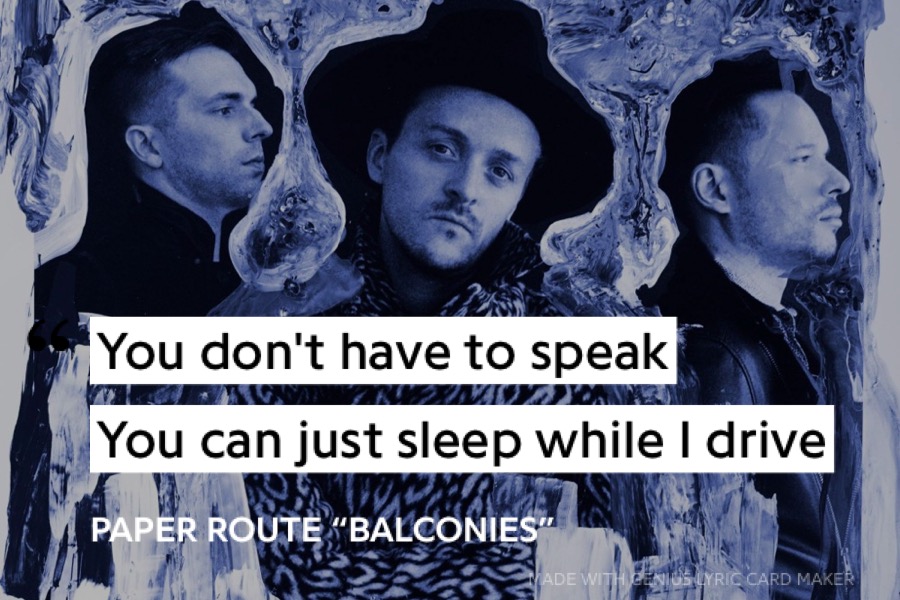
  •  Listening to Paper Route makes me wonder, what if Coldplay, after recording X & Y had continued making electronic music and honed in on their lyrics. Paper Route has a solid pop-rock band, on par with any of their contemporaries (i.e. OneRepublic, Coldplay), but their somewhat eccentric fidelity to their craft, recording their albums themselves in old Tennessee mansions to let the natural acoustics reverberate on the record, had cemented them as an indie rock band. “Balconies” was kind of Paper Route’s first and last hit. The band’s music had been featured in movies and television shows, but “Balconies” got them a late-night performance slot on Seth Meyers. As one of the most obvious hits from their third album, Real Emotion, the song was released to radio but didn’t do too well on the charts. After touring to support the album, the band went on “an indefinite hiatus.” However, as the band has had long gaps between albums, I wonder if JT Daly and Chad Howat will assemble a group of musicians together for album number 4. 

    RAISE YOUR ARMS AND HOLD WHAT YOU CAN’T REPLACE. “Balconies” uses several mixed metaphors to convey a message about being unable to hold it together. The singer claims “that the simple things [he] can’t get right” and he “know[s] that it’s [his] fault,” yet he offers to comfort the listener: “You don’t have to speak/ you can just sleep while I drive.” He talks about the difficulties he faces: “For every wound, there’s a hill to climb” and that he has a “hunting heart trying to survive.” This song can draw an obvious connection to Daly’s lyrical theme of wrestling with God and religion, but it also seems to be about his other theme, struggles with romantic relationships. If it’s the first option, the singer is letting God down in the first verse, and in the second God is offering comfort. I don’t like how the speaker shifts so much in that interpretation, so I think the song is about showing support for a loved one when you both are having a hard time. The minor key keyboard synth riff that is repeated throughout the song sounds like rain, and the subject matter of the song matches the dreary sounds of the song.

    IF I’M IN YOUR DREAMS, AM I WHAT YOU WANT TO FIND? “Balconies” is certainly not Paper Route’s lyrical masterpiece, but it is a comforting, uplifting song. It was a perfect song of the day because of the bleak weather we’ve been having lately. Yesterday it cleared up for a day only to start raining again today. Whenever I hear “Balconies” on days like today, I’m transported back to my childhood on a boring, rainy day. My mom ran the dryer and folded the laundry and as I got older I folded the laundry. She’s watching some late afternoon talk show and I’m watching it too because there’s nothing else to do. I’m sitting on the couch, warm towels just out of the dryer are covering me, and I feel the warmth of the afternoon laundry. Later mom announces it’s boxed macaroni and cheese for dinner. That was pretty typical food when growing up and there was nothing special about it, but on boring days like today, mac and cheese is kind of a highlight. I can’t fully understand the struggles of my parents trying to feed three kids on a single income. I don’t know what their daily hopes and fears were. I was sheltered from it. I can look back fondly on those boring, rainy afternoons when I didn’t have to worry about money or not being loved by my parents. I know that this is not true of every family, so I’m thankful for the privilege that I had for that time. I think “Balconies” taps into that human emotion of a loved one saying, “Don’t worry about it and let carry your burden for a bit.” It may be just a box of macaroni and cheese, and we may have to worry about our nutrition later, but you won’t be hungry. And sometimes that’s what you need.

    Music Video: 
    Seth Meyers Performance:

    Album Release Live Acoustic Performance:

  • n 2017, it had been five years since The Killers released new music, and even longer since they were a “household name.” Lead singer Brandon Flowers talks about starting with the song “Rut,” Wonderful, Wonderful’s third track, which defined the band’s new direction. While The Killers had been on hiatus had released his second solo record, The Desired Effect. Also before recording The Killers’ fifth record, Flowers moved out of his beloved hometown of “The Fabulous Las Vegas” which turned out to be a bad place to raise a family in the ‘10s. Still, digging out of the musical rut wasn’t easy. Flowers found on Wonderful, Wonderful it was ok to write about his family. 

    DON’T NEED NO ADVICE, I GOT A PLAN. The first single from Wonderful, Wonderful, though, “The Man,” doesn’t fall into the typical storytelling songs we come to expect from The Killers, rather “The Man” is a bragging song. The song was featured in the Netflix original film The Perfect Date during a montage when Brooks, played by Noah Centineo, dresses up as “the perfect date” for girls who pay him, the song seems completely serious. The “manly brag” song leaves listeners polarized. For every manly man singing along, there’s a commensurate amount of males twiddling their thumbs, saying “Okay, we get it dude. You’re a man.” Some listeners have interpreted “The Man” as the Brandon Flowers of the past–a youthful arrogance and stubbornness prevalent in men in their late teenage to early 20s.  This “piss and vinegar” masculine tenacity can prove useful when starting a band, but what happens when you grow into Tim the Toolman Taylor? While the song is delivered as completely serious, the video shows cracks in the song’s philosophy.

    THEM OTHER BOYS, I DON’T GIVE A DAMN. I haven’t really talked about toxic masculinity in my blog. The issues surrounding gender identity are a very sensitive subject these days. Sexist opinions that “pink is for girls and blue is for boys” and that women belong in the kitchen and men belong in the boardroom are far more popular than they should be. Growing up in a strictly two-gendered Christian culture, masculinity, and femininity were modeled, and kids were expected to grow up to copy that model. Of course, there were always some exceptions, and not every man was super manly and not every woman super feminine, but there was an expectation of ideals. As I began exploring my sexuality, I also started to confront my presuppositions about gender. When we stop dividing the world into the masculine and the feminine, we can enjoy what we like and not have to worry about what other people think of us. Personally, I identify with a lot of masculine tendencies, but I will probably never be able to tell you how an engine works and I’d much rather go to the symphony than to a monster truck rally. My identity isn’t wrapped up in physical strength, but strength of character. But to Tim the Toolman Taylor, I’m a beta male. How do you respond to that? Whatever dude. I’m just gonna live my life. 

    Read the lyrics on Genius.

    Source:

     The Watch Podcast: talking to Brandon Flowers and Ronnie Vannucci in 2017

  • In the ’70s Alternative Rock was a distinguishing term to separate mainstream classic rockers from experimental, independent rock bands. Sometimes called College Rock in the ’80s and the ’90s, it can be difficult to distinguish between mainstream rock and alternative rock of the ’90s and ’80s. More recently, the genre has been split between Alternative Rock and Alternative. At the heart of Alternative music, however, it is classified as genre-blending. Judah & the Lion had been cultivating a folk rock hip-hop sound from their inception, blending bluegrass instruments with modern sounds. However, the band’s sophomore album defined the style of music they were making: Folk Hop N’ Roll

    HEY, MY LIFE IS REAL GREAT. Founded by lead singer and guitarist Judah Akers when he met an eclectic group of musicians at Belmont University in Nashville, Tennessee, Judah & the Lion started out as a Christian Rock act though started to distance themselves from the genre in their discography following the release of their first EP. The band name Judah & the Lion draws a comparison to the Old Testament poetry in which God is called “The Lion of Judah.” The band’s career started by winning a band competition at Belmont University, which is quite a feat as the mid-sized private Christian college is the alma matter of some of the biggest names in CCM, Country, Pop, and Indie music including Steven Curtis Chapman, Brad Paisley, COIN, Tyler Hubbard of Florida Georgia Line, Lee Ann Womack, Josh Turner, and LANY as well as being home to Mike Curb School of Entertainment and Business, founded by the music producer and CEO of Curb Records. The band gained recognition for their folk rock sound in the early to mid-’10s, but their sophomore record Folk Hop N’ Roll was their highest charting record and boasted the number 19 Hot AC radio hit and platinum-selling single “Take It All Back.”

    AND IT FEELS SO NICE WHEN THE PEOPLE SING ALONG. Rocking an unkempt David Crowder beard, the former college basketball player Judah Akers and crew offer that post-R.E.M.Mumford & Sons sound that was off-putting to me when Judah & the Lion was blowing up in popularity. It seemed like this band was talented, but their particular sound wasn’t for me at the time. I think I became interested in them, though, when I heard an interview with Akers on Lead Singer SyndromeBeing no longer threatened by Jock Rock and listening to the band’s vision helped to make me realize their talent. Today’s version of “Take It All Back” (String Quartet Op. 9 in C Major) confuses me, though. I haven’t been able to find any additional information about this single. Did the band sample a classical composer or is the piece original? And if so, why is it the 9th opus? The band included this track on their second full-length record, and even with the EPs, J&tL hadn’t released nine records, I don’t think. However, there is a Vivaldi-like Mandolin Concerto sound to this song, which sounds similar to Vivaldi’s “Spring” from The Four Seasons. Lyrically, “Take It All Back” is a song about dreaming of the future. No sacrifice is too big for love. Money and fame are only possible with a support system. 

    2.0 music video:
    Live studio version:
    String Quartet version: