•  

    In 2017, Aaron Sprinkle released Real Life, his last release on Tooth & Nail Records. The legendary producer had released solo work sporadically since the ‘90s; however, being the go-to producer for some of the most successful bands in Alternative and Hard Christian Rock was time-consuming, and Sprinkle felt that producing great records was more successful than trying to promote a solo career. Sprinkle’s production always felt cutting-edge when he recorded, whether for Anberlin, Acceptance, Demon Hunter, Falling Up, or a host of other bands. Real Life, however, feels very 2017. Today, let’s explore the album, track by track.

    1. Invincible kicks off the album with that 2017 electronic sound. Featuring Poema’s Elle Puckett contributing a spoken-word/ rap part, the song sounds nothing like what you’d expect from either artist. The lyrics seem to be the speaker coming to realize that he is not invincible. Puckett tries to convince the first speaker that he never needed to be invincible. The song sets the tone for the album of dreams that didn’t work out, but ultimately it’s about redefining dreams for a new future.

    2. “Washed Up” isn’t a particular stand-out track, despite being the second track. Unlike the first track, though, the synth feels more like a classic ‘90s sound. The speaker of the song wishes to be “washed up on the shore” rather than fighting with the tides of the ocean. In Sprinkle’s interviews from this time, particularly on Labeled and BadChristian, now Songs and Stories, we have some context that Sprinkle had been dealing with the struggles of a shrinking music industry. Production budgets shrunk, but producers still had to deliver quality albums. Real Life is a walking away album, and Sprinkle is trying something new, but he ultimately feels “washed up.”

    3. “Never Alone” is a catchy pop song. It feels like it’s missing something to make it a great song. Maybe it’s the programmed drums on “Head back down to Easy Street” that could have been replaced with real drums to make the song come to life. “Never Alone” is repetitive in a kind of annoying 2017 way. The bridge’s harmonies feel like an early ‘90s song. The lyrics add to the theme of the album, encouragement during the uncertain times.

    4. “Real Life” starts off with Eisley’s Sherri DuPree Bemis singing the hook. Her husband, Max Bemis of Say Anything also contributes to the chorus of the song. The song is clunky–the lyrics don’t really flow. The bombastic “Chainsmokers” sound doesn’t really work. It’s a shame, too, not only because it’s the namesake of the album, but it’s a waste of a collaboration. The verses are just a series of dependent clauses that don’t say much. Sherri sings “Save my birthright ‘til I’m feeling up again,” presumably alluding to scripture, but what does it mean? My poor interpretation of the song is that the lyrics are the voices inside the speaker’s head. Sherri represents the wild idea that you can push pause on your life. Aaron brings back the voice of reasoning that “This is real life” and we can’t do that. Max sings “This is real life as I capsize,” perhaps meaning that being brought back to the fact that “this is real life” triggers a catastrophizing response.

    5. “Not Listening” isn’t a song I come back to. It’s not lyrically interesting, and it’s musically simple. The best part of the song is the synths decorating the song between the choruses and the verses.

    6. “Someday.” I talked about this song back in 2021, so I’ll link to the discussion there. While Memphis May Fire and Matty Mullins’ career was post-Tooth & Nail golden age, the recent announcement that Mullins would be touring as Anberlin’s touring singer in 2024 only grafts the singer more into the Sprinkle-verse.

    7. “Steady” brings back the retro synths. It’s one of the better tracks on the album, but not particularly interesting. The bridge is probably the best part of the song.

    8. “I Don’t Know Who You Are” features singer Stephanie Skipper, best known for appearing on the 14th season of The Voice. Before she appeared on the show, she released albums on Gotee Records. She also is part of the duet Copperlily with her husband, Tim Skipper, best known as the bassist for House of Heroes.
    The song is not very memorable on the album, though.

    9. “Step Here” is my favorite track on the album. I talked about the song last November. It is the song that most reminds me of a ‘90s computer game, and with the orchestra hit, it makes me think of some of the music from my mom’s ‘90s Yamaha keyboard.

    10. “Wander” is another one of my favorites. The song’s composition and melody is quite a bit simpler than any of the other songs on the album, but it’s a kind of necessary reprieve. The lyrics are perhaps the best on the album, using concrete images rather than platitudes. It’s also maybe the darkest track on the album, with the chorus: “You thought we were together / You hoped we made it through / But my mind will always wander / Wander back to you.” The line break at “wander” leading into “Wander back to you” adds some room for doubt.


  • Two wrongs don’t make a right, and neither do two lefts. But take a third left, and you’ll be back on course. In 2003, Relient K released their third record, Two Lefts Don’t Make a Right . . . But Three Do. For a band that prided themselves on a teenage sound, Two Lefts was starting to show signs of maturity with singer Matt Thiessen using pop culture as a vehicle to touch on deeper topics such as growing up, spirituality, and love. It served as a bridge between the band’s early sound and their refined crossover appeal on their fourth album, Mmhmm. The band experiments with hardcore punk and Emo, as the music scene was shifting away from jocular pop-punk. 


    THEME PARKS ARE SO MUCH MORE FUN WHEN THE SUN’S OUTSIDE. Relient K’s third record, Two Lefts Don’t Make a Right . . . But Three Do, opens with the upbeat first single “Chap Stick, Chapped Lips, and Things Like Chemistry.” The song talks about going on a field trip to an amusement park and makes several references to cell phones, dating back to when companies limited users’ daytime minutes. Thiessen says that he “lost [his] phone somewhere in the lake on the Batman ride,” probably referring to a now-closed ride, Batman: Knight Flight which was at Six Flag Ohio before the park closed and rebranded in 2004. Six Flags Parks have hosted Christian Rock festivals, and with Ohio’s RadioU sponsoring events and several local bands, Relient K frequently played at the park in the summer. The first song on Relient K’s third album is a reminder of how many church kids would have experienced Relient K.


    OK, SO WHO DOESN’T OWN A CELL PHONE? “Chap Stick, Chapped Lips, and Things Like Chemistry” takes a lyrical turn at the end of the song, almost like a wonky sermon illustration. The message is about relationships “and not just with girls.” The second track on Two Lefts Don’t Make a Right. .  . But Three Do, “Mood Rings,” caused a TikTok controversy in 2022, causing the band to apologize for the sexist lyrics. Making the “Mood Rings” controversy worse was the 2004 book the band released called The Complex Infrastructure Known as the Female Mind, which took its title from the final line of the song. The book categorizes different types of girls in high school, in what seems like mild incell language. In recent years, the band has distanced themselves from the contents of the book, claiming that they contributed very little to the book and that they hadn’t actually read the final product. So when Thiessen claims, “When it comes to relationships” and adds “I’m the dumbest one,” why on earth would anyone read a book or trust what a rock band made up of immature young adults have to say about how to treat, much less categorize others? The answer can probably be found in the insular teachings in evangelical churches at the time. I don’t think that Relient K was trying to harm us, but hearing the repackaged patriarchy from the cool young kids was damaging nonetheless. And if Relient K simply stayed in the Christian tradition, this conversation would be much less interesting.


     Read the lyrics on Genius.

  • As an assiduous student in music, Aaron Marsh of Copeland, attended Harrison School of the Arts, studying trombone and music theory. By the end of the mid-‘00s, Marsh had used Copeland as a vehicle of multi-instrumental compositions, even going so far to work with an orchestra reinterpreting some of their most beloved songs on 2022’s Revolving Doors. The band gave a one-night-only concert  with the orchestra at The Caverns, a concert hall in a cave with opening act Jenny Dee. Between Dee’s and Copeland’s set, the house music played ‘90s rock—Counting Crows and Gin Blossoms, as I recall—as Copeland and the orchestra set up. Marsh has talked about Gin Blossoms influencing his music, especially when Copeland was a more straightforward rock band, but to hear the connection on the night of Copeland’s full transformation into an art rock band reminded about how important early musical influences are on a band’s career. 


     YOU CAN TRUST ME NOT TO THINK. Being a few years younger than Aaron Marsh and the early millennials in Copeland, I was a little too young to remember Gin Blossoms in the height of their popularity. Along with Counting Crows, the two early ‘90s rock bands seemed to not be influenced by grunge or the waning New Wave sound. Instead, they sounded like what would become popular in the late ‘90s with groups like Tonic, Third Eye Blind, and Matchbox Twenty. Gin Blossoms formed in 1987 in Tempe, Arizona. After releasing their debut album Dusted in 1989 on indie label San Jacinto Records, the band gained popularity and signed to A & M Records, releasing Up and Crumbling EP in 1991 and their second album, New Miserable Experience in 1992. The band recorded 7 of the 12 songs from Dusted, releasing three on Up and Crumbling and four, including today’s song “Hey Jealousy,” on New Miserable Experience. 


    YOU CAN SEE I’M IN NO SHAPE TO DRIVE. Before Gin Blossoms released New Miserable Experience, their record label, A & M, forced the band to fire lead guitarist Doug Hopkins. Along with bassist Bill Leen, Hopkins founded the band after playing with Leen in another band while attending Arizona State University. Hopkins wrote “Hey Jealousy” about his ex-girlfriend. The song’s lyrics touch on the guitarist’s alcoholism, which would lead to his firing in 1992 when the band was in the studio recording Experience. Hopkins was both chronically depressed and was said to have drank so much that he couldn’t even stand up to perform in the studio. When A & M gave the band an ultimatum: fire Hopkins or be dropped from the label, the band sent their lead guitarist on a flight back home with enough aftershave and mouthwash to cover up his intense nightly drinking. According to a Rolling Stone article, Hopkins had claimed that signing to a major label made him feel like “property.” Hopkins formed another band in Tempe called Chimeras. Hopkins received a gold record for “Hey Jealousy,” hanging it up on his wall for two weeks and then destroying it. The song that he had penned about jealousy in a relationship he lost due to drinking was now a hit in a band that had moved on without him. Alcohol had destroyed his life. Sadly, the day after going in for a consultation for checking into a detox program, Doug Hopkins ended his life. Gin Blossoms eventually broke up in 1997 after releasing their hit 1996 follow-up Congratulations, I’m Sorry. The band reformed in 2001 and released three albums between 2006 and 2018. 

    Read the lyrics on Genius.

  • Heavy metal music is quite scary to many people even without the visuals. But add the visuals and the backstory along with titles like “Raining Blood,” you’ve got a genre of music that’s pretty great for Halloween. But then you add the macabre images of  classic acts like Alice Cooper and Ozzy Osbourne or Nu Metal giants like Rammstein or Rob Zombie, metal is horrifying. Stone Sour isn’t a shock metal group, but cofounder and lead singer Corey Taylor left the band in 1997 to replace Slipknot‘s original frontman, and became known for an outrageous, downright brutal stage image. 


    DON’T KNOW HOW MUCH TIME HAS PAST. In 2000, Stone Sour reunited, and Corey Taylor fronted both Stone Sour and Slipknot concurrently. While Slipknot released some of their heaviest music, Stone Sour had radio rock singles. The band released their debut self-titled album in 2002 with the single “Bother,” which was on the Spider-Man soundtrack, though Corey Taylor was the credited artist on the soundtrack. In 2006, Stone Sour released their sophomore record, Come What(ever) May.  Like the band’s first record, Come What(ever) May was a hard rock/ alternative metal album, featuring baleful bass-lines, gravel vocals, and angry explicit lyrics. But there were some quieter, albeit moody moments on the band’s sophomore record. “Sillyworld” is a sardonic acoustic-driven, politically-motivated track that earned the band a number 2 hit on the Rock charts. The final track, “Zzyzx Rd.” is a love song to Taylor’s wife and mentions overcoming addiction and getting out of a place of depression. But track 8, “Through Glass,” is Stone Sour’s biggest hit, reaching number 1 on the rock charts. The acoustic rock track is unlike anything else on the record, and because of this song that I had heard on the radio, I checked out the brutal rest of the record. 


    IT’S THE STARS THAT LIE TO YOU. Corey Taylor wrote “Through Glass” when he was in Sweden. More specifically, he wrote the song about his thoughts when he experienced an inability to change the European MTV station because he was suffering from food poisoning. Taylor told The Gauntlet:

            I was sitting in a European hotel room watching a music video channel, seeing act
            after act after act of this insane, innocuous, plastic music. They were plastic,
            bubbly, gossamer-thin groups where it was really more about the clothes they
            wore and the length of their cheekbones than it was about the content of the song
            they were singing. It really made me mad. I was like, “Is this it? Have we just gone
            full circle? Did the singer/songwriter revolution never happen? Is it just the same
            drivel from the same replicate over and over again?
    The video also takes a jab at big music production, showing how artificial modern music has become. Taylor suggests that the music industry has just become cameras and props, all of which disappear after reporters leave. I doubt that Taylor would have positive things to say about the state of pop music in 2022, but thanks to streaming platforms, music is more individualized to the listener’s particular tastes today. There are many artists who are taking back the reins, though the music industry has cut costs as new music doesn’t make much money. But does artists driving their own sound make music more authentic? Or are artists just chasing algorithms?
  • MUNA’s first two albums weren’t exactly uplifting, at least as a whole. Sure there are moments of empowerment, but the glass appears half-empty more times than not with songs about breakups and lost loves. On 2019’s Saves the World, two songs act as companions to a terrible breakup. “Stayaway” is an if/then song, explaining why the speaker won’t go out. She might see her old friends or the friends of her ex and might be dragged back into a bad romantic situation. “Who” is a song that speculates about the person who replaced the speaker. “Who are you singing about now?” Katie Gavin pleads on the chorus.


     WHEN I GO OUT AGAIN… In the fall of 2021, MUNA returned with the bright duet with Phoebe Bridgers, the lead single “Silk Chiffon” from their third and self-titled album. While the other pre-release singles were not as hopeful as the lead single, all of them were more optimistic than the last album’s twin break-up tracks. There was, however, the album’s final single, released with the album, which was so musically different from the previous singles. “What I Want” was also lyrically different from any MUNA track. The ebullient club song feels like an ‘00s Max Martin production. MUNA, for the record, self-produced the song. On an episode of Song Exploder, the group talked about the inspiration behind the song. Taking a synth loop created by Naomi McPherson, singer Katie Gavin took the piece to a Zoom co-writing session with Brett “Leland” McLaughlin. Gavin told Leland, “I want something that’s unapologetic and fun.” Leland encouraged Katie Gavin to go for an uncharacteristic sound and use words for phonetic purposes rather than overanalyzing word choice.

    I’M GONNA MAKE UP FOR IT ALL AT ONCE. Both Katie Gavin and Leland, queer artists, in the Song Exploder episode, talked about how the lyrics of “What I Want” were both “pandemic-informed” and a reaction to internalized homophobia. Gavin talks about how her Irish-Catholic upbringing caused her to hold some internalized homophobia. Leland said, “Certain parts of me, out of necessity, needed to be repressed. I spent more of my life not being myself than being myself.” The result is a song that disregards the admonishment of repressive systems and flaunts the gay experience. It’s a club banger, though MUNA explains that none of their band actually parties much. Katie said,  “We’ve had many conversations about ‘what if people think it’s okay to go get fucked up all the time?’” She goes on to explain, “From my mid-20s to—I just turned 30—and that’s been a kind of on and off ‘I’m sober for a while, and I’m not sober. And I think just after testing it out for a few years, I like it more being sober.” Naomi chimes in that the song is “honoring nightlife as having such a fundamental . . .history for queer people.”  Ultimately, the club is a metaphor for being able to let your guard down when you find a community.  It’s hyperbolic. MUNA offered support after the Pulse nightclub shootings. But “What I Want” is a song about escapism everyone needs sometimes.

    Read the lyrics on Genius.


  • As promised, here is my Top 10 list for albums of the year. It’s a bit late and I’m sure that in time, the importance of this list will change and that albums I hadn’t listened to would chart. I decided to give preference to the albums I blogged about most but I also slipped in a few that I thought would be culturally significant. There were a few cuts that I thought hurt a little, Olivia Rodrigo’s GUTS, the Barbie: The Album soundtrack, and boygenius’s The Record.  I wanted to include some albums that didn’t make the critics’ picks lists to give light to some underrated artists. I hope you enjoy these albums as much as I did—and am doing now.


    10. The Show by Niall Horan. It’s funny how the other One Direction members have been totally eclipsed by Harry Styles. While Styles is certainly talented, and his production team has incorporated some of the most interesting elements into mainstream pop, former bandmate Niall Horan has been sadly overlooked. The Show is an album by an artist who seems to enjoy music from the folk, campfire-ready “You Could Start a Cult” to the tempo-shifting “Meltdown” to The Beach Boys-sounding “Heaven.” A deluxe edition has a beautiful duet of “You Could Start a Cult” with Lizzy McAlpine.

    9. Tension by Kylie Minogue. This album may not be a “10 Out of 10,” but it certainly got me into Minogue’s back catalog. It’s a dance record that you can kind of turn your mind off for, with perhaps the exception of “Hold on to Now.” Tension feels like a party that’s been going on for a long time but not getting old. There’s something about the lead single “Padam Padam” that feels like a Disney villain song.  The title track is also an album highlight. I’d listened to Kylie a little before this album. I liked “Can’t Get You Out of My Head” as a kid, but wasn’t obsessed with it. I listened to 2018’s Golden a few times. But Tension made me a fan.


    8. Gloria by Sam Smith. Pop music looks good on you, Sam. While “Unholy” was the biggest hit of their career and “I’m Not Here to Make Friends” was also a considerable hit, Gloria was pretty underrated. It’s interesting that Smith has started their career with critical acclaim—music for adult contemporary stations—but now the singer has stepped into the 2020s version of shock pop reminiscent of the ‘10s. The album Gloria, though, is tame compared to the scandalous music videos accompanying the singles. I thought Gloria was an experimental album. Smith worked with Calvin Harris and Jessie Reyes on several songs. Pop, R&B, Disco, EDM,  and even the Gregorian-Chant-inspired title track make the album an interesting ride. I can’t wait to see what comes next from Smith.


    7. Bewitched by Laufey. Last year I listened to Spotify’s Crushed Velvet playlist and heard Laufey’s “Dreamer.” The playlist consists of new songs that, from production or composition, sound like they could have been from the ‘50s. Laufey had begun making waves last year with her single “From the Start.” The acoustic lounge song gained attention on social media and raised hype in the young singer’s album Bewitched, which topped Billboard’s Jazz albums. The album displays a truly talented artist who I hope we see collaborating and making incredible music in the future.


    6. Something to Give Each Other by Troye Sivan. We needed this album after the nightlife drought of the pandemic years. After the subdued sounds in the break-up EP In a Dream in 2020 and the love songs in non-album singles after the EP, Something to Give Each Other takes a tonal divergence with singles “RushRush” and “Got Me Started.” In the third single, the ballad “One of Your Girls,” Sivan shows vulnerability confessing a situation when men who identify as straight propose hooking up with the young gay icon. It’s a more sexually mature Sivan album, but it feels vital, young, and free.


    5. The Album by Jonas Brothers. One of the things that made a good album of 2023 was flaws. I haven’t seen this one make a critic’s list, but I think that Kevin, Joe, and Nick leaned into the cheesiness that a Jonas Brothers’ album that fans expected but achieved a musicality we listeners weren’t expecting. It’s yacht rock, gospel, pop, and hints of disco, funk, and country. Jon Bellion’s production team crafts some interesting arrangements, though several of the songs could benefit from an instrumental breakdown. It’s a very short album. I didn’t think that I would enjoy a Jonas Brothers album as I enjoy this one. It was a great album to enjoy last summer. It was the idea of summer even when summer wasn’t a “Summer in the Hamptons.” Maybe it will mean something next summer.


    4. In the End It Always Does by The Japanese House. The sophomore record by Amber Bain’s ethereal musical project is beautiful. “Boyhood” ranked in my top ten songs of the year, but also “Touching Yourself” is a beautiful song about a long distance relationship that is delivered in a way that you could play in any cafe despite the song’s lyrical content that is breezed over with Bain’s lush instrumentation and vocals. Collaborations with MUNA, Charli XCX, The 1975’s Matty Healy, Bon Iver’s Justin Vernon are all welcome guests, but the chief resident of The Japanese House, Amber Bain, is an excellent host on a great record. 


    3. Javelin by Sufjan Stevens. The pathologically private singer-songwriter Sufjan Stevens has been given more than a lifetime’s worth of sadness and tragedy. It was a tough year for Stevens who was suffering from Guillain-Barré Syndrome when he announced the album’s release, having to relearn to walk. Then he announced that his partner Evan Richardson had died last April, apparently coming out. Javelin may be a grief tribute similar to his magnum opus Carrie & Lowell. I would rank the album higher, but Javelin feels like a sequel. I think that it’s lyrically refined but it doesn’t have the raw details we come to expect from a Sufjan album. “So You Are Tired,” “Goodbye Evergreen,” and “Shit Talk” are my favorites so far. More analysis of this record coming soon!


    I’ll post the rest soon!

  • In 2020, amid America’s racial reckoning following the brutal murder of George Floyd, many artists of color came to prominence. Jon Batiste had been playing drums and percussion from the age of 8 and classical piano from the age of 11. Influenced by classical, jazz, R&B, and pop, Batiste released his first album, Times in New Orleans, at 17 and was accepted to study music at Juilliard. After earning his bachelor’s degree, Baptiste went on to earn a master’s degree also from Julliard. In 2004, while studying at Julliard, Batiste formed the jazz band Stay Human. In 2015, Steven Colbert hired Batiste and Stay Human as his house band for The Late Show with Colbert. Batiste’s career has been characterized with prestige, collaboration, activism, and gradual name recognition.


    THAT’S JUST WHO I AM, THAT’S JUST MY RADIO. I first heard of Jon Batiste from his contribution to the Soul original soundtrack. Batiste composed original jazz pieces for the 2020 Pixar film. Along with co-composers Trent Reznor and Atticus Ross, who created the otherworldly synthesizer pieces in the score, Batiste received many awards and nominations, including wins for Best Original Score at The Golden Globes, The British Film Awards, The Academy Awards, and Best Score for Visual Media at the Grammys. In addition to Batiste’s nominations for his work on Soul, Batiste’s fifth album WE ARE won Album of the Year at the 2022 Grammy Awards. Batiste’s win was controversial as none of the singles from the album were hits and the record had left the Billboard 200 albums chart before the Grammys and only returned after the ceremony. Batiste’s 2023 album, World Music Radio, was also nominated for a 2024 Album of the year, but lost to Taylor Swift’s Midnights. Batiste’s 2023 album is a largely collaborative concept album. The album follows a being from another planet who observes the music of earth and ultimately uses Earth’s music to create a “potpourri of the far-flung musical languages of Earth.”

     DON’T WANT TO SHARE A MUMBLING WORD. Jon Batiste’s music inspired many in 2020, giving a performance with Matt Whitaker on the steps of the Brooklyn Public Library on Juneteenth. Batiste grew up in a family that had been active in the fight for civil rights, and the accomplished musician has donated proceeds from singles and projects to charities that support human rights. Batiste’s latest album World Music Radio aims to give the listener a global perspective. Featuring artists like Lil’ Wayne, Lana Del Rey, Jon Bellion, and Kenny G, Batiste shows that he’s a musician’s musician. Today’s track, “Be Who You Are,” features American rapper JID, Korean girl group NewJeans, and Colombian singer Camilo. The lyrics of the song encourage listeners to embrace their uniqueness. The collaboration between the artists from three continents—North and South America and Asia—suggests a global perspective in pop music. Bringing together the sounds of pop, R&B, K-pop, and Latin pop, “Be Who You Are” both reminds listeners that music is global and suggests that perhaps the future of pop music may not be in English. It might just be time to join Duolingo if you want to enjoy pop music in the future!


    Read the lyrics on Genius.


  • January wasn’t too early to start thinking about an Endless Summer Vacationat least for Miley Cyrus. The singer’s eighth studio album came out last March, and the first single, “Flowers” was dropped in January. The single builds on the theme of her last LP, Plastic Heartsand its lead single “Midnight Sky,” in which Cyrus declares “I don’t belong to anyone / I don’t need to be loved by you.” In “Flowers,” Cyrus realizes that she can buy her own damn flowers rather than accept a half-hearted gift from a lackadaisical lover. The singer’s target, of course, is ex-husband Liam Hemsworth

    WE WERE GOOD, WE WERE GOLD. Miley Cyrus and Liam Hemsworth met on the set of the 2010 Nicholas Sparks film adaptation of The Last Song in 2009. The two dated on and off until getting engaged in 2012. They broke off their engagement in 2013 on good terms, dating other people until 2016 when they announced that they again were engaged. The couple married in 2018 but announced their separation the next year and the divorce was finalized in 2020, the couple citing irreconcilable differences as the reason for their divorce. In “Flowers,” Cyrus claims, “I didn’t wanna leave you, baby / I didn’t wanna fight.” But in the end, she realizes, “I can love me better than you can.” Cyrus realizes that she doesn’t need the spark of a romantic gift when she can take care of herself. It’s better to “hold [your] own hand” if your partner isn’t there for you completely.

    I CAN BUY MYSELF FLOWERS. In January when Miley Cyrus first released “Flowers,” avid pop music listeners caught a reference to Bruno Mars‘ “When I Was Your Man.” Liam Hemsworth had reportedly dedicated the song to Cyrus when the two were married. Cyrus, though, takes Mars’ weepy ballad about a lover’s regret and turns it into a revenge anthem, even releasing it on Hemsworth’s birthday, January 13th. The song references several incidents in their relationship, including their lost Malibu home, which burned in 2018. The Mars’ track focuses on the “coulda, woulda, shoulda” of lost love, almost as if the listener were a victim of his ineptitude. Cyrus, however, refuses to be a victim. Self-love is better than whatever she was experiencing, and in the case of “Flowers,” the biggest expression of self-love is revenge. But it’s not a “good 4 u” kind of revenge. It’s perhaps more damaging to the ego of certain men in a hetero-normative relationship. The subtle jabs at using birthdays as release dates and wordplay about meaningful events reinforce this, but the true revenge is, “Sorry Bruno, I don’t need you. I can do it myself! In fact, I’m growing my own flowers in the alcove garden of the expensive home I bought with my success!”

  •  The pandemic was a mixed blessing for music. On one hand, bands were unable to tour, which cut off the lifeblood of the music industry. Album sales, which used to drive the industry, were decimated by the end of the ‘10s as music shifted to digital sales. But even digital sales slowed, and streaming became the industry standard. Even when albums were selling, bands needed to tour, often relentlessly, to make a living. When the pandemic hit and forced touring bands to stay home, several bands found a way to distribute the experiences of a live show via Internet livestream. With the public stuck at home, many of the old bands decided to get back together. It turned out that millennials now had money to spend on the band that they loved in their youth. 

    HE CALLED BACK HOME, BUT THEY JUST MISSED IT. Seth Roberts took 2020 as an opportunity to reform his old band, Watashi Wa. Roberts had several bands before the Watashi Wa reunion, but Watashi Wa was Roberts’ first band. Roberts worked with close friends and reached out to friends from the scene he had known for years, bands that influenced Watashi Wa, and bands that toured with them. The result was People Like People, released in 2022. Almost everything about the album was experimental, from the wide-ranging sounds of punk from pop to hardcore to the lyrical content that Roberts described to the Hit Piece Podcast as “Optimism for the future.” Eight of the thirteen tracks feature another band, some are well-known bands from Tooth & Nail Records’ early days, while others were part of the scene that never broke through. The album’s opening track, “Let Me Prepare You,” features Florida-based band Gasoline Heart. On the Labeled Podcast, Roberts talks with host Matt Carter about the origins of the collaboration.

    DARKER THAN DARK TIMES. According to the interview, part of “Let Me Prepare You” came from a collaboration between Seth Roberts and Gasoline Heart that appeared on Gasoline Heart’s album. Matt Carter then talked about his one-time experience with Gasoline Heart’s lead singer Louis DeFabrizio, whose band The Kick, a predecessor to Gasoline Heart, opened for Carter’s band Emery on their first tour, the Tooth & Nail Tour, in Orlando. According to Roberts on The Rumors Are True podcast, DeFabrizio was in Seth’s band Eager Seas after the original Watashi Wa line-up left the band. DeFabrizio and Gasoline Heart have never been famous but have been important in the background of the scene. The band is name-dropped on Anberlin’s “There Are No Mathematics to Love and Loss.” They released one album You Know Who You Are on Mono vs. Stereo, the rock label of Gotee Records, in 2006. It’s the most-produced album in their discography and the only one without profanity, though the Christian-label released You Know Who You Are was far from a tame Christian Rock record. I’ve attempted to see Gasoline Heart twice at Cornerstone. Let’s just say DeFabrizio is quite a character. He was kicked out of the festival in 2011. He seemed to be quite drunk and was fighting with the festival organizers. That was my only experience with seeing the band, so I was always fascinated with why Louis was so well-liked in the scene. Of People Like People, Roberts told Hit Piece Podcast that he hopes his listeners will be “challenged by . . .  [the album] or maybe to think a little different than the mainstream media.” Roberts has said on several podcasts that he has worked for NewsCorp, and on The Rumors Are True Podcast that the original version of “Let Me Prepare You” had an audio clip of his friend talking about his opinion of the vaccine. Tooth & Nail Records encouraged Roberts to cut the clip, saying that it might make the album polarizing. “Let Me Prepare You” and People Like People is a more conservative take on the pandemic, but Roberts ultimately wanted to create a conversation, rooted in optimism.


  •  

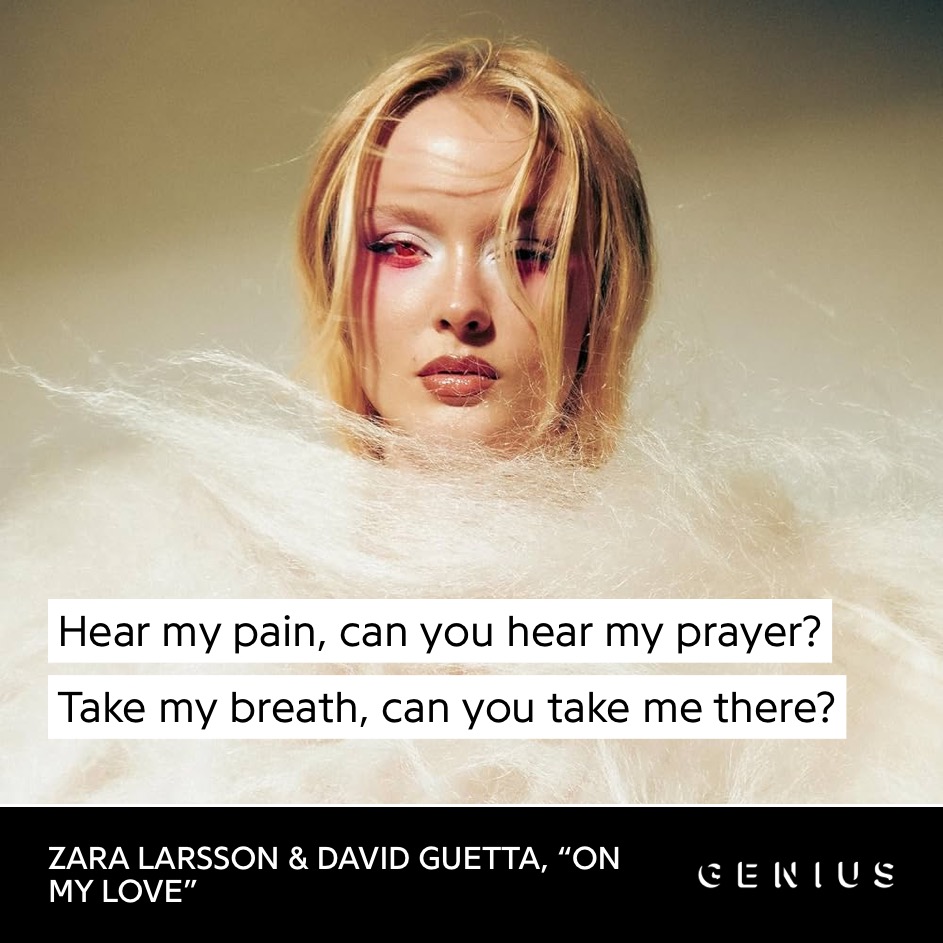
    Zara Larsson is a Swedish singer-songwriter who began her career on the Swedish version of Got Talent, called Talang when she was ten. She won the series and began recording songs in 2012. Her debut EP Introducing was only available in Scandinavia where her lead single, “Uncover” topped the charts in Norway and her home country. In 2013, she signed a contract with Epic Records in America, which broadened the signer’s exposure to a bigger audience. But in 2014, Larsson released her first full album 1, only in Scandinavia. Larsson has released four albums, with Venus being her most recent, released earlier this month. The third single, “On My Love,” was released last September. David Guetta produced the track. It’s an airy electronic track, which is pure emotion. The upbeat song is the basis for introducing my eclectic workout mix. It’s a playlist more about pumping and less about thinking.