• When Jonezetta released their 2006 debut record, Popularity, they dedicated the album to their recently deceased fifth member. Keyboardist Timothy Jordan II took his life in 2015. Jordan had been a promising young musician from Arkansas, which had a small but notable musical scene since acts like Living SacrificeThe Juliana TheoryEvanescenceAs Cities Burn, and others got their starts in the area. Jordan became a touring member of The All-American Rejects just as their career started blowing up with TV performances and bigger tours. However, just before releasing TAR released Move Along, Jordan announced his departure and joined an up-and-coming band on Tooth & Nail Records–Jonezetta. Popularity is a very dancy, upbeat album and featuring Jordan on the keys. 

    THESE HANDS ARE MEANT TO HOLD. Jonezetta never memorialized Timothy Jordan in their two albums other than dedicating Popularity to him. However, The All-American Rejects wrote the song “Believe” about him, and fans also say that “Move Along” pays tribute to Jordan, as the song is an anti-suicide song. The best tribute, though, is As Cities Burn‘s album closer “Timothy” from their 2007 album, Come Now SleepA few years ago, for my after-school ESL music listening class, we listened to Jack’s Mannequin‘s “Swim,” a song I covered last month. I called the song a per aspera ad astra song, a Latin phrase translated as “through hardships to the stars.” The meaning of this phrase is that by enduring difficulties, we will overcome and become great. “Move Along” is a great pep talk of a song, particularly for a hard day. The video depicts the band going through a variety of hard, uncomfortable, or seemingly hopeless situations. However, the song begs the listener to “keep . . strong, like I know ya can.” 

    WHEN YOU FALL, EVERYONE STANDS. Often pushing through the difficulty can make it bearable. Moving on to the next thing can distract us from the failures we can’t fix. But in the moment, that failure is glaring. Relationships end, car accidents happen, tickets are issued, fights occur–“days when you’ve lost yourself completely” are painful to reflect on at night. Certainly, you want to redeem yourself or escape the misery. But holding on and reaching out makes us realize that we’ve all been there. Sometimes I’ve said, “I’d rather die than face what tomorrow holds” only to have something happen, like almost stepping in front of a bus, and I find myself instinctually fighting for my life. No, I guess I’d rather face tomorrow. I won’t doubt that this song has saved lives and helped many people through hard times. However, I do worry about “moving along” as a blanket-prescribed solution. The saying “Fake it until you make it” has some merit, but at some point, you have to be able to say, “I’m not happy. I need to talk with someone about why I’m unhappy.” Sometimes we “move along” too quickly. Just like you shouldn’t put off other emergencies, dealing with our mental health should be the top priority. For my mental health, I found that my close friends have gotten me through my darkest times. However, there are times when a friend is not enough. And that’s when it’s time to stop and seek help from a professional.

    Read the Lyrics on Genius.

  • The best music doesn’t happen in isolation but rather comes out of a community movement. I would define community, when it comes to music, as a mixing of artists who bring different ideas together ideas from various genres. The result of a musical community is stronger musicianship by all those involved. Collaboration, the meeting of minds, happens naturally. Throughout the course of my blog, I’ve talked about various communities. Tooth & Nail, Christian Rock, and evangelical communities are definitely the biggest themes. Tegan and Sara grew out of the Northwestern Canadian/American Indie Rock community in the late ’90s, and by 2013 became pop stars. 

    HERE COMES THE RUSH BEFORE WE TOUCH. Many fans may have been introduced to Tegan and Sara when Meredith Grey and Christina Yang danced to their early acoustic, angry girl music in Grey’s Anatomys earlier seasons. The musical duo of Calgary-born identical twins Tegan and Sara Quin started on the acoustic guitar at home and eventually led to being signed on Neil Young‘s label, Vapor Records. The band gained traction in the indie scene. The White Stripes covered one of their songs, and co-writing with Chris Walla of Death Cab for Cutie also helped them gain indie cred in their early career. But in 2013, the duo changed directions. The result was the big-production, synth pop-driven Heartthrob. “Closer,” Heartthrob’s opening track and lead single, sees the sisters explore new lyrical territory in addition to their musical change-up. Tegan sings lead vocals, but Sara encouraged her to sing a straight-up love song, without the dark and dreary lyrical content the group had been known for. According to an article in Rolling StoneTegan’s lyrics were about “a time when we got closer by linking arms and walking down our school hallway or talked all night on the telephone about every thought or experience we’d ever had. It wasn’t necessarily even about hooking up or admitting your feelings back then.”
    THE LIGHTS ARE OFF AND THE SUN IS FINALLY SETTING. THE NIGHT SKY IS CHANGING OVERHEAD. In a video series the twins released talking about the songs on the album, Sara pushed the lyrics to “make things physical,” referencing high school romance. Tegan best sums up the atmosphere, stating to Rolling Stone, “These relationships existed in a state of sexual and physical ambiguity.” The music gives the impression of a late-’80s early-’90s slumber party, with the sisters singing karaoke on an ancient, faux wood entertainment stand in which the television is built–younger millennials may not remember that artifact–and childish games like spin the bottle and applying lipstick. The video celebrates couples of all genders and sexualities. Both Tegan and Sara are openly queer musicians from their musical inception and have used their music as a platform in recent years to advocate for equality. “Closer” scored pop radio play and has been featured in several television shows including Glee and Bojack HorsemanThe song is a beautifully innocent track about desire–wanting to take things to the next level, but being too young, too naive, and too shy to do so.


  •  There might be one song that defines the ‘90s and reshaped music and the rock star for Generation X and future generations of music listeners. That song, of course, was the lead single from the 1991 sophomore record by Nirvana, Nevermind. Smells Like Teen Spirit,” Nirvana, and Nevermind didn’t invent Grunge. Alice in Chains, arguably, brought the sound mainstream before Nirvana did. The song “Man in the Box,” a hopeless rocker when the sounds of hair rockers were much more optimistic and hedonistic, reached number 18 on Billboard’s Modern Rock tracks.  But Alice in Chains didn’t lead the revolution, nor did Nirvana’s other contemporaries Soundgarden or Pearl Jam.


    HERE WE ARE NOW, ENTERTAIN US. Just as how F. Scott Fitzgerald set out to write a satire of the trivial lives and parties of the New York upper crust and subsequently gave literature and history the most condensed account of what the “Jazz Age” was in The Great Gatsby, Nirvana wrote “Smells Like Teen Spirit,” which resonated with teenage rebellion which had been closely connected with rock music since the ‘50s. While frontman Kurt Cobain and Nirvana were surprised of the band’s impact on the charts and eventually culture, it was the satire of teen rebellion anthems throughout the four prior decades of rock music from The Beatles to Mötley Crüe that reinvented rock music for the ‘90s. But Nirvana and Cobain weren’t the flamboyant stars rock musicians had been expected to be. Cobain was introverted and suffered from depression. Rather than masking his pain on stage, Kurt used his music to channel his feelings, delivering some of the most honest portrayals of himself in the absence of a stage persona. Today artists like Lana Del Rey and Billie Eilish credit Cobain’s stage authenticity as inspiration to show their audiences their truths. 

    I FEEL STUPID AND CONTAGIOUS. While Kurt Cobain’s “public display of depression” was a craved missing ingredient in the rock star persona, it was the singer’s views on social issues that keep him relevant even almost thirty years after his death by suicide in 1994. Cobain considered himself a feminist and spoke out against racism, sexism, and homophobia whenever he could. At one show, Cobain told his audience, “I would like to get rid of homophobes, sexists, and racists from our audience.” On another occasion, Kurt told his audience, “If you’re a sexist, racist, homophobe or basically an asshole, don’t buy this CD. I don’t care if you like me, I hate you.” He believed in counter- culture, the spirit in which rock music had been founded in the ‘50s and ‘60s, which had been forgotten in the ‘80s when the psychedelic Jefferson Airplane became the “corporate targetStarship and you could find a “DeadHead sticker on a Cadillac.” Cobain’s views were not shared with everyone in Grunge. In fact, post grunge tended to be libertarian at best and far-right at worst–think Aaron Lewis’ “Am I the Only One?” But Cobain was never concerned about fitting in with a movement. But thirty years later, other than a lawsuit surrounding the cover art, the music holds up, and artists still look to Cobain as a sort of prophet of inclusivity. Of all the forms of teen rebellion, isn’t that a much better vision for the future?

  • Lana Del Rey‘s magnum opus, Norman Fucking Rockwell! was released in September of 2018 and earned the singer-songwriters the acclaim she had been laying the foundation for since 2012’s Born to Die. A year after her lackluster album/ collection of good songs Lust for Lifeshe released the first single from NFR, The Mariner’s Apartment Complex” and quickly followed it with another single, the 9:38 song “Venice Bitch.” She began building hype for the record, a cohesive record using the Americana formula Del Rey uses best, a year before its release. The singer awkwardly promoted the album in October of 2018, 11 months before its release, at an Apple Keynote event. The singer wasn’t allowed to say the name of her upcoming album or its single, which she played censored, “Venice Bitch,” as Jack Antonoff  played the piano.

    Norman Rockwell’s Saturday Evening Post
    Cover, 
    Public Domain

    YOU DON’T EVER HAVE TO GO FASTER THAN YOUR FASTEST PACE. I remember a coffee table book we had, a warn spiral-bound collection of Norman Rockwell’s most popular Saturday Evening Post covers. The paintings are uniquely American, often slightly uncouth, compared to what would have been considered proper art of the day. Born in 1894 and dying in 1978, Rockwell set out to capture Americans as they were, sometimes overweight, showing full expression to a surprising moment, and in the common working-to-middle class settings of the day. He captured American life in the way that The Simpsons.    or  Rosanne captured the American family when the pretense of the cameras in Leave It to Beaver or The Brady Bunch had packed up and the family was left to untuck their shirts or have an argument. One painting I remember the clearest is No Swimming, a painting in which three boys are running with, trying to put their clothes back on. I stared at that painting taken by the lifelike use of motion and detail of the moving bodies. Viewers don’t know exactly what the boys are running from, but anyone who was once a kid knows exactly what they are running from.  Looking at this painting when I was about seven or eight years old, made me feel a fascination I had never felt before. 


    I’LL PICK YOU UP. “California” is a song that made me think about going back home “to America.” I think about what my mom says when I’m back home: “We’ll do whatever you want to do. It’s all about you.” That’s exactly what a ten-year-old wants to hear a couple days of the year, but as a 30-something I think it’s rather sad. I feel bad that when I come home to America it’s such a big deal. I’d much rather just blend into everyone’s daily life, have a few lunches together, and be able to be “back home” a couple times a year so it’s not so special. I’ve thought about getting a job that would let me get home twice a year. However, now with the pandemic and air travel being what it is, it seems being away is inevitable. So as we come closer to the holidays, although most of the references in “California” don’t really apply to me, the song makes me feel homesick. It makes me miss my Lana Del Rey-fan sisters. It makes me miss my friends who show me around the recently-transformed micro-brewery city full of hipster/redneck nightlife. It makes me miss my parents who make all my favorite foods. If I come back to America, I’ll hit you all up.

    Read “California” by Lana Del Rey on Genius.  

  • I was in a coffee shop in Sinsa, a neighborhood near Gangnam in Seoul when I first heard Kodaline. The Irish band’s debut album, In a Perfect World, and the EPs containing different versions of songs from around that time were perfect for a cup of coffee. Subsequent albums have made the band sound like they were striving to be another Coldplay, but they got it right the first time on their debut.

    I WANNA TRAVEL THE WORLD, BUT I JUST CAN’T DO IT ALONE.  I‘m recommending the acoustic version of “Brand New Day,” featuring Nina Nesbitt.  The lyrics of “Brand New Day” talk about “outgrowing your hometown” and wanting to “travel the world” with someone. As someone who could be said to be (still) on that journey, I remember the feelings of travel thirst. I got to the end of my bachelor’s degree and thought about the constraints of going back home to North Carolina. I thought about how it would be a few years of struggle in a career before buying a house. I thought about my very few trips overseas and how I wanted to get out of America and experience other cultures. I wanted to get away from the people I knew form new patterns and figure out who I was. So many friends who were older than me told me to do it. “When you settle you get roots, and it’s much harder to leave when you have the responsibilities of a mortgage and kids.” So I went to South Korea. And I started establishing roots here. It’s not exactly what I had in mind, but I’m enjoying life and learning something new every day that my younger self would never foresee myself doing.

    WE COULD BE BIG IN JAPAN. While it’s nice to be nostalgic, this song also pushes me forward, but not in a way that makes me question my life decisions (have you really   quenched your travel thirst?) I felt that way for the last few years and was off to a good start around this time. What’s different? I know how crappy things can get. My best years may be behind me. I mourn every day for the experiences I never had as a teenager or young adult. But that’s not to say that life has a limit on awesome experiences. I think about the opportunities I’ve missed because I was thinking about the logistics of them–an awesome layover in Seattle or San Francisco and most recently Munich or Frankfort. I’m so done with being ruled by the fear of enjoying myself. I’m so done with the guilt that I feel when I start to let myself go. I hope for a future in which I find myself drinking Rioja in Spain, admiring the sartorial aesthetics in Austria, nervously attending a fetish party in Germany if nothing more to engage in some voyeurism. Life is a series of brand-new days. It’s time not to waste them. 

    Album version Music Video: 

    Acoustic version featuring Nina Nesbitt:


    Read the lyrics on Genius.

  • It was Superbowl Sunday of 2005 when I bought Anberlin’s Never Take Friendship Personal.  It was the perfect album for high school. The band’s style took a turn on their sophomore album from a classic or ’90s rock sound to a more emotional, mid-2000s sound. The band would redefine themselves with this album, becoming a lesser-known emo staple. Stephen Christian’s vocals meeting Joseph Milligan’s riffs, Deon Rexroat’s heavy bass, and Nathan Young’s reliance on the cymbals make this one of the band’s heaviest records. The band released two recordings of this song on two different albums and many fans debate which one is better.


    THIS WAS OVER BEFORE IT EVER BEGAN.  The original version of “The Feel Good Drag” feels grungier and Stephen’s scream on the bridge was perfectly aligned with the musical trends of the day. The New Surrender version, renamed “Feel Good Drag,” beefs up the guitar intro, and the solo has a quite satisfying bend.  However, having already chosen an Anberlin song for later this month, and without cheating, I’m choosing a cover I found on YouTube several years ago when I was searching for Anberlin covers. Jonathan Slack under the user “jslacking” with 73 YouTube subscribers and only a version of “Feel Good Drag” uploaded 13 years ago, is my most obscure pick yet. From a five-minute research trip of his other social media profiles, the ones linked in his YouTube account, However, Slacks’ vocals and empty bedroom recording is the best acoustic rendition of this song I’ve heard including several released by Anberlin. Unfortunately, the Apple Music Playlist won’t include this version. I can post it on my YouTube playlist. So, I will I have to cheat with the Apple Music playlist and post the Anberlin acoustic version.


    LIKE THE DEVIL’S GOT YOUR HAND. It’s no secret that Anberlin is my favorite group, and “Feel Good Drag” was their biggest hit, reaching #1 on the Alternative Rock chart for one week. On the surface, it’s a song about how cheating dooms the future relationship. However, in interviews with Stephen Christian, right after Anberlin’s hiatus, he talks about it being his failure with premarital sex. That makes Christian’s lyrics, particularly in the second verse, seem condescending. In this sense, this rock hit is a time capsule of Evangelical purity culture. In its original iteration, this song was in the middle of the album I would listen to driving back and forth to Christian High School every day with my sister. We would gossip about people–the relationships that had gone too far, the hypocrites. When it became a radio hit in 2009-2010, I was in Adventist College, doubling down on my conservative values. However, as my mind opened up in Korea (I promise I will get to this story), and I started reevaluating the values that had been instilled in me, I subscribed to The BadChristian Podcast after hearing the interview with Stephen Christian, who started to double down on his conservatism, becoming a music minister in New Mexico and releasing a worship record. At that time, I felt like I was outgrowing Anberlin. I was starting to see God more broadly, and Christian was focusing on the straight and narrow of following the rules. Today I consider “Feel Good Drag” as one of Anberlin’s best songs, but of their catalog, it wouldn’t have been the hit I would have chosen. The band had a much better message–fighting injustice, the complexity of human relationships, dealing with complications in faith and doubt. Why did a simple song about cheating on your significant other become how they’re most remembered?


    Read the lyrics on Genius.


    Never Take Friendship Personal (Original) Version:

    New Surrender (Radio) Version:

    Anberlin Official Acoustic Version:

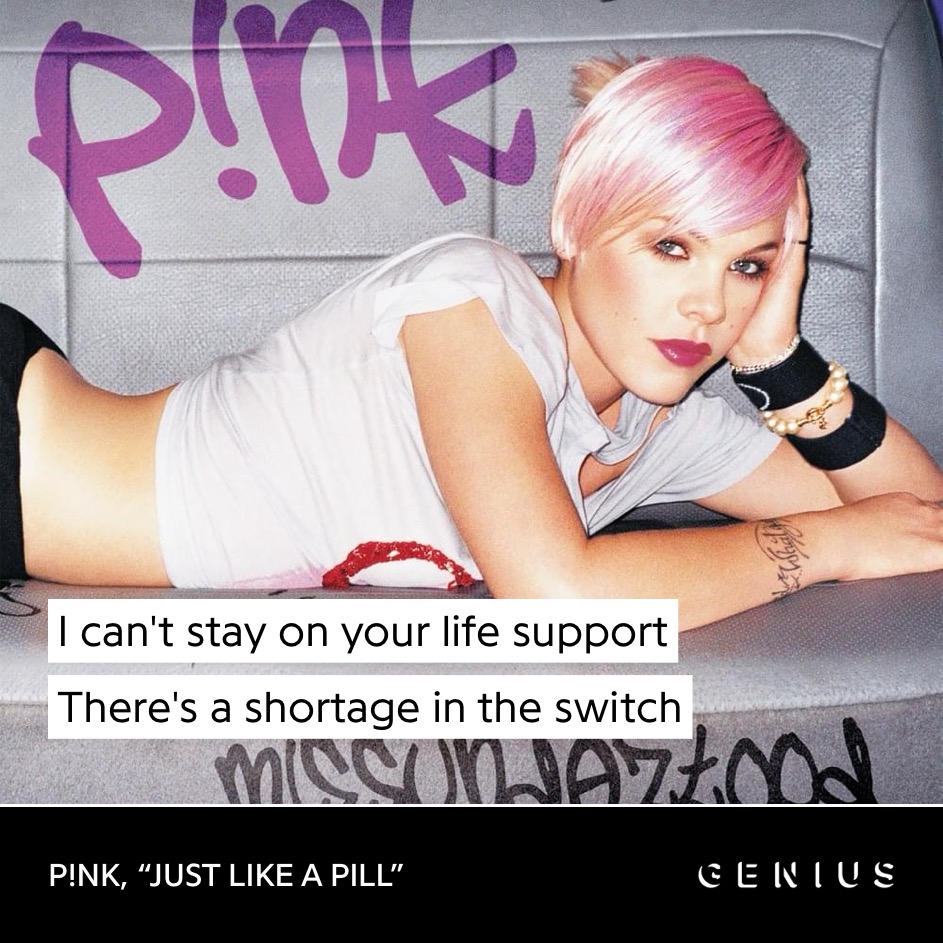
  • Last year, the Hit Parade podcast highlighted one of the most consistent voices in pop music in the previous twenty years. Yet, Alecia Beth Moore, a.k.a. P!nk’s career has been underrated perhaps because it is so M!ssundaztood. First marketed as an R&B act by her record company, P!nk’s debut album, Can’t Take Me Home, introduced the star as racially ambiguous. P!nk’s second album began to bridge the singer into guitar-based rock ballads, which would be the meat of her career. Following the album’s first single, “Get This Party Started,” M!ssundaztood’s second single and second track “Don’t Let Me Get Me” displays Moore’s desire to be a singer on her own terms: a rock-influenced pop star who would sing about what she wanted to.

    I CAN’T STAY ON YOUR MORPHINE ‘CAUSE IT’S MAKING ME ITCH. P!nk was signed by Atlanta-based R&B and Hip-Hop label LaFace Records whose president, L.A. Reid tried to market Moore as an R&B/teen-pop crossover act. But rock would become P!nk’s style of choice by her second record with the singles “Don’t Let Me Get Me” and “Just Like a Pill.” However, rock radio never embraced P!nk like it did female pop-rock stars of the ‘90s Alanis Morrissette or Natalie Imbruglia, or ‘00s female-fronted bands like Evanescence or Flyleaf. Instead, P!nk’s venture into rock music seemed to serve the rock-ifying of pop in the ‘00s heard in acts like Avril Lavigne and Kelly Clarkson. P!nk’s second album was her best-selling record. The album’s first three singles were top-ten Billboard Hot 100 hits. And while the R&B- influenced “Get This Party Started” beat the two rock singles “Don’t Let Me Get Me” and “Just Like a Pill,” the rock songs would lay a template for her rock songs that would later top the Billboard chart later in the decade and in the next. 

    I TRIED TO CALL THE NURSE AGAIN, BUT SHE’S BEIN’ A LITTLE BITCH. “Just Like a Pill” and “Don’t Let Me Get Me” were a counterforce to teen pop. In M!ssundaztood’s second single, P!nk laments “Don’t want to be compared to damn Britney Spears. She’s so pretty; that just ain’t me.” P!nk has explained this lyric as not intended to throw shade on the teen pop singer but rather to state that P!nk viewed herself as an intentionally flawed star and that female singers didn’t have to fit into a Britney Spears mold. Furthermore, P!nk wanted to write songs discussing her life, some of which were never the subject of teen pop. In her fourth hit “Family Portrait,” P!nk talks about abuse and divorce, inspired by her childhood and the end of her parents’ marriage. In today’s song, “Just Like a Pill,” Moore talks about a former toxic relationship she had using the metaphor of the negative side effects of drugs to compare the relationship to. P!nk even talked about her past drug use, and the music video seemed more inspired by Nine Inch Nails than Christina Aguilera’s early videos. It was grimier than a pop video at the time and featured P!nk licking her video boyfriend’s stomach. Britney and Christina would make videos similar to “Just Like a Pill,” but at that point, it would be hard to call their music of that era teen pop. 


  •  

    Like Further Seems ForeverThe Juliana Theory was legendary in the early pop-punk/emo scene. Also like FSF, The Juliana Theory has ties to hardcore. Lead singer  Brett Detar started as the guitarist for Christian metal pioneers Zao, however, as he explains on Theory’s episode of Labeled,  the band was perfectly content listening to Third Eye Blind on the radio in the van while out on tour. When Theory formed, they signed with Tooth & Nail Records but opted not to be marketed to the Christian Rock format. This decision both helped and hurt their career. On the one hand, they toured with other Tooth & Nail artists and performed at Cornerstone, on the other hand, their initial record sales were quite low. 

    IT IS GETTING BETTER NOW. Unlike Further Seems Forever, I don’t have a deep-seated nostalgia for The Juliana Theory. I heard they were a band name, but I wasn’t exposed to their music until college after the band had broken up. While some of their music was catchy, their Tooth & Nail predecessors did a better job at what they set out to do: further the emo/pop-punk genre. However, at the beginning of this year when I heard their two new singles “Can’t Go Home” and “Better Now,” I found two songs that felt on the level of their predecessors. A big factor in this new Juliana Theory is Brett Detar’s growth as a musician. After the Juliana Theory’s initial run, Detar released two country albums and composed music for films. Rejoining with guitarist Joshua Filedler, the band is now a duo, which is in line with where music is going. Last year, the band released an EP on Equal Vision RecordsStill the Same Kids, Pt. 1Similar to now labelmates Anberlin, The Juliana Theory has decided to release their album in two parts. We are still awaiting the second parts of both releases The Juliana Theory’s and Anberlin’s releases, though. 

    HOLD ON. Better Now” is an inspirational song celebrating the incremental accomplishments a person who is trying to turn their life around makes. The video depicts three situations in which individuals make a decision to improve their lives from bad situations. From a U.S. Forces veteran who regains his ability to walk, to a drug addict mother who chooses to clean up her life because it’s influencing her son, to a mother who chooses to leave an abusive marriage, the message of the video is that change is possible. As the video may be triggering, there are helplines available for various crises. While now may be bleak, music can help us believe that light is around the corner. We just need to hold on a little bit longer. But we don’t need to be in a full crisis to enjoy today’s song. We should learn to recognize and appreciate incremental change in ourselves and in others around us. As a teacher, this is important, especially when dealing with problematic behavior from students. But if we look at where we are on the journey, we can get a more complete picture. There’s hope.

  •  

    In recent years, Skillet has become an apologetics band under the leadership of lead singer John Cooper. But before you could catch him on Fox News, Skillet was the band whose CD you had to hide from your conservative parents, whether it was the fetish-wear-inspired pastiche of Invincible or the snake on the angel mannequin on the cover of Collide. Skillet’s early music was influenced by Industrial bands like Nine Inch Nails and Korn, bands known for their anti-Christian messages.  But Skillet’s early music varied greatly, each album seeming to take a completely different set of inspirations. Their 1996 debut self-titled album and its follow-up Hey You, I Love Your Soul pulled from grunge, while the band’s next two albums delved into a dark Marylin Manson sound.

    I’M EVERYTHING YOU WANTED. When speaking with Shane Told of the Lead Singer Syndrome podcast, John Cooper talked about how he was disappointed that youth groups were choosing secular songs for church skits rather than Christian bands’ songs. He went on to say that he took it as a challenge to write better songs that would impact Christian rock. Following what Cooper ranked as the band’s worst album Alien Youth, Skillet released Collide in 2003. The album is the beginning of the franchise that Skillet is today, a band that is arguably one of the most ironclad brands in Christian Rock along with Demon Hunter and Red. Rather than synth-based Industrial sounds that dominated the band’s third and fourth records (excluding their worship record between the two), the band creates a hard rock sound that is embellished with strings. Their follow-up Comatose would explore this sound, going full symphonic at times and subsequent releases seemed to copy and paste the formula from Comatose. 

    But before the formula was laid, Collide was a great record, and there is still a lot of discourse online defending this album.

    WHAT YOU GOT, WHAT YOU WANT, WHAT YOU NEED. With Collide, Skillet maintained the intensity of their synth-based albums, in part due to excellent musicianship with drummer Lori Peters and the crunchy guitars of Ben Kasica. Through years of trial and error, John Cooper’s gravelly voice in singing and screaming blends well on Collide. The album’s first single, “Savior,” was a crossover hit for the band and introduced them to the active rock radio circuit. When the band wasn’t playing Christian festivals, they began touring with groups like Breaking Benjamin and Shinedown. The band’s promotional team tried to get “Savior” in Spider-Man 2 but failed to procure the placement. The song did,  however, reach number 26 on Billboard’s Rock chart. The music video depicts children living with an abusive father. Cooper said that the video was inspired by his relationship with his father when he was growing up, a topic he would explore in the next album’s “The Older I Get.” “Savior” isn’t an epic song that says “Jesus is the savior,” but rather offers the promise that “everything’s going to crash and break.” What’s left is the speaker of the song, who could be interpreted as Christ. But the song also could support the solution coming from within. This seems absurd knowing the cultural icon Skillet has become, but in 2003 the band was just emerging on the scene and could have gone in a different direction.


  • It’s been 22 years since the post-grunge “Hanging By a Moment” was the number 1 song of the year. Although the Christian Rock band Lifehouse never actually topped the weekly charts, the song had so much statistical force via radio play and record sales that the song became one of the rare cases when a single that peaked at number 2 could actually claim the number 1 position for the year. No Name Face featured three singles, but none were as big as “Hanging By a Moment.” For the band’s follow-up, Lifehouse signed a Christian music marketing deal with Sparrow Records. Stanley Climbfall was nowhere near as successful as the No Name Face, but a sophomore slump didn’t plunge the band into obscurity. In 2005, the band released their self-titled album which boasted their number one hit which was appearing in every TV show that year, the prom/wedding favorite, “You and Me.”  

    I WAS YOUNG BUT I WASN’T NAIVE. Blind,” the band’s second single, was overshadowed by the album’s first massive hit, “You and Me,” just as the other singles from No Name Face. But while the wedding and prom industry needs new songs every year and “You and Me” is a rather fine choice, the brooding “Blind” delves into lead singer Jason Wade‘s childhood and his parent’s divorce. The music video stars actress Tina Majorino, best known for her role as Deb in Napoleon Dynamite, who acts as a goth chick browbeaten by her womanizing father. Majorino’s character seems to act as a foil to Wade. When the band is playing in the goth chick’s room, Wade and the girl make knowing eye contact for a moment. Interestingly, the normally no-frills Jason Wade is seen in this video wearing eyeliner, sometimes called guy-liner, a trend that punk and emo groups rocked at this time. Some examples were Green Day and My Chemical Romance. Lifehouse was far from being a dark emo band, but “Blind” was one of their darker songs. Furthermore, Lifehouse in the video seems to represent the role that music plays in escaping childhood/teenage trauma. For one of their biggest Christian Rock hits, Lifehouse didn’t make a moralizing video, but rather when the father is out on his infidelity escapades, the daughter throws a party where everyone dances to Lifehouse and she kisses a boy. And from this party, she comes to the clarity that it’s time to leave her father’s house. 

    I WOULD FALL ASLEEP ONLY IN HOPES OF DREAMING THAT EVERYTHING WOULD BE LIKE IT WAS BEFORE. My mom always scolded me for watching music videos, so as soon as she went out, I’d watch TVU, Fuse, and whatever other music channel wasn’t playing reality TV. Every time this video came on my sister and I would yell “It’s Deb!” When I was growing up my parents fought constantly. I remember going to bed to the sound of their fighting some nights. My parents told us that they made a commitment to marriage so they would not get a divorce. My mom’s parents had divorced, and it probably left a lot of emotional scars. But I secretly wanted my parents to divorce. Maybe it would solve the bitter arguments. For years I blamed my parents for distorting my ideas on marriage. I told myself, if this is marriage, I don’t want it. My parents are still married but live very separate lives. They live in the same house but on opposite sides. They work different schedules. They spend time together, but too much time sets them off on each other. I’ve let a lot of it go since I’ve been away from my family. I think that my parents let go of their childhood trauma in a similar way once they moved away from it. Maybe we’re not really over it, but at least there was the music to help me through it.