• Carly Rae Jepsen became an overnight success with “Call Me Maybe.” Nobody expected the juvenile Kiss to be followed up by E-MO-TION, a pop album praised by critics and fans alike. The standard edition of E-MO-TION has twelve songs, but there were many other songs on deluxe editions of the album. Jepsen wrote over 250 songs in three years while working on E-MO-TION. She released eight extra songs Emotion Side B a year after releasing her third album. In Japan, Jepsen released Emotion Side B+, including “Cut to the Feeling,” a song she gave to the American version of a French/ Canadian film called Ballerina (Leap! in the United States) Jepsen also starred as one of the main voice actors in the film. The anthemic one-off single bridged Carly’s 2015 critical darling with her more experimental 2019 album, Dedicated


    I HAD A DREAM, OR WAS IT REAL? Carly Rae Jepsen’s last Billboard Hot 100 entry was the lead single from E-MO-TION, I Really Like You.” Competition for the chart positions was fierce in an oversaturated market. Manager Scooter Braun pushed Jepsen to include the hook-filled (but often memeified at the time) “I Really Like You” on E-MO-TION; however, no other single from the album charted, despite the album’s stellar reviews and cult following. Jepsen took control of her own career which didn’t translate to the massive success of her breakthrough hit in the streaming era; however, despite not being a mega superstar, Jepsen became one of the biggest indie pop stars, a sort of B-list of pop stars who may not have the commercial recognition but who are fervently supported by their fans. And Jepsen’s fans are quite diverse, spanning from pop lovers to hipsters to the LGBTQ+ community. In any other era of pop music, “Cut to the Feeling” would have had at least a top 40 hit. Jepsen cut the song from her third album because it sounded “too cinematic and theatrical.” I wonder what the song would have done as a proper single on E-MO-TION, but Jepsen’s fidelity to her musical vision has made her the outstanding artist that she is. 

    NO MORE IN-BETWEEN, NOW GIVE YOUR EVERYTHING TO ME. In December 2016, Ballerina was released in France and the U.K. The French-language film was released in Quebec in February and the rest of Canada in March of 2017. The Weinstein Company acquired the rights to distribute the film in America. The company edited the film and rewrote the script in English, casting Elle Fanning, Nat Wolff, and Carly Rae Jepsen in the main roles, and Mel Brooks and Kate McKinnon also voicing roles in the film. The French version of the film was praised by critics for its animation and storytelling, but the American version was mostly panned because the story failed to stick out among many other all-ages animated films. Leap! was an example of Hollywood ruining films just because Americans are too lazy to read subtitles or learn a second language, or in the case of the American IT Crowd, listen to non-American accents. The film did feature three original songs including Carly Rae Jepsen’s “Cut to the Feeling.” Two of the songs Sia’s “Suitcase” and another song Jepsen contributed to the film “Runaways” are not available on Spotify or Apple Music, but can be found on YouTube. “Cut to the Feeling” is a celebratory song and a staple in Jepsen’s catalog. She still performs it with an inflatable sword, which many fans also wield during the performance. The song is bigger than the animated film in which Jepsen voice-acted and released the song. But thanks to Leap! we got one more of the 250+ songs from E-MO-TION’s writing sessions. 


     Read the lyrics on Genius.

  • In 1996, Welsh singer-songwriter   Donna Lewis released her debut single “I Love You Always Forever.” The understated, delicate pop song became an international hit. In the United States, it hit number 2 on the   Billboard Hot 100, unable to take the top spot because of multiple versions that counted as Los Del Rio‘s version of  “Macarena,” the dance track that plagued ’96. Lewis never matched the success of her debut single.


    SECRET MOMENTS SHUT IN THE HEAT OF THE AFTERNOON. Donna Lewis wrote the song “I Love You Always Forever” basing it on a 1953 novel, Love for Lydia by Herbert Ernest Bates. The lines from the chorus “I love you always forever, near and far closer together” appear in the novel, and Lewis’ original title for the song was “Lydia.” While Lewis had a few other minor hits, such as “At the Beginning,” a duet with Richard Marx on the 1997 song for the Anastasia original soundtrack, “I Love You Always Forever” is the singer’s signature song.  The lush imagery in “I Love You Forever and Always” transports the listener to a “cloud of heavenly scent,” to a “windless summer night” to “the heat of the afternoon” or simply to look into “the most unbelievable eyes [you’ve] ever seen.” The success of the sentimental ballad shows that music despite whatever musical trends do, soft rock ballads with sappy lyrics can always pierce through the hipster trends. And because of musical trends, “I Love You Always Forever” has been covered several times in recent years. Today, I’ll talk about two covers from artists I have written about several times: Mike Mains and the Branches and Betty Who.

    YOU’VE GOT THE MOST UNBELIEVABLE BLUE EYES I’VE EVER SEEN. Mike Mains & the Branches released their cover last year and is their most recent single. After an emotionally taxing record, When We Were in Love in 2019, “I Love You Always Forever” is a nice check-in with the couple whose marriage was tested by events mentioned in the record. Betty Who’s version was released as a single between her debut record, Take Me When You Goand her sophomore record, The ValleyThe single was so successful, though, that Who decided to promote the song as the lead single from The Valley and include it as the fourteenth track of the record. Who’s version topped Australia’s airplay chart, reached the Top 4o in New Zealand, and topped Billboard‘s US Dance Club Songs. Who told Spin about why she chose to record the song. She said, “It’s one of those songs that you don’t know, and when you hear it you go, ‘Ah I know this song.’” She went on to say in Vogue that she remembers the song being “everywhere” when she was 5 years old in ’96.  Mike Mains’ version adds masculinity to the track, but Who’s version adds sensuality absent from the other two versions. The harmonized a cappella starts with soft, yet sharp vocals piercing the song combined with the music video in which Who is part of a throuple adds a bit of naughty with the nostalgia. Not there’s anything wrong with that. However, if you prefer to spend your always and forever, with Lewis, Mains, or Who, you’re bound to have this song stuck in your head and only pleasant thoughts of summer afternoons flooding your thoughts.

    Donna Lewis version:

    Betty Who version:


    Dance version from To All the Boys I Loved: 
    Mike Mains & Branches version: 


    Read “I Love You Always Forever” by Donna Lewis on Genius 

  •  

    I thought I’d share a repost today, a dusty memory about New Order, more specifically a keyboard from the ’90s that listening to New Order today makes me think about. Buried under twenty years of dust in my parents’ garage lies an old Yamaha keyboard. It was my dad’s Christmas present to my mom in the mid-90s. This model came with 100 recorded instruments, 100 styles of drum beats, everything from foxtrot to metal, and 25 or so recorded songs. It was a pretty typical family keyboard, but it kept me entertained for years. Although I started playing guitar at the age of 12, I had spent a long time messing around on that keyboard trying to make music. I loved playing the keyboard but hated how fake the instruments sounded. Strings, brass, woodwinds–all sounded like the vegetarian version served at camp meetings. Still, that keyboard played such a crucial role in music in my life.   


    WHEN I WAS A VERY SMALL BOY. I got my first taste of synthesizers from my keyboard. I learned about the Orchestra Hit. It was the sound used in the hits by Britney SpearsBackstreet Boys, and *NSync. Other synths were used in hits like Eiffel 65‘s “Blue” or Darude‘s “Sandstorm.” And of course, all the computer games I was playing had similar synth music. But as the 2000s took full swing, I started to feel frustrated with the family keyboard. My friend’s family had a newer model, and their instruments sounded 2% more real. This didn’t stop me from playing it or using it to create weird songs with my sister on a tape player. I fully loved keyboard synthesizers without appreciating their origin story. My mom told me one day that I was going to start guitar lessons. I just said okay, but part of me was screaming out that I wanted to learn piano first. Why? Michael W. Smith was so cool back in the ’90s. I wanted to learn how to record trippy music like on Delirious’s Mezzamorphis album. And there were Skillet‘s Invincible and Alien Youth albums. And Linkin Park was getting popular. And Earthsuit‘s  Kaleidoscope Superior had me wondering how could Paul Meany rap so fast when playing the keyboard. I took the guitar and loved it, but rock without keys is kinda boring.

    MY MORNING SUN IS THE DRUG THAT LEADS ME NEAR TO THE CHILDHOOD I LOST. I talked about my history with New Order in January two years ago and about my initial disdain for the ’80s sound in February of last yearAnberlin was certainly my gateway drug to New Order’s discography, as they released a cover of this song as the third single from their New Surrender album cycle, rereleasing their album with a bunch of B-Sides. A college professor I worked for loved this song, so I started getting into New Order. I don’t remember when I first heard this song, but I steered away from it for years because of the old synthesizer sounds. I thought it sounded like something I could have recorded on my mom’s keyboard. But years down the road, I see that’s the charm of these old synth classics. The song opens with larger-than-life electronic drums. The keyboard keeps a dark atmosphere throughout most of the song until the end, shifting into a major key. New Order is the real deal. Pop and rock musicians look to their synth-pop songs for inspiration. 

    Music Video:

    Anberlin cover

    My Calvins commercial featuring “True Faith”:

    Parody with James Corden: 


  •  

    Turn Off the Starsself-titled album is one that I listen to every year. The band only released one album in 2006, which contained several reworked songs from their 2004 EP Everything Is OK. The Brit-pop-inspired Toronto-based band’s lyrics are simple. Their minor hit “Please” only has two verses and what could be better described as a pre-chorus and a drop if the song were EDM. The song is a guitar-driven track and, of course, is not electronic dance music. The band creates a wall of sound with the guitars that reach a climax after each pre-chorus. Like bands like The War on Drugs and The Amazing, “Please” creates tension with two chords–E minor and C– for most of the song. The song adds D and A minor to pay off the tension. While the guitar is the star of the song (no pun intended), lead singer Michael Walker’s vocals, particularly his falsetto on the pre-chorus contribute to the emotional payoff of the song.

    WAIT, WHAT A BEAUTIFUL DAY. “Please” is my favorite song on Turn Off the Stars’ album, but the melancholy tune has been the soundtrack for many worries. I’m a recovering catastrophizer. Earlier this month when I watched Inside Out 2 (spoiler alert) and saw Anxiety taking the controls, I thought about how many times I let Anxity take the wheel. I always thought that if I worry about it, it will either not happen or not be as devastating when it does happen. Then I thought about how the new characters in Inside Out 2 seemed to be introduced a little late in the lifespan. Most of my anxiety came as I was a kid. It wasn’t really social anxiety until I was a teenager, but I deeply understood the character of Anxiety making plans “if this, then this”; always worst-case scenarios.  To alleviate my anxieties, or so I thought, I prayed about everything that could happen: “God don’t let the house burn down. Don’t let it explode. Don’t let it collapse under the weight of the snow. Don’t let there be a power surge that fries us when we use the microwave. Don’t let there be faulty electrical wiring in the house.” And so on. 


    I KNOW THAT YOU DON’T UNDERSTAND. When I was about 10 or 11, I began to have anxieties that I wasn’t worthy when Jesus came back again. I said my prayers every night, often falling asleep to them, but I also thought about the bad thoughts I had throughout the day and the times that I disobeyed my parents. And as I got older, there were strange, sexual thoughts. It didn’t help that Sabbath School lessons talked about never knowing if you are saved and things you do keeping you out of heaven. But there was one friend I had that seemed to be calm in his faith. He seemed to just believe and not worry about anything. One night I prayed the sinner’s prayer as outlined by the Baptist theology I was exposed to from my dad’s side of the family and the evangelical media that we had in the house. And that was the point where I began to trust God. This happened around when I was about 12. Of course. For many years, I looked at this as my salvation story. But of course, my readers will know that there is a lot more to this story, and I interpret this grace from my anxiety in a different way today. When we’re kids, we don’t have a lot of control over our circumstances. When we’re adults we have choices that can keep us up late at night wondering what’s the differences between what’s behind doors number 1, 2, or 3. “Please” is a song about those late-night decisions. It’s about that late-night grief that lasts until the morning. In the end, we all need to draw our own conclusions to get past it, and ultimately we need faith in something even if that’s just yourself. 


  • Today we take another dive into my #1 album from 2022, Tyson Motsenbocker‘s Milk Teethspecifically a song that seems unmatched with the other tracks, “Hide from the World.” The song breaks up the musical themes established in the first four tracks. But “Hide from the World” adds whimsical guitar chords and equally whimsical lyrics. Then it’s back to the serious musical tone by track six, “UC Santa Cruz.”

    I WANT TO HANG IN SNOOPY’S DOG HOUSE AND HE SHOULD BE THERE TOO. Unlike the other songs on Milk Teeth, in “Hide from the World” Tyson Motenbocker chooses easily accessible references. On other tracks, Motsenbocker references locations, alcohol brands, and bands, and uses vocabulary that merits a Genius annotation. But except for extremely sheltered evangelical or ex-vangelical kids particularly with the Harry Potter reference in “Hide from the World” most listeners quickly assimilate the meaning that Motsenbocker suggests with the allusions in the song. The sentiment is shared on other tracks, but most succinctly expressed in today’s song. Some days you’ve just had enough and it seems like there’s nothing else the world can give you. It’s “I Blame the World” 2.0. The music video features a man who wants to be alone, but another man, played by Tyson Motsenbocker, tries to impose on the protagonist with a cheerful attitude. At the end of the video, the protagonist discovers a tent in the middle of the forest where he can be truly alone. 

    I WANT THE TENT FROM HARRY POTTER WITH THE FLAP TIED SHUT. Being a teacher, I have to perform a lot for my students. I have to put on a happy face and support my students on their good and bad days. It’s a profession I gladly chose. However, I am an introvert. My resting state is not going out after work. And this is especially true when things get busy or I have a bad day. What’s worse is that my workload has steadily increased every year of my teaching. I’ve taken on or have been tasked with more responsibilities, whether it’s supervision or extra classes. This year is a particularly difficult year with incredibly large class sizes. It feels like I’ve been training my entire career for this year when I feel like I’m on all the time. And when things go wrong, they cause other problems. At the end of the day today, I just felt done. I wanted to hide from the world. I wanted to hide from everyone no matter how kind they were today. The last two classes of the day were with pubescent middle schoolers trying to have their way and lying that they didn’t do anything wrong. There wasn’t enough coffee in the world. But the day did end. Thank God summer break is next week!

  •  Musically, Underoath’s most recent record Voyeurist pays homage to different points in their 25-year career. On the band’s breakthrough album, They’re Only Chasing Safety, Underoath experimented with elements not always heard in Metal. One example was including a church choir on the song “It’s Dangerous Business Walking out Your Front Door.” According to Tim McTague on the episode of Labeled Deep Dives about today’s song “Hallelujah,” the Underoath guitarist said he made up a story about how the 2004 single had religious significance in order to record a youth choir in a church basement. Eighteen years later, the second song on Voyeurist prominently features a choir, this time in the chorus. But unlike “Dangerous,” Underoath had distanced themselves from the Christian music scene.  In an interview with Loudwire, Tim says that “Hallelujah” is about “struggles with everything – faith, life and so on.”  The presence of a choir on “Hallelujah” and the track’s title serve as a kind of musical and lyrical contrast. The lyrics offer title hope, except for the line superimposed on the song: “Hallelujah.” The song is an interesting approach to songwriting; interpolating religious themes from the band’s past and re-contextualizing them.


    WE’RE NOT DREAMING, THIS IS HELLHallelujah is a Hebrew word taken from the scriptures. The word’s most frequent occurrence is in the book of Psalms, the book of poetry that was often sung. Throughout the ages, countless songs have used this word or its Greek variant alleluia, usually in a religious context. From the Gregorian Chant of the Middle Ages to the Christian hymns of the 19th century to the most moving part of George Frideric Handel’s The Messiah, the word Hallelujah alludes to worshiping the Judeo-Christian God. But in 1984, when singer-songwriter Leonard Cohen released his single “Hallelujah,” which has been covered by countless artists, the singer reappropriated the word into a secular setting. The song was a new standard that both people of faith and people of doubt could resonate with. The first two verses of the song tell a story from the Hebrew Bible (or the Old Testament), about David and Samson, two men who have been judged for moral failure by readers and theologians. The third verse of the song addresses the speaker’s doubt, saying “Maybe there’s a God above.” Of course, Cohen’s “Hallelujah” doesn’t take the word completely out of its religious context. And neither does Underoath, a band who will be writing about their deconversion story until they break up. Lyrically, Underoath’s “Hallelujah” deals with the feeling of alienation after deconstruction. There’s bitterness due to the rules that the Christian music industry imposed on artists like Underoath. There’s anger toward the industry that covered up frontman Spenser Chamberlain’s drug addiction in order to continue making money on the band’s financial success. And there’s disappointment in a church that fosters an environment that says it wants honesty, but ultimately the honest get screwed. 
    THIS MADNESS MAY BE IN MY HEAD. Underoath isn’t alone in their deconstruction movement. Many former Christian bands and musicians end up in a place of doubt and recontextualization. In the past, the mainstream of Christianity dismissed this deviation as heresy. Denominations and cults started or individuals rejected religion or merely embraced an individualized spirituality. But never did the aggregate have to acknowledge the reasons why someone left the mainstream if they could just call that person a heretic. Today entire communities are forming around talking about religious trauma. There are deconstruction and ex-vangelical communities almost in the same way that there are denominations. There are probably as many reasons why people deconstruct their faith as there are deconstructionists. Common themes these days revolve around political Christianity, race, gender, and sexuality. Underoath’s “Hallelujah” makes me think of several stories in my own faith journey, but today I’m fixated on the contradiction I felt from reading William Blake’s “The Chimney Sweeper” from Songs of Experience in my Christian university. The poem critiques the Industrial Revolution for its human toll on the poor, in the case of the poem, the children of the poor who had to work sweeping the chimneys. Many of the children died in accidents or contracted lung cancer. Rather than focusing on the need for social justice and the fact that this horrendous exploitation happened in a Christian country and that Blake appealed to the Christian compassion of his readers, the professor teaching the class merely scoffed at the literature and focused on Blake’s unorthodox, heretical religion. Eventually, the human suffering would be alleviated through ungodly socialism, we would learn in the course. The ungodly part wasn’t in the Norton Anthology of English Literaturebut the instructor’s take on it. The words of Blake, though, reminded me of the Christianity that I wanted to be a part of, preached by Stephen ChristianBono, and Underoath at the time. But it seems more and more that my professor’s downplaying human suffering is where Christianity has headed. No wonder more people are turning out like William Blake.
    Music visualizer:

    Digital Ghost performance:

    Lyric video

    The version featuring Charlotte Sands:

    Read the lyrics on Genius.

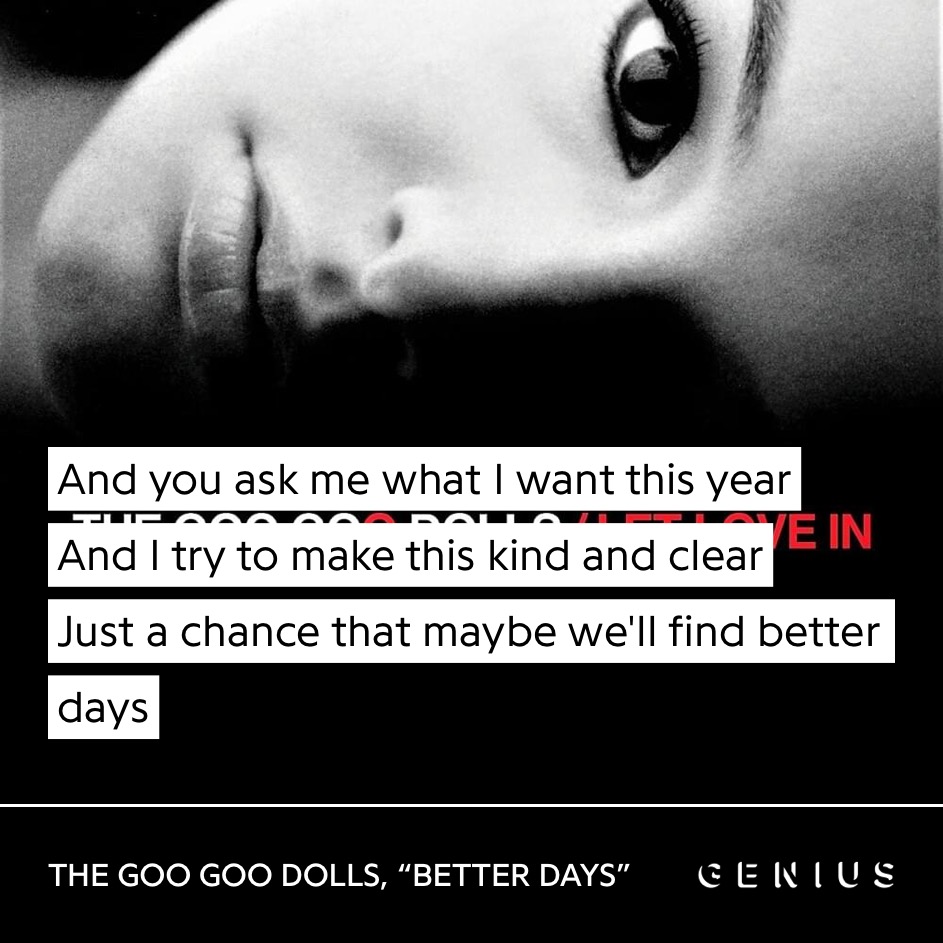
  • In 2006, The Goo Goo Dolls celebrated their 20th anniversary as a band. It’s hard to imagine that the band that started as a punk and metal group from Buffalo, New York, became a staple on Adult Contemporary radio. Their breakthrough song, “Name,” was a lazy-day acoustic track. The band’s biggest album, Dizzy Up the Girl contained a few upbeat acoustic rock tracks like “Broadway” and “Slide.” Still, their biggest song, “Iris,” from the film City of Angels was similar to “Name” except for cinematic string production. Their follow-up, 2002’s Gutterflower also contained the upbeat “Here Is Gone” as well as the rocker “Big Machine.” But in the band’s 20th anniversary year, The Goo Goo Dolls released their mellowest album, Let Love In


    TONIGHT’S THE NIGHT THE WORLD BEGINS AGAIN. I remember my dad saying something like when a band starts to release covers, it’s a sign of the end. I don’t know if there’s data on this, but I’ve noticed cases of this from Sixpence None the Richer to Limp Bizkit. This seems particularly true when the cover is a lead single from the album. A well-chosen cover can give a band with diminishing charting potential a final boost before they fade into fan-only obscurity. In 2004, The Goo Goo Dolls released a cover of Supertramp’s “Give a Little Bit.” While “Give a Little Bit”  was technically not the lead single to their seventh album, Let Love In, the song’s peak at #37 on Billboard’s Hot 100 did signal the waning of The Goo Goo Dolls as hit makers. The lead single for Let Love In, Better Days” bested the cover with a peak at #36, and after that, the band had no more top 40 hits on Billboard’s flagship chart. Despite the band’s fading commercial mark, they continue to release music today. Their sound remains consistent like their ‘90s and ‘00s albums. 

    THE ONE POOR CHILD WHO SAVED THIS WORLD.  The Goo Goo Dolls have several songs that could be described as hopeful and inspirational, but “Better Days” is by far their biggest uplifting anthem. The song was included on a Target-exclusive Christmas album in 2005. The song makes several references to Christmas and even the Christ child. Singer and lyricist John Rzeznik has written about religion in several of The Goo Goo Dolls songs, most notably alluding to an abortion in the song “Slide.” With a “strict Catholic upbringing” until his untimely orphanhood at the age of 15, spirituality remained with Rzeznik’s songwriting. The band rerecorded the song for their 2023 Christmas album, It’s Christmas All Over (Again). In 2005, the song had a moment after the devastation of Hurricane Katrina. CNN and ABC played the song as footage of the catastrophe showed on TV. The song also made John Rzeznik’s Covid livestream setlist that he broadcasted on Facebook live from his front porch. While it’s not Christmas for more than another five months, “Better Days” is an inspirational song we need in what seems like a very dark year. We certainly need hope to keep going. 

  • Last year, Time named Taylor Swift as Person of the Year. She is the first musician to ever hold the title. The musician has certainly permeated into all facets of culture in 2023 as part of what many have called her “Imperial Phase” or maybe Imperial Era?  The biggest artists reach the “Imperial Phase” of their careers before another star rises. There is a part of the American psyche that roots for Taylor Swift–the teen star from Pennsylvania who treated her fans well to a billionaire jet-setting pop star. A big part of how Taylor won the hearts of America–and the world–has to do with fans and music lovers siding with her side of her feud with Scooter Braun. But another part of Swift’s appeal was shattering the glass ceiling which had limited female musicians in the past. Today, though, we’re not talking about Swift but rather another Era-defining musician who pioneered the idea of a female-led portion of the music industry.

    LORD, MAKE ME AN INSTRUMENT OF THY PEACE. In 1997, Sarah McLauchlin was in her “Imperial Phase.” Four years after releasing her third record, Fumbling Towards Ecstasy, McLauchlin released Surfacing. A hectic two-and-a-half-year touring cycle for Fumbling had both built her career and exhausted the singer to the point that she later claimed that she wanted to quit releasing music after her breakthrough record. But Surfacing was highly successful with its massive hits “Angel,” “Adia,” and “Building a Mystery,” which won a Grammy for Best Female Pop Vocal Performance. But McLauchlin was also building a legacy. The same year she released Surfacing, Sarah founded the all-female music festival lineup Lilith Fair. McLauchlin founded the concert because she was frustrated with radio stations and concert promoters refusing to play two female artists in a row. The tour ran for three years with a revival in 2010. The tour grossed $16 million in 1997, and in the festival’s three main years (the revival was a financial disaster) the organizers donated over $10 million to various charities. McLauchlin laid the groundwork for female musicians to take control of what they could in the music industry, and we’re still seeing the impact today.

    IT IS IN DYING THAT WE ARE BORN TO ETERNAL LIFE. Sarah McLauchlin first released her version of “Prayer of St. Francis” as a bonus track on early versions of Surfacing. Later it was included on her Rarities, B-Sides, and Other Stuff, Volume 2. Although the text of the prayer has been attributed to St. Francis of Assisi (c. 1182-1226), it’s not in any of his writings and only appeared no further back than 1912, when it appeared in a French Catholic magazine called La Clochette, or The Little Bell. The prayer gained popularity during the First and Second World Wars. It was adapted into a song in 1967 by South African songwriter, Sebastian Temple. Sinéad O’Connor performed the song at Princess Diana’s funeral in 1997. Today, we’re listening to Sarah McLauchlin’s version. The singer-songwriter has used religious imagery in many of her songs and has even performed for Pope John Paul II, she does not consider herself religious. She has said, “I don’t follow any organized religion, but I do believe in the idea of god as a verb–being love and light. And that we are part of everything as everything is a part of us.” “Prayer of St. Francis” is the prayer of a servant’s heart, and you don’t have to be religious to want to serve others. 

  •  Lana Del Rey returned last year with the latest installment of her “Carol King Era” of songwriting in Did you know that there’s a tunnel under Ocean Blvd?  This new era of the Del Rey persona created by Lizzy Grant feels like a slow progression away from pop hooks, and maybe where this started was with Del Rey’s second album, UltraviolenceBut Del Rey’s real critical acclaim arrived with Norman Fucking Rockwell!, the album that both ended pop Lana and started the ‘70s-styled singer-songwriter that she followed up with Chemtrails over the Country ClubBlue Banistersand Did you know. 

    GIVE PEACE A CHANCE. Lana Del Rey’s fan base is strong, quick to interpret ever line that the singer writes in the blogosphere. Not only do fans read into her released songs, they also track down her unreleased demos and leak them online. Usually Del Rey pays no attention when one of her unreleased songs is leaked; however, when a sped-up version of “Say Yes to Heaven” started appearing on Tik Tok, the singer addressed the song’s leak by releasing it on streaming services. While the track had been leaked on Tik Tok, fans had been talking about “Heaven” since 2016 when snippets of the song emerged online. With credited songwriting and production to The Black Keys’ Rick Nowels, the song has been rumored to be a track cut from Ultraviolence.  While critics seem to love the new Lana Del Rey, some of us miss the old days of hip-hop beats and wall-of-sound dream pop production. Del Rey seems to be giving the fans what they want with the release of “Heaven,” harkening back to the classic voice, rock guitars, and bad-ass lyrics.  

    LIKE A BARGE AT SEA. I was excited to hear “Say Yes to Heaven,” thinking that Del Rey’s looking back at her musical past may challenge Del Rey to go back to the days when her music was easier to listen to. But “Say Yes to Heaven” feels like a Lana Del Rey b-side. It’s missing something, and I believe that’s the fact that the lyrics don’t hit hard enough. “Say Yes to Heaven” has very short verses and a very simple chorus. It’s also a little cliché: heaven, this song, is falling in love with the speaker. It’s not a “Dark Paradise.” No emphasis is place on how bad this boy is. It’s almost a Lana Del Rey song but it needs to be workshopped a few times before it’s officially album-ready to align the song’s imagery and metaphors with a folk tale in rock ’n’ roll history. Perhaps John Lennon’s “Give Peace a Chance could have been a clue as to where the song could have gone, maybe painting a picture of Lennon as a peaceful revolutionary who tried to live peacefully until he was assassinated. There’s certainly a Lennon-Yoko Ono love story Lana could have woven into the lyrics of “Heaven.” Regardless of the weaknesses of “Say Yes to Heaven,” I hope that Del Rey looks at her past eras and thinks about revisiting some of her old songs.


  • Last year, I listened to a podcast introducing artists who sound similar to another artist to help lesser-known artists expand their fan bases just to hear some takes that the commentators had to say about another artist I was preparing to post about. I didn’t actually end up writing about that artist, but I inadvertently discovered a few new artists to add to my AppleMusic library, one of which was Filipina-British singer-songwriter Beatrice Kristi Ilejay Laus, better known by her stage name beabadoobee.


    BUILDINGS AND RUST.  With over 17 million monthly listeners on Spotify, bedroom pop singer beabadoobee opened for Taylor Swift last year on a leg of the Eras Tour. Laus is just one of many artists that Swift was probably introduced to through a rumored ex, The 1975’s Matty HealyBorn in Iloilo City in 2000 and relocating to London with her family at the age of three, Laus was influenced by indie rock from an early age. At the age of seventeen, she learned guitar from YouTube tutorials after having played violin since the age of ten. In September 2017, she released two songs on YouTube, a cover of Karen O‘s “Moon Song” and an original titled “Coffee.” With 300,000 views on YouTube, Bea signed to Dirty Hit Records. The UK-based label housed acts like The 1975, The Japanese House, Wolf Alice, and Rina Sawayama. After signing to Dirty Hit Records, beabadoobee released several EP and started garnering critical acclaim. Supporting tours with Clairo, labelmates The 1975, and Halsey and admiration by Taylor Swift, Harry Styles, and Khalid for her artistry, beabadoobee has become a kind of artist’s artist.  

    LAST NIGHT’S EMERGENCY. In 2022, beabadoobee released her second full-length record Beatopia. The album shows Laus’s blend of indie rock with acoustic singer-songwriter tendencies. The under-refined elements of the album make the album delightful, from the cover art that looks like it was designed by a child to opening track “Beatopia Cultsong.” Most of the album is more at home in a coffee shop than on the radio, but there are certainly some catchy hooks hidden within the album. Deep within the record is today’s song “Pictures of Us.” The song’s lyrics are vague. The short verses deal with a conflict between the speaker and an unnamed female. Musically, the song reminds me of a ’90s soft rock-forgotten gem. The song was originally written by The 1975’s frontman Matthew Healy about his childhood friend,  Bea rewrote the track about a friend she had when she was a teenager. Of the iconic line in the chorus: “She reminded me that God starts with a capital, but I don’t think I can do it” Laus told Apple Music: “It’s so open to interpretation. To me personally, it means someone that you truly, truly admire, but not being able to be on the same page. But you’re trying to be.”