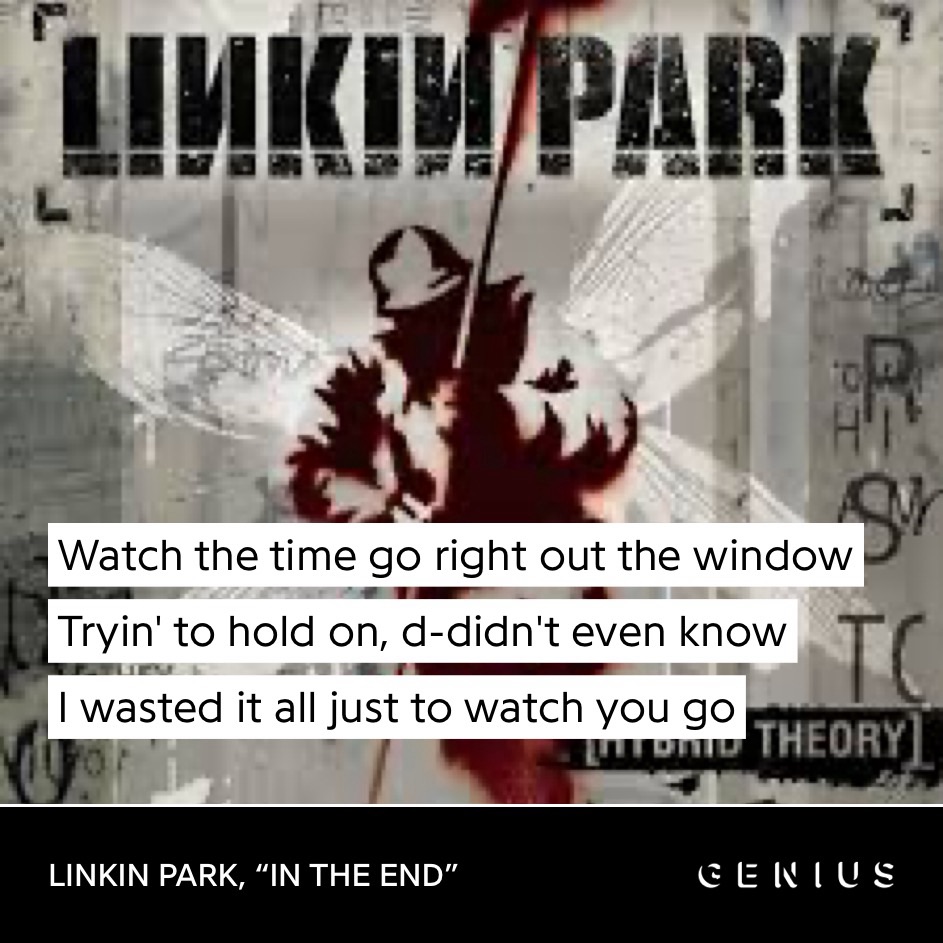
One thing that Linkin Park’s 2000 genre-bending debut album Hybrid Theorydidn’t contain was profanity. This was unusual for the band’s hard rock genre, specifically the Nü Metal sub-genre which was prominent in the late ‘90s and early ‘00s. The band kept the Parental Advisory sticker off their albums until their third album, 2007’s Minutes to Midnight. Linkin Park’s sound was defined by aggressive instrumentation, morose lyrics, and vocal trade-offs between the emotionally grounded Mike Shinoda and the powerful, cathartic voice of Chester Bennington. From the start, the lyrics reflected pain, regret, and sometimes nihilism in songs like “Crawling,” “One Step Closer,” and their cross-over Hot 100 hit “In the End.” The rap-rock essential number-2 hit speaks about the futility of “trying so hard” to get “so far.” Ultimately, effort betrays the speaker who relies on an unnamed subject who lets him down.
IT STARTS WITH… “In the End” is a pessimistic song and a staple in Linkin Park’s catalog. The band’s delivery of a mellow and melodic blend of rap-rock made the song appeal to mass audiences on pop radio. Compared to the hits that shared the radio with Linkin Park’s top hit, “In the End” was a darker song. When the song impacted pop radio in 2002, the radio was transforming from electro teen pop—boybands and Britney Spears to pop-rock and R&B, with artists such as Nelly and P!nk’s rock transformation being some of the top groups. Along with Linkin Park, rock acts like Nickelback and Puddle of Mudd scored mainstream pop hits that year. But none of the pop hits by rock bands were as dark as “In the End.” “Blurry” is a song about a father missing his son in the midst of a divorce. “Hero” by Chad Kroeger of Nickelback and Josey Scott of Saliva was the biggest song from the Spider-Man motion picture. The song from the pre-Disney Marvel franchise seemed to be the product of a more hopeful time at the cinema. But while the realm of pop-rock and R&B was on the more optimistic side in 2002, rock music embodied a range of emotions with hits contemporary to “In the End” being Weezer’s “Island in the Sun,” Tool’s “Schism,” and Jimmy Eat World’s “Bleed American.”
I PUT MY TRUST IN YOU, PUSHED AS FAR AS I CAN GO. In their attempt to connect genres, the band also forged friendships with ‘90s rock titans, metal bands, and rappers. The pessimism of Linkin Park’s “In the End” seemed to connect the dark themes in nu metal, grunge, the 2000s version of post-grunge, and emo. The band’s sound fit in with the “angry white boy” sub-genre of rock, although Linkin Park wasn’t composed of only white musicians. It seemed that music was dark at that time, reflecting a time of uncertainty, disconnection, and dissatisfaction toward life around the turn of the millennium. Lead singer Chester Bennington struggled throughout his life with depression, eventually taking his life in 2017. Linkin Park’s music documents Chester’s inner turmoil, which in later albums plays out as a projection of the global anxieties of nuclear war. Yet, as rock music’s popularity diminished in the more optimistic ‘10s, despite remaining one of the biggest rock bands active at the time, it sank in cultural relevance. In the final months of Bennington’s life, the singer expressed disappointment in the state of rock music and in the band’s unsuccessful attempt to transition into a pop-rock band. Darkness was looming in the late ‘10s, with the rise of populist politics, but pop music stayed apathetic to politics, instead keeping in a hedonistic club culture, ignoring the problems at stake—until COVID.
WATCH IT COUNT DOWN AS THE PENDULUM SWINGS. The message that Linkin Park’s “In the End” conveys is nihilism, a philosophy centered on “nothing matters.” Some have said that nihilism is more of a feeling or even a temporary position rather than a philosophy. Nihilism was explored in 19th and 20th century authors such as Friedrich Nietzsche, Albert Camus, Samuel Beckett, and Bret Easton Ellis. In the ‘90s, Seinfeld explored the concept of a “show about nothing,” taking a comical angle on the philosophy. Nihilistic rock music is rarely quite as humorous. It’s the soundtrack of hard work met with futility. It’s the conclusion of living as if everything can or will be taken away. The aforementioned “angry white boy” music voiced disappointment in the ‘90s with Kurt Cobain raging about social issues. In the ‘00s, the nihilistic lyrics of Staind, Seether, and Three Days Grace conveyed anger, fear, and shame. While not all of the songs by these artists could be summed up with a nihilistic worldview, many of them reflect a speaker who feels that he is inadequately prepared to face the absurdity of life, be it because of misunderstandings between a loved one, feelings of personal lacking, or even an economy that seems designed against the speaker.
TIME IS A VALUABLE THING. Poor, depressed teenage dudes sitting in their gloomy basements, smoking, drinking, experimenting with drugs—that’s what the post-grunge and nu metal genres bring to my mind. I can close my eyes and picture the faces of classmates who bought into the nihilism of ‘00s rock music. As a teenager, struggling with my sexuality in a small town, I resonated with these songs sometimes, but my Christianity brought me back to a position of hope. Musical trends pass, and the “basement dweller” may have gone unnoticed for several years in the mainstream. Last year, Linkin Park reunited and announced a world tour, breaking their seven-year hiatus following the death of lead singer Chester Bennington. The world had gotten a lot more absurd in the time since they had been away. I’ve personally found myself digging into the “break the system,” protest, and sometimes nihilistic lyrics of rock bands, including Linkin Park after last year’s election. Every day I asked myself what matters in a world which tolerates and rewards impropriety. What do laws matter to the lawless leaders? What does diligence in daily life amount to? I’ve fallen behind on my writing, and I have so little motivation to catch up because nothing seems to matter. When I chose “In the End” as the third song in my January playlist, I was anticipating the constant groaning of Trump’s return to office. Two weeks into his second term, it seems that the fear was underestimated. Chaos rules, and institutions we once believed in and took for granted are disappearing. It feels like the end, and it feels like all our efforts never mattered. It feels like when we tried to live good and decent lives with the morals taught at home, church, and school were a sham when subterfuge, lies, and betrayal win. I’m finding it harder and harder to pull myself out of my news doomscrolling and stop catastrophizing about a future that is far from determined. While I feel nihilistic these days, I have to cling to a belief that things are only getting worse before they can get better. I have to believe that in the end, something matters, even if my expectations are underwhelmed in life. And that’s the best I can offer my readers at this time before I spiral into the oblivion of 2025.
Read the lyrics on Genius.
 Mixtapemotions