A “pink elephant” is a metaphor or expression referring to something strange or absurd. The term is often associated with hallucinations or seeing things that aren’t real, especially in the context of being intoxicated. The idea is that a person who is extremely drunk or under the influence of drugs might “see pink elephants,” an exaggerated example of a hallucination. In a broader sense, “the pink elephant in the room” can also refer to an obvious problem or issue that everyone is ignoring or avoiding, though this usage is less common than the phrase “the elephant in the room.” The expression “pink elephant” as a metaphor for drunken hallucinations is thought to have originated in the early 20th century. Its first recorded use can be traced to Jack London’s 1913 novel, John Barleycorn, subtitled Alcoholic Memoirs, in which London discusses the effects of heavy drinking. He writes about how alcohol can cause hallucinations, and while he doesn’t explicitly mention “pink elephants,” this work is often cited as laying the groundwork for the metaphor.
I NEED SURGERY TO KEEP ME BLURRY. Today let’s revisit Stand Atlantic’s Pink Elephant, specifically the hit single “Blurry.” The 2020 album is a solid modern rock album for a band that ventured into harder music on their follow-up records. The lyricism on the album has a predisposition for the bloody, with gritty lines punctuating almost every song. “Blurry” is an example of this lyricism. Comparing a dependent relationship to a “botched lobotomy” and “electric shock therapy,” the song packs an extra punch for an album that isn’t all that heavy. As Halloween draws near, the playlist this week becomes a horror film, particularly. We’ll talk more about that tomorrow.
Last year was the 40th anniversary of Talking Heads’ concert film Stop Making Sense. The concert film was selected as part of the United States National Film Registry in 2021. The media company A24 obtained the rights to the film, remastered it and sent the concert back to theaters globally. After Talking Heads formed in the New York punk scene in 1975, they became pioneers in New Wave and eventually predecessors of Alternative Rock artists. Their musical influence on future generations stemmed from their use of polyrhythms, diverse musical genres such as reggae, traditional African music, and contemporary composers experimenting with avant-garde and minimalism. The band amassed a strong following and rock and minor pop hits. The 1982 concert film Stop Making Sense highlights the band’s greatest hits. After the film, the band released three more albums before officially breaking up in 1991.
I CAN’T SEEM TO FACE UP TO THE FACTS. On January 10th, Paramore uploaded a video to their social media announcing A24 Music’s tribute compilation to the Talking Heads’ concert film Stop Making Sense called Everyone’s Getting Involved: A Tribute Album to Talking Heads’ Stop Making Sense. Paramore released a cover of “Burning Down the House,” the first single from the upcoming album which was released on May 17th. The band had previously talked about their Talking Heads influence. It was the first single the band released after lead singer Hayley Williams fulfilled her 20-year contract with Atlantic Records. The tribute album features current artists covering the classic concert setlist. Miley Cyrus, Paramore, Lorde, girl in red, The National, and eleven other acts contributed sixteen tracks to the 1983 classic concert setlist. The full album received mostly positive reviews. Emily Swingle of Louder particularly praised The Linda Linda’s version of “Found a Job” as “the finest tribute.”
YOU START A CONVERSATION, YOU CAN’T EVEN FINISH IT. The concert film Stop Making Sense opens with Talking Heads’ first hit, “Psycho Killer.” The song originally appeared on the band’s debut album Talking Heads: 77, released in September 1977. Many people thought that the song was about the New York serial killer the Son of Sam, but lead singer David Byrne claimed that the band
wrote the song long before the 1976 killings. The 2024 tribute album also opens with “Psycho Killer,” performed by Miley Cyrus. In a flamboyant performance, Cyrus changes a few lyrics and updates the sound of the classic rock track. Cyrus’s version is scary with the deep vocals spelling psycho throughout the song. The cover also seems to differ from the Talking Heads’ version with Cyrus taking cues from Lady Gaga’s “Bad Romance” or “Poker Face” and David Guetta’s “Titanium.” Cyrus said that she took inspiration from Kylie Minogue when recording her cover of “Psycho Killer.” The cover and the original differ in perspective, with the original seeing singer David Byrne channeling the killer and Cyrus as a horror film victim who “love[s] a psycho killer.” Both versions are spooky editions of a Halloween playlist. Hopefully, the tribute album reignites interest in the quirky work of the Talking Heads.
Twenty years ago, Blindside released their second major-label album, About a Burning Fire. The songs on the album helped to form the classic sound for which the band is remembered while pushing the band creatively. The album features a collaboration with The Smashing Pumpkins’ Billy Corgan on “Hooray, It’s L.A.” The song “Roads” flirts with jazz and the song “Shekina” features orchestration and Swedish yodeling,molding Blindside into more than a hardcore band with a softened sound for radio potential with some of the mellowest songs in their discography. The album’s final song, though, the title track “About a Burning Fire,” features mostly unclean vocals similar to the band’s earlier work. Most of the songs on the album are heavy with lead singer Christian Lindskog balancing clean vocals with occasional screams The album’s lead single “All of Us” bubbled under the Modern Rock chart but the video was a hit on Fuse TV. The second single, “Follow You Down” was a hit on Christian Rock radio.
I MISS MAKING LOVE IN THE SUNDAY AFTERNOON SUNLIGHT. Blindside’s 2002 album Silencewas a surprising success. Touring with P.O.D. and forming a friendship with the band and their circle proved to be part of the secret to this success. The other part was the production of P.O.D.’s producer Howard Benson who helped the band refine their two biggest albums. Silence had exposed the band to film, radio play, MTV, and late-night show performances. About a Burning Fire charted higher on Billboard’s Albums chart than Silence. Unfortunately, the album’s impact was far less than its 2002 predecessor. About a Burning Fire was the last album that Blindside released on Elektra Records after the label’s parent Warner Music was sold to Atlantic Records. Blindside went independent for their next record The Great Depression, which failed to garner the commercial success of their two major-label releases. Realistically, About a Burning Fire was never slated to be a big radio hit, even on rock radio. Christian Lindskog’s sing-scream was a sound that never got much radio play and the scream became less and less popular as the ‘00s pressed on. Still, the heavy music domination was still coming with the success of groups like Underoath, The Devil Wears Prada, and Bring Me the Horizon selling records even if their music wasn’t always rock-radio friendly.
YOU WERE NEVER LATE TO PICK UP THE PHONE AND CALL. NOW IT’S FALL. Consistent throughout Blindside’s discography is their poetic lyrics. “Across Waters Again” is an album track on About a Burning Fire that discusses the difficulties of being an international band. Singer and songwriter Christian Lindskog specifically addresses missing his wife in the song and longing to return back to his homeland of Sweden as he’s spending time in other countries, particularly the smog of Los Angeles where the band recorded About a Burning Fire. The lyrics poignantly express the effort needed to keep a long-distance relationship. The motif of the passing of time and the setting of autumn give the song more urgency. Lindskog had addressed this topic before when writing the band’s second album, A Thought Crossed My Mind. The band’s success only grew since that time, causing Blindside to spend more time in America. Touring eventually calmed down for the band as they began longer intervals between their albums. “Across Waters Again” with the band’s musical clarity, Lindskog’s poetic lyrics, and Benson’s sharp production contain a broken beauty that could not last: a hardcore band from Sweden whose hearts were divided between making great music and taking care of families and responsibilities back home. Ultimately, the families won and we’re left wanting another record from Blindside. But who can blame the band?
In September last year, Paramore released Re: This Is Why, a remix album of the original featuring big-name collaborations like Julien Baker, Wet Leg, The Linda Lindas, and others. Paramore tweeted about the album: “Re: This Is Why is almost a remix album. Some of the songs have been remixed sort of classically, while others were reworked or rewritten. It’s incredible to hear all our worlds colliding.” The album is mostly for fans of the band’s sixth studio album, This Is Why. Some of the reworked songs are more interesting than the originals, but the original versions of the songs on This Is Why make a consistent record and one of Paramore’s best efforts. All the songs from the original album are represented on the remix album with “Running Out of Time” receiving two remixes. The remix album also included an extra song, “Sanity,” a demo of a song the band had written during sessions for After Laughter.
EVERYONE IS BAD, SO WHY ARE YOU A PACIFIST? Some songs on Re: This Is Why are remixes of Paramore, some are collaborations, and some are covers. The first song “This Is Why” features instrumentation by the English band Foals. The second track “The News” features Paramore in the verses and teenage band The Linda Lindas in the chorus. “Running Out of Time” is presented as two classic-style remixes with manipulated original audio. “C’est Comme Ça” is the first of several covers on the album. Rather than Paramore performing the track, Wet Leg performs the track in their own way. The Paramore version of the song stretched Paramore into punk and post-punk, but “C’est Comme Ça” fits perfectly into Wet Leg’s discography. Other cover versions on the album are Bartess Strange’s “Figure 8,” Julien Baker’s “Thick Skull,” and Remi Wolf’s “You First.” These covers do not feature Paramore’s lead singer Hayley Williams singing–as far as I can tell–but I haven’t been able to find out if guitarist Taylor York or drummer Zac Farro contributed to the music or if the other artists’ teams contributed the instruments.
WHICH WOLF WILL WIN NOW, BABY? On Paramore’s 2023 headlining This Is Why tour, the band opened with the non-single “You First.” Several contributors to remix albums opened for the band on their 2023 tour including Foals, The Linda Lindas, Claud, and Remi Wolf. Remi Wolf opened the show for Paramore’s Australian/New Zealand leg. Wolf’s jangly alt-pop sound makes “You First” a stand-out song on the remix album. Paramore’s version of “You First” is a well-written track that drops in several metaphors with memorable lines. Lines about being in a horror film, the myth of the two wolves, and the central metaphor of feeding a stray animal give the song a memorable spot on This Is Why. Remi Wolf’s version becomes a standout track above the remixes of the hits that seemed to have slightly degraded the original versions. Wolf’s version is an upgrade on the original. When I first listened to This Is Why, “You First” wasn’t a particular standout track. Remi Wolf’s version sees rewritten lyrics that tighten up the metaphors, making the song “hit . . . with a tide of bricks.” The music is also a bit tighter, Wolf’s funky ‘70s flare with ‘90s alt-rock guitar. In whichever form you choose to consume the song, the lyrics remind us that no one is really good and that everyone must take account of their actions. But in a classic Paramore fashion, revenge feels much better when the other person gets their comeuppance first.
I’m probably not the only one who thinks of Halsey as a pop singer. It’s forgivable considering the singer’s breakthrough hit was a feature on The Chainsmokers’ biggest hit “Closer,” and her Spotify top songs also sound like late ‘10s electronic songs. Halsey’s pop career was a deliberate effort after she was featured on “Closer.” Her second and third albums, hopeless fountain kingdomand Manicwere described as more “radio-friendly” than her debut BADLANDS. But after earning a solo number-one Billboard Hot 100with the song “Without Me,” Halsey’s musical style has shifted from radio pop. Her fourth album explored industrial rock and alternative rock especially with If I Can’t Have Love, I Want Power’s Nine Inch Nails production team of Trent Reznor and Atticus Ross. On October 25, Halsey is set to release her fifth album, The Great Impersonator, and the singles from the album take similar influence as the singer’s previous album.
I ALWAYS KNEW I WAS A MARTYR AND THAT JESUS WAS ONE TOO. Ashley Frangipane, known by her stage name Halsey, hasn’t had an easy life.
Frangipane was born to a white mother and an African-American father in New Jersey. Her parents dropped out of college because of the pregnancy. Halsey attempted suicide at 17 and was diagnosed with bipolar disorder. She started taking drugs soon after being hospitalized for almost three weeks. She was accepted into the Rhode Island School of Design, but dropped out to attend community college, unable to fund her education. She later dropped out of community college and her parents kicked her out of the house. She was homeless, staying with friends in New York, particularly spending the most time around Halsey Street Station, eventually adopting the name as her stage name. Halsey told Rolling Stonethat by the time she was kicked out of the house, many of her friends were “degenerated stoners,” sometimes drinking Red Bull to stay awake for days because it was safer to stay awake for fear of being raped in the night.
I MINED A COUPLE DIAMONDS FROM THE STORIES IN MY HEAD. Tuning the guitar at the beginning of “Lonely is the Muse,” the second single from The Great Impersonator, is a jarring start to a grungy- ‘90s alt-rock-flavored track. Cranberries-like heavy guitars and overdubbed voices of Halsey whispering and sometimes speaking in a creepy little girl voice leading up to a Lacey Strum scream from Flyleaf’s grungy 2006 debut album center the song on the influences she heard from her mother–Nirvana, Alanis Morrissette, and the Cure. “Lonely is the Muse” musically packages a song full of pain. It’s a song in which Halsey draws on the pain she felt throughout her life, but there’s a particular focus on the time since she began her professional recording career. On Halsey’s last album, If I Can’t Have Love, I Want Power, the singer discusses single motherhood, celebrating her femininity and nonbinary identity. The Great Impersonator adds themes of Halsey’s health struggles. This year, the singer revealed that she had been diagnosed with Lupus and a T-cell disorder. This adds to a list of other health issues that the singer has been diagnosed with. “Lonely is the Muse” deals specifically with unfulfilling relationships with individuals who are attracted to a lonely and broken. Halsey calls out the exploitative nature of these people who view her as a muse rather than a rounded character. She reminds herself of her own worth, but ultimately loneliness and being unrecognizable for her efforts are a constant “martyrdom.” The grunge and emo styles illustrate Halsey’s loneliness. Selfishly, I’m happy that this style of music is finding a place in pop culture again.
There were a few big rock stories that I’ve failed to cover in the last month or so. Oasis needs money, so brothers Liam and Noel Gallagher put aside their differences to do a world tour. Dave Grohl has been canceled for fathering a child outside of his marriage putting the Foo Fighters on indefinite hiatus following the backlash, and Jane’s Addiction will go on hiatus after lead singer Perry Farrell punched guitarist Dave Navarro in the middle of a song on stage. Linkin Park announced a new lead singer, a new album, and a world tour, and the reactions are divided. Seven years after the suicide of lead singer Chester Bennington, Linkin Park live-streamed an announcement that they had chosen Emily Armstrong, of the band Dead Sara as their new lead singer. The band’s defacto leader Mike Shinoda told BBC1 One: “This is intended to be a new chapter of Linkin Park.” The band hoped to celebrate the band’s hits and move forward in a new direction.
THIS IS WHAT YOU ASKED FOR… After Chester Bennington died in 2017, Linkin Park canceled the tour promoting their seventh album One More Light. Tributes for Bennington poured in and Mike Shinoda and the bandmates organized an event in which Linkin Park played a show of the band’s greatest hits at the Hollywood Bowl, with other singers performing in the absence of Bennington. The band then went on hiatus, though the band members, according to Shinoda, wanted to continue touring and making music. However, the practicality of band members matching Bennington’s distinctive voice was not feasible. Shinoda wrote music and released solo projects. Linkin Park kept out of the spotlight until the anniversaries of the band’s first two albums Hybrid Theoryand Meteoramade the band dig into their archives and finish tracks that didn’t make the albums’ final cuts. More than a typical twentieth-anniversary album, fans could hear unreleased tracks by the deceased lead singer. Behind the scenes, in 2023, the band had been meeting with Emily Armstrong who impressed the band. According to the band’s DJ, Joe Hahn, he first asked her to scream. He said, “For me, that did it.”
IT’S POURIN’ IN. It wasn’t long after Linkin Park announced Emily Armstrong as their lead singer that backlash hit the band. Rumors of the band replacing the late Chester Bennington have been fueled for years with many names like Sum 41’s Deryck Whibley and Evanescence’s Amy Lee being a few. Whomever the band found to replace their iconic lead singer would have backlash. However, the controversy with Armstrong was three-fold. The first had more to do with strong reactions from Bennington’s family. Although Bennington’s widow Talindavoiced her blessing of the band continuing with Armstrong, Chester’s son Jamie and mother Susan Eubanks have spoken out against the band’s recent choice. Jamie stated on Instagram that Mike Shinoda had “quietly erased my father’s life and legacy in real time” and Eubanks stated that she felt “betrayed” by the decision. Then there was the matter of Armstrong’s personal controversies, the first about her rumored Scientology faith. Some listeners have pointed out the religion’s beliefs in mental illness and suicide. Bennington struggled with mental health his whole life and eventually took his life. Interestingly, Armstrong identifies as queer, which is said to be against the religion’s doctrine. Finally, Armstrong was a notable witness for disgraced TV star and fellow Scientologist Danny Masterson, speaking on his behalf as a character witness when the That ‘70s Show actor faced three counts of rape. Armstrong never denied accusations of her faith; however, she did disavow Masterson and apologize for her support of the actor, stating that more facts had been revealed about the case now and that she no longer supports the actor.
WE BOTH KNOW THE STORY ENDS. Nobody who loves Linkin Park will ever forget Chester Bennington; his story, his lyrics, his pain, and his voice are the story of Linkin Park. However, Linkin Park is a collective of five other musicians with fans and their own stories to tell. Replacing Bennington with a female vocalist gives the songs a new perspective in a way that a male vocalist couldn’t. Family members of Bennington are still grieving and they have a right to feel that the band has forsaken them. Linkin Park’s new singles from their upcoming album From Zeroare not bad. Emily Armstrong’s vocals fit nicely with the band and “The Emptiness Machine” and “Heavy Is the Crown,” while lyrically feeling a little derivative of the band’s earlier work, musically showing a band that is not afraid to try new things. The songs have charted well in the United States and in Europe. “Heavy Is the Crown” was also chosen to be the theme song for the League of Legends World Championship with the game’s animators creating the band’s music video. Linkin Park’s next chapter is interesting and messy. Will the band start a 2-5 year album cycle with Armstrong? Or will this just be fan service?
On January 16, 2014, Anberlinposted a video on their social media platforms with a special message. The three-minute eighteen-second black and white video opened with a quote by Helen Keller; a droning guitar riff; and footage of a sideways camera playing a loop of a city from a car, an Anberlin concert, and footage from their “Paperthin Hymn” music video–all with a new emblem watermarking the footage. That new watermark was of fingers crossing. As the footage played, each member of Anberlin talked about their experiences in the band. A drumbeat joined the guitar and later a synthline. Then at 1:49 seconds into the video, the band gets to the point of the video: Anberlin is breaking up after releasing a new album and giving a final world tour. The video ends by reiterating the upcoming final album and final tour and with a Tooth & Nail Records copyright notice, inadvertently announcing that Anberlin had returned to their first record label to release their final album.
LOCKING EYES, THE WANING GLANCE. On May 13, 2014, Anberlin released the first single from their July 22nd album Lowborn, “Stranger Ways.” Keen listeners recognized the song from Anberlin’s break-up announcement. The guitar in “Stranger Ways” had changed from its demo form and the production was much more full. The song offered a new direction from Anberlin’s previous electronic era during Vitaland Devotion. The production uses digital manipulation but rather than focusing on synthesizers producers Aaron Marsh, Matt Goldman, and Aaron Sprinkle–along with musical direction from drummer Nate Young who steered the band in their later career–create a musical round or cannon, slowly building into a dream pop wall of sound. Some listeners compared the new sound to the Scottish alternative band The Jesus and Mary Chain, whom Anberlin has listed as one of their influences. Lead singer Stephen Christian has said that one unnamed bandmate felt unsatisfied with the instrumentation and the lyrics of “Stranger Ways” but eventually came around to the song. Matching the creepy guitars are the equally creepy lyrics. The song talks about longing for someone but not being able to make the connection. Love becomes unrequited, staying in the shadows, becoming unnecessarily reverent.
STRONGER MEN HAVE ANSWERED. Thecreepy lyrics and music of “Stranger Ways” are matched with a music video directed by former Norma Jean co-founder and drummer-turned-director Daniel Davidson. The director depicts Anberlin in a house of paused animation, slowly being wrapped in plastic and cobwebs. What makes the video especially disturbing is how Davidson shoots the band members. Each band member appears in separate shots at different places in the house. The camera angle of the first shots only shows band members from the torso up. Hand movements sometimes enter the shot, but the facial expressions seem to take full focus. Viewers first see drummer Nathan Young moving his hands offscreen. Then there’s a shot of Stephen Christian singing as he looks out the window. Next, we see bassist Deon Rexroat then guitarist Joesph Milligan. When the music video premiered, some viewers thought that it depicted the band members masturbating, given the off-screen hand movements and facial expressions. The camera films lower, each shot, eventually revealing each band member pretending to play their instruments.
A LITTLE BIT CLOSER… I remember video comments on the “Stranger Ways” music video pointing out that the band looked like they were masturbating, but it seems that the band has deleted and shut down the discussion. As a result, there is very little discussion about the band’s “last music video.” But I think it’s a missed opportunity. Many people get squeamish with the topic, especially in Christian circles. The musical style “Stranger Ways” imitates, the post-punk of The Smiths, The Cure, and The Jesus and Mary Chain often speaks of unrequited love that expresses itself in stranger ways than other musical genres. Morrissey, former lead singer of The Smiths and one of Stephen Christian’s musical influences has had a very repressive view on sexuality and celibacy which has been well documented in interviews and his Autobiography. Drawing influence from these musical sources and staying in the Christian music industry makes sense as long as a band doesn’t normalize sex and continues to keep it mysterious and dangerous like the repressed ‘80s rockers. But 2014 wasn’t repressed like the ‘80s and videos like “Stranger Ways” would normally be met with blunt conversations around unrequited love, stalkers, and even masturbation. I realize that not everyone is interpreting the music video the way that I am–I can’t imagine what I would have thought if I had seen this video when I was 14 when everything was about jerking off–but imagine if The 1975 had released the same video performing the same way, what would viewers say about that? The Manchester-based band has similar influences but has a much more open discussion about sexuality.
PONDERING THE WHY WE ARE ALONE. “Stranger Ways” could have been a song about the flaws of unrequited love which can lead to stalking–getting “a little bit closer” to that person, but never getting up the nerve to make a prosocial connection. Instead, the music video introduces a subtly sexual element–the speaker masturbates while fantasizing about what falling in love with this person could feel like. Of course, in this masturbatory fantasy, this person is make-believe and no one can ever live up to that fantasy. Anberlin has always pushed what is acceptable in Christian music and some parents and Christian music gatekeepers disliked how Anberlin wrote songs that were commentary rather than instructive. “Stranger Ways” is certainly a commentary on repressive sexuality, whether you factor in masturbation or not. It’s certainly not instructional as the longing in the song is never healthy. At 14 it’s cute and endearing to be afraid to talk to a love interest. But at what point does it start to get creepy? But it’s also the basic premise for genres of music, often the listeners to that style turn out to be well-adjusted adults. Maybe “Stranger Ways” is a parable to show repressed listeners the error of their solitude and just to get out there and take a chance on real love.
Talk about Falling Up was sparse until this year. At one point they were one of the biggest Christian Rock groups and then they became a quirky progressive rock band singing about science fiction and making space operas. With Tooth & Nail Labeled Podcastand HM Magazine’s Black Sheep Podcast, many big-name Christian Rock stars from the past 20 years have gone on the record about their experiences recording, touring, and eventually breaking up. Falling Up’s lead singer Jessy Ribordy remained mostly elusive. A break-up interview with JesusFreaksHideout.com’s podcast and the Christian Rock 20 podcast was my only insight into Ribordy’s experiences with Falling Up until earlier this year when Jessy did three podcast appearances and announced that he was starting a new band, and releasing a final album under the Falling Up moniker, The Chilling Alpine Adventure.
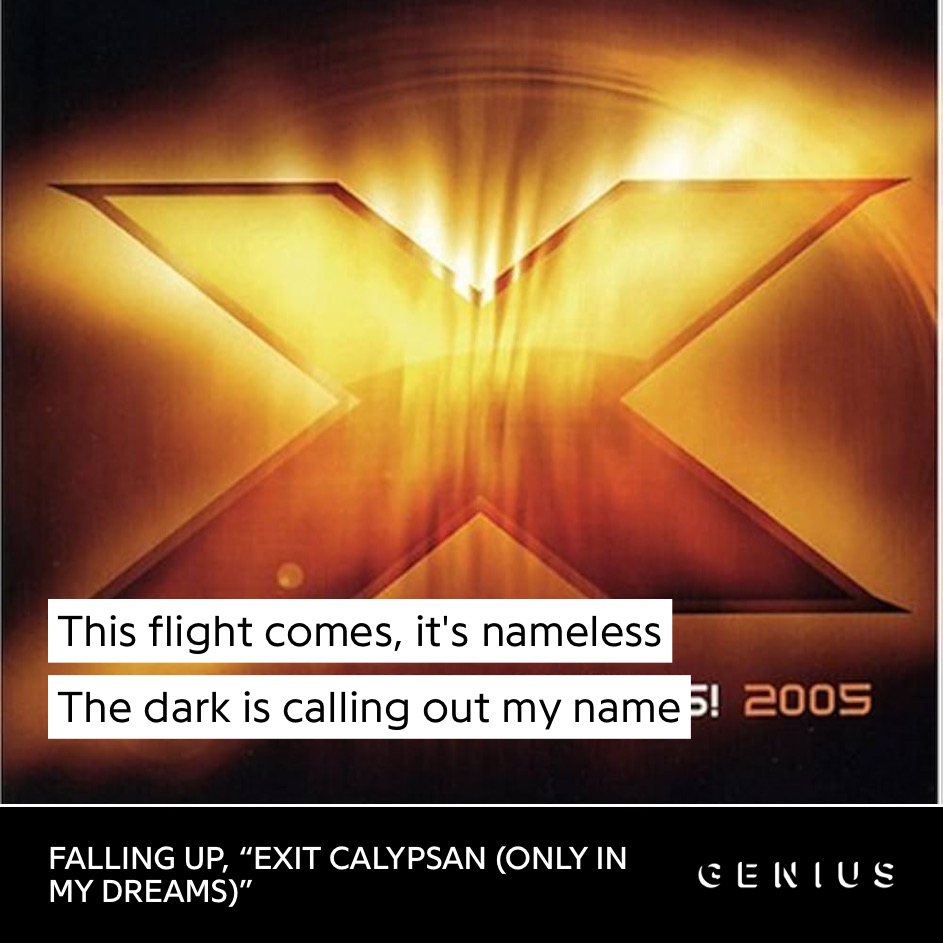
SO EXIT THE FALL, AND NOW IT’S OVER. Jessy Ribordy’s interviews coincide with the twentieth anniversary of Falling Up’s first album Crashings. In his recent interviews, Ribordy doesn’t speak highly of the band’s second album Dawn Escapessaying that the band wrote and recorded the album very quickly, taking only a few days off from a hectic touring schedule. He even addresses the criticism of the album of many of the songs sounding similar, saying that the band was crunched for time. However, Dawn Escapes introduces many themes and motifs not present in the band’s first album that would appear in Falling Up’s later career and in the worldbuilding that Ribordy has created for other projects after Falling Up. It all started with the first single “Exit Calypsan,” released on Christian Radio in an alternate version under the name “Only in My Dreams” (Exit Calypsan) and was later released on the compilation X2005. On Dawn Escapes, the recording seems more refined, the opening synth line enveloping the listener making the original seem like an ‘80s keyboard demo. The guitars also have a more complex rhythm than the single version and the album version adds a haunting bridge.
THE MOVEMENT BURNS WITHIN MY VEINS. “Exit Calypsan” creates a dreamlike landscape musically and lyrically. It’s a weird dream that possibly ends as a nightmare, but the details of “white” washing over the narrator and “dark calling out my name” along with a “nameless”’ flight. A flag flying in the Oregon coastal town of Reedsport roots the speaker in reality before he goes on to describe other abstract details. Reedsport later appears in the album in the song “Lights of Reedsport.” But today’s song is not titled “Exit Reedsport,” instead it’s an imaginary land called Calypsan, possibly referring to the nymph from The OdysseyCalypso who detained Odysseus for seven years on the Isle of Ogygia. It may also refer to a moon in the Final Fantasyfranchise. Jessy Ribordy has continued to develop the world of Calypsan, co-writing a pilot with his wife Alysha, though author James Keith has also written a space fantasy titled Calypsan. Whatever Calypsan is the speaker reminds us “It’s only in your dreams” and that once we “exit the fall” of the dream, the dream world has no power over us.
Everything’s a bit connected with this month’s playlist which has given me new life when writing my blog. It started with watching the FX show English Teacher, which was featured in the trailer and episode 5 “Field Trip” with Brian Jordan Alvarez as Evan Marquez singing New Radical’s “You Get What You Give.” Interestingly Tyson Motsenbocker, with his covers project, also released a cover of “You Get What You Give.” I wanted not to include many repeat posts this month because it’s one of the things that made my blog seem stale to me, but I also wanted to include songs that I was enjoying over interesting stories to tell. And then I listened to New Radical’s Maybe You’ve Been Brainwashed Too. The band broke up soon after releasing the single “Someday We’ll Know.” Last year, I ran across the Jon[athan] Foreman/Mandy Moore duet cover of “Someday We’ll Know.” This year, I decided that it’s time to dust off the truly cheesy song and just enjoy it for what it is. Rather than repeating the stories about Switchfoot’s breakout moment, just read the post about “Dare You to Move.”
IS TRUE LOVE ONLY ONCE IN A LIFETIME? Holding a 29% rating on Rotten Tomatoes, the 2002 film adaptation of Nicholas Sparks’ novel, A Walk to Remember, may not remembered fondly by many other than a certain demographic of grown-up youth group kids who watched the PG film at sleepovers and lock-ins. I’ll discuss the plot of the movie with some spoilers. My sister watched it at her sleepover birthday party, but I never actually watched the movie. I played guitar in my room with a friend who spent the night. I did want to watch the movies because Switchfoot’s music was featured in it. My sister later admitted that the movie’s plot was dumb and that many of her friends were distracted by the young up-and-coming heartthrob Shane West who played the film’s non-believer Landon Carter opposite the Baptist preacher’s daughter Jamie Sullivan played by Mandy Moore. Landon falls in love with the preacher’s daughter who has terminal leukemia, though he doesn’t know that she is sick until he falls in love with her. The movie helped to reinforce the purity culture of the ‘00s with the young lovers waiting until marriage–Landon proposes and the two marry before Jamie dies. The song “Someday We’ll Know” is played right after Landon finds out about the cancer in the middle of the film.
I’M SPEEDING BY YOUR PLACE FOR THE NINETY-SEVENTH TIME TONIGHT.
“Someday We’ll Know,” has even more head-scratching lines than New Radical’s other hit “You Get What You Give.” The song asks many cliched questions about answers to questions we may never know. Asking questions about “Whatever happened to Amelia Earhart?” and “Did the captain of the Titanic really cry?” and then pledging in faith “Someday we’ll know” the answers to these questions. Songwriter Gregg Alexander throws in nods to the Jahovah’s Witness faith that he grew up in, evoking religious language about Samson and Delilah and of love moving mountains. All of the questions lead up to the cringiest question of all: “Why you weren’t meant for me.” The song is forgivable with all of the weird lyrics on Maybe You’ve Been Brainwashed Too, an album that keenly comments on celebrity culture, capitalism, and religion. In the context of a cliched movie about a teen dying of cancer, perhaps the question “Someday we’ll know why I wasn’t meant for you” actually makes the story seem real. Unfortunately, the song’s placement in the movie is only incidental background music like the movies from the ‘00s that used music when licensing was cheap. Listening to the song in the context of a literally fatal romance makes both the movie and the song better. What a missed opportunity to score maybe a 45% on Rotten Tomatoes.
On August 23, 2019, Tyson Motsenbocker released the first single from his second studio album, Someday I’ll Make It All Up to You, “The Last Summer.” The wistful song about growing up and time passing was followed by “Sunday Morning,” a track in which Motsenbocker compares the feelings people get from religious experiences to those that people get from taking drugs. Finishing the trilogy of 2019 pre-release singles for his upcoming February 14, 2020 album was “Autumn Love.” The love song contrasts the passage of time, specifically in autumn, with a constant love that only deepens as natural events from the death of the last Junebug to the leaves changing and frost covering each morning. We are a few weeks into fall, but it’s a strange one in South Korea as the temperature has only started dropping. People are still swimming at the beach in October! “Autumn Love” presents an idyllic autumn scene, but what happens when the season starts to disappear because of climate change?
CHARLOTTESVILLE AND THE LEAVES HAVE CHANGED. In “Autumn Love,” Tyson Motsenbocker talks about trips to the airport and contrasts the winds in Santa Ana, California with the leaves changing in Charlottesville, Virginia. Both place and seasons are constant motifs in Motsenbocker’s music. On the Long Distance ListeningPodcast, Motsenbocker calls the changing of seasons “almost liturgical” as he talks about growing up in the Northwest where there are four seasons, and living in an Eastern state for a time. He describes the “visceral change” he experienced with the seasons, stating, “You can feel the river of time slipping below you” as he experienced the sights and smells of each season from the wheat in the summer to the salted roads in the winter. Yet the singer settled in Southern California many years ago. “And in California,” Motsenbocker says, “I had this moment where my first fall here was really strange and then I didn’t notice it. And then like 10 years went by and I was just like, I was like, whoa, like in a lot of ways, I feel like, you know, it’s odd because I moved here 10 years ago.” Motsenbocker questions what happens when he realizes that his life has slipped by in the absence of notable seasonal changes.
WHEN THE FROST COMES DOWN IN THE MORNING DEW. “Autumn Love” ends with similar synth/organ/theremin(? ) instrumentation as Sufjan Stevens’ “Should Have Known Better.” Motsenbocker has built his career as being Sufjan-adjacent, often working with the same studio musicians in Stevens’ sphere of influence. Motsenbocker draws influence from Stevens, but rather than Stevens’ reclusion and mere pinholes into his personal life through his music, Motsenbocker comparatively, is often forthcoming with explaining what the lyrics he penned meant to him at the time of writing the song. Stevens is certainly a master of capturing a moment and a feeling that then becomes something that listeners incorporate into their sufferings and longings. Motsenbocker’s explanations of his lyrics make him more accessible, which is important for artists who don’t have a huge following like Stevens. As I’ve started to be more intentional with my playlists, today’s song, “Autumn Love,” has me reflecting more on Motsenbocker’s thoughts on living in a place where seasons change more subtly. I love fall and I love the subtle changes, but often I feel too busy with grading and planning in peak academic season to notice those changes. And then I think about college and high school, writing papers inside rather than enjoying the crisp air. Finally, as I’m starting to find some work/life balance being in the same field for over ten years, climate change has really screwed up the shift from summer to fall this year. It makes me, too, wonder how in the future I will notice the subtle passage of time, or will it go by so quickly like Tyson in California? It’s a scary notion and I hope that we can find a new normal.




 Mixtapemotions