Though he only has 45 monthly listeners on Spotify, I can see Ian Mahan joining the ranks of folk artists like Denison Witmer, William Fitzsimmons, Matthew Perryman Jones, and all the other NoiseTrade artists I’ve been listening to. I added this song a few months ago when I was looking for Aaron Marsh collaborations. After taking a minor dive into his other works, I feel like this is one of the reasons I write about music: to discover something new, something obscure. From his mellow interpretation of “Eye of the Tiger” to his piano/guitar melodies intertwined with the small-town-America feel of a boy raised in a small Illinois town, but who has moved to Colorado out of a dream or out of necessity, I hope to get better acquainted with Mahan in the weeks to come.
THIS TOWN IS CLEARING OUT. “Art & Vida” tells the story about an older couple who have witnessed the decay of the small town after NAFTA took the jobs overseas. It’s implied that Art lost his job and was never able to buy the American dream for his bride, Vida. Yet, despite all of the hardship, Art is telling his bride that their love is in their memories and their memories keep the love alive. In the music video, we learn at the end that Vida has died. Not only has Vida died, all of Art’s friends “are in the ground.” The town is dying. The jobs are gone, but there are still bars. The kids and grandkids come to visit once in a while. We see a glimpse of death which started in the rustbelt, which spread to the Bible belt. It’s what I grew up with. It started with the factories closing, then the economy was based on stores and restaurants, but those eventually died off. Walmart came in and became the biggest employer in town. Then New York tax and big farming made the small farms go under. My dad became a truck driver and moved us to North Carolina where the furniture factories had closed down and moved overseas. In Western North Carolina there are a few factories around still, but so much of the economy is tourism for retirees who spend their money in nicer climate. And that’s no way to build an economy.
WE SKIPPED CHURCH BECAUSE THE KIDS WERE IN TOWN. When I was a kid, I wanted to move to the city. I was fascinated with the places and things that were so conveniently located. Of course, everything bigger than McDonough, New York could be considered a city. When we moved to Western North Carolina, it was a city of 16,000 people, more than double the population of the town I was born in. Some days my mind drifts away to meadows and forests. I used to believe that rich people lived in the city and poor people lived in the woods. But now I think it’s opposite. Though my family became more financially secure, moving into the city, or into civilization, made us less free and more entangled to arbitrary norms of society. The bigger the city, the less free you are to be yourself because you have to play nicely with others. Still, it’s nice in a city to be able to choose your tribe, whereas in the country the family ruled. And that was the reason why my family broke away from Central New York. And that’s the model that made me break away from my family and come to Korea. But is it true freedom?
Lancaster, Pennsylvania native Denison Witmer has an over 25 year career working as a singer-songwriter. Raised in the Mennonite church, Witmer recalls the rich sound of hymns sung in 4-part harmonies in the farming community church. Witmer’s early career was Christian music adjacent: signed to labels like the Christian-owned The Militia Group, Tooth & Nail Records, and Mono v. Stereo, an imprint of Toby Mac’s Gotee Records, before his current label, Sufjan Stevens’ and Lowell Brams’ Asthmatic Kitty Records, the former being a longtime collaborator with Witmer. Witmer has been included on several television soundtracks, has been acclaimed by publications like Pitchfork, and performed at festivals like SXSW, Wild Goose Festival, and Cornerstone. But unless you’re looking for slow, fingerpicking music in the vein of Cat Stevens, you’ve probably never heard of him. He’s both prolific and kind of obscure.
BY THE MIDDLE OF THE WEEK… HOW MUCH CAN I TAKE? Starting my song-a-day project two years ago has been a reminder of how much I need music. When I got the idea at the end of 2018, I was going through a bit of depression as I thought about my future. I’ve talked about the power of music that helped to pull me out of my 2011 student teaching depression. My episode in 2018 wasn’t as deep as that. In 2011 the question was if I could teach. Could I keep up with all of the expectations of keeping students passing the tests? In 2018, I believed I could do all of that, but the question was, is it enough? And furthermore, how is doing my job well benefiting my future? I was doing well now, but I’m just a principal change away from going from “the golden child” to the ostracized teacher. I saw that happen at work with the vice principal’s vendetta against the teachers I was working with. One teacher he said was too “strict and lazy.” However, over the years, he’s been unable to get rid of her. I was shocked by how badly he treated her. She had been teaching for 20 years, which was quite a bit of time on my career. Another teacher, he got rid of after six months because another, less qualified teacher had applied for the position. In 2018, I was questioning my career choices in Korea. Wasn’t it only a matter of time before I aged out of the “foreigner charm” and I too was labeled “strict and lazy.”
THEN A SONG COMES ON… I KNOW THAT I’LL MAKE IT. I failed in making the 2019 playlist. The 2020 playlist lasted until November in my GoodNotes, but there was a terrible back up incident. I’m hoping to finish the project this year. I’ve sacrificed time with my Korean studies, exercise time, and other things I could be/should be doing in the evening. But as imperfect as this blog is, writing about a song every day, allowing it to play as a soundtrack through my memories, makes me analyze my thoughts and beliefs. It opens me up to sharing my story, which is really the only possession I have. Writing about music makes me think that writing isn’t such an obstacle. When I heard “River of Music” today, I remembered all the times that music got me out of a hard time and how much it keeps me sane this year in one of the hardest years of teaching. While music makes me nostalgic for the past, it usually transcends the past and challenges me to be more like the times when I was younger and had more of an edge to me. Back when I thought there were fewer obstacles in the way. It makes me take new approaches to my problems. “We live in a difficult time/ Where are you going spend your love?” Music doesn’t give us these answers, but it helps us to make up our minds.
The falsetto sounds of vocalist Josh Ballard‘s voice may not be to everyone’s liking. But back in 2007 when Until June released their debut album, singing high was the way to make it in the indie scene. Until June’s self-titled debut is full of soaring melodies both on the guitar and in Ballard’s vocals. The band’s name makes me listen to them mostly in late spring to early fall. Though hailing from Arizona, this album makes me think of two early summer trips I took up to Michigan. One trip was before I had listened to this album, back in 2008 and the other was after I had listened to this album in 2010. The cool and breezy guitars remind me of the cool nights when walking around the lates and ponds in a northern early summer.
I KNOW IT FEELS LIKE SUMMER. I ended up driving over night from North Carolina to Michigan after my friend’s graduation to crash another friend’s graduation party. After getting practically drunk on espresso (5 shots, I think), I was in the mix to drive all night listening to the new Thousand Foot Krutch album. It was an eclectic mix of friends: my friend, her dad, my sister’s boyfriend who nobody liked, and the Michigan friend’s cousin who no of us knew. This was the time when gas was $4 a gallon, and we all chipped in for gas. We left on a Friday night and came back by Sunday evening. The driving was not bad when everyone was awake. We told jokes, listened to lots of rock music, and refueled on coffee. But when the sun was coming up in Ohio, and I was driving, everyone had fallen asleep. That was the hardest part of the trip. When we made it to the graduation party, we were all falling asleep on the lawn. The Michigan early summer was warm in the afternoon and cool in the evening. We under-packed for the journey, thinking about North Carolina late-May, but the Michiganders weren’t even cold. Lending us their windbreakers, we headed out for soft-serve custard. Early Michigan summer reminded me of growing up in New York, but there were far more lakes and ponds there.
SO I TRIED. Before going to Yap, I spend a few days in Berrien Springs, Michigan. I drove up to Michigan because it was cheaper than flying to O’hare, where we would fly out of to begin the long journey to Yap. I spent a few days with River, getting to know her family and seeing what Adventist life was in one of its capital cities. I got to see Andrews University and met a professor or two as I was thinking about their English master’s. I met River’s mom, an elementary school teacher who worked constantly, cutting out crafts and preparing lessons. Her father and her mother lived very separate lives. It was my first encounter with a Korean ajosshi. The story of how her parents met fascinated me, but what fascinated me more was how they were still together. It seemed that they were fiercely independent forces. They ate separate food–River’s mom cooking both Western and Korean food. They spent time in separate rooms, she in the kitchen and he in the living room. He watched Korean television and sat on the floor. Mr. Jung seemed distant from his wife and daughters. I told Mr. Jung that I was interested in going to Korea. “Oh yes, Korea is a great opportunity. As you can see my wife married the wrong man, but maybe you will meet the right person there.” I thought the conversation was odd, but it’s stuck in my head.
The whirlwind career of Wonder Girls is an interesting read. They were the first South Korean pop group to chart on Billboard‘s Hot 100 and toured with the Jonas Brothers; their career looked like it would be quite promising. But the members wouldn’t stick around. The band originally had 4Minute member Hyuna, but her solo career would pull the singer in another direction. Then there was Sunmi, the singer who turned to K-pop to make support her family after her father died of complications of tuberculosis. But just when the group was blowing up in 2009, she left to focus on her academics. The group went on hiatus after Sunye got married and moved with her husband to Haiti to be missionaries and Sohee left to focus on acting. That was 2013.
WHEN I’M ALONE, I FEEL YOUR TOUCH. Korean summer is much like summer in North Carolina and Tennessee with a few key differences. The temperature climbs steadily throughout the spring. April can be pleasant, but my first year in Chuncheon, I was ready for the air conditioning in late April, as it was hard to sleep at night. Housing is a big key here, though. My second apartment in Chuncheon didn’t have air conditioning. It was brutally hot for about a month, so I just stayed up late until it got cool enough to sleep. Then I moved to Gyeongsan on campus. 2015 was a brutally hot summer, and Daegu had the nickname, Daefrica (Daegu + Africa). My apartment had air conditioning, but I had a roommate that left windows open, and it stopped working. 2015 was a pretty extreme summer, but it’s also a good example of what happens in the summer. First it’s hot from late May to mid June. This heat is sometimes dry, some days humid. And if you don’t have a car as many Koreans get by on public transportation, this means a lot of walking outside if you want to do anything fun. I had a long summer vacation, so I did a lot that summer. But that’s a story for another day. In mid-June, the rainy season starts for about a month. And you get soaked, as the rain seems to come from every direction. Finally August combines the heat and the humidity with a few intermittent showers. As Korea is quite hot, people tend to dress appropriately. It’s a time when shorts get shorter, shirts look tighter on muscle. Everyone is sweaty and soaked from the rain.
WE’RE BACK! In the summer 2015, the Wonder Girls’ record label, JYP, announced that Sunmi would be rejoining the group, and they would be releasing new music in early August. The album was appropriately titled Reboot, and the lead single was a late-’80s concept song of the summer “I Feel You.” And boy was that summer a hot one. In perfect ’80s video fashion, the girls pretend to play instruments while dressed in sexy one piece jumpsuits and high heels. The video is literally dripping with sexiness as the girls melt ice on themselves and get splashed with water. This wet, sexy look would be done again in Sunmi’s solo 2018 Waterbomb Festival Performance after the Wonder Girls split up for good. Sunmi has continued her career using her sex appeal to boost her music, but “I Feel You,” for me, is the song of the summer of 2015, even though it was released late. It was a summer filled with fun and sorrow. It was the summer of youth I never afforded myself growing up. It is a summer I was too old to enjoy then and certainly too old to ever repeat again.
Speaking of ear worms, I’m on the second day of humming perhaps the most well known sax notes in the history of music. In terms of meme music, it’s probably second to Rick Astley‘s “Never Going to Give You Up,” Wham!‘s “Careless Whisper” is so awful, it’s epic. If you just take the song at it’s value as a sexy (or saxy) evening in the city, private planes, yachts, and beautiful women sleeping with a multi-millionaire playboy, the song would have just remained deep in the ’80s vault. But the extra layers the song takes on when you see it on TikTok videos, South Korean entertainment shows, or what sparked this latest outbreak, an inclusion in a school play my my first grade high schoolers, the song takes on new life. None of that can hold a candle, though, to my coworker’s experience with this song.
I’M NEVER GONNA DANCE AGAIN. “Careless Whisper” was a song that started the breakup of the pop duo, Wham! George Michael was clearly becoming the star of the band. Behind the scenes, Michael was struggling to define his sexuality. Though, Michael claims that the song is not autobiographical as he claimed never to have cheated on a lover, the song seems deal with a struggle between Michael’s attraction to both men and women. George Michael claimed to have slept with many women at the beginning of his career. But because he also slept with men and the AIDS crisis was raging on, Michael felt the need to disclose his sexuality to women before sleeping with them. My coworker said, as he was growing up in England at the time, everyone knew he was gay, and his audience didn’t have a problem with it. However, it was a secret for the American audience. Whatever was thought about George Michael’s sexuality, the video for “Careless Whisper” is clearly trying to compensate for something. The camera cringingly focuses on Micheal in bed with “the other woman.” Yet, he feels deep regret when the girlfriend character sees them together. She runs away and leaves on a sea plane. Knowing Michael’s biography about how he would sleep with women, but never get close, shows the tension of that period when someone is questioning their sexuality. It might be a confusing love triangle, and no one wins.
I SHOULD HAVE KNOW BETTER THAN TO CHEAT A FRIEND. The other guys called her “Beak,” because she had a large nose. It was late secondary school and the kids were pretty experienced sexually in that part of England. First generation Italian immigrant, her father had gone away to prison in some ponzi scheme. In the bedroom she had a penchant for giving hickeys, and her record collection included Queen‘s Greatest Hits, the British edition. She thought that the lyrics of “Somebody to Love” were: “Can anybody find me / Somebody to love….bite.” She was kind of a pre-goth, and she did her makeup that way, but her music wasn’t gothic. No The Cure or Joy Division in her stereo collection. Wham! was her jam. My coworker said, all of his early sexual experiences were made to “Careless Whisper.” Thankfully, “Careless Whisper” isn’t stuck in my head very often. But when it and I start humming it at work, it’s extra awkward. My coworker has to remind us that that song has extra significance for him. He said that he got pretty skilled at throwing shoes at the stereo to get the record to stop playing. I have a fear I’m going to need a boot to my head in order to get this tune out of my head.
There was a sandwich shop across the eight-way intersection in Chuncheon where I would often take lunch break. After class, I’d get a Chicken Carbonara or a Soy-sauce chicken sandwich and a cup of coffee. I might spend a little extra time there reading or looking over lesson plans before going back in to work. The cafe was run by a man around my age and his mother, and it was a nice place to eat something familiar and spend some time. The musical choice was quite eclectic: ’90s pop-rock and current K-pop/Hip-Hop. It was in that cafe that I grew an affection for K-pop. I started to understand what the hype was all about.
SO YOU HAVE A DREAM THAT IS BIGGER THAN A LITTLE BOY’S. In February of 2014, Girls’ Generation released their electro-pop album and titular hit “Mr. Mr.” The girls had been famous for a conservative, bubble gum pop, but “Mr. Mr.” takes the singers in another direction. The ear worm begins with a dirty bass synth. The music video depicts the nine members of Girls’ Generation in a sexy medical situation with men playing a beta role some kind of Frankenstein surgery. According to the lyrics, the girls are begging men to be strong, taking the lead in their relationships. This message divided some K-pop fans who viewed the song as sexist. However, the video certainly shows female empowerment, and even the song’s subject asking their man to be a better lover seems to put Girls’ Generation in the driver’s seat.
YOU MADE MY HEART RACE. “Mr. Mr.” was on the tail-end of big female power anthems ruling the American pop charts. There had been something undeniably catchy about Ke$ha‘s 2009 hit “TiK ToK” that all of my straightest college bros couldn’t deny that it was awesome. Then there was Lady Gaga, Katy Perry, and so on–pop music had become a guilty pleasure. Then there was Korea. The year I came to Korea, “Gangnam Style” had just beaten “Call Me Maybe” as the most viewed YouTube video. “Gangnam Style” was kind of a parody of K-pop, and was taken more seriously when it became a hit abroad. In Korea, “Gangnam Style” was playing, but also all the other hits which had a similar EDM, dancey sound. “Mr. Mr.” from a production standard alone, reminded me of the records that challenged my stereo: Linkin Park, Falling Up, and anything by Aaron Sprinkle. This may seem odd, but “Mr. Mr.” inserted gang vocals in a spot impossible to sing live. The song changes key several times, and these key changes seem like they come out of nowhere. Needless to say, after hearing “Mr. Mr.” every day in the cafe across from the academy, I was hooked. And not just on the song, on Kpop.
A fan of the funk/disco band Chic, producer Bob Ezrin convinced Pink Floyd to include a disco beat backing what would become their only number 1 hit in their career. Ezrin also convinced the band to release the song as a radio single, something the band had been against on previous albums as they wanted their songs to be understood in the context of their greater work. The band had been a psychedelic pop act in the ’60s and had done radio, but they felt their artistic concepts were too big for the casual listeners. Classic Rock radio remembers a Floyd that never was, playing tracks from Dark Side of the Moonuntil The Wall, but perhaps without the commercial success of “Another Brick in the Wall,” radio would have forgotten the band.
TEACHERS LEAVE THEM KIDS ALONE. Recorded with school children singing “We don’t need no education” and despised by British prime minister Margaret Thatcher, “Another Brick” is the ultimate protest song of school children everywhere. If we take this song at face value, schools are concentration camps and teachers are the Nazis in charge. The ultimate revolt would be against education, children returning the human race into a feral state, as human infrastructure would deteriorate because no one would know how to operate anything. I’m sure the kid who pretended to be sick today and wished all schools would burn down hasn’t taken that thought to its logical conclusion. This, of course, isn’t want the song is about. Drawing on lead singer Roger Waters’ experience in a Dickensian U.K. school, he argues that this hostile environment caused trauma and years of mental health issues, laying bricks in the wall that separated him from other people. Waters explained in Mojo: “You couldn’t find anybody in the world more pro-education than me. But the education I went through in boys’ grammar school in the ’50s was very controlling and demanded rebellion. The teachers were weak and therefore easy targets. The song is meant to be a rebellion against errant government, against people who have power over you, who are wrong. Then it absolutely demanded that you rebel against that.”
IF YOU DON’T EAT YOUR MEAT, YOU CAN’T HAVE ANY PUDDING. It’s funny, though, contrary to Margret Thatcher, this song didn’t destroy education. Academia is still alive and well, and it’s just as hard as ever to get into a good school. Americans are so racked with university debt as it’s been told to us that you have to go to college to make any money in the modern world. Since Roger Waters’ grammar school days, there have been lots of reforms to education, and school systems has leaped forward with better, research based practices to improve learning and support students. Education will never be perfect. Greedy politicians always think they know better how to educate the nation’s kids. Timmy’s parents will always believe that he’s a perfect angel. People will always think that it’s a babysitter’s job and that anyone can do it. When I hear “Another Brick,” I think about what I’ve learned as a teacher. How I’ve learned to cause less trauma to my students as they grow up. But I also think about how much more we as teachers and as a society need to do for children. We can’t erase what’s happened in Mr. McChoakumchild’s classroom, but we can hear the stories and decide to make the change.
Sandwiched between two metal bands, Anberlin played the show that kickstarted their career in Atlanta, Georgia. Brandon Ebel, Tooth & Nail Records‘ founder, and owner loved the band’s hits, but Chad Johnson, Tooth & Nail’s A&R wasn’t impressed with the live show. For starters, the band was playing pop-punk in between heavy, pre-They’re Only Chasing SafetyUnderoath and chaos metal act Norma Jean headlining. Anberlin sounded a bit more like Jimmy Eat World and Third Eye Blind. Nobody at the show knew Anberlin and were only there to most to the bands that they knew. What was worse was if the band was melodic, they had to have a singer who could hold a tune. Stephen Christian was off-pitch. Eventually, Ebel was able to convince Johnson to sign Anberlin. Their demo of “Ready Fuels” recorded by Matt Goldman, an Atlanta musician-turned producer, helped to solidify the decision. Ebel agreed to sign Anberlin as long as Stephen Christian took vocal lessons.
I CAN’T MAKE IT RIGHT AS WE SCREAMED AT THE NIGHT. Last year, Stephen Christian released his fourth Anchor & Braille album. Building on the pop sentimentality of his last A&B effort, Songs for the Late Night Drive Home, the album somewhat ironically titled Tensionis an album that explores Christian’s range as a vocalist and a musician. “Madness” feels like a throwback track from mid-’90s Top 40 radio. It’s a song about resolving tension between a significant other. It’s a mature take from the same songwriter who is writing about early 20s encounters with “day late friends.” How long Christian’s conflicts as a husband and a father can carry his lyrical content until he sinks into a lack of inspiration like Dark Is the Way, Light Is a Placeis hopefully not an experiment he is trying to repeat. Still, the songs on Tension seem to be a reconciliation with Christian’s career. Songs for the Late Night Drive Home was not particularly reflective on where the artist was as the former frontman of Anberlin. His critically disappointing Praise & Worship record Wildfires relied on cliches and functioned as a corporative, vertical worship rather than addressing the social or personal issues Christian had become known for. But Christian starts to channel some of the Anberlin songwriting techniques on Tension leaving long-time fans wondering if the Orlando 5-piece has something to say about post-Trump America.
TRY TO EXPLAIN YOURSELF TO A STONE WALL. Hearing Christian’s story about how the major hurdle to the band’s success was his voice made me think about failure and resilience. I think that being the front man of Anberlin and being told that you have to take vocal lessons because your pitch is off had to be tough to hear. When you wrap your whole self into a project to where it becomes your identity and you find out that you’re still lacking. That’s how my failure during student teaching felt. And yet, vocal training did Stephen well. Sure, he’s still got some hiccups in live performances. Most bands do given the smokey clubs, the lack of sleep, and grueling schedule. But Stephen’s vocal range on songs like “(*Fin),” “I’d Like to Die,” and “The Haunting” set Anberlin apart. It makes me think of the list of things I want to achieve. No, I may never record the songs in my head and I’m not going to become a rock star. Last night I talked with a friend about my plans for grad school. How am I going to be a good enough writer to talk for 20-40 pages each class about anything? I think of a quote from Stephen Christian when he was giving a pep-talk to Anberlin after the ending of their Christian Punk band, SAGOH 24/7 (Soldiers After God’s Own Heart). “Listen, let’s give this one year. And let’s work our asses off. And in one year, if we haven’t made it, if we aren’t signed, then that’s it. We’re going to quit.” And that one year made worked out for them. It may take more than a year to lay the foundation for my goals. But remembering that achievement doesn’t come easy is the lesson for me. Whether it’s keeping up a relationship or writing a paper for grad school, I expect a bit of a fight.
Turn Off the Stars was a short-lived Canadian pop-rock band. The band was often compared to Coldplay or Keane, but their often wall-of-sound guitars liken them more to Oasis or The Verve. In 2006, their self-titled debut album had one RadioU/Christian Rock hit “Please,” the second track from the record. Released in the fall of 2006, this was the soundtrack to freshman year in college, which meant driving on frosty mornings to McDowell Technical Community College to obtain an Associate’s Degree that (maybe) saved me $20,000. It was also the year that my family moved to Nebo, buying their first house. But this album took on a new life as it was one of my few albums I could listen to in the car without my mom complaining. So it was an album we listened to several times when we took the long drive up to New York to visit my dad’s side of the family, seeing family members we hadn’t seen in nearly 10 years.
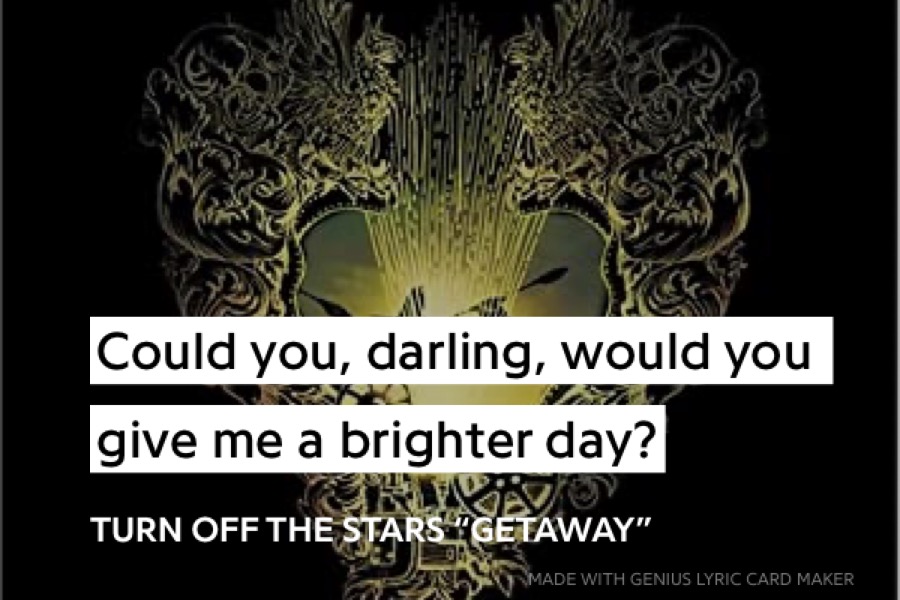
I’VE BEEN RUNNING WITH MY SOUL SO TIRED ABOUT YOU. “Getaway” is one of the simplest songs on the record, but it’s a great example of how a song’s atmosphere has taken me on mental journeys. The song is in the middle of the record and it shows that guitar is everything on this record. Starting out with a lonely sounding plucked acoustic guitar and leading into a moody, noisy guitar solo reminiscent of the first track on the record, “I Wasn’t Ready,” the band somehow captures a “great north” Canadian sound on this album. Of course the wildlife sound on “I Wasn’t Ready” sets the listeners up for this Canadian sound. The album artwork and the band’s name makes us think of this being a night album, and “Getaway” is a kind of “dark night of the soul” song. Clouds turn off the stars, covering them, and intermittent bands of rain fall around the car as it drives, headlights dimly lighting the heavily pine tree-wooded state route. The summer evening ended with a conversation that made the two feel uncertain about their commitments toward each other. Bouts of depression on his behalf has him doubting if she can be his saving grace.
I’VE BEEN LYING IN MY HEAD SO TIRED ABOUT YOU. The band is named after a 1976 Bill Evan’s song. I’m reminded of late summer in central New York at my grandfather’s church camp. The second weekend of August is the family reunion, and in 2008 just before starting my junior year and ten years after we moved my family went back up to visit New York. The reunion was a potluck lunch and barbecue on Saturday afternoon and it would last until the night. Some distant relatives making appearances and leaving after an hour or two, but the core, my dad’s brothers and sisters and their children might stay around, sitting around the bonfire late into the night. On a few occasions, someone would bring illegal fireworks from South Carolina or Tennessee, but usually we’d just go look at the constellations over the meadow in front of the “camp,” a large dilapidated building central to the property. And on the drive home from that day Turn off the Stars plays on the CD player, reminding me of the cool evening, the warm fire, and family.
Ten years ago, Deas Vail released their self-titled album, and with the exception of a Christmas EP, For Shepherds & Kings, and a B-sides album, this has been their last full-length project. Composed of husband and wife Wesley and Laura Blaylock and three other musicians, Deas Vail is Latin and Old French, meaning “humble servant of God.” As a lighter indie rock band they gained momentum in the Christian Rock and Warped Tour scenes before stopping touring and ultimately disappearing from the scene. Their final, self-titled album is a beautiful collection of songs, produced by Relient K guitarist and self-proclaimed minimalist, Matt Hoopes. Minimalism seems to be a consideration as there is nothing particularly florid in the album or packaging, from the lyrics that don’t stick out at first, to the cover art, to the subdued tones throughout the album. Listening to Deas Vail reminds me that it’s not the grand days that make a lifetime great, but the cumulated moments of sunny afternoon walks.
I’M CROSSING FINGERS AND HOPING LIFE WORKS OUT. This album was particularly impactful to me in the springs of 2013 and 2014. I was living in Chuncheon at the time and walked everywhere. I learned the city that way. It took me 45 minutes to walk (in the opposite direction) to HomePlus or Emart, Korean department stores similar to Walmart or Target. It would be something I’d do on a Sunday or after work when I needed something. As I walked, I listened to music on my Galaxy S3. Winter, spring, summer, and fall I walked. In the winter I just bundled up and trudged over the snow-covered sidewalks. In the spring I dressed in layers, taking them off as I got hotter, my sweaty hoodie taking up space in my backpack. I’d even walk home with my groceries, my hands so full, I must have looked crazy. The weather only became miserable in late July into August. So a few drippy trips later, I realized that I needed to keep my dignity and started taking the bus. Other times, I figured if I really needed to, at any point, I could catch a bus or a taxi, but I rarely did. I wanted to save money if I could and live as frugally as possible.
Lotus Lantern Parade in Seoul. Source: YeonDeungHoe on Flickr.
I’M CROSSING RIVERS, AND HOPING I DON’T DROWN. This album also reminds me of Saturday afternoon trips to Seoul. After church, I’d often go home and rest, but if I wanted something good to eat or to hang out with someone, I’d take 3 or 4 pm train to Seoul. Chuncheon had a regular subway line which took about an hour and a half to the outskirts or a fast train that took a little over an hour to go to the city center. If you didn’t purchase the tickets in advance, you might be standing, though. This album was a soundtrack to the weekend I attended the Lotus Lantern Parade, a Buddhist festival held on one of the main streets of Seoul a week before Buddha’s birthday as celebrated in South Korea. The two years that I attended this parade, I felt so overwhelmed with a spirit of tranquility. Late April, when the parade is held, has some of the most perfect weather in Korea. Nights are warm and usually it’s not raining at that point. The streets are calm; Seoul is usually sprawling on a Saturday night with people out enjoying their nightlife. As the sun is setting, the parade begins, simple at first with men, woman, and children–many of them with connection to a Buddhist temple–marching and holding up messages and symbols of their religion. The parade has a constant wooden drum and chant that lulls the audience into a peaceful trancelike state. As the parade continues, people start carrying lanterns symbolizing Buddhist traditions and teachings. More and more elaborate lanterns appear as the parade continues. The floats at the end are quite spectacular. After the parade, I caught the train back to Chuncheon, listening again to Deas Vail. The beauty that I saw that day, from the warm afternoon sunlight to the beautiful lanterns shine in my memory and make me contemplate how can I, “alone in a stranger’s bad dream,” become a person who reflects peace on this earth.