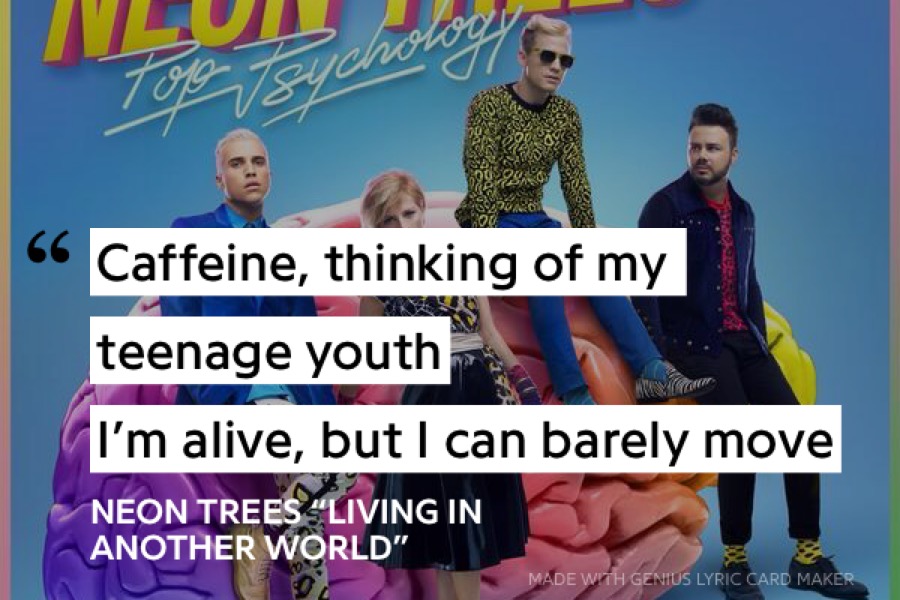
Tyler Glenn, lead vocalist and songwriter for Neon Trees came out as gay in a Rolling Stoneissue on April 10, 2014. This may not have been shocking as the flamboyant singer echoed the styles of Elton John or queer New Wave bands, but he could not reconcile his sexuality with the religion of his upbringing, Mormonism. Prior to coming out to his friends, family, and later the public, Glenn considered suicide. Coming out for Glenn allowed him to be his true self, and songs on their third album, Pop Psychology, talk about love, identity, and faith in the 2010s. However, in the following years, Mormonism has doubled down on its rejection of same sex marriage, prompting Glenn to no longer identify as Mormon, even releasing a solo album, Excommunication in 2016.
TV’S TELLING ME TO BE MYSELF. When I was student teaching, I began watching the first season of Glee, which was a little too campy to admit to. I stopped and started the show many times, but I started watching it again when I came to Korea. I finished the fourth season and started the particularly awful fifth season, which divided the original cast in New York and a new cast that no one cared about in Ohio. There were a few good numbers, including Tegan and Sara’s “Closer” and Neon Tree’s “Everyone Talks.” As awful as it was, Glee was one of the shows that humanized gay couples for me. I think I stopped watching the show because I felt that it was leading me astray. In my breakthrough year of 2014, I caught the flu after a workshop weekend in April. Still teaching at the institute (학원), I came home on my break time completely exhausted once my flu meds stopped working. I laid on the couch and watched Glee Season 5, seeing Kurt and Blaine’s relationship. It was one of the most healthy relationships I had ever seen on TV. It challenged my faith. How could it be wrong? And what did it say about me?
I GUESS I’VE ALWAYS BEEN THIS WAY. I remember hearing about Glenn’s coming out in 2014, although I wasn’t particularly familiar with Neon Trees beyond hearing some of their hits. While I was in America, Alternative radio caught on to their first record. This was at the time when Mumford & Sons, Phoenix, and poppy alternative bands started to dominate the radio. They kind of created a trinity of Mormon bands alongside The Killers and Imagine Dragons on Alternative radio. Their song “Everybody Talks” was a fun single, and then when they released “Sleeping with a Friend,” which was Glenn’s admission to the rumors about his sexuality and the blurry lines between love and friendship between a gay man and his straight friend. The song set apart the band as not for everyone. Remember that in 2014 it may have been cool for a female singer to be Bi-curious, but openly gay musicians were not universally celebrated. However, Glenn didn’t publicly come out until the eve of releasing Pop Psychology. While Neon Tree’s career may have become less popular, Glenn’s coming out prompted Imagine Dragon’s Dan Reynolds to take a stance in support of LGBT rights, especially regarding the Mormon faith. While I’m not Mormon, people of faith coming out had a big impact on my life as I questioned who I was. Starting in 2010, when folk-CCM singer Jennifer Knapp came out as lesbian to 2016 when Everyday Sunday’s lead singer, Trey Pearson, came out as gay and seeing the support and positive messages that fans have shown has been encouraging. But back to that sofa in 2014 when I realized that maybe my theology was wrong: If Kurt exists, and he does, he is the way God made him. The desires God gave him are not to marry a woman, but he found love with another man. And Kurt isn’t just an unreal character. Kurts and Blaines and Santanas and Brittneys exist. God made them that way. Is my hypothetical religion true or is it overlooking something?
Adam Dutch is a DJ from Ocean City, Maryland, who specializes in blending pop, rock, hip-hop, and EDM. In 2018, he took two very sad songs, the current hit at that time by Bastille and Marshmello, “Happier,” and set it to Anberlin‘s 2005 fan favorite, “Paperthin Hymn.” What the track gains is a harder, more passionate vocal line from Bastille’s lyrics, along with Stephen Christian‘s occasional line, adding “I thought you said forever over and over.” Anberlin’s lyrics, though, are mostly buried in the musical layers, making the song about a breakup and not about death. But, by choosing this mashup, I believe I have disqualified myself from writing about “Paperthin Hymn” on another “Sunday morning” or on an “August evening,” so I will bring the original songs into the conversation as well.
I THOUGHT YOU SAID FOREVER OVER AND OVER… Anberlin’s “Paperthin Hymn” is an excellent example of how a rock song can be melancholy and rock too. The band released other songs about loss and depression. They released many other songs in minor keys, but the elegiac lyrics, the Deon Rexroat D minor bass riff build, and Joseph Milligan’s guitar riffs build this song into a simultaneously hauntingly tragic and kick-ass song. Certainly, as the song became the band’s greatest hit in their early career, it must have lost some meaning when played live. According to Stephen Christian’s Tumblr explaining Anberlin’s songs, “Paperthin Hymn” is reportedly about the death of Stephen Christian’s grandmother and the death of Joseph Milligan‘s sister to cancer. Lyrically, the song is a reminder to show your affection for the people you love because we cannot know how long they will be with us. The song also laments the cost of the band’s heavy touring schedule as the loss of loved ones happened to the band as they were out on the road. There’s an inevitable guilt that comes from pursuing a dream that keeps you away from loved ones.
I WANNA RAISE YOUR SPIRITS. Unlike Anberlin, the British pop-rock band Bastille had what it took to survive the changing landscape of rock music. Prior to “Happier,” a collaboration with anonymous DJ/producer Marshmello, the band had already explored EDM and had cultivated a rather radio-friendly pop sound. “Happier”’ is a song about a relationship nearing its expiration date. Being together doesn’t make each partner as happy as they could be, and the singer feels that if he leaves, his partner will be able to recover and find true happiness, whether with another person or pursuing a dream. I wrote about this feeling last week. And although in hindsight I don’t have regrets about ending that relationship, I’ve had similar feelings in my current relationship, but love and communication along with relationship reassessment got us healthy again. I’m certainly not one to say that all relationships should last forever. I believe in divorce, but I also think that love that’s not worth fighting for is never love.
Like Stephen Kellogg and the Sixers, Matthew Perryman Jones was part of 2012’s 25 Love Songs: A Special Gift from NoiseTrade. I had downloaded the album to hear the new Paper Route single as the band was taking an incredibly long time to release their sophomore The Peace of Wild Things. What I discovered was a bunch of indie folk artists like Kellogg, Jones, Leagues, Cary Brothers, and so many others. Matthew Perryman Jones has contributed music to television soundtracks for shows like Kyle XY and Love, Death & Robots. He gave away much of his music for free on NoiseTrade. I remember downloading the Jars of Clay Spring Tour 2012 sampler, on which featured two songs from Jones who also supported the band on tour. Jones’ “Land of the Living” was covered by progressive Christian band Gungor on their album One Wild Life: Soul.
I’VE BEEN DRIVING ON THE HIGHWAY THAT LEADS TO MY HOMETOWN. In “Echoes of Eden,” the singer uses religious language to convince himself that just as his past was secure and full of wonder, his future “lead . . . to that City glorified.” Jones is not a mainstream CCM singer, but, like so many folk and country singers, he shows how Christian faith have shaped his life and art. Likewise, I find that there are certain comforts to take in the Christian message and my memories of a strict religious upbringing. The singer listens for “the echoes of Eden,” reflecting on where he and where all of humankind has been. According to an interview with blogger Katie Gustafson, Jones revealed that he suffered from panic attacks and crippling depression in his teens, even dropping out of school by his senior year. He says that despite his Christian upbringing, he felt distant from God, except when he played music. “My song was my salvation,” he stated. And music helped heal him and made him into a successful singer songwriter today.
A CHANGE IS CALLING OUT. Matthew Perryman Jones is kind of a perfect example of a somewhat secular folk-rock singer-songwriter who writes on Christian themes. Unlike U2, he doesn’t seem to say anything too controversial that makes the Christian market question cancel him. His story about how music and faith help to treat his depression resonates well with the readers of Christianity Today and Relevant Magazine. But these publications under represent artists who have been hurt by the church structure. So many people who grew up Christian have been hurt by the church, so when they hear “the echoes of Eden,” they don’t feel the “old timey religion” hometown feel that others feel. Instead they feel judgement and point out the hypocrisy of the state-sanctioned religion that has done damage in their past. These two drastically different reactions make sense based on how prominent Christianity is in Western culture. For me, I’m kind of somewhere between the two. I find that Christianity and the message of Jesus is comforting, but I also feel like I gave it too much power over me. Maybe most of us are just trying to separate the good from the bad.
Every year my school’s first grade curriculum reads an article about life in Iceland. This scenic, yet lonely Northern European island boasts some of the hardest working Europeans and some of the most expensive goods, as so much is imported. As for exports, Iceland sends fish and aluminum to other EU countries and the United States; however, before the pandemic tourism made up to 10% of Iceland’s GDP. As for cultural exports, we get the word geyser from Icelandic. The country harnesses its geysers and volcanos to power the country with what they call geothermic power. Aside from some beautiful scenes in movies like 2014’s The Secret Life of Walter Mitty much of Iceland isn’t common knowledge to most Americans. Some music fans will remember avant-garde singer-songwriter Björk from the ‘90s or post-rock band Sigur Rós. In 2011, Of Monsters and Men did it for Iceland and became the nation’s highest charting hit with the song “Little Talks.”
YOU’VE BECOME A TEMPO THAT MY HEART KNOWS. The band’s third release explores beyond the realm of their home genre of Indie-Folk rock. The result is today’s song, “Soothsayer,” the album’s catchy closer that sounds like a female-fronted ‘80s rock ballad. The song digs into the emotions of a relationship on the hinge of becoming serious. The singer has already invested so much time into the relationship, and she wants her time and her feelings to pay off. Sound familiar? It’s the late night in the blue light of the TV screen conversation you have when you assess your feelings.
I KNOW THIS CAN’T BE WASTED LOVE. But romantic love isn’t the only feeling we have to assess. Lately I’ve been assessing my love for my career. Teaching is one of the most abusive loves. Teachers truly have to be masochists to take the abuse from administration, parents, and sometimes students and the media if we’re particularly unlucky. I’ve been down because of this abuse lately. On a weekend I felt worn down, I thought about designing a teacher website as a kind of digital resume to show potential schools my teaching skills, but I fell discouraged after looking at examples. The examples were educators who wrote articles, had stellar student reviews as well as great student work. I just felt tired from all of the grading and planning and the rinsing and repeating. Even one of my recent podcasts, Straight, White American Jesus,the hosts are religious studies professors, and they talk about reading 100 papers a week and doing the podcast. Who has the time? That being said, when the feelings of being overwhelmed subside–I’ve not been this busy in prior years, I usually feel fulfillment in seeing my students’ achievement. At this point, though, I wonder how to weave all the elements in my story together to make an impactful career? As an educator, I encourage my students to follow their dreams, but I don’t know what my dream is. I just don’t want my love, the time that I’ve put into my career, to be wasted.
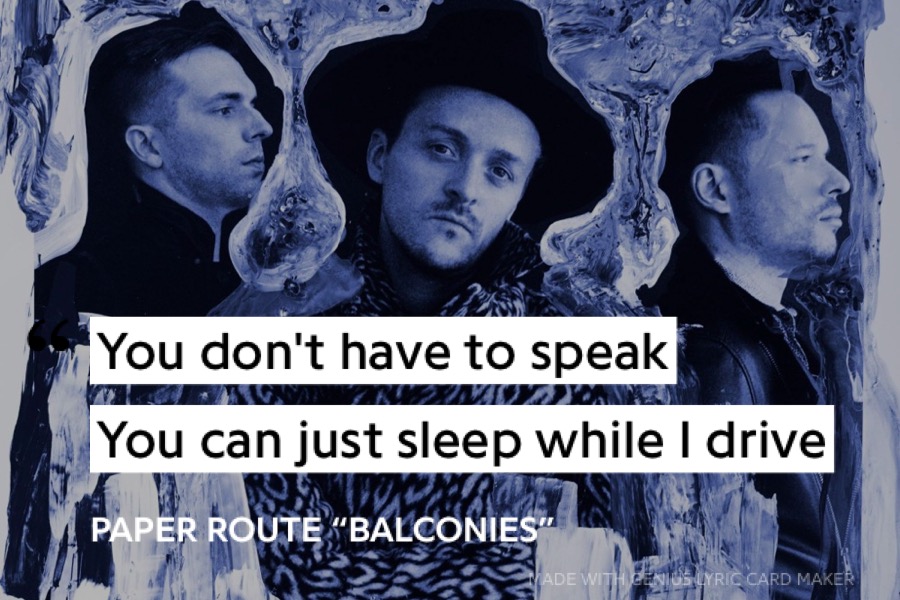
Listening to Paper Route makes me wonder, what if Coldplay, after recording X & Yhad continued making electronic music and honed in on their lyrics. Paper Route has a solid a pop-rock band, on par with any of their contemporaries (i.e. OneRepublic, Coldplay), but their somewhat eccentric fidelity to their craft, recording their albums themselves in old Tennessee mansions to let the natural acoustics reverberate on the record, had cemented them as an indie rock band. “Balconies” was kind of Paper Route’s first and last hit. The band’s music had been featured in movies and television shows, but “Balconies” got them a late night performance slot on Seth Meyers. As one of the most obvious hits from their third album, Real Emotion, the song was released to radio, but didn’t do too well on the charts. After touring to support the album, the band went on “an indefinite hiatus.” However, as the band has had long gaps between albums, I wonder if JT Daly and Chad Howat will assemble a group of musicians together for album number 4.
RAISE YOUR ARMS AND HOLD WHAT YOU CAN’T REPLACE. “Balconies” uses several mixed metaphors to convey a message about being unable to hold it together. The singer claims “that the simple things [he] can’t get right” and he “know[s] that it’s [his] fault,” yet he offers to comfort the listener: “you don’t have to speak/ you can just sleep while I drive.” He talks about the difficulties he faces: “for every wound there’s a hill to climb” and that he has a “hunting heart trying to survive.” This song can draw an obvious connection to Daly’s lyrical theme of wrestling with God and religion, but it also seems to be about his other theme, struggles with romantic relationships. If it’s the first option, the singer is letting God down in the first verse, and in the second God is offering comfort. I don’t like how the speaker shifts so much in that interpretation, so I think the song is about showing support for a loved when you both are having a hard time. The minor key keyboard synth riff that is repeated throughout the song sounds like rain, and the subject matter of the song matches with the dreary sounds of the song.
IF I’M IN YOUR DREAMS, AM I WHAT YOU WANT TO FIND? “Balconies” is certainly not Paper Route’s lyrical masterpiece, but it is a comforting, uplifting song. It was a perfect song of the day because of the bleak weather we’ve been having lately. Yesterday it cleared up for a day only to start raining again today. Whenever I hear “Balconies” on days like today, I’m transported back to my childhood on a boring, rainy day. My mom is running the dryer and folding the laundry and as I got older I folded the laundry. She’s watching some late afternoon talk show and I’m watching it too because there’s nothing else to do. I’m sitting on the couch, warm towels just out of the dryer are covering me, and I feel the warmth of the afternoon laundry. Later mom announces it’s boxed macaroni and cheese for dinner. That was pretty typical food when growing up and there was nothing special about it, but on boring days like today, mac and cheese is kind of a highlight. I can’t fully understand the struggles of my parents trying to feed three kids on a single income. I don’t know what their daily hopes and fears were. I was sheltered from it. I can look back fondly on those boring, rainy afternoons when I didn’t have to worry about money or not being loved by my parents. I know that this is not true of every family, so I’m thankful for the privilege that I had for that time. I think “Balconies” taps into that human emotion of a loved one saying, “Don’t worry about it and let carry your burden for a bit.” It may be just a box of macaroni and cheese, and we may have to worry about our nutrition later, but you won’t be hungry. And sometimes that’s what you need.
I went through a Jack Kerouac/Beat phase around 2015-2016 back when I was trying to as many authors that I hadn’t read. I read a few of his books and they’re kind of a blur now, but I remember reading On the Road, Big Sur, and The Dharma Bums. At the time of reading these books, there was something about the nomadic lifestyle, free of anchoring possessions that resonated with my college-debt, experience seeking soul. Of course, On the Road is Kerouac’s most accessible and popular novel, which introduces us to the themes Kerouac explores in his work–a migratory life, sexual fluidity, and Americana, but The Dharma Bums especially highlights another theme: seeking enlightenment. This 1958 novel brought Buddhism into the living rooms of post-World War II Americans.
I DON’T WANT TO DRIVE IF I CAN’T KEEP THE KEYS. Today is Buddha’s birthday as celebrated in South Korea. Buddhism, like every major world religion, takes on various forms and denominations, so talking about what a Buddhist believes may not be completely accurate. However, the Buddha taught his followers to give up worldly desire because it can lead to suffering. One of the most effective ways to do that was to free oneself of their possessions. Today when I listened to Tyson Motsenbocker’s “Talk All Night for Nothing,” I thought back to the time when I valued adventure over stability. This wasn’t a long period of time, and adventure for me was nothing wild. But seven months into my first relationship in the summer of 2015, I began to feel trapped. Even though we were never really right for each other, I jumped right in. That’s what you do when you have no dating practice for 26 years. That’s what you do when you were brought up taught that purity was more important than happiness. But when summer came and I had a lot of free time, but his busy work assignment kept me from hearing from him for days, I couldn’t help but to seek adventure with a smartphone and a few choice applications, and this ended the relationship.
THINK I WANT YOU TO TEXT ME SOME MORE. While Motsonbocker’s song seems to be about someone else, I wonder if it’s about him. After the death of his mother, Motsenbocker walked from San Diego to the Golden Gate Bridge, writing his debut album on his journey. I don’t want to assume anything about Motsenbocker, but I wonder if when he is writing about the girl he doesn’t then does want to text him is really about the time when he was detached from society, grieving the loss of his mother. My summer of ’15 has a few break-up songs I’ve written filed away on my computer and the music is in my brain. Our first break up didn’t take. I promised to work through it and try harder. I thought I loved him, and I could have been happy enough. But I wasn’t sure that happy enough was good enough. I teetered between security and adventure. But on July 31st I ended it. It didn’t feel right. I thought I loved him, but I wanted more than good enough. I wanted a future, and I couldn’t see it with him. I just wanted to have fun for a bit. I wanted to experience the Kerouacan life like everyone else. And that’s when you realize that all you talked about all night, meant nothing.
Until June was a promising young emo-pop band by the time they released their debut album. The American band had a number one hit in Greece, and their songs were included on many television shows. Their melodic, often airy guitar and piano sounds blended nicely with lead singer Josh Ballard’s falsetto vocals. While there were several artists that did falsetto on the radio during that time (i.e. Maroon 5 and James Blunt), Until June’s music was more closely akin to fellow Indie Christian rockers like Deas Vail or Copeland and wasn’t exactly mainstream for American pop at the time. Still, 2007’s self-titled debut album was a like a glass of iced tea on an early summer evening. The band had potential. Their 2012 delayed follow up Young & Foolishwas also a fine album, and I apologize that song isn’t on Apple Music (I’ll substitute for another song from their first album). Their Wikipedia page lacks citations and there is very little information about them around the web. Their Twitter and Facebook went silent by 2014. So, what went wrong?
HOW I LET YOU GO, HOW YOU SLIPPED AWAY? There were two major times in my life that I consider my nadir. Today, I’ll talk about one of them. It was at the end of college. I had finished up the course work for my English major and my minors and it was time for me to do my student teaching. My college did two placements for student teaching. They tried to give us one public and one private school teaching spot. On a rare occasion, a teacher would be given a third placement, but we were told to avoid that. A third placement meant you messed up. Student teaching would be the final class before graduations. Up until that point, I had been a pretty solid student, acing most English classes with a few A-‘s for the tougher professors. My lowest score was Intermediate Spanish, a B-, but B’s were pretty rare for me. I made A’s in my education classes and took them seriously. However, when it came to student teaching, something was off. There was the daily work at school and the paperwork and documentation I had to keep up with in the evening. At first I turned in my work on time, but later fell behind. I tried to do the teaching plans first, documentation could wait for the end of the course.
I DREAMT OF SLEEPING IN THE SEA. To make matters worse, I was not good at teaching at that time. I was so nervous of being observed by my professors and my cooperating teacher who held the fate of my teaching license in their hands. About midway through my first placement, my college professor finally observed me. He had been working on his dissertation and hadn’t been around much. He confronted me that my teaching was not up to standard and my paperwork that I had turned in was not unsatisfactory. My cooperating teacher agreed and from that point it was very hard to go to school, knowing that I was looking forward to my failure. I lost all confidence in myself and my lessons deteriorated. I came home every day depressed. One day I took a bath and sat in the tub for hours, wishing I could drown. It was the closest I had ever come to contemplating suicide. I had come so close to what I thought was my dream of being a teacher, but I sucked at teaching. I had no idea what I was going to do with my life. Fortunately, I had a few systems in place. I had friends I could reach out to. I had professors (not my advisor) who were concerned about me. They had graded me and they didn’t want me to fail. And I had music. Anberlin‘s Dark Is the Way, Light Is the Place, Relient K‘s Forget and Not Slow Down and Paper Route’s “Better Life.” And those songs mixed with my prayers in the car kept me attending. Family over Christmas and a surprisingly uplifting final season of Smallville lifted my spirits over the holidays. After graduation in December, I took a third student teaching position to prove to myself I could do it.
Before she was a singer, Paula Abdul was a dancer and choreographer, working on Hollywood movies and with some of the biggest names in ’80s music in the golden age of the music video. But when her debut album dropped in 1988 her third single, “Straight Up” took her to the top of the charts. “Straight Up” started a streak of six number-one hits. However, Abdul released her latest studio album in 1995, occasionally touring with the old songs since, but mostly working on other endeavors, like judging American Idol, The X Factor,Masked Singer, and other reality TV appearances.
HOW ABOUT SOME INFORMATION, PLEASE? “Straight Up” is straight up a guilty pleasure song these days. The song has appeared in movies, but it’s not to the cliché level of some classic rock songs, like “Walking on Sunshine” or “One Way or Another.” Coming across the song today at work while grading papers on a gloomy, now third day of no sunshine and heavy rain, I remembered how this song first resonated with me–hearing it on the staticky radio, running errands on a rainy day. The D-minor chord progression of this track offers that classic ’80s overproduced sound with a twinge of sadness, a hint of badassery, and a heavy dose of nostalgia. But what I noticed today was while the first part of the song was catchy, the production on the second verse and the bridge doesn’t hold up. Modern recording practices could have nailed it, but the instrumentation leaves Abdul’s vocals bare, and the vocalization and mismatched rhymes need something to cover them. But then I did a little research. It turns out that one of the produces of Abdul’s first record was Glen Ballard, a name that looked familiar. Ballard was a famous producer and performer whose career started with Michael Jackson‘s Thriller. After working with Abdul, he would go on to produce Alanis Morrissette‘s Jagged Little Pill. In the 2000s, he worked with Katy Perry to rebrand her as a pop star on One of the Boys, an album that seems to miss the mark on production by today’s standards. According to an episode of Lead Singer Syndrome,P.O.D. lead vocalist, Sonny Sandoval, talked about Ballard (their producer for their Testify album which also features Perry) took young artists on as projects. He spent lots of time with these musicians and helped to rebrand them.
AM I CAUGHT UP IN A HIT-AND-RUN? Despite all of the metaphors involving one night stands and slamming, this song got me thinking about intentions. I get very frustrated when people don’t show their intentions or when they have some game of chess they’re playing with other people. In fact, one criticism about working in Korea is that the boss’s intentions are never clear. You have to play mind games to figure out what your boss actually wants. Not coming from the business world where I can see the value of masking your true intentions, I don’t think trickery or manipulation have any place in the classroom. But two years ago, our boss hired a teacher who was very shady. He was the boss’s lapdog, and we learned that he had ambition to be promoted. We also found that he was a habitual liar, even lying about his resume credentials. But he maneuvered around school, building key relationships and trying to show himself as the go-to teacher for responsibilities. His dishonesty and opaque intensions, but the other teachers in my department on edge, and eventually we developed closer alliances because of him. I tried to use my position of authority and my job experience to raise concern about how dangerous this teacher was to not only the teachers’ mental state, but also how this teacher was teaching students wrong information and was ignorant of basic English skills needed to instruct in an English as a foreign language classroom. What worked best was to straight up tell him about his faults and keep pointing them out rather than letting it be points of gossip. When I told him straight up, he started to back down on his ambition and even set his sights on a new school.
It’s been 20 years since the post-grunge “Hanging By a Moment” was the number 1 song of the year. Although the Christian Rock band Lifehouse never actually topped the weekly charts, the song had so much statistical force via radio play and record sales that the song became one of rare cases when a single that peaked at number 2 couldactually claim the number 1 position for the year. No Name Facefeatured three singles, but none were as big as “Hanging By a Moment.” For the band’s follow up, Lifehouse signed a Christian music marketing deal with Sparrow Records. Stanley Climbfall was no where near as successful as the No Name Face, but a sophomore slump didn’t plunge the band into obscurity. In 2005, the band released their self-titled album which boasted their number one hit which was appearing in every TV show that year, the prom/wedding favorite, “You and Me.”
I WAS YOUNG BUT I WASN’T NAIVE. “Blind,” the band’s second single, was overshadowed by the massive first hit, just as the other singles from No Name Face. But while the wedding and prom industry needs new songs every year and “You and Me” is a rather fine choice, the brooding “Blind” delves into lead singer Jason Wade‘s childhood and his parents’ divorce. The music video stars actress Tina Majorino, best known for her role as Deb in Napoleon Dynamite, who acts as a goth chick browbeaten by her womanizing father. Majorino’s character seems to act as a foil to Wade. When the band is playing in the goth chick’s room, Wade and the girl make knowing eye contact for a moment. Interestingly, the normally no-frills Jason Wade is seen in this video wearing eye liner, or sometimes called guy-liner, a trend that punk and emo groups rocked at this time. Some examples were Green Day and My Chemical Romance. Lifehouse was far from being the dark emo band, but “Blind” was one of their darker songs. Furthermore, Lifehouse in the video seems to represent the role that music plays in escaping childhood/teenage trauma. For one of their biggest Christian Rock hits, Lifehouse didn’t make a moralizing video, but rather when the father is out on his infidelity escapades, the daughter throws a party where everyone dances to Lifehouse and she kisses a boy. And from this party she comes to the clarity that it’s time to leave her father’s house.
I WOULD FALL ASLEEP ONLY IN HOPES OF DREAMING THAT EVERYTHING WOULD BE LIKE IT WAS BEFORE. My mom always scolded me for watching music videos, so as soon as she went out, I’d watch TVU, Fuse, and whatever other music channel wasn’t playing reality TV. Every time this video came on my sister and I would yell “It’s Deb!” When I was growing up my parents fought constantly. I remember going to bed to the sound of their fighting some nights. My parents told us that they made a commitment to marriage so they would not get a divorce. My mom’s parents had divorced, and it probably left a lot of emotional scars. But I secretly wanted my parents to divorce. Maybe it would solve the bitter arguments. For years I blamed my parents for distorting marriage. I told myself, if this is marriage, I don’t want it. My parents are still married, but live very separate lives. They live in the same house but on opposite sides. They work different schedules. They spend time together, but too much time sets them off on each other. I’ve let a lot of it go since I’ve been away from my family. I think that my parents let go of their childhood trauma in a similar way once they moved away from it. Maybe we’re not really over it, but at least there was the music to help me through it.
Number One Gun was a band that was always around in the Christian Rock scene, but never seemed to be anyone’s favorite band. From 2007-2014, the band became a solo project for Jeff Schneeweis. Former band members went on to form the band Surrogate, but also contributed to the NOG’s last album This Is All We Know, which is still shrouded in controversy. The episode of the podcast Don’t Feed the Trolls called “Band Brotherhood,” features a fun conversation with Number One Gun’s former guitarist, Chris Keene, where he dishes on the lead singer Jeff Schneeweis and his failure to deliver on Kickstarter pledges. Several other members from other bands have talked about Number One Gun as the example of what not to do in a Kickstarter campaign. All in all, it’s a pretty sad way to end a career in Christian Rock.
I GIVE IT UP TO YOU, I NEED A NEW LIFE. When I’m feeling nostalgic, I can sit in bed and try to remember every band that had a hit on RadioU. Number One Gun was a band that was always there. In fact, when I read the book by Spin Magazine writer, Andrew Beaujon Body Piercing Saved My Life: Inside the Phenomenon of Christian Rock, Beaujon visits Tooth & Nail’s headquarters and in the basement, Number One Gun is recording what Beaujon said is a sappy, generic pop sound (if I remember correctly). Sappy and generic. Sometimes you need the grilled cheese on white bread and American cheese of music. That’s what Number One Gun is. Their early hits like “We Are” and “The Starting Line” are pretty much that. However, to Schneeweis’s credit, I think that Gun’s music significantly improves with his last two albums, To the Secrets and Knowledge and This Is All We Know. The latter having guest spots by Sarah Ann from seeyousoon and Stephen Christian of Anberlin. But, as with a lot of Christian Rock, you may be scratching your head wondering what the hell the lyrics mean. Case in point, who is “you” in this song? “I give it up to you, I need a new life” seems to imply God. But “I could see what you bring / False hope and fear” seems to imply the devil.
WILL I HAVE ENOUGH TO MAKE THE SUN RISE. I grew up post-dc talk Jesus Freak, an album that defined ’90s Christian Rock and on which 2000s Christian Rock furthered. Nineties Christian Rock was all about the big three bands dc talk, Audio Adrenaline, and Newsboys, and all three bands were radical in their countercultural message. Audio Adrenaline declared “you can take a stand in your Public school,” the Newsboys said “take ’em to your leader son,” and dc talk asked, “What would people think if they knew that I’m a Jesus Freak? What would people do if they find that it’s true?” In 2001, Skillet told their followers to “grab all the freaks and let’s go” as they “took over the world… the alien youth.” Mute Math, when they were still a Christian band, echoed the Apostle Paul in saying they were a “Peculiar People.” In Christian subculture, weirdness was a virtue and it was coupled with an abrasive attitude toward everyone who wasn’t Christian or really Christian (aka evangelical). Eventually weirdness in Christian Rock led to embracing punk/alternative styles. Bands could be “freaks” in their style choices. These bands could play the martyr card when both the mainstream world and more conservative Christians mocked or condemned them. And how did weirdness play out for Christian kids? I can’t speak for everyone, but being “set apart from the world” and expecting to be rejected by peers that were either a) directly of the world or b) Christians who were too much of the world was a lonely confirmation that I was on the right path. While my peers were having fun, I sat at home becoming more and more introverted. I didn’t know how to cultivate any social skills. I was terrified of being led astray, and in most situations with other people, I was too weird.




 Mixtapemotions