Today we take another dive into my #1 album from 2022, Tyson Motsenbocker‘s Milk Teeth, specifically a song that seems unmatched with the other tracks, “Hide from the World.” The song breaks up the musical themes established in the first four tracks. But “Hide from the World” adds whimsical guitar chords and equally whimsical lyrics. Then it’s back to the serious musical tone by track six, “UC Santa Cruz.”
-
I WANT TO HANG IN SNOOPY’S DOG HOUSE AND HE SHOULD BE THERE TOO. Unlike the other songs on Milk Teeth, in “Hide from the World” Tyson Motenbocker chooses easily accessible references. On other tracks, Motsenbocker references locations, alcohol brands, and bands, and uses vocabulary that merits a Genius annotation. But except for extremely sheltered evangelical or ex-vangelical kids particularly with the Harry Potter reference in “Hide from the World” most listeners quickly assimilate the meaning that Motsenbocker suggests with the allusions in the song. The sentiment is shared on other tracks, but most succinctly expressed in today’s song. Some days you’ve just had enough and it seems like there’s nothing else the world can give you. It’s “I Blame the World” 2.0. The music video features a man who wants to be alone, but another man, played by Tyson Motsenbocker, tries to impose on the protagonist with a cheerful attitude. At the end of the video, the protagonist discovers a tent in the middle of the forest where he can be truly alone.I WANT THE TENT FROM HARRY POTTER WITH THE FLAP TIED SHUT. Being a teacher, I have to perform a lot for my students. I have to put on a happy face and support my students on their good and bad days. It’s a profession I gladly chose. However, I am an introvert. My resting state is not going out after work. And this is especially true when things get busy or I have a bad day. What’s worse is that my workload has steadily increased every year of my teaching. I’ve taken on or have been tasked with more responsibilities, whether it’s supervision or extra classes. This year is a particularly difficult year with incredibly large class sizes. It feels like I’ve been training my entire career for this year when I feel like I’m on all the time. And when things go wrong, they cause other problems. At the end of the day today, I just felt done. I wanted to hide from the world. I wanted to hide from everyone no matter how kind they were today. The last two classes of the day were with pubescent middle schoolers trying to have their way and lying that they didn’t do anything wrong. There wasn’t enough coffee in the world. But the day did end. Thank God summer break is next week!
-
Musically, Underoath’s most recent record Voyeurist pays homage to different points in their 25-year career. On the band’s breakthrough album, They’re Only Chasing Safety, Underoath experimented with elements not always heard in Metal. One example was including a church choir on the song “It’s Dangerous Business Walking out Your Front Door.” According to Tim McTague on the episode of Labeled Deep Dives about today’s song “Hallelujah,” the Underoath guitarist said he made up a story about how the 2004 single had religious significance in order to record a youth choir in a church basement. Eighteen years later, the second song on Voyeurist prominently features a choir, this time in the chorus. But unlike “Dangerous,” Underoath had distanced themselves from the Christian music scene. In an interview with Loudwire, Tim says that “Hallelujah” is about “struggles with everything – faith, life and so on.” The presence of a choir on “Hallelujah” and the track’s title serve as a kind of musical and lyrical contrast. The lyrics offer title hope, except for the line superimposed on the song: “Hallelujah.” The song is an interesting approach to songwriting; interpolating religious themes from the band’s past and re-contextualizing them.WE’RE NOT DREAMING, THIS IS HELL. Hallelujah is a Hebrew word taken from the scriptures. The word’s most frequent occurrence is in the book of Psalms, the book of poetry that was often sung. Throughout the ages, countless songs have used this word or its Greek variant alleluia, usually in a religious context. From the Gregorian Chant of the Middle Ages to the Christian hymns of the 19th century to the most moving part of George Frideric Handel’s The Messiah, the word Hallelujah alludes to worshiping the Judeo-Christian God. But in 1984, when singer-songwriter Leonard Cohen released his single “Hallelujah,” which has been covered by countless artists, the singer reappropriated the word into a secular setting. The song was a new standard that both people of faith and people of doubt could resonate with. The first two verses of the song tell a story from the Hebrew Bible (or the Old Testament), about David and Samson, two men who have been judged for moral failure by readers and theologians. The third verse of the song addresses the speaker’s doubt, saying “Maybe there’s a God above.” Of course, Cohen’s “Hallelujah” doesn’t take the word completely out of its religious context. And neither does Underoath, a band who will be writing about their deconversion story until they break up. Lyrically, Underoath’s “Hallelujah” deals with the feeling of alienation after deconstruction. There’s bitterness due to the rules that the Christian music industry imposed on artists like Underoath. There’s anger toward the industry that covered up frontman Spenser Chamberlain’s drug addiction in order to continue making money on the band’s financial success. And there’s disappointment in a church that fosters an environment that says it wants honesty, but ultimately the honest get screwed.THIS MADNESS MAY BE IN MY HEAD. Underoath isn’t alone in their deconstruction movement. Many former Christian bands and musicians end up in a place of doubt and recontextualization. In the past, the mainstream of Christianity dismissed this deviation as heresy. Denominations and cults started or individuals rejected religion or merely embraced an individualized spirituality. But never did the aggregate have to acknowledge the reasons why someone left the mainstream if they could just call that person a heretic. Today entire communities are forming around talking about religious trauma. There are deconstruction and ex-vangelical communities almost in the same way that there are denominations. There are probably as many reasons why people deconstruct their faith as there are deconstructionists. Common themes these days revolve around political Christianity, race, gender, and sexuality. Underoath’s “Hallelujah” makes me think of several stories in my own faith journey, but today I’m fixated on the contradiction I felt from reading William Blake’s “The Chimney Sweeper” from Songs of Experience in my Christian university. The poem critiques the Industrial Revolution for its human toll on the poor, in the case of the poem, the children of the poor who had to work sweeping the chimneys. Many of the children died in accidents or contracted lung cancer. Rather than focusing on the need for social justice and the fact that this horrendous exploitation happened in a Christian country and that Blake appealed to the Christian compassion of his readers, the professor teaching the class merely scoffed at the literature and focused on Blake’s unorthodox, heretical religion. Eventually, the human suffering would be alleviated through ungodly socialism, we would learn in the course. The ungodly part wasn’t in the Norton Anthology of English Literature, but the instructor’s take on it. The words of Blake, though, reminded me of the Christianity that I wanted to be a part of, preached by Stephen Christian, Bono, and Underoath at the time. But it seems more and more that my professor’s downplaying human suffering is where Christianity has headed. No wonder more people are turning out like William Blake.Music visualizer:Digital Ghost performance:
Lyric video
The version featuring Charlotte Sands: -
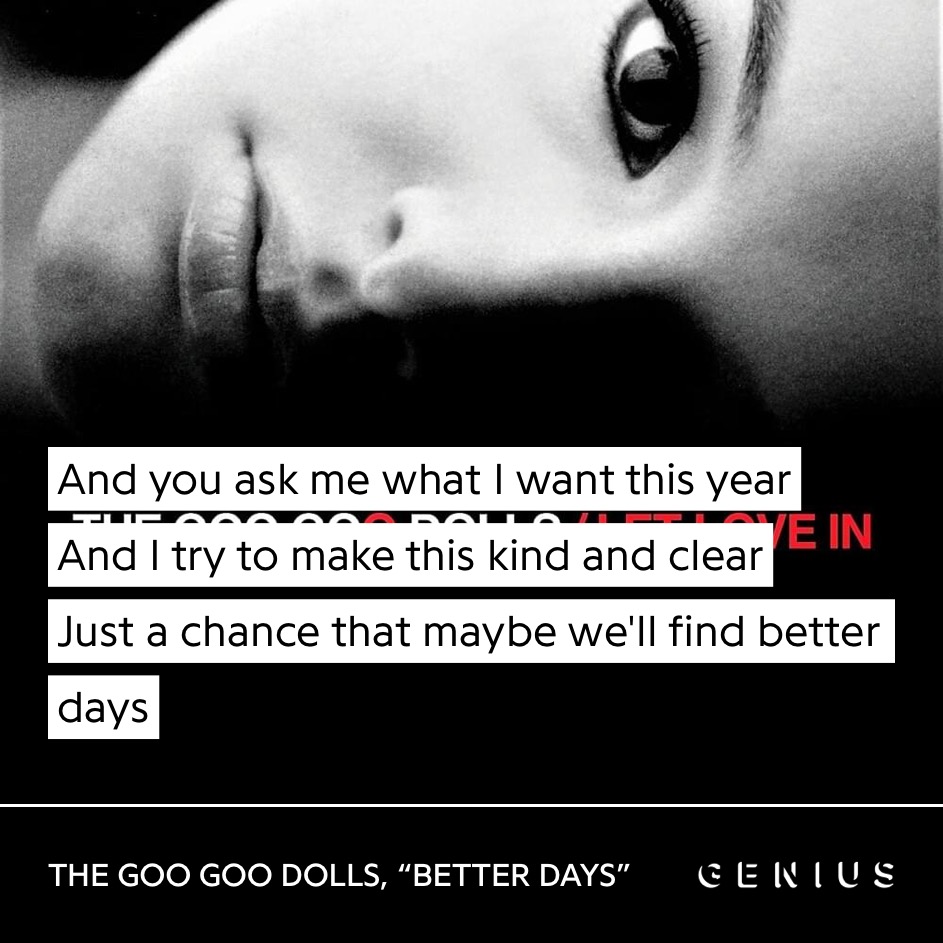
In 2006, The Goo Goo Dolls celebrated their 20th anniversary as a band. It’s hard to imagine that the band that started as a punk and metal group from Buffalo, New York, became a staple on Adult Contemporary radio. Their breakthrough song, “Name,” was a lazy-day acoustic track. The band’s biggest album, Dizzy Up the Girl contained a few upbeat acoustic rock tracks like “Broadway” and “Slide.” Still, their biggest song, “Iris,” from the film City of Angels was similar to “Name” except for cinematic string production. Their follow-up, 2002’s Gutterflower also contained the upbeat “Here Is Gone” as well as the rocker “Big Machine.” But in the band’s 20th anniversary year, The Goo Goo Dolls released their mellowest album, Let Love In.
TONIGHT’S THE NIGHT THE WORLD BEGINS AGAIN. I remember my dad saying something like when a band starts to release covers, it’s a sign of the end. I don’t know if there’s data on this, but I’ve noticed cases of this from Sixpence None the Richer to Limp Bizkit. This seems particularly true when the cover is a lead single from the album. A well-chosen cover can give a band with diminishing charting potential a final boost before they fade into fan-only obscurity. In 2004, The Goo Goo Dolls released a cover of Supertramp’s “Give a Little Bit.” While “Give a Little Bit” was technically not the lead single to their seventh album, Let Love In, the song’s peak at #37 on Billboard’s Hot 100 did signal the waning of The Goo Goo Dolls as hit makers. The lead single for Let Love In, “Better Days” bested the cover with a peak at #36, and after that, the band had no more top 40 hits on Billboard’s flagship chart. Despite the band’s fading commercial mark, they continue to release music today. Their sound remains consistent like their ‘90s and ‘00s albums.
THE ONE POOR CHILD WHO SAVED THIS WORLD. The Goo Goo Dolls have several songs that could be described as hopeful and inspirational, but “Better Days” is by far their biggest uplifting anthem. The song was included on a Target-exclusive Christmas album in 2005. The song makes several references to Christmas and even the Christ child. Singer and lyricist John Rzeznik has written about religion in several of The Goo Goo Dolls songs, most notably alluding to an abortion in the song “Slide.” With a “strict Catholic upbringing” until his untimely orphanhood at the age of 15, spirituality remained with Rzeznik’s songwriting. The band rerecorded the song for their 2023 Christmas album, It’s Christmas All Over (Again). In 2005, the song had a moment after the devastation of Hurricane Katrina. CNN and ABC played the song as footage of the catastrophe showed on TV. The song also made John Rzeznik’s Covid livestream setlist that he broadcasted on Facebook live from his front porch. While it’s not Christmas for more than another five months, “Better Days” is an inspirational song we need in what seems like a very dark year. We certainly need hope to keep going.
-
Last year, Time named Taylor Swift as Person of the Year. She is the first musician to ever hold the title. The musician has certainly permeated into all facets of culture in 2023 as part of what many have called her “Imperial Phase” or maybe Imperial Era? The biggest artists reach the “Imperial Phase” of their careers before another star rises. There is a part of the American psyche that roots for Taylor Swift–the teen star from Pennsylvania who treated her fans well to a billionaire jet-setting pop star. A big part of how Taylor won the hearts of America–and the world–has to do with fans and music lovers siding with her side of her feud with Scooter Braun. But another part of Swift’s appeal was shattering the glass ceiling which had limited female musicians in the past. Today, though, we’re not talking about Swift but rather another Era-defining musician who pioneered the idea of a female-led portion of the music industry.LORD, MAKE ME AN INSTRUMENT OF THY PEACE. In 1997, Sarah McLauchlin was in her “Imperial Phase.” Four years after releasing her third record, Fumbling Towards Ecstasy, McLauchlin released Surfacing. A hectic two-and-a-half-year touring cycle for Fumbling had both built her career and exhausted the singer to the point that she later claimed that she wanted to quit releasing music after her breakthrough record. But Surfacing was highly successful with its massive hits “Angel,” “Adia,” and “Building a Mystery,” which won a Grammy for Best Female Pop Vocal Performance. But McLauchlin was also building a legacy. The same year she released Surfacing, Sarah founded the all-female music festival lineup Lilith Fair. McLauchlin founded the concert because she was frustrated with radio stations and concert promoters refusing to play two female artists in a row. The tour ran for three years with a revival in 2010. The tour grossed $16 million in 1997, and in the festival’s three main years (the revival was a financial disaster) the organizers donated over $10 million to various charities. McLauchlin laid the groundwork for female musicians to take control of what they could in the music industry, and we’re still seeing the impact today.
IT IS IN DYING THAT WE ARE BORN TO ETERNAL LIFE. Sarah McLauchlin first released her version of “Prayer of St. Francis” as a bonus track on early versions of Surfacing. Later it was included on her Rarities, B-Sides, and Other Stuff, Volume 2. Although the text of the prayer has been attributed to St. Francis of Assisi (c. 1182-1226), it’s not in any of his writings and only appeared no further back than 1912, when it appeared in a French Catholic magazine called La Clochette, or The Little Bell. The prayer gained popularity during the First and Second World Wars. It was adapted into a song in 1967 by South African songwriter, Sebastian Temple. Sinéad O’Connor performed the song at Princess Diana’s funeral in 1997. Today, we’re listening to Sarah McLauchlin’s version. The singer-songwriter has used religious imagery in many of her songs and has even performed for Pope John Paul II, she does not consider herself religious. She has said, “I don’t follow any organized religion, but I do believe in the idea of god as a verb–being love and light. And that we are part of everything as everything is a part of us.” “Prayer of St. Francis” is the prayer of a servant’s heart, and you don’t have to be religious to want to serve others.
-
Lana Del Rey returned last year with the latest installment of her “Carol King Era” of songwriting in Did you know that there’s a tunnel under Ocean Blvd? This new era of the Del Rey persona created by Lizzy Grant feels like a slow progression away from pop hooks, and maybe where this started was with Del Rey’s second album, Ultraviolence. But Del Rey’s real critical acclaim arrived with Norman Fucking Rockwell!, the album that both ended pop Lana and started the ‘70s-styled singer-songwriter that she followed up with Chemtrails over the Country Club, Blue Banisters, and Did you know. GIVE PEACE A CHANCE. Lana Del Rey’s fan base is strong, quick to interpret ever line that the singer writes in the blogosphere. Not only do fans read into her released songs, they also track down her unreleased demos and leak them online. Usually Del Rey pays no attention when one of her unreleased songs is leaked; however, when a sped-up version of “Say Yes to Heaven” started appearing on Tik Tok, the singer addressed the song’s leak by releasing it on streaming services. While the track had been leaked on Tik Tok, fans had been talking about “Heaven” since 2016 when snippets of the song emerged online. With credited songwriting and production to The Black Keys’ Rick Nowels, the song has been rumored to be a track cut from Ultraviolence. While critics seem to love the new Lana Del Rey, some of us miss the old days of hip-hop beats and wall-of-sound dream pop production. Del Rey seems to be giving the fans what they want with the release of “Heaven,” harkening back to the classic voice, rock guitars, and bad-ass lyrics.LIKE A BARGE AT SEA. I was excited to hear “Say Yes to Heaven,” thinking that Del Rey’s looking back at her musical past may challenge Del Rey to go back to the days when her music was easier to listen to. But “Say Yes to Heaven” feels like a Lana Del Rey b-side. It’s missing something, and I believe that’s the fact that the lyrics don’t hit hard enough. “Say Yes to Heaven” has very short verses and a very simple chorus. It’s also a little cliché: heaven, this song, is falling in love with the speaker. It’s not a “Dark Paradise.” No emphasis is place on how bad this boy is. It’s almost a Lana Del Rey song but it needs to be workshopped a few times before it’s officially album-ready to align the song’s imagery and metaphors with a folk tale in rock ’n’ roll history. Perhaps John Lennon’s “Give Peace a Chance” could have been a clue as to where the song could have gone, maybe painting a picture of Lennon as a peaceful revolutionary who tried to live peacefully until he was assassinated. There’s certainly a Lennon-Yoko Ono love story Lana could have woven into the lyrics of “Heaven.” Regardless of the weaknesses of “Say Yes to Heaven,” I hope that Del Rey looks at her past eras and thinks about revisiting some of her old songs. -
Last year, I listened to a podcast introducing artists who sound similar to another artist to help lesser-known artists expand their fan bases just to hear some takes that the commentators had to say about another artist I was preparing to post about. I didn’t actually end up writing about that artist, but I inadvertently discovered a few new artists to add to my AppleMusic library, one of which was Filipina-British singer-songwriter Beatrice Kristi Ilejay Laus, better known by her stage name beabadoobee.
BUILDINGS AND RUST. With over 17 million monthly listeners on Spotify, bedroom pop singer beabadoobee opened for Taylor Swift last year on a leg of the Eras Tour. Laus is just one of many artists that Swift was probably introduced to through a rumored ex, The 1975’s Matty Healy. Born in Iloilo City in 2000 and relocating to London with her family at the age of three, Laus was influenced by indie rock from an early age. At the age of seventeen, she learned guitar from YouTube tutorials after having played violin since the age of ten. In September 2017, she released two songs on YouTube, a cover of Karen O‘s “Moon Song” and an original titled “Coffee.” With 300,000 views on YouTube, Bea signed to Dirty Hit Records. The UK-based label housed acts like The 1975, The Japanese House, Wolf Alice, and Rina Sawayama. After signing to Dirty Hit Records, beabadoobee released several EP and started garnering critical acclaim. Supporting tours with Clairo, labelmates The 1975, and Halsey and admiration by Taylor Swift, Harry Styles, and Khalid for her artistry, beabadoobee has become a kind of artist’s artist.LAST NIGHT’S EMERGENCY. In 2022, beabadoobee released her second full-length record Beatopia. The album shows Laus’s blend of indie rock with acoustic singer-songwriter tendencies. The under-refined elements of the album make the album delightful, from the cover art that looks like it was designed by a child to opening track “Beatopia Cultsong.” Most of the album is more at home in a coffee shop than on the radio, but there are certainly some catchy hooks hidden within the album. Deep within the record is today’s song “Pictures of Us.” The song’s lyrics are vague. The short verses deal with a conflict between the speaker and an unnamed female. Musically, the song reminds me of a ’90s soft rock-forgotten gem. The song was originally written by The 1975’s frontman Matthew Healy about his childhood friend, Bea rewrote the track about a friend she had when she was a teenager. Of the iconic line in the chorus: “She reminded me that God starts with a capital, but I don’t think I can do it” Laus told Apple Music: “It’s so open to interpretation. To me personally, it means someone that you truly, truly admire, but not being able to be on the same page. But you’re trying to be.” -
Tropical House is a subgenre of electronic dance music (EDM) that is characterized by its laid-back, feel-good vibes and tropical-inspired melodies. It often incorporates elements of house music, deep house, and chillwave, and is typically characterized by a tempo of around 100-120 beats per minute. Instruments often played or sampled in the genre included steel drums, marimbas, ukuleles, other tropical instruments, synths, and drum machines. The lyrics are often about love, relationships, and the beach. The genre can be traced back to the ‘00s but became extremely popular in the ‘10s. Ed Sheeran’s “Shape of You” has been called the biggest song in the genre. Avicii and Martin Garrix were early popularizers of the subgenre.
SPARKS WILL FLY, THEY WILL IGNITE OUR BONES. Norwegian DJ Kyrre Gørvell-Dahll, or Kygo, was influenced by Avicci’s music and started emulating the late DJ’s sound in his created music. Kygo both wrote new music and remixed existing tracks, many of which were rock or disco tracks. In 2013, Kygo remixed Ed Sheeran’s “I See Fire,” sparking the DJ’s career as a go-to remix artist for groups like The xx, Ellie Goulding, and Kylie Minogue, among others. But it was the original song “Firestone” in 2014 that established Kygo as not just a remix DJ but as a collaborator and producer of original songs. Kygo doesn’t sing on his own tracks, so every song he produces features another artist. For his first hit, “Firestone,” Kygo teamed up with Australian pop singer Conrad Sewell. The song was a massive hit in Europe, Australia, Mexico, and Lebanon. It got some radio airplay in America, peaking at #35 on Billboard’s Pop Airplay chart and #8 on Billboard’s club chart. The song has proven to be a lasting hit with over a billion streams on Spotify.
WE LIGHT UP THE WORLD. “Firestone” would eventually appear on Kygo’s 2016 debut album, Cloud Nine. The DJ gathered other famous names for this record including John Legend, Kodaline, Julia Michaels, Tom Odell, and others. The subgenre that Kygo helped popularize essentially replaced the former most popular form of EDM–Dubstep, a far more aggressive, chaotic-sounding style. Besides Ed Sheeran’s venture into Tropical House music, the genre was highly embraced by K-pop with major Tropical House hits by Winner, SHINee, Taeyeon, Chungha, and many others. It’s still prevalent in (non-K-) pop music today, though pop producers seem to be embracing a larger sound pallet rather than completely replacing the sound on the radio waves. The genre even appears in rock and alternative, which is no accident given Kygo’s work with Kodaline, U2, and OneRepublic. The genre is perfect for the summer and makes clubs feel like summer. And as the world is warming up due to climate change, those summers seem to be getting longer and longer. It’s a pleasant genre that doesn’t seem to be going anywhere soon.
-
The summer rainy season kicked off about a week ago and the music of Anson Seabra is my soundtrack for a rainy summer day. Getting into the 29-year-old singer-songwriter’s music has taken me some time. In my opinion, the melancholy piano and overly clear voice front and center in the production on the recordings that brought him to Internet fame are a slowly acquired taste. This is particularly true of his breakthrough, 2020’s Songs I Wrote in My Bedroom on songs like “Hindenburg Lover” and his follow-up EP 2021’s Feeling for My Life on songs like “Walked Through Hell.” Last year, however, Seabra released A Heart Is a Terrible Thing to Break. Seabra’s sound seemed to evolve after releasing Feeling for My Life, leading to a truly great indie rock 2023 record with instantly catchy melodies.
TWO HOPELESS STRANGERS IN A LOVE-DRUNK HAZE. What makes A Heart Is a Terrible Thing to Break different from Anson Seabra’s previous work is that this album is guitar-based rather than piano-based. Seabra’s voice is unique with guitar and it rests in a sweet register blending seamlessly with the electric and acoustic strings, whereas sometimes pianos make his voice seem glaringly eccentric, standing out above the pressed keys. The album mixes up Seabra’s musical styles from acoustic ballads to the R&B radio-friendly “Broken Boy” to the adult contemporary “Heartbreak Souvenirs.” The album’s variety also seems to form a cohesive sound, never giving listeners too much of one particular sound, but never straying wildly into musical or lyrical experimentation. Seabra’s songwriting voice is also part of the reason for the cohesion. Songs touch on similar themes, especially heartbreak and falling in love, without recycling phrases. Besides guitar, Seabra’s inclusion of drums on several songs makes A Heart Is a Terrible Thing to Break stand out in his discography. Most notable is today’s song, “Supposed to Be Love Song.” The drums add a disco flare to the song from the verse and make Seabra’s most catchy chorus.
THEY ALL SEEM TO SOUND THE SAME. Lyrically, “Supposed to Be a Love Song” is relatable. The lyrics paint lyrics of a picturesque romance, heading to Paris, meeting in Amsterdam, the hype that others put into the speaker, and the listener’s love story in “We were teenage dreams, we were movie stars.” It reminds me of every time it seemed the stars were aligning and sunshine and rainbows were ahead. How many movies with a perfect cast seem to fall apart? I remember watching Zoolander 2 and remarking, “It feels like the actors shot every scene at gunpoint.” There was no passion in the performance. It’s also happened in situations when I was planning the perfect vacation or the perfect rooming situation in college or the perfect work environment. And let’s not forget the time when America allowed same-sex couples to wed and it looked like we were set for a liberal future in 2016. I can’t say that all of the situations I’ve listed have a silver lining. Sure, work and college turned out okay and maybe it was for the better. “Supposed to Be a Love Song,” however, rewards the listener with an earworm. The speaker even admits in the bridge: “That’s okay / Too many love songs anyway / And they all seem to sound the same.” “Supposed to Be a Love Song” wouldn’t be as fun as a love song; it would be a cliche and the listener would have a harder time relating to it. “Supposed to Be a Love Song” expresses a complex emotion that is harder to capture in a song. And rather than a love song, it builds a community of listeners who can relate to it. -
There had been hints and tendencies listeners could pick up on from earlier Falling Up records. There was the occasional strange word choice on Crashings. There was esoteric storytelling on Dawn Escapes. There were the made-up words on Exit Lights, the remix record. And for the band’s third studio record on BEC Recordings, Captiva, Falling Up delved into Greek mythology and science fiction. But for the band’s fourth record, Fangs! Falling Up presented a full concept record without Bible verses in the album notes. This time fully indulging in world-building.
SOME OF US HAVE SEEN GOLDEN ARROWS POISED. Working with frontman Casey Crescenzo of cult-status progressive indie band The Dear Hunter, the sound on Fangs! steers the band away from the electronic and Nu Metal influence Falling Up had previously embraced. Before releasing the record, lead singer Jessy Ribordy shared the story behind the concept record. Ribordy explained that the story is a prologue to the album, and the album is about what a traveler from another planet encounters. The record’s lyrical content, even being tuned into the backstory, is obscured with new vocabulary, almost coded like an Elon Hubbard novel, not that Falling Up will start a new religion. Fangs! was a polarizing record, signaling a mass exodus of fans who had witnessed Falling Up’s change in status from a massive mainstream Christian Rock band to a niche sound of sci-fi/fantasy, even stoner rock.

Ophelia by John Everett Millais. Source:
Wikipedia Commons.HAVE YOU FORGOTTEN ME FOR FLOWERS IN YOUR HAIR? In this C. S. Lewis/ Greek mythology/ Hamlet space opera of Fangs!, we come to one of the catchiest tracks on the record, “Goddess of the Dayspring, Am I,” the ninth track on the record. In the verse, the song is kind of an Odyssey retelling of the story up until this point, with the traveler recalling the adventure accompanied by an up-tempo guitar tremolo. But the chorus slows down; it’s a lament because the Goddess of the Dayspring has died. The traveler runs his hands over her dress; his hands touching her lifeless body, pleading with her to come back to life. The goddess is partially inspired by Shakespeare’s Ophelia, Hamlet’s lover who takes her life by drowning in a river after losing her sanity. When I was listening to this record in college, I always pictured Sir John Everett Millais’s painting depicting Ophelia’s corpse floating in a calm stream with flowers surrounding the body. Jessy Ribordy’s delivery of this loss feels authentic, despite the song being a complete work of fiction. But there’s no time for the grief to last; the song picks up with rapid drumming as if the traveler runs off past the mourning courtiers to investigate.
-
Last year, it seemed that Billboard’s Hot 100 was gridlocked by legacy acts. Besides K-pop groups, two artists were able to break through last year: David Kushner and Noah Kahan, folksy singer-songwriters known for their hits “Stick Season” and “Daylight.” Pop critics were divided on the singer-songwriter trends. The New York Times Popcast critics complained about the monotony of “Daylight,” especially considering the Indie Pop and Alternative acts on the fringes of the Hot 100. YouTuber Rick Beato, however, praised the “Stick Season,” saying something to the effect that these songs were making music “sound like music again” when he counted them down on one of his countdowns of the most popular song countdowns. A few months later, rock guitars seem to be making a comeback on the pop charts.
BUT I THANK GOD EVERY DAY FOR THE GIRL HE SENT MY WAY. Noah Kahan’s music out-charted David Kushner’s on the Hot 100. Their breakthrough success certainly wasn’t out of nowhere with the massive country chart-toppers last year. While neither Kahan nor Kushner was associated with Country music, their folk-driven white, presumably straight, young man sound countered years of flamboyant electro-pop and trap-beat Hip-Hop reigning atop Billboard’s flagship chart. This year’s Hot 100 looks like a course correction in the first half of the year—female pop stars, male and female rappers, and a Christmas song in January as the chart numbers are always a few weeks behind. But two number-one hits and one number-two hit feel like they owe at least a nod to Kushner and Kahan for paving the re-emergent singer-songwriter trend in pop music. Number one hits: “Lose Control” and “Too Sweet”— bluesy, non-Country associated songs by Teddy Swims and Hozier topped the Hot 100, and newcomer Benson Boone reached number 2 with his international hit “Beautiful Things.”
I FOUND MY MIND; I’M FEELING SANE. After dropping out of Brigham Young University-Idaho, Benson Boone focused on building his career as a singer. In 2021, he auditioned for American Idol, making it to the top 24 on Season 19 before dropping out of the show. Later in 2021, Boone signed to Night Street Records, a label owned by Imagine Dragons frontman Dan Reynolds. Benson released several singles, seeing some domestic and international success with his debut single, the JT Daly-produced “Ghost Town.” Boone’s biggest song, so far, is a song about mental health, love, and possibly a transactional God. “Beautiful Things” reached number 2 on Billboard’s Hot 100. Similar to Hozier’s “Too Sweet,” “Beautiful Things” is a rock-based ballad, almost a throwback to the ‘90s or ‘00s when pop-rock was a viable genre. The song touches on Boone’s presumable faith background, partially quoting the book of Job with “the Lord gives and takes away.” Today’s song is riddled with anxiety and the belief that the good things in life don’t last. The “girl [his] parents love” could reject him. However, the anxiety feels like it’s on a grander, more biblical scale, such as a car accident, cancer, or the earth swallowing her up. In the second verse, Benson asks “If everything’s good and it’s great, why do I sit and wait till it’s gone?” The catastrophizing doesn’t seem to be limited just to the girl. With a career trajectory seemingly on the up and up a #2 Hot 100 single and opening for Taylor Swift on the Eras Tour in the UK, few singer-songwriters, particularly non-country male singer-songwriters today, stay on the pop charts for very long in the 2020s. Any singer’s fifteen minutes of fame can be up with no guarantees of a follow-up hit. But because we’re always rewriting the guidebook for how to be a pop star, these observations may be moot.