• Lana Del Rey‘s magnum opus, Norman Fucking Rockwell! was released in September of 2018 and earned the singer-songwriters the acclaim she had been laying the foundation for since 2012’s Born to Die. A year after her lackluster album/ collection of good songs Lust for Lifeshe released the first single from NFR, The Mariner’s Apartment Complex” and quickly followed it with another single, the 9:38 song “Venice Bitch.” She began building hype for the record, a cohesive record using the Americana formula Del Rey uses best, a year before its release. The singer awkwardly promoted the album in October of 2018, 11 months before its release, at an Apple Keynote event. The singer wasn’t allowed to say the name of her upcoming album or its single, which she played censored, “Venice Bitch,” as Jack Antonoff  played the piano.

    Norman Rockwell’s Saturday Evening Post
    Cover, 
    Public Domain

    YOU DON’T EVER HAVE TO GO FASTER THAN YOUR FASTEST PACE. I remember a coffee table book we had, a warn spiral-bound collection of Norman Rockwell’s most popular Saturday Evening Post covers. The paintings are uniquely American, often slightly uncouth, compared to what would have been considered proper art of the day. Born in 1894 and dying in 1978, Rockwell set out to capture Americans as they were, sometimes overweight, showing full expression to a surprising moment, and in the common working-to-middle class settings of the day. He captured American life in the way that The Simpsons.    or  Rosanne captured the American family when the pretense of the cameras in Leave It to Beaver or The Brady Bunch had packed up and the family was left to untuck their shirts or have an argument. One painting I remember the clearest is No Swimming, a painting in which three boys are running with, trying to put their clothes back on. I stared at that painting taken by the lifelike use of motion and detail of the moving bodies. Viewers don’t know exactly what the boys are running from, but anyone who was once a kid knows exactly what they are running from.  Looking at this painting when I was about seven or eight years old, made me feel a fascination I had never felt before. 


    I’LL PICK YOU UP. “California” is a song that made me think about going back home “to America.” I think about what my mom says when I’m back home: “We’ll do whatever you want to do. It’s all about you.” That’s exactly what a ten-year-old wants to hear a couple days of the year, but as a 30-something I think it’s rather sad. I feel bad that when I come home to America it’s such a big deal. I’d much rather just blend into everyone’s daily life, have a few lunches together, and be able to be “back home” a couple times a year so it’s not so special. I’ve thought about getting a job that would let me get home twice a year. However, now with the pandemic and air travel being what it is, it seems being away is inevitable. So as we come closer to the holidays, although most of the references in “California” don’t really apply to me, the song makes me feel homesick. It makes me miss my Lana Del Rey-fan sisters. It makes me miss my friends who show me around the recently-transformed micro-brewery city full of hipster/redneck nightlife. It makes me miss my parents who make all my favorite foods. If I come back to America, I’ll hit you all up.

    Read “California” by Lana Del Rey on Genius.  

  • I was in a coffee shop in Sinsa, a neighborhood near Gangnam in Seoul when I first heard Kodaline. The Irish band’s debut album, In a Perfect World, and the EPs containing different versions of songs from around that time were perfect for a cup of coffee. Subsequent albums have made the band sound like they were striving to be another Coldplay, but they got it right the first time on their debut.

    I WANNA TRAVEL THE WORLD, BUT I JUST CAN’T DO IT ALONE.  I‘m recommending the acoustic version of “Brand New Day,” featuring Nina Nesbitt.  The lyrics of “Brand New Day” talk about “outgrowing your hometown” and wanting to “travel the world” with someone. As someone who could be said to be (still) on that journey, I remember the feelings of travel thirst. I got to the end of my bachelor’s degree and thought about the constraints of going back home to North Carolina. I thought about how it would be a few years of struggle in a career before buying a house. I thought about my very few trips overseas and how I wanted to get out of America and experience other cultures. I wanted to get away from the people I knew form new patterns and figure out who I was. So many friends who were older than me told me to do it. “When you settle you get roots, and it’s much harder to leave when you have the responsibilities of a mortgage and kids.” So I went to South Korea. And I started establishing roots here. It’s not exactly what I had in mind, but I’m enjoying life and learning something new every day that my younger self would never foresee myself doing.

    WE COULD BE BIG IN JAPAN. While it’s nice to be nostalgic, this song also pushes me forward, but not in a way that makes me question my life decisions (have you really   quenched your travel thirst?) I felt that way for the last few years and was off to a good start around this time. What’s different? I know how crappy things can get. My best years may be behind me. I mourn every day for the experiences I never had as a teenager or young adult. But that’s not to say that life has a limit on awesome experiences. I think about the opportunities I’ve missed because I was thinking about the logistics of them–an awesome layover in Seattle or San Francisco and most recently Munich or Frankfort. I’m so done with being ruled by the fear of enjoying myself. I’m so done with the guilt that I feel when I start to let myself go. I hope for a future in which I find myself drinking Rioja in Spain, admiring the sartorial aesthetics in Austria, nervously attending a fetish party in Germany if nothing more to engage in some voyeurism. Life is a series of brand-new days. It’s time not to waste them. 

    Album version Music Video: 

    Acoustic version featuring Nina Nesbitt:


    Read the lyrics on Genius.

  • It was Superbowl Sunday of 2005 when I bought Anberlin’s Never Take Friendship Personal.  It was the perfect album for high school. The band’s style took a turn on their sophomore album from a classic or ’90s rock sound to a more emotional, mid-2000s sound. The band would redefine themselves with this album, becoming a lesser-known emo staple. Stephen Christian’s vocals meeting Joseph Milligan’s riffs, Deon Rexroat’s heavy bass, and Nathan Young’s reliance on the cymbals make this one of the band’s heaviest records. The band released two recordings of this song on two different albums and many fans debate which one is better.


    THIS WAS OVER BEFORE IT EVER BEGAN.  The original version of “The Feel Good Drag” feels grungier and Stephen’s scream on the bridge was perfectly aligned with the musical trends of the day. The New Surrender version, renamed “Feel Good Drag,” beefs up the guitar intro, and the solo has a quite satisfying bend.  However, having already chosen an Anberlin song for later this month, and without cheating, I’m choosing a cover I found on YouTube several years ago when I was searching for Anberlin covers. Jonathan Slack under the user “jslacking” with 73 YouTube subscribers and only a version of “Feel Good Drag” uploaded 13 years ago, is my most obscure pick yet. From a five-minute research trip of his other social media profiles, the ones linked in his YouTube account, However, Slacks’ vocals and empty bedroom recording is the best acoustic rendition of this song I’ve heard including several released by Anberlin. Unfortunately, the Apple Music Playlist won’t include this version. I can post it on my YouTube playlist. So, I will I have to cheat with the Apple Music playlist and post the Anberlin acoustic version.


    LIKE THE DEVIL’S GOT YOUR HAND. It’s no secret that Anberlin is my favorite group, and “Feel Good Drag” was their biggest hit, reaching #1 on the Alternative Rock chart for one week. On the surface, it’s a song about how cheating dooms the future relationship. However, in interviews with Stephen Christian, right after Anberlin’s hiatus, he talks about it being his failure with premarital sex. That makes Christian’s lyrics, particularly in the second verse, seem condescending. In this sense, this rock hit is a time capsule of Evangelical purity culture. In its original iteration, this song was in the middle of the album I would listen to driving back and forth to Christian High School every day with my sister. We would gossip about people–the relationships that had gone too far, the hypocrites. When it became a radio hit in 2009-2010, I was in Adventist College, doubling down on my conservative values. However, as my mind opened up in Korea (I promise I will get to this story), and I started reevaluating the values that had been instilled in me, I subscribed to The BadChristian Podcast after hearing the interview with Stephen Christian, who started to double down on his conservatism, becoming a music minister in New Mexico and releasing a worship record. At that time, I felt like I was outgrowing Anberlin. I was starting to see God more broadly, and Christian was focusing on the straight and narrow of following the rules. Today I consider “Feel Good Drag” as one of Anberlin’s best songs, but of their catalog, it wouldn’t have been the hit I would have chosen. The band had a much better message–fighting injustice, the complexity of human relationships, dealing with complications in faith and doubt. Why did a simple song about cheating on your significant other become how they’re most remembered?


    Read the lyrics on Genius.


    Never Take Friendship Personal (Original) Version:

    New Surrender (Radio) Version:

    Anberlin Official Acoustic Version:

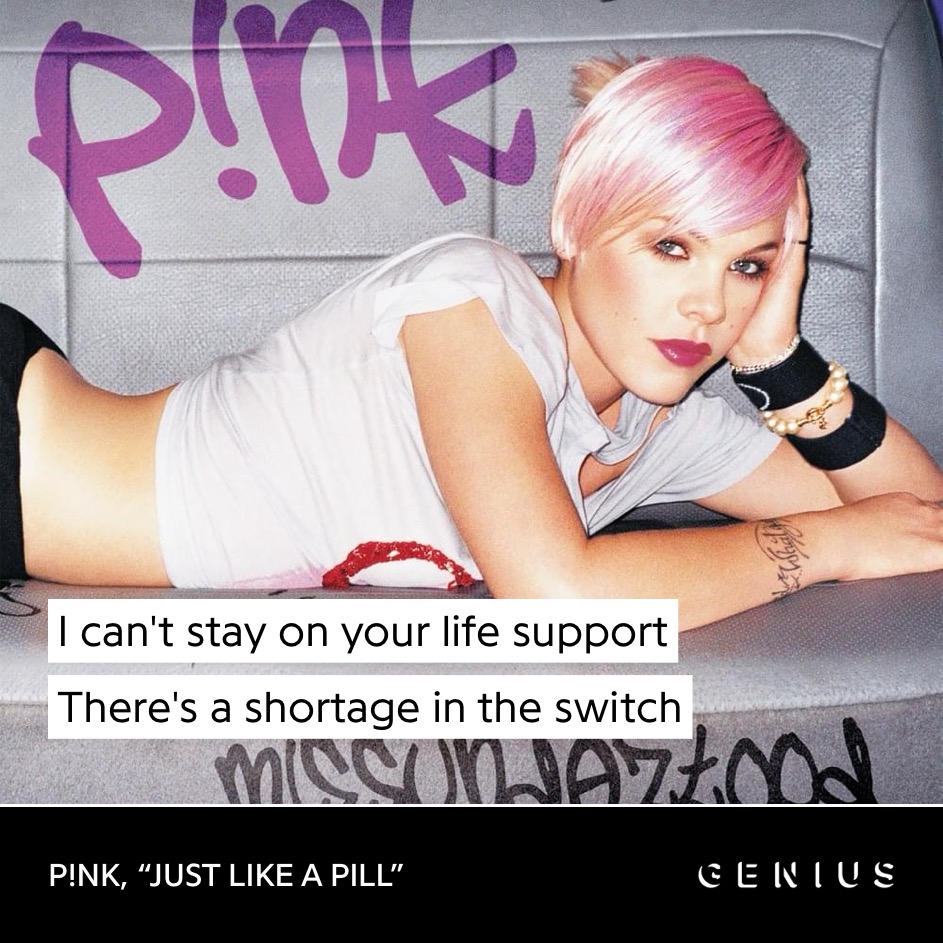
  • Last year, the Hit Parade podcast highlighted one of the most consistent voices in pop music in the previous twenty years. Yet, Alecia Beth Moore, a.k.a. P!nk’s career has been underrated perhaps because it is so M!ssundaztood. First marketed as an R&B act by her record company, P!nk’s debut album, Can’t Take Me Home, introduced the star as racially ambiguous. P!nk’s second album began to bridge the singer into guitar-based rock ballads, which would be the meat of her career. Following the album’s first single, “Get This Party Started,” M!ssundaztood’s second single and second track “Don’t Let Me Get Me” displays Moore’s desire to be a singer on her own terms: a rock-influenced pop star who would sing about what she wanted to.

    I CAN’T STAY ON YOUR MORPHINE ‘CAUSE IT’S MAKING ME ITCH. P!nk was signed by Atlanta-based R&B and Hip-Hop label LaFace Records whose president, L.A. Reid tried to market Moore as an R&B/teen-pop crossover act. But rock would become P!nk’s style of choice by her second record with the singles “Don’t Let Me Get Me” and “Just Like a Pill.” However, rock radio never embraced P!nk like it did female pop-rock stars of the ‘90s Alanis Morrissette or Natalie Imbruglia, or ‘00s female-fronted bands like Evanescence or Flyleaf. Instead, P!nk’s venture into rock music seemed to serve the rock-ifying of pop in the ‘00s heard in acts like Avril Lavigne and Kelly Clarkson. P!nk’s second album was her best-selling record. The album’s first three singles were top-ten Billboard Hot 100 hits. And while the R&B- influenced “Get This Party Started” beat the two rock singles “Don’t Let Me Get Me” and “Just Like a Pill,” the rock songs would lay a template for her rock songs that would later top the Billboard chart later in the decade and in the next. 

    I TRIED TO CALL THE NURSE AGAIN, BUT SHE’S BEIN’ A LITTLE BITCH. “Just Like a Pill” and “Don’t Let Me Get Me” were a counterforce to teen pop. In M!ssundaztood’s second single, P!nk laments “Don’t want to be compared to damn Britney Spears. She’s so pretty; that just ain’t me.” P!nk has explained this lyric as not intended to throw shade on the teen pop singer but rather to state that P!nk viewed herself as an intentionally flawed star and that female singers didn’t have to fit into a Britney Spears mold. Furthermore, P!nk wanted to write songs discussing her life, some of which were never the subject of teen pop. In her fourth hit “Family Portrait,” P!nk talks about abuse and divorce, inspired by her childhood and the end of her parents’ marriage. In today’s song, “Just Like a Pill,” Moore talks about a former toxic relationship she had using the metaphor of the negative side effects of drugs to compare the relationship to. P!nk even talked about her past drug use, and the music video seemed more inspired by Nine Inch Nails than Christina Aguilera’s early videos. It was grimier than a pop video at the time and featured P!nk licking her video boyfriend’s stomach. Britney and Christina would make videos similar to “Just Like a Pill,” but at that point, it would be hard to call their music of that era teen pop. 


  •  

    Like Further Seems ForeverThe Juliana Theory was legendary in the early pop-punk/emo scene. Also like FSF, The Juliana Theory has ties to hardcore. Lead singer  Brett Detar started as the guitarist for Christian metal pioneers Zao, however, as he explains on Theory’s episode of Labeled,  the band was perfectly content listening to Third Eye Blind on the radio in the van while out on tour. When Theory formed, they signed with Tooth & Nail Records but opted not to be marketed to the Christian Rock format. This decision both helped and hurt their career. On the one hand, they toured with other Tooth & Nail artists and performed at Cornerstone, on the other hand, their initial record sales were quite low. 

    IT IS GETTING BETTER NOW. Unlike Further Seems Forever, I don’t have a deep-seated nostalgia for The Juliana Theory. I heard they were a band name, but I wasn’t exposed to their music until college after the band had broken up. While some of their music was catchy, their Tooth & Nail predecessors did a better job at what they set out to do: further the emo/pop-punk genre. However, at the beginning of this year when I heard their two new singles “Can’t Go Home” and “Better Now,” I found two songs that felt on the level of their predecessors. A big factor in this new Juliana Theory is Brett Detar’s growth as a musician. After the Juliana Theory’s initial run, Detar released two country albums and composed music for films. Rejoining with guitarist Joshua Filedler, the band is now a duo, which is in line with where music is going. Last year, the band released an EP on Equal Vision RecordsStill the Same Kids, Pt. 1Similar to now labelmates Anberlin, The Juliana Theory has decided to release their album in two parts. We are still awaiting the second parts of both releases The Juliana Theory’s and Anberlin’s releases, though. 

    HOLD ON. Better Now” is an inspirational song celebrating the incremental accomplishments a person who is trying to turn their life around makes. The video depicts three situations in which individuals make a decision to improve their lives from bad situations. From a U.S. Forces veteran who regains his ability to walk, to a drug addict mother who chooses to clean up her life because it’s influencing her son, to a mother who chooses to leave an abusive marriage, the message of the video is that change is possible. As the video may be triggering, there are helplines available for various crises. While now may be bleak, music can help us believe that light is around the corner. We just need to hold on a little bit longer. But we don’t need to be in a full crisis to enjoy today’s song. We should learn to recognize and appreciate incremental change in ourselves and in others around us. As a teacher, this is important, especially when dealing with problematic behavior from students. But if we look at where we are on the journey, we can get a more complete picture. There’s hope.

  •  

    In recent years, Skillet has become an apologetics band under the leadership of lead singer John Cooper. But before you could catch him on Fox News, Skillet was the band whose CD you had to hide from your conservative parents, whether it was the fetish-wear-inspired pastiche of Invincible or the snake on the angel mannequin on the cover of Collide. Skillet’s early music was influenced by Industrial bands like Nine Inch Nails and Korn, bands known for their anti-Christian messages.  But Skillet’s early music varied greatly, each album seeming to take a completely different set of inspirations. Their 1996 debut self-titled album and its follow-up Hey You, I Love Your Soul pulled from grunge, while the band’s next two albums delved into a dark Marylin Manson sound.

    I’M EVERYTHING YOU WANTED. When speaking with Shane Told of the Lead Singer Syndrome podcast, John Cooper talked about how he was disappointed that youth groups were choosing secular songs for church skits rather than Christian bands’ songs. He went on to say that he took it as a challenge to write better songs that would impact Christian rock. Following what Cooper ranked as the band’s worst album Alien Youth, Skillet released Collide in 2003. The album is the beginning of the franchise that Skillet is today, a band that is arguably one of the most ironclad brands in Christian Rock along with Demon Hunter and Red. Rather than synth-based Industrial sounds that dominated the band’s third and fourth records (excluding their worship record between the two), the band creates a hard rock sound that is embellished with strings. Their follow-up Comatose would explore this sound, going full symphonic at times and subsequent releases seemed to copy and paste the formula from Comatose. 

    But before the formula was laid, Collide was a great record, and there is still a lot of discourse online defending this album.

    WHAT YOU GOT, WHAT YOU WANT, WHAT YOU NEED. With Collide, Skillet maintained the intensity of their synth-based albums, in part due to excellent musicianship with drummer Lori Peters and the crunchy guitars of Ben Kasica. Through years of trial and error, John Cooper’s gravelly voice in singing and screaming blends well on Collide. The album’s first single, “Savior,” was a crossover hit for the band and introduced them to the active rock radio circuit. When the band wasn’t playing Christian festivals, they began touring with groups like Breaking Benjamin and Shinedown. The band’s promotional team tried to get “Savior” in Spider-Man 2 but failed to procure the placement. The song did,  however, reach number 26 on Billboard’s Rock chart. The music video depicts children living with an abusive father. Cooper said that the video was inspired by his relationship with his father when he was growing up, a topic he would explore in the next album’s “The Older I Get.” “Savior” isn’t an epic song that says “Jesus is the savior,” but rather offers the promise that “everything’s going to crash and break.” What’s left is the speaker of the song, who could be interpreted as Christ. But the song also could support the solution coming from within. This seems absurd knowing the cultural icon Skillet has become, but in 2003 the band was just emerging on the scene and could have gone in a different direction.


  • It’s been 22 years since the post-grunge “Hanging By a Moment” was the number 1 song of the year. Although the Christian Rock band Lifehouse never actually topped the weekly charts, the song had so much statistical force via radio play and record sales that the song became one of the rare cases when a single that peaked at number 2 could actually claim the number 1 position for the year. No Name Face featured three singles, but none were as big as “Hanging By a Moment.” For the band’s follow-up, Lifehouse signed a Christian music marketing deal with Sparrow Records. Stanley Climbfall was nowhere near as successful as the No Name Face, but a sophomore slump didn’t plunge the band into obscurity. In 2005, the band released their self-titled album which boasted their number one hit which was appearing in every TV show that year, the prom/wedding favorite, “You and Me.”  

    I WAS YOUNG BUT I WASN’T NAIVE. Blind,” the band’s second single, was overshadowed by the album’s first massive hit, “You and Me,” just as the other singles from No Name Face. But while the wedding and prom industry needs new songs every year and “You and Me” is a rather fine choice, the brooding “Blind” delves into lead singer Jason Wade‘s childhood and his parent’s divorce. The music video stars actress Tina Majorino, best known for her role as Deb in Napoleon Dynamite, who acts as a goth chick browbeaten by her womanizing father. Majorino’s character seems to act as a foil to Wade. When the band is playing in the goth chick’s room, Wade and the girl make knowing eye contact for a moment. Interestingly, the normally no-frills Jason Wade is seen in this video wearing eyeliner, sometimes called guy-liner, a trend that punk and emo groups rocked at this time. Some examples were Green Day and My Chemical Romance. Lifehouse was far from being a dark emo band, but “Blind” was one of their darker songs. Furthermore, Lifehouse in the video seems to represent the role that music plays in escaping childhood/teenage trauma. For one of their biggest Christian Rock hits, Lifehouse didn’t make a moralizing video, but rather when the father is out on his infidelity escapades, the daughter throws a party where everyone dances to Lifehouse and she kisses a boy. And from this party, she comes to the clarity that it’s time to leave her father’s house. 

    I WOULD FALL ASLEEP ONLY IN HOPES OF DREAMING THAT EVERYTHING WOULD BE LIKE IT WAS BEFORE. My mom always scolded me for watching music videos, so as soon as she went out, I’d watch TVU, Fuse, and whatever other music channel wasn’t playing reality TV. Every time this video came on my sister and I would yell “It’s Deb!” When I was growing up my parents fought constantly. I remember going to bed to the sound of their fighting some nights. My parents told us that they made a commitment to marriage so they would not get a divorce. My mom’s parents had divorced, and it probably left a lot of emotional scars. But I secretly wanted my parents to divorce. Maybe it would solve the bitter arguments. For years I blamed my parents for distorting my ideas on marriage. I told myself, if this is marriage, I don’t want it. My parents are still married but live very separate lives. They live in the same house but on opposite sides. They work different schedules. They spend time together, but too much time sets them off on each other. I’ve let a lot of it go since I’ve been away from my family. I think that my parents let go of their childhood trauma in a similar way once they moved away from it. Maybe we’re not really over it, but at least there was the music to help me through it.
  • One of the biggest challenges of writing about music that I often run into is there isn’t always a lot to talk about. Just because it’s a good song, doesn’t mean that it is a conversation piece. New music is particularly hard to write about. It takes a lot of research, and it takes quite a few listens over some time to pick up the nuance. Furthermore, I mostly write about old music because I have memories associated with it. These memories are acquired over time, and can’t be forced onto a song every Friday with the new release cycle. But when a song has layers of meaning, or in this case, layers of history, not only is it easier to write about, but also I can connect with the song on a deeper level. I won’t be able to get into all of the layers that I want to in this short post, but I’ll see what I can accomplish. 


    I’M CAUGHT UP IN YOU. First appearing on Sparrow Records, Luna Halo debuted as a Christian Rock band. The band was formed in 1999 by brothers Nathan and Cary Barlowe who had been part of a Beastie Boys/DC Talk-inspired group Reality Check, which had disbanded in 1998. Luna Halo’s debut album Shimmer had the hit “Superman” and the song “Hang On To You,” written by fellow labelmate Delirious. The band disappeared and changed members, but reassembled in Nashville to relaunch with their sophomore, self-titled record. The band announced that they were no longer a Christian band, and were in fact, a different band. The Barlowe brothers liked the name Luna Halo, keeping it for their next musical project. The band’s greatest accomplishment, however, was Taylor Swift‘s cover of “Untouchable.” Luna Halo never released a follow-up album, and “Untouchable” launched guitarist Cary Barlowe’s career as a country music songwriter. 


    YOU’RE UNTOUCHABLE, BURNING BRIGHTER THAN THE SUN. In 2019, Taylor Swift announced that she would be re-recording and releasing new versions of her back catalog. This was a response to her failed attempt to buy back her masters which Scooter Braun had sold for $300 million.  This would allow her music to be used without her consent and without her making money from the appearance of that song. In 2021, Taylor released the first of these projects, a re-imagination of Fearless, her 2008 multi-platinum sophomore album, which rocked both the Country and pop charts. As we saw last year, Swift now shrugs off music executives’ conventions and takes control of her own musical direction. Taylor’s Version of Fearless is a long album. She released all of the bonus tracks from Fearless: Platinum Edition and some cut tracks from that era that never made it to recording.  Taylor Swift’s version of “Untouchable” highlights the lyrics of the song, which Swift slightly changed. While the verses are short, we get the image of a teenage girl in awe of someone she thinks is “untouchable” to her. It’s quite a different meaning when a late-20s  Nathan Barlowe sings about a girl who’s out of his league. However, in 2024, very little seems “untouchable” for the superstar Taylor Swift. The star has seen the world, famously dated in Hollywood and the music scene. She’s become the celebrity who goes from hometown hero into her gated mansion. The star herself has become “untouchable” to many, yet you still hear of her doing incredible things for her fans.  What’s the untouchable dream for Taylor? Is it justice from the music industry?


    Luna Halo Original Version: 


    Taylor Swift’s Saturday Night Live version: 


  •  The season 2 Labeled podcasts finale concluded the story arc of Tooth & Nail Records’ start from collecting likeminded, DIY-spirited bands to a marketably lucrative record business backed by major- label distribution, a slowing in the market and uncertain times, then back to a purely indie label. As the story goes, the label had signed two bands for general rock radio, The Classic Crime and Jonezetta. These bands were not intended for Christian radio, like how The Juliana Theory had been half a decade before. In 2006, at the time of this marketing strategy, the label was losing some of its most successful acts to major labels. Could the new signees save the label?

    WHEN THE CHORUS DIES, DOES IT KILL YOU TO BE ALONE? Neither bands reached the level Tooth & Nail had planned for them. The Classic Crime has had a successful career, but mostly because the label accidentally marketed them to Christian radio. Jonezetta, however, wasn’t played on RadioU, but I think I bought their first album Popularity in the Family Christian Bookstore after listening to the sample CD that sample CD player in their stores is the reason why I listened to more Christian Rock when I was a teenager because CDs were expensive and it was always disappointing to buy a record and only like one track). Jonezetta was marketed as the Tooth & Nail version of The Killers, Jonezetta got on tours with AnberlinMuteMath,   Shiny Toy Guns, and Family Force 5. The record Popularity was filled with fun hooks and ‘80s styled dance rock tracks, but “The Love that Carries Me” is in the center of the record, setting a calmer tone on the record. The keyboard and groove of the song seems to be a transition to the sound the band achieved on their next record, Cruel to Be Young

    SORRY, SORRY BUT MY WORDS MEAN NOTHING. “The Love that Carries Me” is a song about a misinterpreted song. In the vein of the title track, “Popularity,” many songs on the album deal with the superficiality of popularity. It’s a hipster irony of being “too cool for radio,” but secretly chasing it. The speaker states that “words mean nothing” and that the song is nothing more than an addictive ear worm for kids until they move on to the next thing. But “The Love that Carries” is much more than a trend; it is not a commodity; it is not fast fashion. The album examines popularity from a mid-2000s emo band perspective in ways that groups like The All-American Rejects and Taking Back Sunday arguably did better in their lyrics. “The Love that Carries Me” criticizes the popular kids who keep friendships and relationships to the surface and cast friends aside when things get difficult, and there’s a subtle comparison in the lyrics to people who do that to those who buy records and only scan for the catchy tracks. We cannot regard friends in the way that they are fleeting, otherwise we won’t be loved in the hard times and we will miss out on the deep connections that make us human. I certainly could try to be better friend, to pay back those who have pushed me along. So let’s all think of ways to be a better friend.

    Read the lyrics on Genius. 

  • Watashi Wa was a band signed to Tooth & Nail Records in the early ’00s. The band was formed in 2000 when the members were still in high school. After releasing two albums on Bettie Rocket, a small label, the band signed to Tooth & Nail in 2002. The next year, they released their LP The Love of LifeThe band broke up two years later and singer Seth Roberts went on to form the band Eager Seas. Roberts negotiated with the label to fulfill Watashi Wa’s contract with his new band; however, Eager Sea’s debut record undersold the label’s expectations. The label decided to re-release the record as Watashi Wa’s final album titled Eager Seasincluding the band’s most recognized song “All of Me” on the record. Roberts went on to form the band Lakes and signed to The Militia Group.  

    IT WAS WRITTEN IN A LETTER TO ME. Maybe it was an abundance of incredible releases in 2003 that made Watashi Wa’s The Love of Life fall unnoticed from the shelf. I hadn’t even heard of Watashi Wa until I saw the band appear on a Tooth & Nail sampler given away with Further Seems Forever How to Start a Fire, and I bought the album at a discount several years after its release. In 2003, Tooth & Nail alone had released Anberlin‘s and Mae‘s debut albums, Beloved, Lucerin Blue, the first FM Static record, Spoken’s  A Moment of Imperfect Clarity, and Thousand Foot Krutch‘s Phenomenon. There were other Christian albums that I bought that year, too, like Skillet‘s Collide, Big Dismal‘s only album, and Delirious‘s Touch. Then there was Evanescence‘s Fallen, which I also bought in the Family Christian store before it was removed. Maybe also there was a lack of promotion. The band didn’t have a Christian Rock radio single unlike most of the bands listed. Years later, Watashi Wa’s music is fine. They are a mellower Tooth & Nail band in a time when edgier pop-punk was what was making the label sore. Seth Roberts talked about his perspective of how his band fit into the arc of Tooth & Nail’s success on the Labeled podcast. Roberts talks about how he tried to make music that paid tribute to his musical heroes in Tooth & Nail history but ultimately failed to produce a record that drew the attention to make a profit for the label. Now sixteen years later, Watashi Wa is back with another tribute to Tooth & Nail’s glory days. I hope that this time around the band will get the recognition they deserve.

    MAYBE IT’S CRAZY. Seth Roberts has told the story of Watashi Wa’s first run on Tooth & Nail Records on several podcasts, such as Labeled. The band recorded The Love of Life with legendary producer Gggarth, known for his work with Kiss, Rage Against the Machine, and Red Hot Chili Peppers, and later for recording other Tooth & Nail albums such as Beloved’s Failure On and The Orange County SupertonesChase the Sun. The band hadn’t even signed with Tooth & Nail Records but the label had enabled the band to record their album before signing the contract. Watashi Wa was a band at the beginning of Tooth & Nail’s imperial era when the label had money to spend on up-and-coming bands. But with this new ear, calm bands faired not as well as heavy bands. On labeled, Roberts talked about the band’s lack of bands willing to tour with a calmer band being a factor in the eventual demise of Watashi Wa, though band members leaving in pursuit of personal goals was also a contributing factor. Roberts revived the band in 2022 and after People Like People, the band is planning to release new music soon.