When Acceptance released “Cold Air,” in the summer of 2020, I was immediately taken by the catchy, ’80s New-Wave electronica meets The Outfield-style harmonies sung by lead singer Jason Vena. However, the rest of the album failed to pack the punch that their 2005 debut and 2017 sophomore record had. Acceptance had become known for their lyricism, Vena’s near-perfect execution in his mid-to-high range vocals, and often haunting/ mysterious guitar parts–all mixed and produced by Aaron Sprinkle. However, what Wild, Free offered was clipped guitars, electronics, and gruffer vocal takes by Vena. There were certainly some highlights, but other than “Cold Air,” there hasn’t been much to come back to–except for a song that got stuck in my head today: “Wasted Nights.”
I THINK WE MET AROUND THE FIRST OF MAY. Billy Power had an interesting interview with Jason Vena back in 2015, in which Vena talks about how his first marriage dissolved while he was on the road with Acceptance. Vena explains that the two of them were high school sweethearts, yet distance proved too much for the couple. He spoke fondly about his second wife in this episode. They met after Acceptance had broken up and Vena had quit music for a day job. Knowing Vena’s history makes me wonder which relationship he’s talking about in this song. To some extent, if you give more in a relationship, you receive more. This is not always true because everyone is different, and of course, this is not taking into account abusive situations. However, any given two people are not necessarily compatible. Relationships take time, and the payoff can be a fairytale romance or a bitter divorce after the seven-year itch. One line from How I Met Your Mother that I think about is when Ted is comparing his break up with Robin to “the emotional equivalent to an English degree.” You’ve learned the other person’s subtleties, yet it won’t work in the next relationship. But then I think about if you don’t break up with that person. Wouldn’t it be pretty rewarding to study up for that A? Or should you aim for a C?
A FADED MEMORY THAT I STILL KEEP IN MY HEAD. There are two types of people: process people and product people. Product people see task A and complete it right away and take a break until it’s time to solve task B. Then, there are process people. Process people start many tasks at once and work a little here and there. Both types like their styles. I’m a process person. I often have five things going on at once. I watch TV while cleaning my house, but often miss scenes because I have to go into the other room. I have a planner full of tasks to complete by December, but if I have to move the task to next year because some other goal is important, I’m ok with that. Lately, I’ve been challenging myself to completion, but honestly, for process people, we fear success. We want to constantly be in the process. So what happens when a process person dates a product person. You learn to cool down because it’s the weekend. The task for the other person is finished, and you need to learn to calm your racing mind. You need to learn the virtue of being lazy.
Everything Switchfoot has done musically rests in the shadows of their 2003 album, The Beautiful Letdown. While Letdown was sonically superior to their prior albums, the once surf-rock band still needed to finish evolving after their commercial blockbuster record. I’m biased to think that Nothing Is Soundis lyrically and musically superior to Letdown, but that may be because of how Letdown lost its novelty over the countless plays on youth group trips, on Christian radio, then on rock and alternative radio, and finally on pop radio and in some TV shows. Subsequent Switchfoot releases garnered less attention.
LAST WEEK SAW ME LIVING FOR NOTHING BUT DEADLINES. Two albums after Letdown, Oh! Gravity.attempted to bring Switchfoot back; this time with an experimental album with a flair for the avant-garde. The poppy second single stalled on the adult contemporary chart and was never released to pop and alternative radio as planned. But Switchfoot’s fidelity to their Christian fans continued to drive record sales and concerts. And while the Guitar Hero-themed,star-studded video for “Awakening” never impacted MTV or VH1, it certainly did well on TVU. The music video starred actors Tony Hale, Adam Campbell, and Jayma Mays. Hale plays a straight-laced office worker who challenges his friend, Campbell, to a game resembling Guitar Hero, on the console, and the guitar controllers are made of cardboard. It was fun to see Buster Bluth rocking out with guyliner and his tie around his head. And around that time there was also talk about how Hale was actually a Christian in Hollywood, though he wasn’t aligned with the evangelical coalition. Of course, Switchfoot’s lead singer Jon Foreman was also one of the more liberal voices in the mainstream Christian Rock community.
MAYBE IT’S CALLED AMBITION. “Awakening” is a song about being revitalized. Many of Switchfoot’s songs are anthems to “Dare You to Move.” Today, “Awakening” gives me energy. This year has been busy and the winter has seemed long. There have been several setbacks as I have tried to reach my goals. But “Awakening” reminds me that tomorrow is a new day, and I can do this. It doesn’t hurt that it’s almost midterm season and several of my responsibilities are being put on pause. Still, “Awakening” puts me back on track to chase my original goals. Like “More than Fine,” “Awakening” is a morning song. Both songs are about having a great day, and the intentionality it takes to make that day great. While I’m writing this post at night, it was a pretty good day. And because today is Sunday, I want to take that positive attitude into the new week. I know that I can do this! Let’s have a good week!
We all have to pay the bills, and musicians are certainly no exception. Randy Torres formerly of Project 86 works in sound design. Dan Koch of Sherwood writes music for adverting. Stephen Christian is a music pastor. All of these examples, though, have kept the band separate. The Fold released two records on Tooth & Nail Records, but never achieved the greatness of their label-mates, save a Grammy nomination for the packaging of their sophomore record. Though having a smaller fanbase than other Tooth & Nail bands, The Fold started partnering with brands, writing theme songs, most notably Lego’s Ninjago, for which they performed exclusively for seven years.
I SPENT A LONG TIME BUILDING LADDERS TO THE STARS. Today’s song comes from The Fold’s 2013 independent record, Moving Past.“Live Forever” is the album’s fourth track. The themes on the album are somewhat humanist and somewhat Christian. The subject of “Live Forever” is not about one’s eternal resting place in heaven, but rather it’s an assertion that “I can’t live forever.” The song doesn’t correct its theology, but rather realizes that death is restful after years of toil, particularly toil caused by fruitless tasks such as “building ladders to the stars.” And coupled with the album cover artwork reminding me of Charon as he sculls his boat along the river Styx, we come to trust death as a natural process. The upbeat tone of “Live Forever” keeps the lyrics from falling into a depression. Practically, who wants to live forever? Who wants to outlive their peers? For much of human existence, early death was a reality. Thirty-five was once considered old, but yet we’re living long and longer these days. And now there’s talk of trans-humanism, scientific advancement that will allow us, or the most wealthy of us, to upload our consciousness to the cloud and download it onto a younger body. If this ever happens, people will have to grapple with problems eighty years often cut short.
THESE BONES DON’T STAND A CHANCE. I fear the future every day. I fear poverty. I fear losing my loved ones as I get older. I don’t think a teenager ever thinks they will wake up in a thirty-three year old body, but I’m fearing how fast the calendar pages are turning. I’ve heard people say they think life is long. I don’t remember the last time I was bored. It seems there’s always something to fill up my time. And yet, I wonder, does there come a point when you say, I’ve lived a good life; I’m ready for it to end? On my darkest days when I think I’d rather be dead than face what’s up next, but on the way to work I almost step in front of a bus and I start fighting for my life. I think about the sad story I heard yesterday about one of my former coworkers’ daughters died from a genetic disease after she spent her young life studying and working very hard as nurse. It’s horrible to hear about someone dying in their 20s. There’s so much life she couldn’t live. Dying at sixty has us saying “she was too young.” We don’t want the day that we finally have to say goodbye to our loved ones—grandparents, aunts and uncles, and our parents. Mental illness aside, there’s never a good age that we can say, “I’m glad to have lived this long and I hope that I die tomorrow.” Perhaps it’s our mind that wants to live forever, but our bodies protest in the end.
I talked about my history with Red in 2021 when I talked about their single “Breathe Into Me.” The band’s debut album, End of Silence, starts strong before getting monotonous. Somewhere after the album’s hooky hit songs “Breathe Into Me,” “Let Go,” and “Already Over,” the mysterious “Lost,” and the worshipful “Pieces,” the album suffers a sameness that makes it a little hard listen to in its entirety. Today, we’ll look at what went wrong on this album.
1. “Intro” (End of Silence). In terms of albums with introductions, The End of Silence does well at establishing the mood of the album. It’s not a skippable track. The unintelligible voices are probably studio conversations dubbed mysteriously, though Spotify has lyrics posted. A melancholy piano plays and strings are added to the short piece. The song leads into “Breathe Into Me.”
3. “Let Go” ups the hard rock sound of the previous song. The soaring chorus leading into the abrasive second verse shows off the vocal prowess of lead singer Michael Barnes, who interestingly isn’t credited as a writer for many of the songs on the record.
4. “Already Over” feels like a pop song in the Evanescence vein. In some ways, the song sounds like wrestling with God, but the speaker feels the object of the song is “suffocating” him. The band, though, has talked about the song being about addiction and the chorus being a different “you,” meaning giving the addiction over to God. The introduction with the strings and the piano are blended with distant-sounding screams of lead singer Michael Barns to remind us that we’re not listening to garden-variety Top 40 when the driving beat takes us into the first verse. The chorus brings back the guitars, and the song no longer sounds like a ballad.
5. “Lost” Red again takes down the momentum on this track. The lyrics seem to be a worship song but also seem to be about a struggle with identity. Completely “lost in you” seems like a positive thing in the context of the song, but there is a clear struggle. And how is this erasure of identity any different from the “suffocating” in “Already Over”? It’s interesting to think about how I feel about this song now versus in 2006.
6. “Pieces” is the slowest song on the album other than “Already Over, Pt. 2.” The song talks about the Christian theme of being broken before finding Christ, a common theme on this record.
7. “Break Me Down.” The record picks back up with “Break Me Down.” The elements of the first half are present in this song, but it feels bland. In fact,
8. “Wasting Time.” Copy and paste the description from “Break Me Down.” The back half of the album has a few different parts–acoustic guitars on “Break Me Down,” beginning a song with a breakdown on “Wasting Time”–but it’s mostly the same tempo, screaming, strings for effects, piano adding a haunting effect. It feels like a “Waste of Time” to talk about.
9. “Gave It All Away.” Ctrl + V. Interesting experiment: Put “Gave It All Away” after “Pieces” and see if the album feels slightly less dull. Maybe if I could have done this I would have listened to the album the whole way through in the car.
10. “Hide” adds a bit extra vulnerability in Michael Barnes’ voice, mostly absent since “Let Go.” The song turns into an instrumental called “Nocturne,” which essentially ends the album. Was it a memorable album for anyone who doesn’t have nostalgia for it? Even when it came out, I felt that Christian Rock was losing my attention as I started listening to other, non-nu-metal-influenced bands. Rob Graves created a nice composition and a cohesive album, but I think the failure is the lyrics. There’s nothing specific about the struggle or addiction. The hits often give us the general idea, but a great album fills in specifics with its non-hit tracks. So tracks 7-10 feel like the same vague struggle with nothing new to say about it.
11. “Already Over, Pt. 2” changes some of the lyrics and plays the song acoustically. It’s an epilogue for the album that seems to feel like a kind of salvation. My review of this album stands as just okay, a little monotonous, but bursting with potential. But rather than closing the matter, I’m interested in some of the themes of music production and lyrics, and the history of this band that I want to explore in either a reworking of this review, exploring another song in-depth from this album, or tracking the progression of the band on future albums. But for now, this review is over.
In December 2022, I opened up my Instagram one morning as I often did after my 5 a.m. alarm. There was a post from mikemainsmusic, who hadn’t been very active on social media. Mike Mains and the Branches hadn’t released an album since 2019 and had only released a few singles between 2020 and 2021. In the post, Mike Mains wrote about his suicide attempt in 2021. He wrote: “1 year ago today I attempted to take my life. I am here because of my wife Shannon.” He went on to say that we wrote the post “to encourage those who’ve danced with this dark devil.” After his suicide attempt, he wrote that he “bought a one way ticket to the desert to get help.”
DARLING, MY HEART IS FULL OF REGRET. After talking about his suicide attempt, Mike Mains told fans that he and the Branches would return with new music in 2023 and tour dates. Mains also talked about how his sobriety contributed to his mental healing after his suicide attempt with the Bringin’ It BackwardsPodcast In June, Mains released the first singles from the upcoming album,Memory Unfixed. Like the band’s previous album, When We Were in Love,Mains’ latest album was released through Tooth & Nail Records. Mike Mains and the Branches have been touring with the album since, many dates of which are “living room shows,” shows that gracious fans open up their homes for intimate concerts. Memory Unfixed isn’t much of a departure in sound from When We Were Young. The lyrical difference between Mains’ second album, 2004’s Calm Down, Everything Is Fine and 2019’s When We Were in Love is stark, with the former being a more straightforward Christian album. Both Mains’ third and fourth albums discuss suicide and marital issues frankly, which is seldom heard in Christian records.
I AM MOSES; MARY, TAKE ME DANCING IN THE RAIN. “Lost Boys” opens Mike Mains and the Branches’ Memory Unfixed. Alluding to the band of boys over whom Peter Pan leads in J.M. Barrie’s classic children’s book, “Lost Boys” sees Mains imagining himself as one of those lost boys trapped in Neverland. The song doesn’t strictly stick to the Peter Pan metaphor but shifts to the Old Testament story of Moses. Furthermore, the “good girls crying in their beds” feels like a channeling of Tom Petty’s “Free Fallin’.” Peter Pan is a common motif in music from Metallica’s “Enter Sandman” to Tyson Motsenbocker’s “Wendy Darling.” Each song that alludes to the children’s novel meditates on different parts of the story’s narrative. However, one of the most common purposes for the metaphor is to show the speaker’s arrested development. The metaphor only seems more relevant for millennials and Generation Z who are struggling to meet the benchmarks of an adult life laid out to us from our parents’ generations. The meditation on the Lost Boys of Neverland could have been a look at men and masculinity in the 2020s, but instead, Mains makes the song insular. He looks at one lost boy, rather than the collective. But if we look at the issues in the collective, one lost boy’s story might make a bit more sense.
In 2004, Relient K had two breakthrough hits: “Be My Escape” and “Who I Am Hates Who I’ve Been.” The band attempted on the albums that proceeded Mmhmmwith songs that could work on both Christian and pop radio, to limited success. While Relient K’s music was often love songs rather than Christian songs, the breakup album, 2009’s Forget and Not Slow Down, marked a shift in the band’s overt Christian themes and started talking about adult relationships. The band followed up their sixth studio album with two covers EPs combined to form the album Is for Karaoke. The album features pop and rock covers in a pop-punk style. The band finally released their seventh studio album, Collapsible Lung, in 2013.
I PLAN TO TAKE THE RIGHTEOUS PATH. Rather than working with Mark Lee Townsend, who has producer credits on every Relient K album except for Collapsible Lung, the band worked with Nashville-based producer Paul Moak and Nashville transplant Aaron Sprinkle. The album is bookended by “Don’t Blink” and “Collapsible Lung,” the only songs written solely by lead singer Matthew Thiessen and guitarist Matthew Hoopes. Other tracks on the album were co-written with friends of the band pop songwriters. Lyrically, the tone of the album sounds much more secular than previous Relient K albums. The album seemed to be mostly geared toward the general market, though it failed to send one of the radio-ready songs to the charts. The bookends of the album sound like a Relient K album, but the center feels like what happens when a band tours with lighter pop-rock bands like Hellogoodbye.
DON’T BLINK OR IT’S GONE. “Don’t Blink” opens up the “Prodigal” album where Forget and Not Slow Down leaves the listeners. Forget and Not Slow Down ends with Matt Thiessen’s mixed feelings about a breakup. Guitarist Matt Hoopes wrote “Don’t Blink,” inspired by nostalgic ‘90s rock. The lyrics reflect on his life and growing up. Like FANSL, “Don’t Blink” could be seen as a breakup song, though there is a bright hope in the lyrics. The song can come across as self-righteous when the speaker says he “plan[s] to take the righteous path,” particularly in light of the somewhat hedonistic lyrics in the album’s center, such as in tracks like “P.T.L.” and “If I Could Take You Home.” But “Don’t Blink” feels like it comes from an experience of a real person, whereas the center tracks in the album feel like they happened to a caricature or even to someone in a sermon illustration. Relient K is part of a certain youth group culture, but just as youth group kids grow up, the band grows up too. While the band’s 2016 album Air for Free would return to in-band songwriting and topics of faith and more Christian-sounding romances, albums like Collapsible Lung are puzzling. While it doesn’t seem like the band meant for it to be a Prodigal’s son story, the band’s failure to crossover brought them back into the Christian music industry.
Charlie, the third record from Charlie Puth, tells pretty much the same story as the previous two Charlie Puth records: the tales of being unlucky in love. The twelve tracks on the album come from a place of heartbreak, being used, and nostalgia for a good time in love. Musically, most of the songs are saccharine pop with Puth’s somewhat funk-inspired falsetto. Every record Puth has released has steadily raised in critical reception. Charlie holds an 81% on Metacritic; his debut, Nine Track Mind, holds a 37%. Today we’ll look at the tracks that make up Charlie. I am surprised at the difference in critical reception between the albums. Personally, I think that while his first albums lack maturity, the albums have more variety than the third record as we’ll see in more detail.
“That’s Hilarious” kicks off the album with a heartbreak. Similar to Third Eye Blind’s break-up hit “Losing a Whole Year,” Puth laments “You took away a year / Of my fuckin’ life.” The song is ironic in that nothing is actually hilarious unless Charlie is talking about the tears his ex cries when she thinks about him. The music video shows Charlie on the verge of a mental break.
“Charlie Be Quiet!” is a song about not revealing feelings too soon. In Puth’s songwriting, there are so many examples of heartbreak, so today’s song finds the singer shielding his feelings to not ruin a potential relationship.
3. “Light Switch” is the stand-out track of the album. As much as I’ve listened to Charlie, I feel that all of the tracks are trying to be this version of Puth. It’s musically the best the album gets.
4. “There’s a First Time for Everything” finds Charlie missing an ex. Most of the songs are about Charlie being missed, but “There is a first time” for him missing his ex. The song starts out with ‘80s synth pop potential and the storytelling lyrics should set a scene, but Puth’s fast delivery fails to deliver an appropriate feeling. Like many of the songs on the album, the intro is the best part.
5. “Smells Like Me” is a revenge song. The speaker hopes that his love still wears his jacket even when she kisses her new love. The guitar and synth in this song accomplish a retro sound more than the previous one, but Puth’s unmistakable voice and stutter make the song solidly a 2020s song.
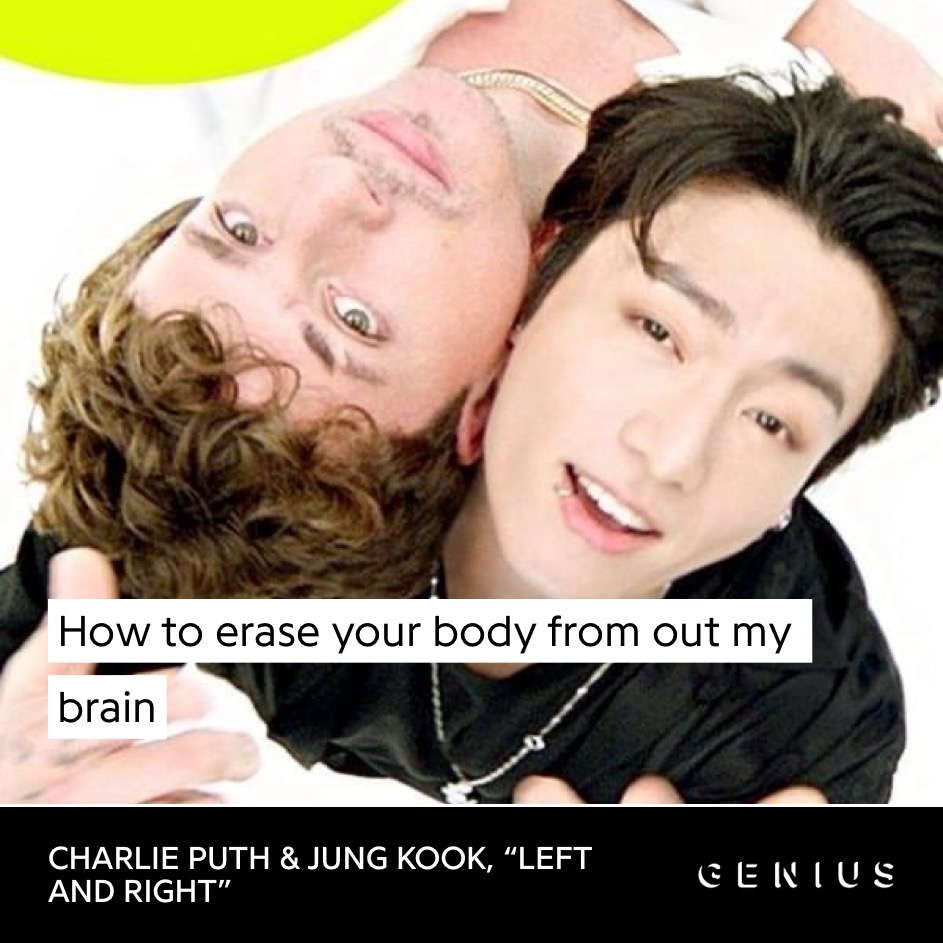
6. “Left and Right” is another example of a pop singer leeching onto BTS to get a higher chart position. The song is the highest-charting song from the album. The song is catchy but very simple.
7. “Loser” Loser = lose her. I’m getting sick of this album after hearing Puth saying the quiet part out loud.
8. “When You’re Sad I’m Sad” The lack of comma in the title makes me hate this song more than I should. I think lyrically it’s pretty good, but the composition is too simple. I’d love to hear a band like Copeland reinterpret this one.
9. ““Marks on My Neck.”I never got hickeys. I don’t get how it’s a mark of pride. It seems animalistic, like how cats mate. The symbolism of the song is pretty straightforward.
10. “Tears on My Piano” is one of the more interesting tones on the album with ‘90s harmonies. The song is partly inspired by Taylor Swift’s “Teardrops on My Guitar” and last month it was the basis for my Apple Music version of my Rainplaylist. The song stands out more for its guitar riff than its piano parts. This is one of the ways that Puth could have done to make the album more dynamic.
11. “I Don’t Think That I Like Her” is another storytelling song on the album. But it’s hard to get into these storytelling songs for lack of detail. Is this album about the same girl? Did this girl even exist? There seems to be a lack of feeling in the songs and the music itself is the object.
12. “No More Drama” is the final break-up song on the album. Just as Charlie says goodbye to an ex, he says goodbye to the album.
As talented as Charlie Puth is, influenced by the great singer-songwriters from the ’70s and ’80s, I hope that he comes out with an album that shows off his talent.
Back in 2010, we learned that yes, a pickle can get more likes than Nickelback, a band that had become the most hated “butt rock” band in the mid-’00s. In fact, the conclusions of the social media study found that a pickle had more likes than Oprah Winfrey or other beloved figures. It turns out that internet users’ hate outweighs Internet love, or the terrible outweighs the good. In 2014, the most hated rock band would become U2 after their release of Songs of Innocencewas forced into every iTunes user’s library. People tried everything to scrub the songs from their shuffle. Today, people have mostly forgotten about Nickelback, and Apple Music no longer comes standard with that U2 album, so people have other musical axes to grind. Justin Bieber has grown up and is no longer blaring in our cultural continuousness. So who is the most hated band these days? After the 2019 Super Bowl,Maroon 5, for taking to the stage when the NFL was in the middle of racial controversy around Colin Kaepernick’s taking a knee during the National Anthem, and many other musical acts refused to play that year. Or is it the “rock groups” who take the name of rock ‘n’ roll in vain?Imagine Dragons orColdplay, who has garnered a lot of hate due to their pop sound and supposed generic sound?
THIS JOY IS ELECTRIC. “There’s not much to hate about Coldplay. But every time I hear one of their songs I kind of don’t realize I’m listening to anything,” my coworker once said. Many listeners have also come to this conclusion. In the video “Where Coldplay Went Wrong,” critic Frank Furtado, of the YouTube channel Middle 8, argues that Coldplay is the commercialized version of more talented, authentic bands more hidden in the scene. He also argues that lead vocalist Chris Martin’s avoidance of personal details in his lyrics makes their songs mediocre at best. Finally, he argues that by singing Viva La Vida, Or Death and All His Friends, the band has been virtually producing the same record over and over again, watering down their lyrical and musical depth in the process with the exception of 2019’s Everyday Life. One thing Furtado doesn’t talk about, though, is the danger of working with the same producers’ album after album. Perhaps Coldplay’s relationship with producers Brian Eno and Rik Simpson is to blame. Essentially, Coldplay is using the same ingredients and mixing them differently.
GOT ME SINGIN’ EVERY SECOND, DANCIN’ EVERY HOUR. Still, I admire Coldplay for their use of the recording studio as a musical instrument. Bigger than Coldplay is the production of Brian Eno, the producer who created three of U2’s most iconic albums The Joshua Tree,Achtung Baby, and All That You Can’t Leave Behind, worked with Genesis, Devo, Toto, and David Bowie, and scored The Lovely Bones—the soundtrack making the movie watchable. But for their latest single, Coldplay turns to a producer with a “Higher Power,” Max Martin, the producer, who at the time, had the second most Hot 100 number 1 hits under his belt, second to The Beatles’
producer George Martin. Starting with Ace of Base in the early ’90s and then writing and producing for the Backstreet Boys, Martin would score his first number-one hit with Britney Spears in 1998 and then again with “It’s Gonna Be May,” I meant, “It’s Gonna Be Me” for *NSYNC. He cultivated Katy Perry to become a hit producer, then took P!nk to the top of the charts. He replaced the banjos for EDM with Taylor Swift taking her from the top of the country charts to the top of the pop charts. He introduced the pop charts to dark R&B singer The Weeknd. However, Martin’s production doesn’t always mean success these days. Carly Rae Jepsen‘s Max Martin production on E-MO-TIONand Dedicatedand Jennifer Lopez‘s “First Love” were minor hits. “Higher Power” was a moderate comeback hit for Coldplay, but it was the other Max Martin track featuring BTS, “My Universe” that would take Coldplay to the top of the charts again.
In 2021 Girls5evapremiered on Peacock. The premise of the show was a ridiculous one-hit-wonder girl group from the early ‘00s gets sampled by an up-and-coming rapper, Lil Stinker, which causes the disbanded Girls5eva to reunite for their now middle-aged fans. The show; created by the writer and co-producer of The Unbreakable Kimmy SchmidtMeredith Scardino,and comedy mogel Tina Fey; reexamines fictionalized relics of the new millennium in the light of the ‘20s cultural climate. In the show’s first season, the remaining members of Girls5eva–ironical the group is now four members after singer Ashley died in an infinity pool accident–reconcile the problematic lyrics of their early songs. For a one-hit-wonders, it turns out they had many songs and videos, which are revealed over the show’s now three seasons.
A LOVE THAT’S ARTIFICIAL, BUT HIS WALLET MAKES US HAPPY. In the second season of Girls5eva, the group writes new material and tries to break back into cultural relevance. Showrunner and songwriter Sara Bareilles plays Dawn, who takes on the role of the primary songwriter for the group. The group almost achieves a true second wave, but stalls when it comes to their US tour in season 3. Each season explores the balance of recognizing and appreciating the past while moving in a new direction. It’s about creating art, even if that art is just joke songs about female empowerment or overcoming arthritis. But no matter how Dawn, Wickie (Renée Elise Goldsberry), Summer (Busy Philipps), and Gloria (Paula Pell) try to move in a new direction fans always pull them back to the old days. Today’s song, “Sweet’N Low Daddy” is an example of the girls pulled into the past. In the fourth episode of Season 3, “Orlando,” the girls have been whisked off to play a private birthday party for an extremely wealthy woman who has married an elderly man.
NEVER HAVE TO MEET HIS PARENTS ‘CAUSE THEY DIED DURING NIXON. Most of the episodes of the third season of Girls5eva sees the girls playing their new songs. But the van tour across America wasn’t paying the bills. Wealthy and nostalgic Taffy England (Catherine Cohen) assembles some of the biggest *fictional* stars from the turn of the millennium to celebrate her birthday party. The gig is supposed to be a pretty straightforward money grab until Dawn starts to feel guilt for the lyrics of the song Taffy wants the group to perform, “Sweet’N Low Daddy,” a song the group had performed for a fictional soundtrack. Dawn fears that the song influenced Taffy’s life choices–marrying a wealthy man and waiting for him to die so that she can inherit his assets. In the end, Dawn ends up refusing to perform but offers her spot to Taffy to sing with the rest of the group. In the end, while watching the group on stage, Dawn realizes that even though she thinks of the song as problematic, Taffy just loves the song and her marriage to her geriatric husband is incidental. The episode does bring up the question of how much responsibility an artist should take for a worldview that has shifted since the piece’s release. It reminds me of James 3:1 which talks about how teachers will be judged harder. And those words could keep anyone from creating. But artists, and teachers, feel compelled to share what they know. I guess we all just have to be ready for an apology tour.
I talked about yesterday how Beenzino started my appreciation for Korean Hip-Hop. That appreciation turned into a love for the genre in 2016 when I joined a Korean gym, and it was mostly because of the winner of the fifth season of the massive reality program in South Korea called Show Me the Money, BewhY (비와이). By 2016, South Korea was fully in the middle of peak Hip-Hop culture. My students weren’t listening to Idol music but knew all the words to the rappers who were on Mnet’s Show Me the Money series. I found it kind of funny how the show censored Korean profanity while English f-bombs were allowed to be broadcasted! In the midst of the profanity storm that came with Korean Hip-Hop (no judgment intended), devout Christian BewhY’s rap career started.
I’M SO INDEPENDENT. Lee Byeong Yoon (이병윤) is a charismatic performer. Some music critics have compared his melodic rapping to Drake, but when I heard him, I’d never heard anything like it. Much of BewhY’s sound comes from famed Korean Hip-Hop producer Gray. BewhY’s songs don’t follow a particular song formula. Rather than verses and chorus, intros and outros, and bridges that connect most song hooks together, BewhY’s songs are more about ebbs and flows of energetic bursts. Tempos and tunes change in a way that I can only describe as a scene change in musical theater or opera. BewhY’s music uses funk bass and often takes jazz and classical samples. Often his songs lack a chorus, which makes his music seem like it wouldn’t work commercially, yet the hooks laid throughout the songs keep listeners guessing. And driving these interesting compositions is BewhY who raps with passion and conviction, almost desperation to make his point. To English speakers, though, the message filters through only in the selected English words.
MY FAITH AND EGO HAVE DEFINITELY GOTTEN STRONGER. BewhY has been outspoken about his Christian faith from the beginning of his career. He told The Korea Timesin 2016 that he does not use “slanderous” or “blasphemous” lyrics in his songs. Some of BewhY’s music has been described as Christian Hip-Hop, particularly songs like “David,” “Neo Christian Flow,” and “In Trinity,” just to name a few. Unlike the Christian music scene in America, though, BewhY’s lyrics use profanity and bear “explicit” labels. Last year I looked at Zior Park’s “Christian,” which seems to be a parody of Christian morality culture. And while BewhY seems to be far from hedonistic in his somewhat private life, the virtues he raps about in some of his songs, unironically, seem to represent a materialistic Christianity inline with Hip-Hop’s culture of showing off money. Songs about his Christian faith come across as arrogant, as if his faith declaration makes him a spiritual patriarch in the pluralistic country of South Korea. So my experience of listening to BewhY has changed. I can feel his passion; I love the music and it motivates me to feel a similar conviction the artist feels. But the underlying message, when I read the translations, makes me a little sad. It’s something that I don’t understand having read the words of Jesus and his message against the love of money. It’s something I don’t understand after reading about Peter and his betrayal. It’s something I don’t understand as a kid growing up equating self-esteem with arrogance and doing the work to see my self-worth.




 Mixtapemotions