• South Korean rapper Beenzino (빈지노), not to be confused with American rapper Benzino, began his career by posting his songs on the Korean Hip-Hop community site DC Tribe in 2010. Rapper Simon Dominic discovered Beenzino on the website and eventually, Beenzino started getting more exposure through rap festival performances in South Korea. Beenzino performed with two hip-hop duos, Jazzyfact and Hotclip as well as garnering features on songs by Verbal Jint, Epik High, Dok2, and other Korean Hip-Hop artists as the genre was entering a burgeoning success in the 2010s. Along with producer Shimmy Twice, Beenzino released Lifes Like in 2010 with Jazzyfact. The next year, the duo released the single “Always Awake” before taking a hiatus until their 2017 EP, Waves Like.


    WHEN THE CITY OF SEOUL SLEEPS. Following his collaborative effort in Jazzyfact, Beenzino signed with 1llionare Records, a small but powerful Hip-Hop label in South Korea. Founded by rappers Dok2 and The Quiett, the label helped to launch the careers of several rappers and made Korean rappers household names in the country. While his Hip-Hop career was beginning, Lim Seong Bin (임성빈), or Beenzino, was studying sculpture at Seoul National University, Korea’s top university.  In 2014, Beenzino released 2 4: 2 6, his debut solo EP. Beenzino collaborates with many rappers in the scene on his debut EP, but the record stood out to critics because of the album’s beats and jazz samples.  As a bonus track, Beenzino included “Always Awake,” Jazzyfact’s 2011 single.  The Latin jazz-influenced “Aqua Man” later became a Korean Hip-Hop standard. However, Beenzino’s breakthrough into commercial acceptance would be in 2013 with the single “Dali Van Picasso” from his 2014 follow-up EP Up All Night


    I GOTTA LIVE MY LIFE NOW, NOT LATER. Beenzino was not only one of the first Korean rappers I liked but also one of the first Korean artists I started listening to. Granted, by listening it was mostly a few songs. “Dali Van Picasso” was a new song when I was in my second year of teaching in Chuncheon. There was a cafe across the street from the institute run by a lanky guy, I’d guess about 30 who ran the cafe with his “mommy.” He didn’t speak much English. I must have had everything on the menu, but every week, maybe up to three times a week when I wasn’t eating at the cheap kimbap on the other side of the street before the owner got a bad cough and I got worried that what she had was contagious. Chicken carbonara with a latte. I loved the music in the shop, late ‘90s pop-rock and recent K-pop. I loved “Dali Van Picasso” because it was a smooth jazz hip-hop piece about painters. I remember “Aqua Man” as a song that they played in my gym a few years later, and I don’t remember the first time I heard “Always Awake.” All of these three tracks have a rhythmic smooth jazz sound that seems like early ‘80s Hip Hop when the genre started by sampling jazz records. Beenzino’s biggest tracks aren’t aggressive. They’re smooth and dreamy without being sleepy. Before Beenzino, I never thought coffee shop Hip-Hop could be a thing. And, to be fair, many of his songs violate my rules about profanity on playlists for the public. But Beenzino was exactly the rapper I needed to fill a nichè I never knew about. 


    English translation:


  • TOMORROW X TOGETHER, or TXT called by their fans, were the first group from Korea to headline Lollapalooza. The x is pronounced as “by” so the band is called “Tomorrow by Together.” The group has been one of the biggest K-Pop boy bands since their debut in 2019. Signed to Big Hit Entertainment, home of BTS and the first boy band signed to the label since the Bangtan Boys, TXT debuted five years after their label mates. The lyrics of today’s song, “Lo$er=Lo🩷er” touch on the bleak state of Millennials and Gen. Z, especially due to financial status; however, TOMORROW X TOGETHER’s music is optimistic. The band’s motto as it appears on their website is: “Come together  under one dream in hopes of building a better tomorrow.” 

  • It seems like a lifetime ago when the United States was enraptured in a gaslighting, dogmatic, and ultimately illogical argument that only heterosexual couples could marry. Even before the U.S. Supreme Court delivered the decision in Obergefell v. Hodges that same-sex couples had a fundamental right under the protection of the U.S. Constitution to marry and receive the same benefits as heterosexual couples, the opposition to gay marriage was thinly veiled homophobic stereotyping and appeals to Christian values. But reversing centuries of homophobic biases to gain both popular and judicial support for marriage equality was a feat of activism, which often traces its roots back to the late ‘70s and the short-lived political career of Harvey Milk. However, marriage equality was unimaginable to the so-called “Mayor of Castro Street” as it was incongruent with the polyamorous sexual preferences of the fifth district member of San Francisco’s Board of Supervisors.

    I CAN’T CHANGE. In 2012, Macklemore & Ryan Lewis released their debut album, The Heist, which featured several big radio singles, including two Billboard Hot 100 hits: “Thrift Shop” and “Can’t Hold Us.” The duo’s third single, “Same Love,” reached number 11. A gospel-flavored piano plays as Benjamin Haggerty, known as Macklemore, begins a testimony. Unlike the party tones of the previous singles, in “Same Love,” Macklemore confesses his childhood fears that he might be gay, due to his tendencies toward neatness and the arts because he wasn’t like the other boys. Growing up as an Irish Catholic in the liberal city of Seattle, Haggerty eventually realized that he was straight. The rapper grew up with many gay role models, including four gay uncles, though he only mentions one in the song. Producer Ryan Lewis also had a gay uncle. Macklemore wanted to write an empathetic song to move his listeners. His original first verse was inspired by a thirteen-year-old boy’s suicide letter, who killed himself because of his sexual identity. 

    NO CRYING ON SUNDAYS. Macklemore & Ryan Lewis wanted to call out the homophobia in Hip-Hop, religion, and society. Rather than rapping, Macklemore preaches to his congregation. Fellow Seatle-based singer-songwriter Mary Lambert sings the hymn-like chorus.  The chorus is a personal testimony by a queer artist, expressing her truth. While Macklemore’s rhymes and reasons come from a self-identifying heterosexual cis-gendered man who is making logical and emotional arguments for society’s acceptance of homosexuality and gay marriage, Lambert offers her voice as one who claims that she is unable to change her sexual identity, rather she fully accepts herself. She talks about her love who “keeps [her] warm.” While Lambert was singing from outside of the hip-hop community, her music career began in the evangelical Mars Hill mega-church. The infamously toxic community at Mars Hill was homophobic and misogynistic, and as Lambert embraced herself, she left the community. Lambert has had a successful musical career outside of her collaboration with Macklemore & Ryan Lewis, even adapting the chorus of “Same Love” into “She Keeps Me Warm” on her 2013 EP, Welcome to the Age of My Body. “Same Love” was the first-charting song on Billboard’s Hot 100 that talked about marriage equality. The song along with its music video, directly supported a referendum that would allow marriage equality in the state of Washington. Minds were starting to change in 2012. Homosexuality was no longer a special issue on a late-night ‘80s sitcom, but becoming a central issue. It was making less and less sense that only straight couples could marry. Straight people were starting to understand that the love between a man and a woman was the same love between people of the same sex.


  • Today I’m going to update my Under the Covers playlist on Apple Music. Every now and then I like to update my playlists with some of my new discoveries. Some of the covers on this playlist may make us long for the original, but ultimately, I think that the song I’m basing the playlist on, today’s song, “Circles” covered by Boyce Avenue, actually sounds better than the genre-bending artist Post Malone‘s original, though I still like it.  

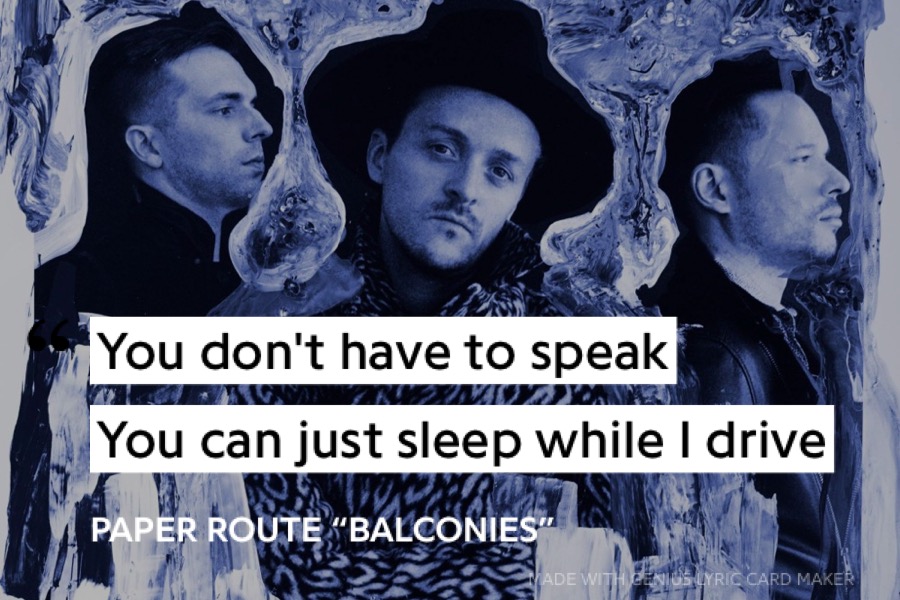
  •  Listening to Paper Route makes me wonder, what if Coldplay, after recording X & Y had continued making electronic music and honed in on their lyrics. Paper Route has a solid pop-rock band, on par with any of their contemporaries (i.e. OneRepublic, Coldplay), but their somewhat eccentric fidelity to their craft, recording their albums themselves in old Tennessee mansions to let the natural acoustics reverberate on the record, had cemented them as an indie rock band. “Balconies” was kind of Paper Route’s first and last hit. The band’s music had been featured in movies and television shows, but “Balconies” got them a late-night performance slot on Seth Meyers. As one of the most obvious hits from their third album, Real Emotion, the song was released to radio but didn’t do too well on the charts. After touring to support the album, the band went on “an indefinite hiatus.” However, as the band has had long gaps between albums, I wonder if JT Daly and Chad Howat will assemble a group of musicians together for album number 4. 

    RAISE YOUR ARMS AND HOLD WHAT YOU CAN’T REPLACE. “Balconies” uses several mixed metaphors to convey a message about being unable to hold it together. The singer claims “that the simple things [he] can’t get right” and he “know[s] that it’s [his] fault,” yet he offers to comfort the listener: “You don’t have to speak/ you can just sleep while I drive.” He talks about the difficulties he faces: “For every wound, there’s a hill to climb” and that he has a “hunting heart trying to survive.” This song can draw an obvious connection to Daly’s lyrical theme of wrestling with God and religion, but it also seems to be about his other theme, struggles with romantic relationships. If it’s the first option, the singer is letting God down in the first verse, and in the second God is offering comfort. I don’t like how the speaker shifts so much in that interpretation, so I think the song is about showing support for a loved one when you both are having a hard time. The minor key keyboard synth riff that is repeated throughout the song sounds like rain, and the subject matter of the song matches the dreary sounds of the song.

    IF I’M IN YOUR DREAMS, AM I WHAT YOU WANT TO FIND? “Balconies” is certainly not Paper Route’s lyrical masterpiece, but it is a comforting, uplifting song. It was a perfect song of the day because of the bleak weather we’ve been having lately. Yesterday it cleared up for a day only to start raining again today. Whenever I hear “Balconies” on days like today, I’m transported back to my childhood on a boring, rainy day. My mom ran the dryer and folded the laundry and as I got older I folded the laundry. She’s watching some late afternoon talk show and I’m watching it too because there’s nothing else to do. I’m sitting on the couch, warm towels just out of the dryer are covering me, and I feel the warmth of the afternoon laundry. Later mom announces it’s boxed macaroni and cheese for dinner. That was pretty typical food when growing up and there was nothing special about it, but on boring days like today, mac and cheese is kind of a highlight. I can’t fully understand the struggles of my parents trying to feed three kids on a single income. I don’t know what their daily hopes and fears were. I was sheltered from it. I can look back fondly on those boring, rainy afternoons when I didn’t have to worry about money or not being loved by my parents. I know that this is not true of every family, so I’m thankful for the privilege that I had for that time. I think “Balconies” taps into that human emotion of a loved one saying, “Don’t worry about it and let carry your burden for a bit.” It may be just a box of macaroni and cheese, and we may have to worry about our nutrition later, but you won’t be hungry. And sometimes that’s what you need.

    Music Video: 
    Seth Meyers Performance:

    Album Release Live Acoustic Performance:

  • n 2017, it had been five years since The Killers released new music, and even longer since they were a “household name.” Lead singer Brandon Flowers talks about starting with the song “Rut,” Wonderful, Wonderful’s third track, which defined the band’s new direction. While The Killers had been on hiatus had released his second solo record, The Desired Effect. Also before recording The Killers’ fifth record, Flowers moved out of his beloved hometown of “The Fabulous Las Vegas” which turned out to be a bad place to raise a family in the ‘10s. Still, digging out of the musical rut wasn’t easy. Flowers found on Wonderful, Wonderful it was ok to write about his family. 

    DON’T NEED NO ADVICE, I GOT A PLAN. The first single from Wonderful, Wonderful, though, “The Man,” doesn’t fall into the typical storytelling songs we come to expect from The Killers, rather “The Man” is a bragging song. The song was featured in the Netflix original film The Perfect Date during a montage when Brooks, played by Noah Centineo, dresses up as “the perfect date” for girls who pay him, the song seems completely serious. The “manly brag” song leaves listeners polarized. For every manly man singing along, there’s a commensurate amount of males twiddling their thumbs, saying “Okay, we get it dude. You’re a man.” Some listeners have interpreted “The Man” as the Brandon Flowers of the past–a youthful arrogance and stubbornness prevalent in men in their late teenage to early 20s.  This “piss and vinegar” masculine tenacity can prove useful when starting a band, but what happens when you grow into Tim the Toolman Taylor? While the song is delivered as completely serious, the video shows cracks in the song’s philosophy.

    THEM OTHER BOYS, I DON’T GIVE A DAMN. I haven’t really talked about toxic masculinity in my blog. The issues surrounding gender identity are a very sensitive subject these days. Sexist opinions that “pink is for girls and blue is for boys” and that women belong in the kitchen and men belong in the boardroom are far more popular than they should be. Growing up in a strictly two-gendered Christian culture, masculinity, and femininity were modeled, and kids were expected to grow up to copy that model. Of course, there were always some exceptions, and not every man was super manly and not every woman super feminine, but there was an expectation of ideals. As I began exploring my sexuality, I also started to confront my presuppositions about gender. When we stop dividing the world into the masculine and the feminine, we can enjoy what we like and not have to worry about what other people think of us. Personally, I identify with a lot of masculine tendencies, but I will probably never be able to tell you how an engine works and I’d much rather go to the symphony than to a monster truck rally. My identity isn’t wrapped up in physical strength, but strength of character. But to Tim the Toolman Taylor, I’m a beta male. How do you respond to that? Whatever dude. I’m just gonna live my life. 

    Read the lyrics on Genius.

    Source:

     The Watch Podcast: talking to Brandon Flowers and Ronnie Vannucci in 2017

  • In the ’70s Alternative Rock was a distinguishing term to separate mainstream classic rockers from experimental, independent rock bands. Sometimes called College Rock in the ’80s and the ’90s, it can be difficult to distinguish between mainstream rock and alternative rock of the ’90s and ’80s. More recently, the genre has been split between Alternative Rock and Alternative. At the heart of Alternative music, however, it is classified as genre-blending. Judah & the Lion had been cultivating a folk rock hip-hop sound from their inception, blending bluegrass instruments with modern sounds. However, the band’s sophomore album defined the style of music they were making: Folk Hop N’ Roll

    HEY, MY LIFE IS REAL GREAT. Founded by lead singer and guitarist Judah Akers when he met an eclectic group of musicians at Belmont University in Nashville, Tennessee, Judah & the Lion started out as a Christian Rock act though started to distance themselves from the genre in their discography following the release of their first EP. The band name Judah & the Lion draws a comparison to the Old Testament poetry in which God is called “The Lion of Judah.” The band’s career started by winning a band competition at Belmont University, which is quite a feat as the mid-sized private Christian college is the alma matter of some of the biggest names in CCM, Country, Pop, and Indie music including Steven Curtis Chapman, Brad Paisley, COIN, Tyler Hubbard of Florida Georgia Line, Lee Ann Womack, Josh Turner, and LANY as well as being home to Mike Curb School of Entertainment and Business, founded by the music producer and CEO of Curb Records. The band gained recognition for their folk rock sound in the early to mid-’10s, but their sophomore record Folk Hop N’ Roll was their highest charting record and boasted the number 19 Hot AC radio hit and platinum-selling single “Take It All Back.”

    AND IT FEELS SO NICE WHEN THE PEOPLE SING ALONG. Rocking an unkempt David Crowder beard, the former college basketball player Judah Akers and crew offer that post-R.E.M.Mumford & Sons sound that was off-putting to me when Judah & the Lion was blowing up in popularity. It seemed like this band was talented, but their particular sound wasn’t for me at the time. I think I became interested in them, though, when I heard an interview with Akers on Lead Singer SyndromeBeing no longer threatened by Jock Rock and listening to the band’s vision helped to make me realize their talent. Today’s version of “Take It All Back” (String Quartet Op. 9 in C Major) confuses me, though. I haven’t been able to find any additional information about this single. Did the band sample a classical composer or is the piece original? And if so, why is it the 9th opus? The band included this track on their second full-length record, and even with the EPs, J&tL hadn’t released nine records, I don’t think. However, there is a Vivaldi-like Mandolin Concerto sound to this song, which sounds similar to Vivaldi’s “Spring” from The Four Seasons. Lyrically, “Take It All Back” is a song about dreaming of the future. No sacrifice is too big for love. Money and fame are only possible with a support system. 

    2.0 music video:
    Live studio version:
    String Quartet version:
  • Imagine being a new band in 2019, releasing your first EP which has earned enough hype to put you on a big tour with a veteran band, only to have that tour canceled because the industry came to a halt with the pandemic. That’s what happened to brothers Sam and Ben Taylor and their friend Nathan Beaton of Paradise Now. The Welsh band did not tour with Disciple in 2020 as planned, however, they released an extra EP called Lockdown Mixtape to lead up to their full-length debut, We Never Die, both released in 2021. The band’s social media has been quiet since the release of the LP.

    IT’S GETTING OLD. In 2019, Tooth & Nail Records revealed that they had signed a new band. The label posted a photo of the band’s silhouette and asked fans to guess who had been signed. I commented “dc talk?” which got a few laughs from the community. Sometimes when a band is signed with Tooth & Nail Records, listeners know who the band is. Often it’s a band connected to the scene; someone who has opened for a bigger Tooth & Nail act. Often these bands have a well-grown pre-signee fanbase. On the Labeled Podcast, host Matt Carter has talked about how the label doesn’t usually sign a band from out of the blue. Yet some bands seem random on an otherwise connected label, and Paradise Now seems to have come from out of nowhere. The band’s Spotify biography talks about the band forming an eclectic sound in Wales “without a local music scene.” There are a few famous Welsh bands, such as my bloody valentine, Manic Street Preachers, LOSTPROPHETS, and Badfinger, and solo recording artists, such as Tom Jones, Duffy, Donna Lewis, John Cale, and Bonnie Tyler–but according to Paradise Now, the local music scene is just whoever happens to wander into Bridgend, and music lovers couldn’t build a niche rock scene as in America and even London. 

    WE’RE BETTER NOW. Unfortunately, it seems that Paradise Now has become the all-too-common story of a Tooth & Nail band underperforming and then disappearing. This month, Spotify shows that Paradise Now has only around nine thousand monthly listeners. However, looking at streaming numbers of other smaller Tooth & Nail bands, Paradise Now’s nine thousand monthly streams look average. However, I wonder if Tooth & Nail will resurrect the band. Paradise Now being in Wales seems to be a great barrier to their American audience, especially with being able to jump on tours. Perhaps the band’s momentum was a casualty of the pandemic. But today, we’re not looking at the band’s debut album, but we’re going back to an obscure track on their EP, Supernatural. The band has a tight modern rock sound, influenced by worship music, hard rock, and electronic music. Three of the six songs appear on We Never Die in 2021. “WildOnes” gets a remix and today’s song “Machines” gets an acoustic version on the follow-up EP, Lockdown Mixtape. “Machines” is one of my favorite songs by the band. It showcases lead singer Sam Taylor’s earnest vocals, and the lyrics deal with fighting against “non-stop goals,” being wrong and trying to find “a better way,” and begging the listener “Please don’t judge me quite yet.” It’s also one of my “chilly songs”–creating warmth out of a cold atmosphere. I don’t know when and if we’ll hear anything else from Paradise Now, but I think they are certainly worth a listen.

    Read the lyrics on Genius.

    Lyric video:

  •  


    In 2018, I met a young man who claimed to like “Indie music. You know, like Coldplay and Imagine Dragons?” I hope I didn’t roll my eyes in the middle of the conversation because it was extremely hard to bite my tongue when he had just named two of the biggest bands in the world. The kid in his early twenties talking to me in my early thirties at the time did, however, remember a time when calling Coldplay indie was more accurate. My first exposure to Coldplay came in 2001 when they released their third single “Trouble” in America. Specifically, I remember watching the music video with my dad on MTV or MTV2. While “Yellow” may be the more remembered single from Coldplay’s early days, I only have recollection of hearing the song a while after hearing “Trouble.”

    THEY SPUN A WEB FOR ME. Coldplay formed in 1997 when the members attended University College London. After releasing two EPs and signing to Parlophone Records, the band released their debut album Parachutes in 2000 and had their first hit with the album’s lead single, “Shiver.” The album was released just as interest in the so-called genre of Brit-pop was fading out of favor, especially in America, yet experimental British bands like Radiohead and Muse were maintaining and even gaining popularity with music hipsters in America. However, a band’s UK citizenship wasn’t a guaranteed hit back around the turn of the millennium. Coldplay’s gradual increase in popularity in the first years of the twenty-first century was at a weird time in rock music, mainly because the band was a mellow rock band. The lachrymose piano on “Trouble” sounded so different from what anyone was doing in rock or pop music. The song was slow and dark, and the ballad’s lyrics expressed a subject of remorse that perhaps only an established act could pull off as a minor hit between upbeat bangers.

    AND THOUGHT OF ALL THE STUPID THINGS I’D SAID. Coldplay certainly didn’t stay in the land of dreary Indie Pop. “Trouble” didn’t chart on the Hot 100, but the more accessible “Yellow” peaked at #48. The band’s second album A Rush of Blood to the Head began to see more popularity and by the time Coldplay released X&Y they had become a household name. Moreover, other British bands started appearing, such as Keane, and the pop-rock band became a huge trend in the mid-’00s as bands like The Fray, Snow Patrol, and OneRepublic racked up hits partly due to the genre’s playability in Prime Time television dramas such as Grey’s Anatomy. All the while, the comparison between Coldplay and U2 grew. Songs like “Trouble” had musical complexity, a trait selected against the evolution of marketability. Still, for all of the hipsters out there who hate Coldplay, please remember that the opening track of the soundtrack that popularized The Shins, Garden State, is Coldplay’s “Don’t Panic.” So, is Coldplay an indie band? Definitely not now. But just like hipster college radio darlings R.E.M. and those listening to The Cure before they were on the radio, Coldplay followed the process of building their career from college radio to MTV and then to the pop charts. 


  • Three years ago, I taught a lesson on Irish music to my students. I played examples of Celtic instrumental music. I showed videos of River Dance. I played sad songs like “The Parting Glass” and “Danny Boy.” Then I played some famous Irish artists like Enya,  U2, and The Cranberries. Then I played  Kodaline‘s “High Hopes.” When I asked my students which they liked the best, they said Kodaline. But that was kind of a stupid question for a music lover. There are times when I want to listen to Celtic bagpipes and jigs. There are times I want to go out and have fun in an Irish pub and hear Celtic punk rock. There are times I want to listen to U2, and it’s certainly not the same day I want to listen to Enya, but those days happen too. But like my students, I think Kodaline’s first album fits more into my everyday listening habits.

    BROKEN BOTTLES IN THE HOTEL LOBBY. While In A Perfect World  is a great everyday listen, you have to be careful watching the music video for “High Hopes.” It’s a beautiful love story between an older man and a somewhat younger woman. The couple meets when she runs away from her wedding and she saves him from trying to kill himself in his car. They begin their relationship when he takes her to his meager cottage.  The two build their relationship, but the tone of the video changes when they are lying in bed and he notices the scars on her back. Then, as the guitar solo starts, the couple is shot by a man carrying a shotgun. The two are in a pool of blood.  The man wakes up in the hospital and sees her bed is empty. At the end of the video, she hugs him from behind. Lead singer Steve Garrigan wrote “High Hopes” after a bad breakup. I think the graphic nature of this video is meant to be metaphorical. The woman saves the older man from his destructive ways. They fall in love but when he discovers her scars, the relationship reaches levels of problems that lead to another person/outside factor “shooting”  both partners. The end of the video could either mean she left him and he’s remembering her, and the embrace is just holding on to memories, or it could be that she left for a while but comes back to him. Either way, the video is a bit shocking, so I didn’t play it for my students. 

     I KNOW IT’S CRAZY TO BELIEVE IN STUPID THINGS. In 2021, Garrigan released his memoir, titled High Hopes: Making Music, Losing My Way, Learning to Livein which the singer talks about his shyness and became the lead singer of the immensely popular Irish band. He talks openly about therapy and living with social anxiety and how music was the vehicle to a place of healing. For me today, though, “High Hopes” got me thinking about how futile it seems to get ahead. It seems that I’ll always be plugging along at the same type of job, even if I get more education. Every year the resources dry up just a little bit more, and you’re left feeling as if you should be grateful for your job in the ever-growing “hard economic times.”  Still, why are more duties added to the contract and no extra pay? Will the situation convalesce back to what it was? I think back to my hopeful outlook after just graduating from university and how oblivious I was to how the world actually works. And yet, the world keeps spinning around the sun. We have to have hope or else we go crazy. We have to believe that somehow the systems will work out or that we will find a solution hidden in an overlooked option. High hopes feel like friendly hills from far away, but as the day gets closer, they become jagged mountains. But we climb a mountain the same way we take a walk, one step at a time. 

    Read “High Hopes” by Kodaline on Genius.