• A few years ago, I remember (shamefully) having a conversation with my students as to why K-pop would never fully make it in America and my argument had to do with how American radio stations rarely played music in a foreign language. But K-pop proved me wrong, albeit, it didn’t hurt that BTS sang some of their major hits in English. But just as BTS was ascending to international fame, a legal barrier threatened the band. 

    AN UNENDING HISTORY. Last October, BTS announced that they were taking a break from releasing new music together, which promptly caused Hybe Corporation‘s stock, the band’s record label, to plummet. Each member of BTS would release solo records, and they would reconvene in 2025 to assess future projects as a group; however, Hybe Corporation’s chairman Bang Si-hyuk (방시혁) expressed some doubts about the timeline as a renegotiated contract hadn’t been discussed. The reason for this musical break had to do with South Korean law. All able-bodied males must complete a conscription period of 18-21 months before the age of 35. Before BTS’s hiatus, the topic of mandatory military service, particularly for public figures making a great impact internationally–singers, actors, and sports stars like the Korean national Son Hyeung Min who plays for the Korean National League in the World Cup and for the Premiere League Club of Tottenham–had been hotly debated. Besides the growing debate over the necessity of mandatory enlistment, the economic repercussions of ordinary male citizens working on a low-government-granted stipend, the unfairness that only male citizens must serve, issues regarding traditional views of gender and sexual identity, and the question as to whether a trained professional army over a conscripted demographic would be more effective, opponents of celebrity enlistment argue that internationally famous groups like BTS are actually serving the country as cultural ambassadors. However, the counter side to this argument is that celebrities have to do their duties just as ordinary citizens and asking what is the measure of international fame a celebrity would have to acquire to relieve him of military service?  

    I GET HEAVEN TO MYSELF WHEN I’M WITH YOU. Kim Seok Jin (김석진) is the oldest member of BTS. He was also the first to enlist and complete his military service, but just before joining he released the single “The Astronaut” and its accompanying music video. The track was written by Jin and several other writers, including DJ Kygo and Coldplay who recorded the instruments for the song. Lead singer Chris Martin‘s 16-year-old son, Moses, also received a writing credit on the track that helped to produce the hit. “The Astronaut” feels like it fits within Coldplay’s most recent space theme in Music of the Spheres, perhaps even a sequel to their hit “My Universe,” which featured BTS. Earlier this year, Coldplay performed on Saturday Night Live and performed an English-language version of “The Astronaut”; however, the song has not been officially released to streaming services and the official video of the performance has been taken down from YouTube. Coldplay’s appearance on SNL was a bit odd since they were not promoting new music, though they have announced that the direct follow-up to Music of the Spheres has been finished and they will start playing songs from the new album this year. Jin’s “Astronaut,” though shows what a future of rock band collaborations with the K-pop boy band might sound like in the future. Coldplay has claimed that they will finish recording new music by the year 2025, which happens to coincide with BTS’s planned reunion. The dates are probably purely coincidental and Coldplay may decide to release new music after 2025, but the aging band is certainly looking for ways to stay relevant in an ever-changing music climate. Maybe being the backing band for up-and-coming acts could keep the veteran rockers fresh? 
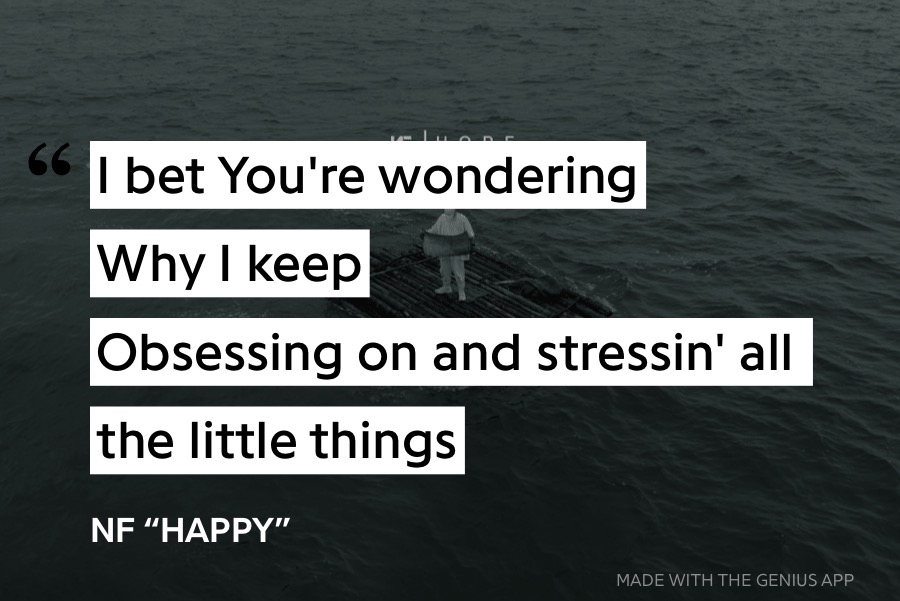

  • Nathan Feuerstein is one of the most successful Christian hip-hop artists today. Born and raised in a tiny town in central Michigan, Nate, better known by his moniker, NF, had a hard home life as a child. After his parents divorced, he was raised by his mother until he and one of his sisters were abused by his mother’s boyfriend. After that, he returned to live with his father. NF channeled his struggles with anxiety and mental health in his music.


    DEAR GOD, PLEASE HEAR ME OUT. Last month, NF released his fifth studio album, Hope, and the single “Happy” is still making waves on Spotify playlists. While NF does not claim to be a Christian Rapper but rather a hip-hop artist who happens to be a Christian, his music is played on both secular and Christian radio, especially due to his clean (though often brutally honest) lyrics. Currently, NF has amassed over 18 million monthly streams on Spotify, making him a highly successful artist, especially for a Christian artist. And while NF’s career may have started out signed to a Christian label, slowly but surely, the rapper started branching into secular hip hop early in his career. His music became so popular that in 2018, Eminem even squeezed NF’s name into the song “The Ringer,” a dis-track about other rappers whom Eminem perceived to be imitating “The Real Slim Shady.” Of course, NF had always listed Eminem as one of his biggest influences, but the fact that a clean Christian rapper was even on Eminem’s radar is a testament to how popular he had become in the late ’10s. That’s more than KJ-52 ever got with his attempts to get Shady’s attention in “Dear Slim” and “Dear Slim, Pt. II,” unless you really read into Eminem’s lyrics. 

    I CAN’T IMAGINE WHO I’D BE IF I WAS HAPPY. “Happy,” though, isn’t a rap track in the traditional sense of hip-hop. It’s rhythmic but sung in a way that much ’10s and ’20s hip-hop has become less distinguishable as rap. The song deals with NF’s OCD, which he was diagnosed with in 2018, and his other mental health struggles. The song is a prayer to God, and the chorus asks the question about what happiness would look like for the speaker. No matter how much money and fame the speaker receives, he will always self-sabotage his happiness. And this is what keeps NF relevant to both Christian and non-Christian audiences. Typical Christian music fixes everything. The problems are all past tense and glory hallelujah I can keep talking about that one time I was delivered from depression. But you don’t have to be a medical professional to realize that struggles are often ongoing. We all have crappy days that can turn into crappy years. Some have had traumatic experiences like when NF witnessed his mother getting addicted to opioids and overdosing in 2009. It’s about messed up home lives that cause issues later in life prayer is not enough to set the mind at ease. After all, no person would get into a car accident and refuse medical help but rather go directly to church to pray away the injuries! Sometimes it takes years of therapy and that only reduces the pain. There’s no happy solution, but listeners can find solace. We can know that we’re not that abnormal. And that’s the hope.
     

  • The 2014 film Boyhood was a highly acclaimed film that has an incredible Rotten Tomatoes score, yet nobody talks about it anymore. The film was shot over 12 years from 2001 to 2013 using the same actors and feels like a piece of turn-of-the-century Americana, a kind of early 2000s rendering of a Norman Rockwell painting of the imperfect white, working-class American family. The film not only explores boyhood and coming of age, but also parenthood and the complications of raising a family while trying to better oneself as well as the struggles of co-parenting through a divorce. The events and pop culture throughout the years are woven into human themes. The soundtrack for the film is a combination of famed indie artists of the early ’00s and popular music of the time. Seamlessly joining the soundtrack was virtually unknown folk-rock band Family of the Year, with their song “Hero.”

    I DON’T WANT TO BE YOUR HERO. “Hero” appears in the movie toward the end when Mason, Jr., played by Ellar Coltrane, drives his old pickup down the Texas highway. He is now 18 years old, graduated, and become himself. This comes after a scene with his mother, Olivia (Patricia Arquette). She wonders, “What was it all for?” when she reflects on the hardships of parenthood. She had raised her kids and wonders what’s next for her. She tells her son, “The next big event is my fucking funeral.” She had kept her family a paycheck away from eviction at some points but ultimately raised a successful family, yet she wonders what it was all for. Family of the Year’s “Hero” serves as a reflection on the themes of the movie. The song talks about the conflict between wanting stability and wanting something greater than what you have right now. You long to be allowed to leave, but you still hold down a job to keep the girl around. 

    ‘M A KID LIKE EVERYONE ELSE. Watching Mason’s family struggle in the 2000s reminded me of growing up in a family that lived paycheck to paycheck in the ’90s to ’06 when I graduated high school. I remember church pantry handouts and hand-me-downs from cousins. Clinton-era social programs let us go to the doctor when we needed to, and our moldy old house had me sick quite a bit as a kid. My dad worked as a logger in New York until the payment was so bad that he decided to go to truck driving school. When my dad became an over-the-road truck driver we started making more money, but we didn’t have health insurance. We prayed we didn’t get sick or injured, and thank God nothing bad happened. My mom would eventually go to nursing school and go to work when I was in high school. I’m very proud of what my family did, but I remember talks with my dad that echoed what Olivia said in Boyhood. What is it all for? The existential question that haunts us with every passing year. What is it all for? “Hero,” tells us “Everyone deserves a chance to walk with everyone else” but what does that mean? Boyhood, life, marriage, divorce, the economic depression–rituals of the American Dream. Everyone deserves it, but isn’t it all just vanity and vexation of the spirit?
    Trailer for Boyhood:
    Music Video (original cut):

     Music Video (Boyhood cut): 

  • I was talking with my Gen X coworker earlier this year about music, and somehow Jonas Brothers came up. He asked me, as a defender of pop, if the band of brothers had ever made a good album. I thought about the question. Of course, I can’t consider the teeny-bopper music from the band’s early days. But I could say that Nick Jonas’ latest record Spaceman was a masterfully produced album by Greg Kurstin blending ‘80s and ‘90s R&B with contemporary electronic pop. I thought that the DNCE record was fun. I thought that “Sucker” was a great Ryan Tedder production and showed potential for where the Jonas Brothers could go, although Happiness Begins was a bit of a disappointment. But no, I couldn’t say that I liked any Jonas Brothers album.


    ROCK FOR ME TO STAND ON. But that all changed when Jonas Brothers released The Album last Friday. But being able to call this album great comes with years of breaking down some of my musical biases and hang-ups. The first is a discussion about when does a bubble gum act get the right to grow up? Nowadays many music critics will tell you that every song The Beatles ever put out is miles above any other act, but I wonder if that’s because we have Sgt. Pepper’s Lonely Heart’s Club Band and what came after it? In the ‘00s “teeny boppers” had to do something drastically sexual to distance themselves from their innocent pasts and earn critical success. When teen heartthrob Justin Timberlake promised to “have you naked by the end of this song” or Britney Spears went full-blown “Toxic” critics started giving those acts more respect. It was a string of two singles that changed my opinion on Justin Bieber: “Sorry” and “Love Yourself”  before the singer’s Hillsong douchebaggary came to light. Miley Cyrus rode the wrecking ball and Harry Styles walked the Fine Line somewhat distancing themselves from their respective Disney and boy band careers. The redemptive arc of Jonas Brothers would be Nick and Joe’s solo efforts. But the second caveat has to deal with the musical trend of embracing what is—no—what was the opposite of cool: soft rock, more specifically the sounds of the late ‘70s and early ‘80s nicknamed in the early days of  “Yacht Rock.”

    WINTER WITH THE A.C. The latest offering from Jonas Brothers opens with the smooth-to-bombastic “Miracle.” On a recent episode of the podcast Switched on Pop, Charlie Harding talks with Kevin, Joe, and Nick Jonas about the musical influences that made them decide to make music together once again. Nick told Charlie, “[The Album] was about putting something together that sounded like what coming to one of our shows is like. We’re a band, and it’s band music.” The implications of this question my ‘00s understanding of what a band is, though. If I turned on MTV and saw blink-182 running around naked, I knew that their live shows, each member of the three-piece were playing instruments. But most small bands hire back up musicians who aren’t permanent members. So are Jonas Brothers a band? One topic the brothers talked about in the Switched on Pop interview is other musicians diminishing Jonas Brothers’ musicianship. Rather than focusing on what is not music, the brothers refocused the conversation on their musical influences that went into The Album. They fondly recalled the records they listened to with their dad—Bee Gees, America, Paul McCartney, and Stevie Wonder—and hearing that makes a lot of sense in the context of The Album. And today’s song seriously takes some Stevie Wonder influence. The smooth sounds of the latest Jonas Brothers album arrived just in time for a scorching hot summer. And even if we’re going to feel awkward about this release in ten years, in the summer of ‘23 the once uncool is now seriously cool.


  • Formed in 1992 as the house band for a series of UK youth outreach events called The Cutting Edgedelirious? became a full-time band after singer Martin Smith was hospitalized for several weeks after a car accident in 1995. Smith read Bill Flanagan’s book U2: At the End of the Worldinspiring him to make the band a full-time career. The band released their second full-length studio album, King of Foolsand their first under the moniker Delirious. The song “Deeper” hit the UK pop charts, unexpectedly, peaking at number 20. The band would sign to Sparrow Records for their U.S. distribution, spanning several CCM and Christian Rock hits and helping to create the next generation of worship music. Delirious’s music is usually worship, but they are a jam band at their core, particularly evidenced by their two follow-up records to King of Fools, Mezzamorphis and GloThe band writes anthems that sound like U2, but include electronic experimentation in the vein of Radiohead, guitar solos from the classic rock era of long songs, all to the lyrics of lines lifted from Eugene Peterson’s Message paraphrased Bible. 

    THE WONDER OF IT ALL IS THAT I’M LIVING JUST TO FALL MORE IN LOVE WITH YOU. For me, delirious? is a bit of an embarrassing t-shirt I found in a closet back in middle school. An episode of Good Christian Fun drudged up old memories when I thought their music was the coolest. I bought their Mezzamorphis album in 1999 maybe because it also contained a version of “Deeper.” The crazy electronic, noise pop to the dreary sounds at the end of the album was all I listened to on a rainy day, while I was reading a Hardy Boys novel. The following year, delirious? released their album Glo, which took the band in a more guitar-driven direction. About that time, I also started getting into Pink Floyd, but as a good Christian young man, I was worried about the psychedelic rockers influencing me to do drugs, and sometimes they cursed. Delirious, though, rather than singing about drugs and sex, sang about falling deeper in love with God. And they had some killer guitar solos, so while I enjoyed listening to Dark Side of the Moon and The Wallmy spiritual diet consisted of delirious? as the main course, and sometimes some Pink Floyd for dessert. Embarrassing, right? I was disappointed with the band’s follow-up to GloTouchthe American reworking of the band’s U.K. failed mainstream radio crossover attempt Audio Lessonover. Lyrically, Smith attempted to write love songs, which just came across as simple and uninspired. Musically, the band took all of the drollness of Mezzamorphis, but failed to add enough experimentation to make listeners come back to the record. 

    MAYBE I COULD RUN, MAYBE I COULD FLY TO YOU. I bought King of Fools later when I saw it in the discount bin at the local Family Christian store. I had high expectations for this album and I knew several of the songs from Delirious’s double live record, Access:d Live Worship in the Key of D. King of Fools was a fine album to listen to, but after my experience with Touch, my musical tastes were migrating away from CCM worship music. Touch was released in 2002 for American listeners. King of Fools was an album of the time of Step Up to the Microphone by the Newsboys and Supernaturalthe final DC Talk album, and sounded fine like these Christian Rock classics. But five years later, music was moving on. P.O.D. was blowing up on Rock radio. Earthsuit and The Benjamin Gate offered a sonically-driven harder rock sound, and delirious? decided to go back into writing less interesting Praise and Worship stadium anthems. Flicker and Got Records put out tighter rock music. Eventually, Tooth & Nail would enter their golden age, moving from low-cost production punk bands to Alternative music played on Read the lyrics on Genius. and Fuse. Delirious was just a relic of my CCM past, just missing the “best years of your life” era of music, which people say is the music that you listen to when you are 15 years old. But the memories of listening to delirious? in my bedroom, about longing for a deeper relationship with God, my mind filling in the blanks with what that means based on my understanding of sermons, Sabbath School lessons, and evangelical culture at that time, is best summed up by a feeling of being utterly alone with what some would call an imaginary father figure. It was a time when I introspected and ruled the depression of loneliness as holy. After all, if others are living the “worldly life,” and I’m left out of their eventual downfall, I will be raised up to be with the Father and Son and Holy Ghost. An embracing old T-shirt that you wore in public until you were just a little too old that’s somehow still in the bottom of your dresser.

  • Last Friday, Lauren Daigle returned with her first record since 2018’s blockbuster sophomore record, Look Up Child. Daigle’s music has been featured in movies and television shows from Blade Runner 2049 to Grey’s Anatomy, which makes the singer stand out from other artists in her genre, Contemporary Christian Music, a genre she dominated with the number-one Christian song for sixty weeks for the crossover hit, “You Say.”

    WE KNOW THE FUTURE’S BURNIN’ BRIGHT. Maybe like me, you spent a part of the ‘10s backsliding from your evangelical upbringing. Don’t worry, I’m not here to tell on you. You probably stopped listening to DC Talk and Michael W. Smith, and maybe became a “Bad Christian” with Emery, followed Michael Gungor’s journey, or went full-out atheist like Underoath. Somewhere along the way, what was playing on Christian Radio sounded like a bad version of what was popular two years ago on the pop station, only mellower. Somewhere along the way, Hillsong and Bethel Music started dominating Christian radio with worship music that sounded like Imagine Dragons’ knock-offs. Meanwhile, we were listening to Lana Del Rey and Sufjan Stevens and sometimes mainstream pop radio, only to hear a truly talented singer from Louisiana singing on the radio Christian music. But it didn’t take too long to pick up on Daigle’s affinity for sounding so much like Adele that the songs feel stale after a few listens.

    THIS IS WHAT HE CAME FOR. Another comparison between Lauren Daigle and Adele is the gaps between their albums. Fans had to wait six years between 25 and 30. Adele’s third and latest album was released two years prior to Lauren Daigle’s third and eponymous album. So what has she been up to since 2018? While the singer has toed the line in a radically divided America, in 2020 Daigle reportedly was  riding her bicycle in her hometown where polarizing worship leader Sean Feucht was holding his “Let’s Worship Tour”—controversial for protesting COVID lockdown measures. Daigle claims that she was asked to participate in the show, though wasn’t officially billed. This appearance, though, caused Daigle to lose bigger musical appearances such as New Year’s Rockin’ Eve. That appearance was November 2020. A year and a half and an Adele album later, Daigle is back on the top of Spotify singles with “These Are the Days.” It’s a feel-good song, but I can’t help but feel a little ominous about what she’s singing about. It’s very subtle, but it’s really prosperity gospel—Christ died to make your life easier on earth. However, my Seventh-Day Adventist reading of the Bible said that things were supported to turn into a shit-show in the end days. Instead, Christians are forming these coalitions to take away the rights of non-Christians. It will be interesting to see how Lauren Daigle’s latest offering stacks against Look Up Child.

    Read the lyrics on Genius.

  • If “midnights become [Taylor Swift‘s] afternoons,” then the 3 a. m. edition of Swift’s latest album Midnights are the hours the singer starts winding down for the morning. Today’s song, “Would’ve, Could’ve, Should’ve” comes from the Aaron Dessner-produced fan edition of Midnights, which tonally brings the singer back to her evermore era. In the promotion for Midnights, Taylor released a statement regarding the album’s concept. She wrote in an Instagram post: “Midnights, the stories of 13 sleepless nights scattered throughout my life, will be out October 21.”

    BUT, LORD, YOU MADE ME FEEL IMPORTANT.  Taylor Swift scheduled three nights in Nashville for this run of the Eras Tour. Playing in stadiums, Swift’s shows have had to be delayed or canceled due to weather; however, the last night of her Nashville show was delayed for four hours when a lightning storm hit the Nashville area, and a shelter-in-place warning was issued. Rather than canceling or shortening her set, Swift took to the stage at 10 p.m. and performed her epic 45-song set, though opening acts Gracie Abrams‘ and Phoebe Bridgers‘ sets were cut. The final Nashville show ended well after Midnight at 1:30 a.m. The reviews of the show applauded Swift for soldiering through the costume changes, choreography, and guitar-picking in the rain, which the singer refused to use as an excuse for lessening the production value of her live shows. One of the features that makes the Eras tour special is the fact that Swift plays songs from every album she has released, and every show contains a few songs she rarely plays in concert. Each show contains a few exclusive songs only performed at that show. One of the songs performed on the final night in Nashville called Aaron Dessner to the stage for a rock-style performance of “Would’ve, Could’ve, Should’ve.”

    AND I’M DAMNED SURE NEVER WOULD’VE DANCED WITH THE DEVIL AT NINETEEN.
    The sleepless night that “Would’ve, Could’ve, Should’ve” takes Taylor Swift back to seems to be around 2010 when the 19-year-old star broke up with the much older singer-songwriter and guitarist John Mayer. Swift dealt with this break up on her third studio record, Speak Now, which not-so-coincidently Swift announced on Instagram just prior to her mini-Nashville residency as the next in her series of “Taylor’s Version” releases. Meyer has been criticized for his relationship with the much younger singer. While Swift initially defended Meyer during the relationship, the song “Dear John” on Speak Now was pretty damning. “Would’ve, Could’ve, Should’ve” is a mature look back at a time when the singer thought she knew better than the critics, but now she sees that the relationship was an imbalance of power. And while John Mayer has never been explicitly named in Taylor’s work, fans wonder if there’s going to be more “red scarf” moments in her “From the Vault” bonus tracks when the album is released on July 6th. 


  •  

    Years ago, I made a Sunny Day Mix for a girl I had a crush on after she made me a playlist of songs about rain. She called my playlist too mid-tempo, and I actually didn’t like the music on her rainy day mix, either. It didn’t work out, but I thought today, I’d make an updated my Sunshine Mix. And just so that it’s not too mid-tempo, let’s start it off with the slow sounds of beabadoobee. Same rules apply: one song per artist and one song name per artist. Enjoy!


  • Today we finally do it. We look at Harry StylesFine Line track by track. So far, I’ve published three posts about Styles’ 2019 record. This record set expectations high for last year’s Harry’s House, which has a higher Meta Critic rating but has also been criticized for its bi-polar nature between the beginning and ending of the record. I think that the dynamics on Fine Line are more evenly dispersed. To compare the two albums, I was surprised by the catchiness  and musicality of Fine Line, beginning my listening experience with Styles both unaware of his previous album and One Direction career and heavily biased against the former boy band singer–I’ve come around to both his eponymous record and One Direction career. Listening to Harry’s House, however, I brought my expectation from listening to Fine Line, but felt disappointed by the derivative sounds that the artist often used in One Direction. Keeping that in mind, let’s appreciate Fine Line and dig into Harry’s House another day.


    1. “Golden” kicks off the record with momentum. Blending ’60s Doo-wop harmonies with late ’90s guitar-styled adult alternative rock production, the song touches lyrically on the ideas in Robert Frost’s “Nothing Gold Can Stay.”

    2. “Watermelon Sugar” ingeniously weaves a sexual innuendo in a family-friendly sounding song that anyone can enjoy.

    3. “Adore You” had an incredible promotional budget. It’s a song I should talk about at some point because Styles and his team engaged in world-building to create the fictitious island of Eroda (Adore backwards). Coupled with the song’s music video which feels like a film adaptation of  a children’s book, the song feels like only connected to the rest of the album because of its fruit references, i.e. “cherry lipstick state of mind.”


    4. “Lights Up” feels like a gospel turn on the record. The song was the first promotional and radio single from the album. The single’s release on National Coming Out Day in 2019 had fans speculating about Harry Styles’ message in the song and video. The video shows Styles shirtless with women and men, and feels a bit like a precursor to “Watermelon Sugar.”


    5. “Cherry” is another fruit reference on the orally-fixated album. From track four, we start to enter a bit of non-stand-out tracks that are fun in the context of the album, but not particularly stand out otherwise. The summertime sounds of Appalachian picking coupled partially distracts from the fact that “Cherry” is a break up song, though recalling some of the tender moments between Styles and his ex-, American/French model Camille Rowe. Styles has said that the break up with Rowe inspired the album Fine Line. Her voice is sampled at the end of “Cherry.”

    6. “Falling” furthers the break-up theme of the album. It’s the album’s piano ballad and feels quite different from the often psychedelic instrumentation throughout the record. The video reinforces the imagery of the singer being alone with his thoughts in hotel rooms, as he feels like he is drowning in his sorrow. 


    7. “To Be So Lonely” brings the folk sound back to the album. 

    8. “She” is a rare example of an extended guitar solo on a modern pop record.  The six-minute track has Styles singing the blues about his lost relationship. “She” lives on only in his daydreams. 


    9. “Sunflower, Vol. 6” brings the summer-mood back to the album. The late-summer flower imagery couples with the sticky feeling and trying to feel clean with “toothpaste.” Styles said of the song that he wanted the track to be a “deep cut” from the album, and encouraged listeners to listen to the album as a whole. Indeed, listening to “Sunflower” is a highlight, but its even better in the context of the whole record.

    10. “Canyon Moon” brings back the Appalachian sound. Styles called the track “Crosby, Stills, and Nash on steroids.” The song refers to Laurel Canyon in Los Angelos and references the music scene from the ’60s and ’70s. 


    11. “Treat People with Kindness” brings the album back to its high. It’s a ‘7os hippie track that feels like it could have been a remastered recording from that era. It also feels like an Old Navy commercial. 

    12. “Fine Line” is a slow burn. The final track on the record is the longest on the album. Styles gets to say everything else as the relationship escapes into the ether. It’s a classic closing track that meditates on its subject with the repeated phrase, “We’ll be a fine line” and a musical crescendo–horns and guitar. I skipped this track most of the time when listening to the record because I don’t think of this album as a depressing thinker like a Tyson Motsenbocker record. Styles’ vocal tones are a bit hard to swallow on this track, but the instrumentation at the end is a pay off. 


  •  

    The Corrs formed in their hometown of Dundulk, Ireland. Consisting of four siblings, the band started as a duo of the two eldest siblings and became a quartet in 1990. They got their start playing in their aunt’s local pub, but after being discovered by their manager, the band started getting gigs in Dublin. In 1994, the band was asked to play for the World Cup in Boston after the US ambassador to Ireland say their show in a Dublin bar. In 1996, they played the Olympics and then they opened for Céline Dion. The band’s sound was rooted in Celtic folk music, but in their third album In Blue the band started to cross over into a mainstream pop sound.

    THE DAYLIGHT’S FADING SLOWLY.  To bring The Corrs into the new millennium, the band enlisted Robert John “Mutt” Lange to produce their third album. Lange’s mainstream success started when he produced AC/DC’s Highway to Hell. In the ‘80s he was known for his Def Leopard albums, but in the late ‘90s the producer worked with pop acts, including his wife at the time, Shania Twain, crafting her crossover country to pop sound. The sound on the first single and first track on In Blue, Breathless,” 
    sounds like that early ‘00 sound, the use of auto tune coming into prominence but not quite refined, like watching an old sci-fi flick that seemed so realistic back in the day, only on rewatching it twenty years later you can almost see the green screen. The Corrs weren’t a band I listened to much. I couldn’t name a single song of theirs before I made my Irish artists playlist, but somehow I recognized this one. It sent me back to sipping Frappuccinos in Barnes and Nobel Starbucks and not trying to be caught looking at the men’s interest magazines. I remember passing on this group when one of their live videos was really popular on VH1. Teenagers really don’t get adult contemporary.

    TEMPT ME, TEASE ME. When I watched the grainy video on YouTube, I had some thoughts. The first thought I covered—how generically ‘90s the production sounds thanks to the auto tune. The sisters’ harmonies kind of meld into one and the personality is drained from the mix. The second was about how unexpectedly graphic the video teases. Silhouettes evoking naughtiness, trying to seduce some random “hot boy” in wife beater. All the while there’s the only guy in the band. That was the other thing I thought about was how cringy it is to make a “sexy video” as a family band. The focus of The Corrs, in this video at least,  is on the three sisters. Then there’s this older brother. Of course, the family band singing love songs for isn’t new, but singing about seduction is kind of awkward—unless it’s a joke. Anyway, my intention wasn’t to knock this song. It’s still very catchy and it reminds me of my childhood.  And it inspired me to check out The Corrs’ other albums, particularly their tradition-leaning first two albums. Because unlike teenage me, thirty-something me is all about adult contemporary.