• Republic was the end of an era for New Order. The band’s popularity was at its peak after scoring hits in America even outside of the dance hall. But it was an album that the band didn’t want to make. According to then-bassist Peter Hook, the band’s music club in Manchester, The Haçienda, was in dire financial straits, and the band’s record label Factory Records threatened to go bankrupt. The band members’ funds were tied up in Factory Record and the finances of the club were also entwined. However, bassist Hook and lead singer Bernard Sumner were “at the point in the relationship where you hate each other’s stinking guts.”  

    BREAKING IS A CRIME. Republic was released in 1993 and charted the best of all New Order’s albums on the Billboard album charts. The band went on a five-year hiatus after playing the Reading Festival in August, and New Order’s millennial records were nothing like the height of their popularity in the late ‘80s to early ‘90s.  The album artwork for Republic has been interpreted in several ways. Depicting a house on fire on the left-half of the cover and beach holiday on the right half, critics have interpreted the artwork to be a statement about the forest fires in California or the race riots in Los Angelos in 1992. The couple on the beach is blissfully unaware that their house burns while they are enjoying their vacation. Other critics have pointed out that the cover draws a similarity between modern decadence and the burning and collapse of the Roman Empire, a republic that became corrupted as it forgot its ideals. And yet others interpret the artwork along with many of the songs on Republic as a dig at their record label for forcing the band to record a record they didn’t want to write and for forcing a dysfunctional band to work together.

    HEAR ME TALK, BUT NEVER SPEAK. In case you’ve missed it the world is constantly in crisis. New Order’s “World,” their penultimate song before a lengthy hiatus is that topic. What’s the problem? Love is a commodity on the markets, but apparently, it’s a non-renewable resource.  Although it’s a thinly-clad metaphor for prostitution, the song also reminds us that love for mankind is bought and sold, and that resource might be used up. The year is 1992. George W. Bush is in office. The Cold War had ended and with it many problems had come to a close. But just as one war finishes others begin. Bosnia. The Rwandan genocide. Blame of the “other” for the economy. David Koresh and Timothy McVeigh. Clinton’s impeachment. Yes, I’m zooming ahead over the decade. All of these were things I heard in the background of my childhood. Given all of those images of the ‘90s in a time that was interpreted at church to be apocalyptic (and the title of the song: “World” inserted between the band’s name New Order isn’t lost on me), I think about how a lack of love and empathy is the world’s primary problem. 

    Read the lyrics on Genius.


  • Last March, I wrote about the track that comes directly before “Typecast” on Hidden Hospitals‘ 2018 album LiarsPulling Teeth.” Liars is the second LP by the Chicago-based progressive rock band. Singer Dave Raymond started in a short-band called League in 2004 before joining a band called Damiera, a math-rock band which evolved into another band called Kiss Kiss. Finally in 2011, with member changes, Hidden Hospitals was ready to release their debut EP. The band’s co-founder, guitarist Steve Downs departed before the band recorded Liars. With only Raymond left on guitar, the band experimented with synthesizers throughout the record. 

    TELL ME A STORY I’VE HEARD BEFORE.  On the Little Fires podcast Dave Raymond explained some of the craft behind his lyrics and writing process. Raymond’s discussion of rock music is perhaps the best description of the visceral feelings listeners get when listing to Hidden Hospitals. He says: “It ain’t leather jackets and ripped jeans. It isn’t sex and f–king slamming whiskey, it’s just saying yes . . . whatever’s coming at me is going right through me or over me. That’s f–king rock ‘n’ roll.” Raymond talks about working with J. Hall, producer and lead vocalist for the Helmet-influenced Hundred Years War, and about how Weezer‘s Blue Album changed his life musically, and ultimately switched his genre preference from Hip-Hop to rock and even helped him listen to The Beatles through the context of Weezer. Speaking of “Typecast,” Raymond described the humorous lyrics as being “what my ego says I am.” In psychological terms, though, it’s actually the id carrying out these fantasies while the ego is moderating the life full of exploring a destructive self-serving addiction.
    KICKING A DEAD HORSE THAT KICKS BACK. “Typecast” picks up the pace from “Pulling Teeth,” which is an engaging song too. The heavy guitar of “Typecast” and the somewhat irregular drumming sound like they are playing competing rhythms, yet somehow when Raymond sings his quiet lyrics within the layers of sound, the song seems to even out. Like “Pulling Teeth,” “Typecast” works in several metaphors, clichés, and mental images that take a bit of listening to make sense. The meaning of the term typecast refers to actors who are only cast as a particular role, often because of their excellence portraying that role or the actor’s performance is so culturally linked to that role, the actor cannot be cast in any other role. However, the song seems to do little with acting, but rather deals with type-casted person, giving into their unadulterated self. What we have instead is a singer who lucidly tell his faults as a lover. The tone of the song is so sharp and biting that it seems that actually the partner of this lover or even an outside perspective is pretending to be the singer. “Typecast” sets up a truly toxic relationship in which the speaker wants control to the point where he even controls the level of spontaneity his lover is allowed to bestow. He says, “A scripted romance is half full of heart.” He tells his lover to “Tell [him] a story [he’s] heard before / One where [he] knows the ending.” The lover is instructed: “Show me the moves I’ve loved you for, but nothing else.” The singer can’t help but admit that “I’ll leave us broke[n] beyond compare / Terrorize your safest thoughts / I’m not the one you think you love.”

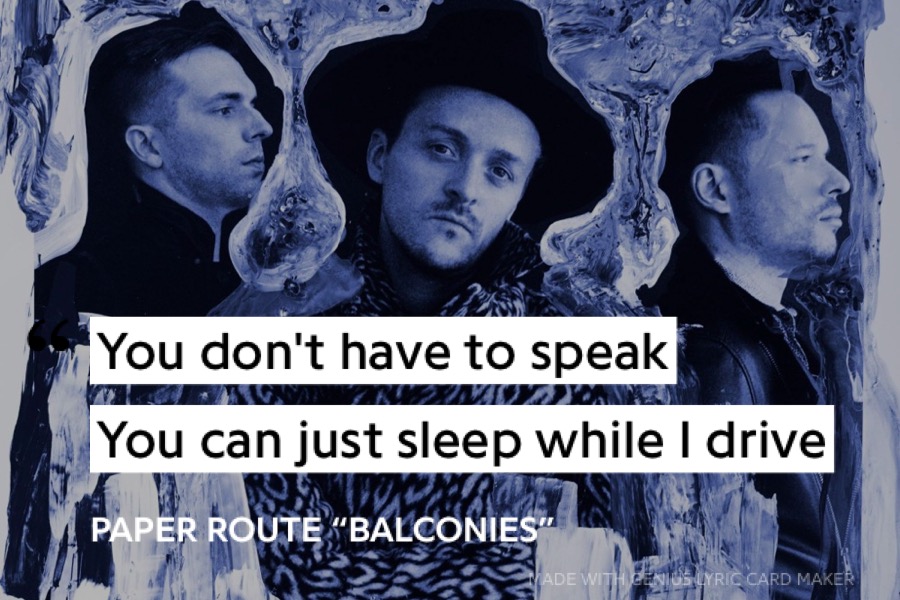
  • Listening to Paper Route makes me wonder, what if Coldplay, after recording X & Y had continued making electronic music and honed in on their lyrics. Paper Route has a solid pop-rock band, on par with any of their contemporaries (i.e. OneRepublic, Coldplay), but their somewhat eccentric fidelity to their craft, recording their albums themselves in old Tennessee mansions to let the natural acoustics reverberate on the record, had cemented them as an indie rock band. “Balconies” was kind of Paper Route’s first and last hit. The band’s music had been featured in movies and television shows, but “Balconies” got them a late-night performance slot on Seth Meyers. As one of the most obvious hits from their third album, Real Emotion, the song was released to radio but didn’t do too well on the charts. After touring to support the album, the band went on “an indefinite hiatus.” However, as the band has had long gaps between albums, I wonder if JT Daly and Chad Howat will assemble a group of musicians together for album number 4. 

    RAISE YOUR ARMS AND HOLD WHAT YOU CAN’T REPLACE. “Balconies” uses several mixed metaphors to convey a message about being unable to hold it together. The singer claims “that the simple things [he] can’t get right” and he “know[s] that it’s [his] fault,” yet he offers to comfort the listener: “You don’t have to speak/ you can just sleep while I drive.” He talks about the difficulties he faces: “For every wound, there’s a hill to climb” and that he has a “hunting heart trying to survive.” This song can draw an obvious connection to Daly’s lyrical theme of wrestling with God and religion, but it also seems to be about his other theme, struggles with romantic relationships. If it’s the first option, the singer is letting God down in the first verse, and in the second God is offering comfort. I don’t like how the speaker shifts so much in that interpretation, so I think the song is about showing support for a loved when you both are having a hard time. The minor key keyboard synth riff that is repeated throughout the song sounds like rain, and the subject matter of the song matches with the dreary sounds of the song.

    IF I’M IN YOUR DREAMS, AM I WHAT YOU WANT TO FIND? “Balconies” is certainly not Paper Route’s lyrical masterpiece, but it is a comforting, uplifting song. It was a perfect song of the day because of the bleak weather we’ve been having lately. Yesterday it cleared up for a day only to start raining again today. Whenever I hear “Balconies” on days like today, I’m transported back to my childhood on a boring, rainy day. My mom ran the dryer and folded the laundry and as I got older I folded the laundry. She’s watching some late afternoon talk show and I’m watching it too because there’s nothing else to do. I’m sitting on the couch, warm towels just out of the dryer are covering me, and I feel the warmth of the afternoon laundry. Later mom announces it’s boxed macaroni and cheese for dinner. That was pretty typical food when growing up and there was nothing special about it, but on boring days like today, mac and cheese is kind of a highlight. I can’t fully understand the struggles of my parents trying to feed three kids on a single income. I don’t know what their daily hopes and fears were. I was sheltered from it. I can look back fondly on those boring, rainy afternoons when I didn’t have to worry about money or not being loved by my parents. I know that this is not true of every family, so I’m thankful for the privilege that I had for that time. I think “Balconies” taps into that human emotion of a loved one saying, “Don’t worry about it and let carry your burden for a bit.” It may be just a box of macaroni and cheese, and we may have to worry about our nutrition later, but you won’t be hungry. And sometimes that’s what you need.

    Music Video: 
    Seth Meyers Performance:

    Album Release Live Acoustic Performance:

  •  

    I’ve talked about Eisley, the named-for-Star-Wars sister/cousin band from Tyler, Texas. Their major-label debut garnered indie cred, but due to some issues in the music industry, the band’s label de-prioritized their sophomore release, delaying it almost a year from its recording and mastering. As for promotion, the record label pulled radio support as they weren’t sure which format to market the band and canceled plans for a second music video to the band’s only non-radio single “Invasions” and never released the video for today’s song, “Many Funerals.” Eisely can be added to the list of Christian-adjacent bands that were failed by major labels. Some of these groups saw initial success, whether radio, video, or touring, but ultimately they were left abandoned by the major label. Although RadioU plays some of their latest singles, by the end the Room Noises cycle, Eisley’s creative path didn’t have them marketed to the Christian rock format, which is what happened to groups like MaeCopeland, and The Juliana Theory.

    YOUNG AND AGILE, SEASIDE BORN. The eerie, somewhat passé lyrics of “Many Funerals” make the listener imagine a dark sea-side setting, that perhaps is set in the past. The lyrical content is fictional. The Dupree parents are still alive (and active on Instagram), and the Dupree children were born in a landlocked county in Northeast Texas. There’s not much information online about Eisley’s comments on the song, so listeners are left to guess what it’s about. The listener, the person the song seems to be addressing, seems also to have died by suicide. Sherri sings, “How could you have left us here? You had your friends, you had us, goodbye.” It could also be blaming the person for a sickness or accident that person had no control over, which sometimes happens when someone dies. No matter the cause of death, “Many Funerals” is a gloomy album opener. Elizabeth Kübler-Ross’s On Death and Dying categorizes stages of grief humans had been unconsciously practicing for millennia. Art–be it literature, painting, song, or dramatization–helps us as a species reconcile with our own mortality. We can see others in their grieving processes. However, we cannot weigh the grief of individuals in the past, when death was much more prevalent, nor can we weigh the grief of others in the present, in a time when statistically we are living longer, despite the cancers, heart disease, car accidents, and gun violence. One funeral is one too many. Eventually one day, the funeral will be yours if it’s not mine first. 

    I’M CONTENT TO LIE PEACEFULLY. As music takes on a meaning beyond its original intent, I will again hijack this song to use it as my own soapbox in order to address the senseless killing at a night club in Colorado Springs. I first saw that there was another shooting when I was on Instagram. Then I saw it on the news. It turned out it was an LGBTQ+ club. It turns out it was in Colorado Springs, Colorado, which so happens to be the home of moral majority bulwark Focus on the Family. It’s the state where gun-loving, homophobic far-right candidate Lauren Boebert barely clinched a second term. Boebert other anti-LGBTQ+ politicians and public figures have offered condolences online, but it’s easy to question their sincerity when Boebert and company have spent their entire career attacking LGBTQ+ people and organizations and bolstering gun rights. Since I wrote about Westboro Baptist Church on Sunday, I wanted to understand the group through a firsthand experience so I found a podcast, an interview with the current pastor, Timothy Phelps, son of founder Fred Phelps, Sr., on the Pastor with No Answers Podcast. I thought that host Joey Svendsen balanced the interview well by allowing Phelps to talk about his beliefs and pushing back on them in a respectful way. That being said, I don’t necessarily recommend listening to this interview, particularly if you struggle with issues of depression especially regarding your sexuality or if you have past religious trauma. What I took away from listening to the interview was that due to the church’s strong belief in Calvinist pre-destination and their view that only the most faithful to the letter of God’s law (as understood by Westboro Baptist Church’s teachings) will be saved. Everyone else is awaiting to be burned for eternity, and somehow “the kindling wood,” bundles of sticks, or faggots,  is what God hates the most. And while Boebert and other right-wing groups may not belong to Westboro Baptist Church, they all belong to churches that think very similar things about gay people–that they are doomed to burn for eternity. But until then, what’s the far right’s solution? Restrict rights? Conversion camps? Mock and insult publicly? Propose solutions like building a wall and trapping all the gays in to not be able to reproduce? Influence a political genocide? Or preach and brainwash until you get a suicide? Nope the fundamentalism secretly and not so secretly wishes us all dead. And I’m sick of questioning my right to exist.


  • First appearing in 2001, Lovedrug released their eponymous EP in 2002 and their  Rocknroll EP in 2004 before releasing their debut record, Pretend You’re Alivein June 2004. Selling over 20,000 records soon after the record was released, the band was signed to Columbia Records, and their song “Spiders” was intended to be marketed as a radio hit. But rock star grandeur was never really in Lovedrug’s reach, as the label dropped the band in the middle of restructuring. Lovedrug was a hard-working band, touring with acts such as The Killers, Robert Plant, Sam Phillips, Switchfoot, and Copeland. They would enjoy some success with their follow-up record, Everything Starts Where It Ends, but would continue making music until 2020, although they are probably best remembered for their first two records.  

    SEARCHING ON A WIRE FOR A WIREThe Militia Group was a record label founded by former Tooth & Nail Records employee Chad Pearson. Pearson founded the label in 1998, and some artists in Tooth & Nail’s sphere signed to The Militia Group. Pearson who grew up overseas in Papua New Guinea in a missionary family had discovered Christian rock through Tooth & Nail Records. Pearson curated a group of artists who were ambiguously faith-based or ambiguously agnostic. Lakes (Watashi Wa‘s Seth Roberts‘ band post-Eager Seas’ failure on Tooth & Nail), Waking Ashland‘s Jonathan Jones‘ We Shot the Moon, and Denison Witmer all called The Militia Group their home along with groups like The Beautiful Mistake, Copeland, The Rocket Summer,   QuietdriveRufioThe Summer SetAcceptance, and their most successful act, Cartel. At one point, they almost signed Fall Out Boy. In this context, Lovedrug signed with The Militia Group. They toured with fellow Militia Group acts and played at Cornerstone, which led many fans to think that they were a faith-based band. However, in a 2011 interview with IndieVision, the interviewer is awkwardly shut down when guitarist Jeremy Gifford explains that the band is not Christian, though he doesn’t claim to speak on behalf of everyone in the band’s beliefs. In fact, Christian media, back in the late ’00s were keen to include bands with any kind of faith into the fold. Jesusfreakhideout included Lovedrug’s Everything Starts Where It Ends and Paramore‘s Riot! on their best of 2007 list. 

    CONNECTED TO THE OTHER END OF THIS TWISTED FREQUENCY I’VE SPUN. Joan Osborne asked the question “What If God Was One of Us?” Plumb tells us that “There’s a God Shaped Hole in all of us.” Both of these songs were on the Bruce Almighty   soundtrack, a movie that was both praised and condemned by Christians for handling the lesson that no human could do a better job than God. Or Morgan Freeman for that matter. When an overtly religious song evokes God, there’s a theological agenda. Sometimes a Christian band tries to be cool, singing about girls and nonsense for fourteen songs and tacks on a ballad about being lost without any direction until finding God. This track is either in the center of the album or attached to the end as sort of an epilogue to the album, either to be skipped or included to fulfill a contract. Sometimes, the band feels that this inclusion–no longer having to meet the j’s per minute quota of the ’90s–is the real purpose of the album. They would usually give a 15-minute speech toward the end of their set, saying something like, “You know guys, our band believes that you are here for a reason” or something like what Roma Downey said on every episode of Touched By an Angel. Using God in a song, though, whether by an evangelical band or by one that is agnostic immediately triggers a confirmation bias in listeners’ minds. “But God doesn’t it feel so good?” Paramore declares in their breakthrough hit “Misery Business.” “I’ve found God,” The Fray declares in “You Found Me.” Hundreds of examples would make the band palatable to a Christian audience. When Michael Sheppard imagines “If God (or god) was on the radio,” listeners at Cornerstone, at the Copeland tour, and at the Nothing Is Sound Tour with Switchfoot heard what they wanted to hear. God was on the radio, speaking to them, telling them exactly what they already knew. Funny how that happens.

     Official Video:


    Haley Williams Instagram Live: 

    Further Reading/Viewing/Listening:

    Chad Pearson, founder of The Militia Group:

  •  

    Many Christians and former Christians were crestfallen by the marriage of politics and religion, particularly displayed from the 2016 election of Donald Trump. How could religious leaders we looked up to, who taught us about the fruits of the spirit, now say that Trump was appointed by God? Back in 2012, though, a band from Hartsville, South Carolina, began to see inconsistencies between what the Bible said and what was preached.

    YOU BETTER MEAN WHAT YOU SAY. Sent By Ravens released two records with Tooth & Nail Records before going on an indefinite hiatus. Unlike many Tooth & Nail acts, Sent By Ravens was a Christian Rock band that dealt with Christian themes directly. The band’s debut record, Our Graceful Words, produced by Aaron Sprinkle, challenged listeners on spiritual themes on songs like “New Fire” and “Beautiful List.” Other songs on the record like “Trailers vs. Tornadoes” and “Stone Soup” displayed a post-hardcore sound.  But the vision for Christian Rock that Sent By Ravens shared with listeners unfortunately failed, and that could be because of their potentially divisive sophomore record, Mean What You Say. By divisive, I mean that Mean What You Say was uncomfortable for two groups of Christian music listeners. While bands like Anberlin and Underoath had made a career on mostly relationship-based songs, other bands like Kutless and Seventh Day Slumber took an opposite trajectory into worship music. There were other bands like Sent By Ravens who sang about spiritual subjects, but much of the Christian Rock audience was either moving away from Christianity or deeper into Christianity and further away from rock. The sincere lyrics of the band felt awkward to the soon-to-be deconstructionists, and the questions the band raised made the future MAGA Christians double down in their politically conservative agenda. 

    I DON’T HAVE TO KILL WITH MY HANDS. Mean What You Say” is the title track from Sent By Ravens’ sophomore record. The song and others on the album addresses the hateful messages that some vocal Christian individuals and groups spread to disparage fellow believers and non-believers. The song was specifically inspired by the hatred spewed by Westboro Baptist Church. Church members can be seen on TV getting attention for their causes in the most abrasive way possible with provocative signs. The church’s central message is in their URL(not shared for the purpose of decency): “God hates fags.” The church is obsessed with homosexuality, protesting at funerals of famous people no matter the deceased’s actual sexual orientation, making outrageous claims that the deceased was gay or furthered the “gay agenda.” In addition to the religious group’s unyielding homophobia, the church members also demonstrate extreme anti-semitism, islamophobia, transphobia, and xenophobia. Many Christians and non-believers alike label the church as a hate group, and there have been many lawsuits against the church and its founder, Fred Phelps, Sr., even a Supreme Court case against the church’s founder. When I was going to a religious high school, my Bible teacher condemned Westboro Baptist church and joked about them being crazy fanatics. But the messages about homosexuality weren’t that much different at Bible class. Maybe it was less obsessive, but I felt deep down, the far right is what the “moderate fundamentalists” really wanted. Maybe Westboro Baptist church was speaking to something they found instinctively true. Today’s song challenges listeners to “mean what they say.” But this message causes Christians either to become more loving and affirming or more hateful and intolerant of others. 

    Read the lyrics on Genius.

  • Today we take another dive into Aaron Sprinkle‘s 2017 record, Real Life. In a sense, Real Life was a farewell record. Sprinkle had scaled back his productions in the early ’10s, only working with bands he really wanted to. Real Life is also his final record on Tooth & Nail Records. Since moving to Nashville in the ‘10s, Sprinkle began working on other musical projects outside of the Tooth & Nail world. Real Life blends trendy late ‘10s pop hooks and ‘80s/‘90s electronic sounds.

    MEET ME WHERE THE LIGHT GETS IN YOUR EYES. Today, I’m updating the hideous album artwork for my Aaron Sprinkle Essentials playlist on Spotify and creating an Apple Music edition. After all, it is Apple Music playlists I’m basing the Aaron Sprinkle list on–Max Martin, Jack Antonoff, Greg Kurtsin, etc. I think Aaron Sprinkle deserves his own playlist, so here it is:
  •  

    I got into Kye Kye in 2013 when I was also starting to listen to K-pop. The Christian electronic band made up of Estonian-born, Portland, Oregon-based siblings with their vaguely spiritual, ethereal pop music never quite caught on with any part of the Christian music scene. They may be too artistic for the Christian pop world and not heavy enough for the Christian rock world. The band is still around today, though not releasing Christian music. Today I wanted to delve into their remix EP, Young Love


    1. “Broke.” This is a remix of the band’s single from the record. I remember it kept losing on RadioU‘s Battle of the Buzz but when it was released in regular rotation, it caught on and even topped their countdown show, TMW.
    2. “Introduce Myself.” On the album Young Love, “Introduce Myself” is kind of a mundane track; a kind of meandering intro to public speaking class that breaks the rules of good speech writing. As a dubstep track, it’s little more fun. 
    3. “Walking This.” Back in May I talked about the original version of this song and who it seemed to be closely related to today’s song. In fact, the two tracks appear back to back on both the standard and the remix version, but on the remix album they are switched in order. It would seem like you would “Know This” before “Walking This.”
    4. “Knowing This.” Today’s song envisions God as a “perfect lover.” The Genius annotations have scripture backing up every line of the song. 

    Original Version:

    Remixed version:

    5. “Trust and Trees” Kye Kye’s lead singer Olga Yagolnikov’s vocals are often subtle beneath the music. From reading the lyrics, the song seem spiritually esoteric. 

    6. “My Sight” is a song I’ve never listened to much. It’s one of the more blatantly spiritual tracks from the band, talking about the resurrection. 
  • Writing a song that an entire nation sings for a year or more is no small feat. In 2018, the K-pop band iKon released a single that was hummed by the elderly and even banned in some elementary schools for what teachers and administrators said was inappropriate lyrics, but was really about the students singing it excessively. Unlike some K-pop bands, iKon’s members are often involved with the songwriting process. Kim Han-bin (김한빈), better known by his stage name B.I, took inspiration from the ending scene from the 2016 musical La La Land when writing iKon’s “Love Scenario,” the song that was called “The Song of the Year” in South Korea in 2018.

    THE LOVE SCENARIO WAS CREATED AND NOW THE LIGHTS ARE OFF. Spoiler alert: In the final scene of La La Land, Mia (Emma Stone) and Sebastian (Ryan Gosling) play out a “love scenario” which plays to a beautiful instrumental fantasia. In this fantasy, Mia and Sebastian imagine themselves together, patching up an otherwise ill-fated relationship throughout the film. By the end of the piece, the audience learns that Mia and Sebastian are not actually together in reality and were not able to patch up their differences. But in that instrumental moment–Sebastian playing a piano in a night club and Mia watching him at the piano, the “love scenario” feels more real than what actually happened. B.I wrote “Love Scenario” with lyrics of pining for a lost love, but the group sings the song in a “happy-sad” way. He described the emotion of the song: “I wanted to express what I found regrettable, neither sad nor happy, in the warm farewell.” The song reminds listeners that relationships don’t always work out, and that just because it didn’t work out doesn’t mean it’s a waste of time to have loved. It reminds me of Alfred Lord Tennyson who said in his poem “In Moratorium” after his friend died at the age of 22 of a brain hemorrhage, “‘Tis better to have loved and lost than never to have loved at all.”

    THE ELECTRIC FEELING IN BETWEEN MY RIBS. “Love Scenario” brings back lots of memories for me. It’s not so much about picturing various scenarios in which life could have worked out differently. Instead, the song transports me back to 2018 when the song was everywhere in South Korea, the phone stores, the gym, the cafes, anywhere shopping, and sung in the classroom. And I think about this song today as I think about my former students who took  their CSAT today, the only college exam in South Korea held on only one day of the year. The graduating class in 2018 were just second graders in middle school singing that dumb song over and over again. Since I’ve been teaching for many years at the same school, I’ve discovered that class dynamics are so important and that some classes are more enjoyable than others. And while teachers are not supposed to have favorite students, I think that my favorite grade of all my years of teaching was this year’s graduating class. It might be because of the students’ personalities, but I also feel like it was their grade that I finally got it together as a teacher, like the years before I “faked it before I made it” and that year I could stop “faking it.” So today, rather than focusing on what could have been, I would rather celebrate the accomplishments my students  have made in their learning and I have made in my teaching.  Congratulations class of 2022!

    Read the English translation on Genius.

    Read the Korean lyrics.

    Lyric video with English translation:

    Music Video:

  • In 2003, Stacie Orrico was among a spate of Christian artists crossing over to secular radio. At that time, it seemed like every act was secretly Christian. Stacie Orrico’s breakthrough record as a Christian artist came when ForeFront Records released Genuine in 2000. The record sold well and several singles were released including the biggest hit “Don’t Look At Me,” which topped the Christian Hit Radio charts for eight weeks.
     

    CHASING DOWN EVERY TEMPORARY HIGH TO SATISFY ME.  Stacie Orrico’s first record was unambiguously Christian. Though she dealt with teenage issues, her thesis lay in the message of her biggest hit, “Don’t look at me, look at Him,” meaning Jesus. But “Don’t Look At Me” didn’t have a music video. Christian labels often released one music video per album because videos are a great expense and the record sales often didn’t mirror general market acts. Orrico’s team chose to make a video for the album’s title track, “Genuine.” The video featured Orrico dancing to the song leading a team of female dancers. The video was successful both in Christian and secular markets, reaching the Top 5 on Disney.com. In 2001, Orrico opened for Destiny’s Child on their Survivor Tour. With this attention, Orrico signed with Virgin Records and began working on her sophomore, self-titled record. Stacie Orrico wasn’t quite a Katy Hudson to Katy Perry rebranding. While the lead single of Stacie Orrico, Stuck,” had nothing to do with a spiritual topic, the song was promoted on some Christian Radio and music video programs. Elsewhere on the record, songs are vaguely and sometimes explicitly spiritual, though much less than on Genuine. 
    WHY CAN’T I LET IT GO?   Stacie Orrico’s second single, (There’s Gotta Be) More to Life” uses a subtle evangelistic tool of bating listeners with an existential question. Some chose to answer that question right away, but the more marketable artists don’t. If listeners was really wondering what that more is, while either filling their homes with luxurious imported Missoni furniture or drunk-driving to the club on the weekend, they only need to listen to Orrico’s debut record to find out what the answer is. I’ve been importuning upon my readers Christian songs popular for millennials when we were in middle and high school this year. As a kind of exvangelical, I feel nostalgic for this music, and really I don’t think that there’s too much I disagree with. I think there’s gotta be more than what I’m seeing right now, but I wouldn’t be so quick to name what that thing is. And just like me, not all of the Christian singers of the ’90s and ’00s are cemented in political evangelical Christianity. Oricco’s most recent album, Beautiful Awakening, was released in 2006. She mostly works on other projects these days and is married to the actor Isaiah Johnson and talked about parenting bi-racial children during the Black Lives Matter protests in 2020 with her husband on the Never Thought I’d Say This podcast. Oricco seems like a really cool person, and like the episode of Good Christian Fun, I’m going to have to send this song “Heavenbound.”