• Stephen Kellogg parted with his band, The Sixers, in 2012. Though the band doesn’t consider themselves right-wing, they were named the “Armed Forces Entertainer of the Year” in 2010. Kellogg continues to play for the troops and raises money for St. Jude’s every holiday season. His last album with the Sixers, Gift Horse is a treasure of Northeastern folk rock tunes, delving into topics of family, love, religion, and existential dread. 

    HIS RANTS COULD BE CONTAGIOUS.  In a concert clip, Stephen Kellogg describes “Charlie and Annie” as his memories from middle school during a time he didn’t feel very safe. The song talks about an ill-fated romance between alcoholic Charlie, who shows his kindness just enough to partially redeem himself through the singer. He’s a victim of his addictions, though the singer doesn’t let him off the hook. Annie is a beautiful woman who had quite the past before she got tied down by “Charlie and motherhood.” Charlie is emotionally abusive and Annie is tied to her husband who is holding her back from greatness. The speaker isn’t very present in the song, but rather tells about his observations of this toxic marriage. The speaker places distance between himself and the main subjects. To me the speaker seems to be older now thinking about friends of his parents. Perhaps he was friends with Charlie and Annie’s kids and witnessed the emotional abuse in the marriage when over visiting his friends. And the kids who were friends with Charlie and Annie’s kids didn’t want to be around Charlie when he was drunk because he would shout at them and manipulate them to think that they had done something wrong. 

    WE WERE ALL AFRAID HE WAS DESCRIBING US. I think that the way that Stephen Kellogg wrote “Charlie and Annie” is both specific enough to make the story feel real, yet vague enough to make you feel like it’s describing someone you knew. We’ve all been around unhappy marriages when we grew up. We’ve been around adults who fight constantly. When I was growing up, I constantly heard adults talking about staying together for their children. It was on TV, in church, and in conversations I overheard from my parents talking about their adult friends. Never were the families ever happy for sticking it out when there were fundamental problems. But when I was growing up, I always wondered what was so bad about divorce? If something could stop the screaming at night, if something could stop the resentment, if something could stop the emotional harm done, wouldn’t it be worth it. Kids start to wonder if they are doomed to repeat their parents mistakes, finding partners just as maligned. And some of us grow up feeling like we’ll never get married. I remember when I was in elementary school, there was a special pull out time called “Banana Splits” for children whose parents divorced. I think they were given snacks and, maybe banana splits. One day I asked my mom if I was ever going to get to attend. She said, “Your dad and I are never going to get divorced.” And I believed her, even though it seemed that they should have.
    Studio:
  • Let’s take a look at one of my favorite fall albums, Copeland‘s 2005 sophomore record In Motion. I consumed the first three Copeland albums around the spring and summer between senior year and college. 
    I think that Beneath Medicine Tree was on sale at Best Buy so I picked it up maybe around April. Then I picked up In Motion in the summer and Eat, Sleep, Repeat in the late autumn. I always associate Copeland albums with the seasons in which I listened to them. And like the brown leaves on the album cover of In Motion, I’d like to talk about a short memory with each song.


    1. “No One Really Wins.” The album opens with grungy guitars, a sound that Copeland would soon abandon in later albums. The song also sets the album up with a spiritual theme–the fight between “heart and mind” and “grace and pride.” The message of the song is to “change if you want, but don’t . . . change for me” which was something very different from the sermons I grew up with. 

    2. “Choose the One Who Loves You More.” I thought that this was a Jars of Clay moment on a Copeland record. The “rainy,” relaxed pace of this song slows down the moment of In Motion and the track feels a little long. It would often be the song that I would skip in the car.

    3 “Pin Your Wings.” I remember watching the music video to this song on TVU. I thought the song was catchy like the song for their first video, “Walking Downtown” on Beneath Medicine Tree, but I didn’t think it “Pin Your Wings” was anything special. The song returns the album to it’s post grunge ’90s rock musical theme. Lyrically, “Pin Your Wings” feels like the most immature, high school emo song that Copeland has written, not that that’s a bad thing. 


    Music video:

    4. “Sleep.” I included this track a few months ago in my Dreaming playlist. I think that this is one of the first times that we can see Copeland turning to experimental sounds rather than simply organic instrumentation. The hypnotic piano riff makes the song a little bit sleepy even along with Aaron Marsh‘s calming vocals. 

    5. “Kite.” Probably one of the most bizarre Copeland songs, “Kite” feels like a European folk song from an old recording. 


    6. “Don’t Slow Down.” The chorus is one of the most beautiful moments on the record. Marsh’s harmonies are flawless. The dissonance in the melody of the verse is completely resolved with the chorus and the guitar fill.

    7. “Love Is a Fast Song.” I think this is the heaviest Copeland song. Last week, Marsh said on social media that they wanted to start including their heavier songs in their set lists again. 


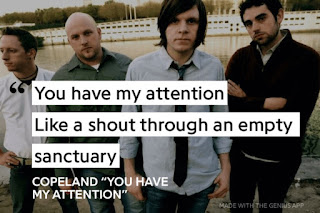
    8. “You Have My Attention.” After the heavy guitar solo of “Love Is a Fast Song,” the quiet moments of “You Have My Attention” begin with Marsh’s calm vocals backed by an acoustic guitar and some kind of light percussion like a cymbal. This song feels like it was recorded in a church. Aaron Marsh has talked about his relationship to Christian music and faith, saying that there are “no Christian Copeland songs,” and the only times that Copeland gets spiritual is when Marsh is singing about his grandmother. But to me, In Motion feels like a very spiritual record, and “You Have My Attention” is perhaps some kind of spiritual thesis to the album. Whether that thesis is spiritual or secular, the album clearly uses religious imagery to convey its point.

    9. “You Love to Sing.” In Eat, Sleep, Repeat, Copeland started to tackle a Burt Bacharach  sound along with old timey Hollywood musical sounds.  “You Love to Sing” feels like a predecessor to their later more elaborate work, only in the form of a slow moving rock song. “You Love to Sing” is a perfect roadtrip song for me. It keeps me focused on the road, and the time just slips away.
    10. “Hold Nothing Back.” The final track on In Motion is a little underwhelming. It sounds like it was recorded in either a park or a busy food court. A simple acoustic guitar is the basis of the song, but eventually other instrumentation is added. The message of the song is the dichotomy between freedom and security in a relationship. The speaker tells the listener “Do what you want” and “Go where you want, but I won’t be too far.” He leaves us with this thought: “If you fall in love . . . hold nothing back.” 
  • Listening to Michael Stripe and Peter Buck talk, I couldn’t place R.E.M. as southerners from Georgia. The Netflix Song Exploder‘s episode on “Losing My Religion” wasn’t the first time I had heard R.E.M. talk about their music; however, I was both intrigued and put off by Michael Stripe in the extended interview. He is perhaps one of the most articulate rock stars I’ve ever heard speak; however, I picked up on an underlying arrogance when he talked about this song. According to most accounts, the band recorded Out of Time using the mandolin as kind of a throw-away record before they returned to more conventional writing approaches. The band chose “Losing My Religion” as the lead single, thinking that it wouldn’t chart or that it would just be a minor hit. The band would quickly record more material and go on charting in the lower regions of the Rock Charts. However, “Losing My Religion,” despite its unconventionality became a number 4  Hot 100 hit, a number 1 rock chart hit, and it went to number one in several countries. Michael Stripe seems smug when he talks about the band’s underdog success. Occasionally, the music charts reflect effort and poetry and musical effort. Occasionally, the band who all the bands are drawing inspiration from also becomes popular. And that time was 1991. 

    I’M CHOOSING MY CONFESSIONS. Michael Stripe was raised in a religious background in the Methodist tradition. Borrowing a Southern cliché, “Losing My Religion,” brilliantly dances around the actually meaning in the lyrics. Stripe said that it’s about the awkwardness one feels around someone they love. However, the imagery in the music video and some of the lyrics in the song evoke existential meanings, often bating the devout as the lyrics pick apart problems with devotion. One of the reasons that the song was so successful internationally was the response to the sex scandals in the Catholic church around the world. In some contexts, the song is a protest against religion. In a somewhat of counter-argument, the alternative Christian rock culture in the 2000s also “lost their religion.” The mantra many bands and radio stations said was, “It’s not about religion, it’s about a relationship.” Multi-platinum CCM crossover artist Lauren Daigle blithely touted this new cliché on her 2018 album Look Up Childtitling a track “Losing My Religion.” This song was not a cover of R.E.M.’s hit, but rather a song about “losing [her] religion, in order to find you.” The listener can fill in the blank, but it’s pretty obvious from Daigle’s context that it’s about God.

    THAT’S ME IN THE  CORNER, THAT’S ME ON THE STAGE. But “Losing My Religion” also has served as a rejection of faith or a reshaping of it. In the last decade, a trend emerged in Christianity in which once prominent leaders and followers, mostly in evangelical persuasions, began to ask questions about what faith meant in the 21st century. When confronted with certain questions, especially regarding gender roles, politics, race, homosexuality, gender identity, and whether or not the scriptures were meant to be taken literally today. The deconstructionists, as they are called, didn’t find the traditional answers in mainstream Christianity satisfactory. Of course mainstream Christianity pushes back and often proves itself the culprit the deconstructionists rail against. For me, growing up being taught that I belonged to only true religion and that all the other religions lied to manipulate their followers, “losing my religion” was a scary notion. It was 2014 in the middle of my missionary days when I decided to finish watching Ryan Murphy‘s Glee. The show often tackled religion, mainly Christianity. Religion is one point of identity for the characters in the small Ohio town. One episode in Season 2, “Grilled Cheesus,” dealt with religious idolatry, the prosperity gospel, atheism, and crisis. Finn (Cory Monteithsings the song “Losing My Religion,” and this is the episode’s catharsis. It was campy, and I thought it was sacrilegious, but it raised a question that was too often ignored in my religion: how should we deal with homosexuality? The show depicts real gay people in ways I’d never seen them on TV or in real life, and it bothered me that Christianity had made gay people seem like imaginary, sinful beings that could easily “pray away the gay” and change. It wasn’t just a theoretical English major debate from university, though. There was something more to this question.

     Read the lyrics on Genius.

    R.E.M.

    Glee Version:
  • A short lived indie-rock band from Dallas, Texas, The New Frontiers released one full-length album on The Militia Group in 2008 before calling it quits the following year. Their album Mending was produced by Matt Goldman, the Atlanta-based producer known for heavy-hitting bands, like Underoath, The ChariotAs Cities Burn. Goldman, however, isn’t exclusively a hard rocker. Working as the drummer of the Christian Rock band Smalltown Poets, Goldman’s early production credits include Luxury, Copeland, and Casting Crowns. The New Frontiers’ mellow folk-rock album,   Mending drew critical acclaim from Paste and Daytrotter. The band contributed the track “Mirrors” to the the 2008 Cornerstone Festival digital mixtape along with many other indie rock acts who performed at the festival. “Mirrors” deals with coming to terms with an inescapable realization of who one is by “mak[ing] peace with the world.”

    TURNED 22 WHEN YOU WERE FOUND. Today’s song brings me back to my childhood when the constant cycle of snow, salting, melting, and spring flooding, made driving a new car in Chenango County pointless. So everyone drove old GM-affiliated rust buckets that broke down in the winter, stranding you in the snow. It was only a matter of time that the 1970s Chevy would die and you’d have to fork out money to buy a 1980s Buick or Oldsmobile. When you got into the car and drove the roads in Chenango County, you’d be driving for a while between farms and fields and forests until you descended the hill into town–Oxford or Norwich, right or left. My first home was off the highway before my family moved deeper into the hills, where the “family commune” was located, where so many of my aunts and uncles lived. The first home was much better than the second, at least in my memory. When my family moved to my aunt’s old trailer, I was sick every winter, which, in New York was practically six months out of the year. But reflections in my memory of the cabin–pristinely kept, glazed wood, neat and tidy interior–probably never was as pristine as my memory. My parents insisted that the dilapidated shack they saw from the road was, in fact, just as my parents remembered it. The colors much paler, the roof much less stable, the porch much more rotten. “I never let the lawn get this bad, though,” my father assured him. “I wonder who Uncle Nathan has living there now.” “Do you think we can ask him to go inside?” I reverted to my boyhood, pleading with my parents like when he asked them to stop at the ice cream shop in town. “No,”my dad said taking my old cap off and scratching my head. “I don’t think that will be possible. Uncle Nathan hasn’t gotten along with our family for years. Him and your grandfather got into a big argument at the family reunion last year. But there’s always an argument. That’s why we had to move away in the first place.”

    WE ARE ALL MIRRORS IN DISGUISE. Last October, after I wrote about “Mirrors” and spent a lot of time thinking about my childhood in an attempt to get in touch with my writing style, I saw a message on Facebook from my dad that the house I lived in from birth to five had burned down. He sent pictures:

    The first picture is me about three years old in front of the cabin and the second is the morning after the fire. I don’t think anyone was hurt, but it’s still sad to me. I fantasized about being able to go back into the house. Of course, I don’t want to be one of those “we used to live here” people, but somehow I wanted to walk the floors that I could hardly remember. Today I finished watching the final episodes of This Is Us. Without spoiling the sad wrap up, I thought that Jack’s (played by Milo Ventimiglia) words to his children when his sons started to shave summed up the theme of my blog: “When you’re young, you’re always trying to be older. Then when you get old, you’re always trying to go back.” But we can never go back. We can’t go home, not really. Even if everyone is alive and even if your family has never moved, everyone is not the same. So in this nostalgic season–the fall as it gets colder, we stay inside more, the evenings get longer–let’s remember to enjoy today and capture it because it will be gone soon. 

  • In 2015, Sufjan Stevens released his saddest album. The songs on Carrie & Lowell give listeners insight into the folk singer’s upbringing and his process of dealing with the grief of losing an abusive parent. Stevens’ mother Carrie had passed away in 2012 from cancer, and “Death with Dignity,” the album opener, finds the lyricist struggling for the words to tell the story. He says “I don’t know where begin,” showing how something deeply personal is hardest to talk about. The song structure is unique in that there is no chorus, but rather five verses–this is a fact I never noticed in all the times I listened to the song before I wrote about it last year. “Death with Dignity” is best in the context of the entire album, but if you don’t have the time to dive into the depths of sorrow like a mourner’s kaddish, the song is a sweet twinge of sadness to throw into an otherwise happy playlist. 

    AMETHYST AND FLOWERS ON THE TABLE. I was on the fence about the 2016 pilot of This Is UsThe time-jumping drama was just confusing. Mandy Moore and Milo Ventimiglia in the past and Smallville‘s Green Arrow in the present. However, the big reveal at the end of the episode where you learn (spoiler alert) that the third triplet had died, and Rebecca and Jack decide to adopt Randall who had been left at the fire station, and the doctor saying some cliche line about “life handing you the sourest of lemons and using them to make lemonade” all delivered to the tune of “Death with Dignity,” I was sold on the drama. As for the song, Stevens, for being as he is in his lyrics, shies away from celebrity spotlight. He offers little details into his personal life with the exception of this record. We know that his mother Carrie was a substance abuser and struggled with schizophrenia. We know that Lowell Brams was her second husband, and he was present during Stevens’ formative years. Lowell would go on to do some musical projects with Stevens after this album, but it was the death of his mother and the need for closure that drives this album. The second track on Carrie & Lowell get explicit about the abuse, but “Death with Dignity” merely paints the setting–Stevens’ life in Oregon, the death, the abuse, and the forgiveness. 

    WHAT IS THAT SONG YOU SING FOR THE DEAD? Forgiveness is somewhat of a dirty word. I grew up with a fear of not forgiving. The pastor said in a sermon that if there is anyone you’ve not forgiven, you can’t go to heaven with the bitterness in your heart. At that time, I wondered if we should forgive the person who is unremorseful? How do we make sure that we’re not taken advantage of again? Thinking back on that, I realize how many vulnerable people were in the congregation; people suffering from truly evil things done to them. Forgiveness is a process, and it can’t be forced. Carrie & Lowell is a beautiful portrayal of forgiveness as it naturally happens. Learning to forgive your parents for the mistakes they made when raising you is always a process, and when there is clear signs of abuse, forgiveness may be impossible. I’m in no position to say that a victim must confront his or her abuser with forgiveness. I think that anyone who forces forgiveness on a victim adds another layer to the abuse. Music, church, scripture, and poetry are no substitute for mental health professionals, and it’s criminal how pastors have assumed that role. However, just as an album like Carrie & Lowell helped Stevens deal with his grief, so can art and religion be a supplement to our healing.

    Live version:

  • Anchor & Braille has been Anberlin‘s lead singer Stephen Christian‘s side project for a while. Some of Anberlin’s songs started out as Anchor & Braille songs. In 2009, Christian collaborated with Aaron Marsh and a few other hometown musicians including Louis DeFabrizio of Gasoline Heart, and released A&B’s debut record Felt, an album that feels as if Christian were the lead singer of Copeland somewhere between their In Motion and Eat, Sleep, Repeat releases. Anchor and Braille’s sound would vary greatly over their occasional four albums as well and the makeup of the ‘band’ would just become Stephen Christian collaborating in the studio with other musicians. You can tell that it’s the same singer of Cities and Never Take Friendship Personal struggling relationships.

    SHE MAKES THREATS I HOPE THAT SHE SEES THROUGHFelt was an album that appeared in my Junior year of college (one of them 🙂 around a month or so before New Surrender was released. The album was great for studying music. Christian seems to make statements of faith with tracks like “Rust” (The Story of Mary Agnosia), “Introspect,” and “Sleep. When We Die,” and it was fun to see what a less-censored Stephen Christian might say. Ultimately, the album seems to be about loneliness and breakups. Christian seems to lose the ability to write about these subjects in his follow-up The Quiet Life as well as Anberlin’s Dark is the Way, Light Is a Place. Even though Anberlin’s Vital sees an improvement in Christian’s writing, he relies too much on cliches to talk around his subject matter. This is also present on the third Anchor & Braille record, Songs for the Late Night Drive Home.

    SING TO ME EVERY NIGHT AND I’LL MAKE YOU THE HAPPIEST MAN ALIVE. Anchor and Braille performed at Cornerstone in 2011. It was really just Anberlin playing in a tent. Anberlin had played an average show (“Feel Good Drag” as an encore?), headlining the main stage after Blindside had sub-headlined. The band rushed over to a small tent to play Anchor & Braille songs. Christian explained that “Like Steps in a Dance” was the radio hit of the album if the album were to have a radio hit. It’s one of the most fun and accessible songs on the album. Christian doesn’t explore the range of his voice as much on this song. The mechanical beat and the piano and guitar make the song quirky and memorable. As for the lyrics, it’s a veiled toxic relationship. If Christian writes about healthy relationships, he often runs into cliched lyrics. After completing this song and many one or two others, Anchor & Braille finished their set. My sister and I were able to get an autograph of Stephen’s novel The Orphaned Anything’s Memoir of a Lesser Known and we got a picture together. And that was the last time I saw Anberlin/Anchor & Braille in concert. 

    Read “Like Steps In A Dance” by Anchor & Braille on Genius

  • In 2011, Rolling Stone named Eric Clapton as the second greatest guitarist of all time–Jimi Hendrix was the first. Coming to prominence in 1963 as the replacement guitarist for The Yardbirds, forming the group Cream, Blind Faith, and Derek and the Dominos, Clapton has started and played with and started a number of bands and took songs from each of his musical eras into his solo career in ’80s and ’90s. In 1970, Clapton joined with three other musicians he worked with in another band, Delaney & Bonnie to form a “make-believe band” called Derek and the Dominos. The band only released one record, Layla and Other Assorted Love Songs, but the title track became one of Clapton’s signature tunes particularly for its guitar riff. 
    YOU GOT ME ON MY KNEES. Derek and the Dominos formed during recording sessions of former Beatle George Harrison’s third solo record, All Things Must Pass. And that connection between Clapton and Harrison wasn’t the only one. Clapton and Harrison had been friends for years, but were involved in what Alan Light of the New York Times described as “one of the most romantic entanglements in rock’n’roll history.” The entanglement involved model Pattie Boyd, the subject of at least ten songs including several Beatles songs: “Something,” “For You Blue,” “She’s Waiting,” and “I Need You”; several Harrison solo songs, Clapton’s “Wonderful Tonight”; and several tracks on Layla and Other Assorted Love Songs, including the title track. Boyd married Harrison in 1966, but they separated in 1974 and finalized their divorce in 1977. According to Boyd, she decided to separate with Harrison after he cheated on her multiple times, with the breaking point being Harrison cheating with Beatles drummer Ringo Starr’s wife, Maureen. After separating, Boyd moved in with Eric Clapton and was married to him in 1979. Clapton fell in love with Boyd when she was married to Harrison. Clapton briefly dated her sister, Paula, but later turned to heroin.

    NOBODY’S WAITING BY YOUR SIDE? After getting clean, Clapton pursued “Layla” again. Clapton and Boyd married in 1979 after having, by some accounts, a “duel” with Harrison for Boyd. But the marriage was anything but a fairy tale. Both Clapton and Boyd drank too much. Clapton admitted that he abused and even rapped Boyd during their relationship. In 1986, Clapton had a son with Italian model, Lory Del Santo. Meanwhile, Boyd failed to get pregnant, and the Clapton and Boyd divorced in 1989. Tragically, Clapton and Del Santo’s son, Connor, died after falling from a window from Clapton’s 53rd story apartment in Manhattan–Clapton penning his heartbreaking hit “Tears in Heaven” from this experience. Personally, the more I read about Clapton, the more problematic I think he is. His legacy is marred with racism, sketchy political views, and sexual abuse, and yet he seems largely immune to scrutiny for two reasons 1) his status in the early days of rock and 2) the sympathy for the death of his son in 1991. “Layla” is my favorite Clapton song. I think the guitar riff is iconic and it reminds me of being a child watching football with my dad–the first time I heard the guitar riff played before a commercial break. And it’s that NFL connection that makes this an autumn song for me. And it’s Thursday night, the night the weeknight game has moved to. But if you don’t wish to support Clapton, feel free to skip this song. He certainly has enough money from over the years. 
    Live:

    Unplugged: 

    Derek and the Dominos version:

  • My my, hey hey/ Rock ‘n’ Roll is here to stay” declares Neil Young in his 1978 song.  Rock music has had lasting presence in pop culture since the age of Chuck Berry and  Little Richard. Some points in the ’60s, ’70s, ’80s, ’90s, and ’00s the genre took the primary spots on radio charts outside of the genre. However, around the end of the ’00s, Hip Hop decimated the genre. The rock bands left standing, mostly traded their axes for acoustic guitar, keyboards, EDM beats, or Trap rhythms. Much of the rock music was indistinguishable from other genres, and that trend continues into the 2020s. However, just as rock bands cross over to the pop charts, the late 2010s to 2021 is seeing pop singers experiment with rock music. From Miley Cyrus performing with Metallica to rappers like Post Malone and Machine Gun Kelly flirting with emo, some may argue that Rock is seeing a mainstream resurgence. Enter Olivia Rodrigo‘s “good 4 u,” the first guitar-driven song to top the British pop charts for more than four weeks since 2003’s “Bring Me to Life” by Evanescence

    YOU BOUGHT A NEW CAR AND YOUR CAREER’S REALLY TAKING OFF. Disney Channel star-turned musician Olivia Rodrigo released her debut album Sour back in May this year. The album is one of the biggest of the year for several reasons. Critics loved how self-aware Rodrigo’s lyrics were for the late teenage years. Musically, listeners and critics loved the genre-bending of the songs. Rodrigo was influenced by pop, synth-pop, punk, and metal. The album’s second single, “good 4 u,” taps into the angry girl rock song, popularized in the ’90s by Fiona Apple and Alanis Morissette–critics even calling Sour the Jagged Little Pill for Generation Z. While modern “sad girl” music influenced by these ’90s stars, artists like Lana Del ReyLorde, and Billie Eilish, has tended to avoid heavy guitars and drums as if it were an embarrassing trend, Rodrigo leans into it on “good 4 u.” Many listeners have cited a similarity between Rodrigo’s second chart-topping hit and Paramore‘s breakthrough single, “Misery Business.” Rodrigo admitted to taking the inspiration for parts of the song and eventually gave writing credits to Paramore’s Haley Williams and Zac Farro.

    I’VE SPENT THE NIGHT CRYING ON THE BATHROOM FLOOR. “Good 4 u” captures the grief of the “loser” of a break up. This is in contrast to the “victor” who is doing great with someone new. While some breakups occur completely mutually, but those kind of break ups don’t make good rock songs. Keane‘s “We Might as Well Be Strangers” takes a sad approach of two people who don’t know each other anymore. But in “good 4 u” the listener is either 1) passive aggressively rubbing the speaker’s face in her success or 2) genuinely misses the other person and is even looking for her affirmation. Either way, Rodrigo calls him a “damn sociopath.” Today’s song isn’t  just sour; it’s as spicy a jalapeño. Rodrigo’s hit takes a few jabs at her assumed ex, co-star Joshua Bassett, who reportedly got famous, according to Rodrigo, on the coattails of her success. The lyrics of the song use sarcasm, even including a singing-laugh more commonly heard in musical theater than pop or rock music. Whereas the lyrics are about rage, the video is pure revenge. Some may feel a similarity to the “Misery Business” video. The video shows Rodrigo burning down a house, losing her mind with rage, yet looking cute and pretty all along the way. 

    Read the lyrics on Genius.


  •  

    Rebecca Jean Smallbown, better known as by her stage name Rebecca St. James, was born in Australia but moved to Nashville, Tennessee, as a teenager in the early ’90s. A year before her family relocated, St. James began her singing career at the age of twelve, opening for Carman on his Australian tour. In America, Smallbone signed a record deal with ForeFront in 1994 taking the name St. James at the label’s request. 

    I KNOW YOU MAY MAKE MISTAKES. Rebecca St. James became one of the biggest CCM singers. Her early records were forged in rock rather than adult contemporary, in a similar vein of the female rockers of the late ’90s like Alanis Morissette and Natalie Imbruglia. But with the turn of the millennium, the popularity of female rock stars declined and electro-pop acts like Britney Spears and Christina Aguilera also changed the CCM musical landscape. In 2000, St. James released her fourth record Transform, an album that utilized the synth sounds found in the bubblegum acts of the day. The lead single “Reborn” traded the heavy guitars in her prior two lead singles from her previous records “Pray” and “God” for the pads and programming. But Transform served St. James in softening her sound to be more marketable to adult contemporary. Other than the heavy electronics on the track “Lean On” written with Christian Rock band Earthsuit and the the throwback rock track to her old style “All Around Me,” much of the album is adult contemporary oriented. The album’s second track “Don’t Worry” was a big CCM hit that has St. James sing-talking, telling a cliche story about meeting a friend at a grocery store and explaining how the singer has changed because she met God–St. James was never not a Christian. 

    THERE’S FORGIVENESS AND A SECOND CHANCE. Wait for Me,” though, became one of Rebecca St. James’ biggest hits. The song is about waiting until marriage to have sex. The lyrics paint a romantic picture about two partners being pulled together by God. The song was popular in the purity culture movement in Evangelical Christianity and St. James even wrote a book about sexual purity. At the time of the song’s release, St. James was 23 years old, and the singer wouldn’t marry until 2011. To this day, the singer talks about her struggles to stick to her convictions even into her 30s until marrying former Foster the People bassist Jacob “Cubbie” Fink, exchanging purity rings because he too “waited until marriage.” To children there are fairy tales of brave princes and beautiful princesses, and to adolescents they told us the fairy tale that God was preparing the right person for me if only I did my best. It’s actually the source of a lot of evangelical trauma. How many evangelical kids grow up to find out that their parents didn’t wait? How many kids that “waited” are now divorced? I dreamed about marrying Rebecca St. James when I was a teenager. I never lusted after her, so that’s great, right? I just thought that God was calling me to fall deeply in love with a sweet girl with a cute Aussie accent. Or maybe Jaci Velasquez. But why did Greg Long‘s piercing eyes cause something that I felt ashamed of. Why did I keep sinning with the Kohl’s catalogue, turning to the men’s underwear or swimwear section? In my 20s, I wondered what I was really waiting for. It started to feel more and more pointless. 

    Purity song parody:


  • If you’re driving through Columbus, Ohio you can tune your radio to 88.7 and find out where music is going. First hitting the airwaves in 1996, the radio station went worldwide via SkyAngel satellite network. RadioU plays Christian Rock and has been home to artists who would otherwise never hit the radio waves. However, bands often disappear from the playlist over time. This can because the band changed their sound or their message. Artists like the NewsboysAudio Adrenalinedc talk, Jars of Clay, and Jennifer Knapp were played in the ’90s and first few years of the ’00s, but the listeners didn’t like the direction that those artists took in their later careers. Other groups like Copeland, Mae, and MuteMath started out with RadioU and “got too big,” or at least that was the story. Sometimes they will pick up groups like Thrice, Red Jumpsuit Apparatus, and Paper Route, in the middle of a successful career. 

    TAKE IT SLOW. Partly because of RadioU many bands sprung out of Columbus. Relient K, House of Heroes, Everyday Sunday, and John Ruben are just a few artists from this part of the Buckeye state. However, none are more successful than twenty one pilots. The duo makes Spotify and record sales lists most musicians only dream of. Their fanbase is as devoted to the band like K-pop followers. Known as The Clique, many interpret the lyrics of the songs as a direct message to them. Long time fans even bully new fans on social media and call out those who aren’t true fans. As I talked about last year when I wrote about Mae, there are some cults I just could never follow. However, while I don’t agree with many of Mae‘s musical choices, when I hear twenty one pilots, I wonder WTF is this? Seriously, what are you kids listening to these days? Emo-Rap? What is going on here? I don’t think I can be friends with anyone who loves Imagine Dragons and twenty one pilots. Maybe, but everyone I’ve met who likes these two groups–we’ve had issues. I do invite the challenge. 

    WE DON’T DEAL WITH OUTSIDERS VERY WELL. That being said, “Heathens” is kind of thought-provoking. On a collaboration EP with MuteMate a band of seriously good musicians that never quite lived up to their potential, twenty one pilots re-envision some of their biggest songs up until that point. After the split of Earthsuit, a short-lived New Orleans-based Christian Rock band, vocalist/rapper Paul Meany took about half of the band to MuteMath. The band’s first EP sounded promising, but their debut record was boring. The follow up featured a song on the Twilight soundtrack and the songs were more interesting, but albums after Armistice were lacking–somethingMaybe the vocals of Earthsuit’s Adam LaClave? While at times bland, I can’t doubt the musical talent of MuteMath. They add an interesting edge to the “Heathens” (remix).  The word heathens is Christian slang for someone who is an outsider from your group. It’s often said in a joking way about when friends are acting too “worldly.” Sometimes it’s meant to be harshly judgmental, like in the original sense of the word. Lyrically, “Heathens” deals with darker sides of humanity–the reality that we don’t know our own friends well enough to know their true intentions, much less a stranger’s. We want to say, “I knew him. He would never would do that.” Yet time and time again we see the news stories of another “murderer sitting next to you.” Netflix is filled with docu-series of people who never suspected the cold-blooded killer who went to their church or worked in the next cubical. A mild-mannered square who happens to make sarin gas in his basement. Another pastor becomes involved with a sex scandal. Didn’t see that one coming. Rather than deflecting blame and assuming goodness, this song recognizes that “you might be one of us.”
    Original music video:

    Remix:

    Read the lyrics on Genius.