• March 15th is the Ides of March, the day when Julius Cesar was stabbed. I realized that I didn’t celebrate Casimir Pulaski Day (March 1st, also a Sufjan Stevens song), nor did I celebrate Pi Day with a song about circles yesterday, but I thought that it would be fun to analyze Stevens’s most ironic song of all, in which he states to his fans that he doesn’t want to be their “Julius Caesar… [nor their] personal Jesus.” The pairing of the two figures I found fascinating because in Dante’s Inferno we meet Judas (betrayer of Christ), and Brutus and Cassius (betrayers of Caesar) in the deepest layer of hell, tortured by Satan himself. Beware indeed the Ides of March.

    I DON’T WANT TO BE THE CENTER OF THE UNIVERSE. Just when we thought we firmly established Sufjan Stevens as a folk singer, perhaps an heir to Woody Guthrie or Gordan Lightfoot, he goes and makes an electronic album. While the singer-songwriter had incorporating synths into his folk sound prior to 2010’s Age of Ads, the album was polarizing to his fans. He did it again for his 2017 Planetarium album, but because the album was largely instrumental, I mostly wrote off the album. But 2020’s The Ascension was what happens when a folk musician record an album in the middle of a move, while all the instruments are in storage. The song “Video Game” uses the metaphor of something popular controlling the masses, yet the singer doesn’t want to partake; however, in the end, he realizes the necessity as a “procedure.” Is it the rules of society? The music industry? social media? 

    I DON’T CARE IF EVERYBODY ELSE IS INTO IT. Every year we gain a few new social media platforms. In the early ’00s, MySpace was so instrumental in building the modern music industry because it was the first time that people could not just follow, but friend their favorite bands and musicians. MySpace wasn’t the first social networking site that musicians used, but it became a preferred medium because band members could share status updates, inform followers of upcoming tours, and even preview their upcoming albums, all between your status updates and photos of your high school friends. MySpace virtually replaced its band predecessors like MP3.com and PureVolume. And although the bands’ MySpace hay-day didn’t last long at all, music’s relationship with social media was just beginning. I remember hearing an interview on a podcast talking about how social media is not optional for musicians today. The example given was that a band could be cryptic and insular between rare insights from interviews gleaned from Rolling Stone articles, but now, fans would feel neglected if they are ignored. Sufjan Stevens has maintained his privacy in this digital age. The rumors of his song meanings have listeners guessing what he really thinks. Yet, while refraining from social media, the star of “Video Game” is viral TikToker Jalaiah, dancing throughout the entire video. “Video Game” is Sufjan’s most pop song in his discography. He’s using pop music to scrutinize the dangers of pop culture. And he’s using a TikToker to help spread his message of non-conformity. Beware the Ides of March, ya’ll.

  •  

    Some people listen to music casually. It’s on in the car, you dance to it at the club, you sing it at church. Maybe there was a song you love from high school. Then there’s those for whom music is a Multi-sensory Aesthetic Experience. If words on a page can evoke every sense, can’t music do the same? Throughout history people have reported seeing colors when they listen to music. In 2003, a group of musicians from Norfolk, Virginia debuted on Tooth & Nail Records with Destination:Beautiful. After their second release, the band’s success scored them a deal Capitol Records, but the band landed in the purgatory of distancing themselves from Christian radio but being too Christian and too indie to be marketed to the pop or rock markets. After the release of the independent eps (m)orning, (a)fternoon, and (e)vening, the band took a break and came back to Tooth & Nail Records releasing their second* Self-titled record.

    IT’S A LOSING GAME. Unfortunately, Mae’s passion doesn’t always translate into great albums, according to critics, and as a listener-turned critic, something about the band prevents me from experiencing the full aesthetic. Sometimes it’s clunky lyrics like this song. Other times the song isn’t quite catchy enough. And then there is the bands accessibility. Is it pop? Is it rock? Is it emo? The band members aren’t particularly cool dudes or charismatic, flamboyant, or visibly crazy artist types. Rather than being pulled in by the deep concept, I believe this band had I find myself just listening to the singles. Still, the band has a cult following, and as a cult follower of other bands I understand that outsiders of the cult may never be convinced.

    WITH BRAND NEW EYES. If you love something let it go. Let it die, and it will resurrect. A seed has to die to grow a tree. Hold on loosely because if you cling too tightly, you might lose control. This song talks about forgiveness, but in an interesting way. Rather than working so hard to repair it, you let it die and then rebuild it. I have to wonder if this is a metaphor for the band’s own career. Most of the members of Mae split to work in music in other capacities, but the cult following of Mae drew three members, including lead singer Dave Elkins, back to restart the band in 2018. It’s my hope that this band will do well–better than their modest success. I hope that they write an album that makes their music click for me. I truly want to be blown away by a multi-sensory aesthetic experience, and I believe this band is talented enough to deliver it. But if our particular aesthetics never align, I can never accuse this band of not being true to themselves, which in and of itself is what music should be all about.


    *Although the band has never released an album called Mae, they released (m)(a)(e), a compilation of (m)orning, (a)fternoon, and (e)vening and Multisensory Aesthetic Experience, which is what the letters M.A.E. stand for, much like P.O.D. released the album Payable on Death.

  • Kye Kye released two albums in the early 2010s. My earliest memory with this indie-electronic band was their single “Broke” on RadioU, which took a while to grow on their listenership, failing to beat the other singles of the week on their “Battle of the Buzz” program. However, when the single was finally released to regular rotation, it quickly topped their “TMW” (Ten Most Wanted) program. That summer, I saw the band perform at Cornerstone in the Come & Live tent before or after Showbread. Lead singer, Olga Yagolnikov Phelan, seemed a little shy when talking to the audience, but the band sounded great when performing. The band’s strength lies in their atmospheric sound rather than their spiritually cryptic lyrics. 


    TAKE YOUR TIME; I ALREADY SEE IT. One Saturday night in college some of my friends and I were invited to one of our professor’s homes. That night the professor taught us a game involving classic issues of National Geographic and a roll of Christmas wrapping paper. This game you had to learn by observation and once you learn the rules, you demonstrate but never say the rules out loud. I watched as my friends started catching on little by little, some catching on quickly, while others were just as frustrated as me. I was the very last one to figure out the game, so my frustration must have given so much joy to everyone in the know. The story of that Saturday night has come to be a metaphor for my old ways of thinking. I used to think that I had the world figured out. I had made some connections when looking at the enigma of classic National Geographic magazines lying on the floor. My religion had helped me interpret the Bible correctly and there was a long history of literature, philosophy, and culture that was just reacting to false religions. If only we could put the parts together. If only we could put aside the human problem with religion, we could solve the puzzle and be at one with the divine.

    IT DOESN’T COME AT ONCE. I grew up with the teaching of progressive revelation. This is a Christian idea in many denominations and a central doctrine of the Seventh-day Adventist church that teaches that God doesn’t reveal truth all at once. For Adventists, this explains a clean lineage from Martin Luther to the teachings of Ellen White, collecting only the legalistic aspects of John Calvin. Other churches use progressive revelation to excuse the church’s historical defense of slavery. However, as we are now living in a time of rapid changes in beliefs about wealth inequality, race, gender, and sexuality, the Church continues to be a bulwark behind what those in power hide. Rather than saying that revelation and truth is progressive, the church should rather say, those with white hair will soon be dead. The ones whom the older bigots haven’t run away will have slightly more progressive ideas as times and circumstances allow and will come to power as their hair is turning white. And over time, the church can pretend its atrocities never even happened because the old guard has died off. The most shocking example is the Adventist church in Nazi Germany siding with Hitler. History is carefully forgotten. The organized Church, no matter how you put the pieces together comes up with the same results. And while times seem chaotic, I keep coming back to what I think the central message of this song is: “Love is accepted.” Despite whatever the wrongs “the haters” do, love is about accepting someone no matter what journey they go on. Love is not about subjecting others to your wills. It’s about the journey together.
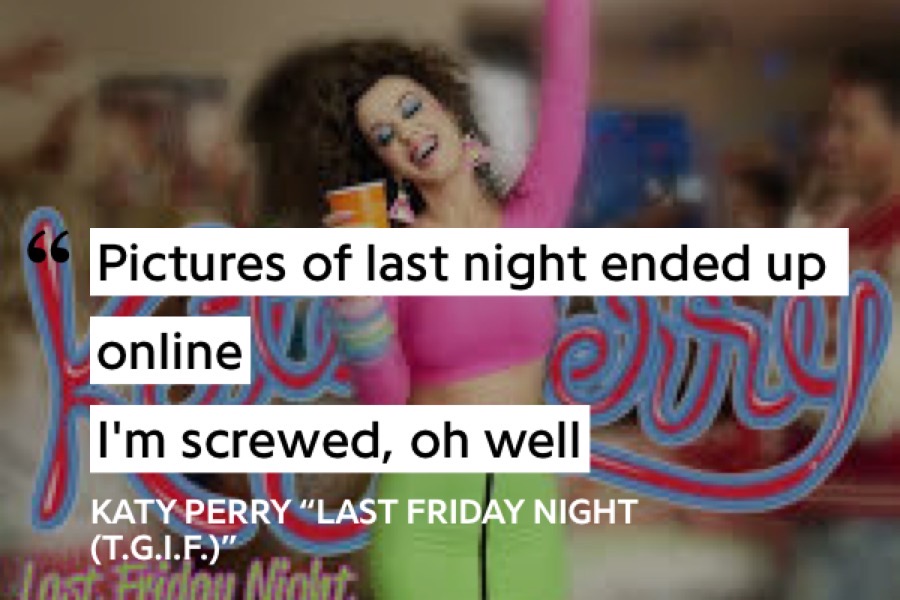
  • When I sat down to write, I was going to pick Katy Perry’s “Hot ‘N’ Cold,” which is kind of become a mantra at school along with the old song “Fever,” as it’s hot in the classrooms until the central office turns of the heat, then it’s freezing. I’m sweating and then freezing. That being said, I watched the “Hot ‘N’ Cold” music video and was starting my research, when the “Last Friday Night” video autoplayed. This was another song that was one of my college jams, but this one was more of a guilty pleasure for two reasons: one, I was an anti-pop hipster who only liked cool bands, and two, Katy Perry, and this song in particular, stood against everything I believed in.

    THINK WE KISSED, BUT I FORGOT. Growing up Seventh-day Adventist, my mom taught my sisters and I to keep the Sabbath. Seventh-day Adventists worship on Saturday rather than Sunday, like most Christians. The church teaches the Old Testament practices of not doing any work from sundown on Friday to sundown on Saturday. That translated to millions of Adventists not watching television on Friday night and no Saturday morning cartoons. As I grew up, I learned that Adventists believed that keeping the Sabbath was a covenant of salvation, and that the end times would be triggered by forcing members to work on Saturdays and go to church on Sundays. That being said, there were very few times when I was allowed “to break the Sabbath” when I was growing up. That meant no sports. That meant no hanging out with friends who weren’t Adventist because they would tempt you to do something to break the Sabbath like watch movies or play games that didn’t make you think of God. So, Katy Perry’s “Last Friday Night” describes a phenomena I could only judge as sin. But it sure looked fun. 

    IT’S A BLACKED OUT BLUR, BUT I’M PRETTY SURE IT RULED. Teenage Dream is Katy Perry’s best album, and maybe really only good one. I talked about the title track last month, but I didn’t talk much about my experience listening to this album. It was my summer of ’10 album. I listened to it track by track, which I hadn’t done with Perry’s previous album. I was in the middle of a literature degree and slowly expanding my musical horizons to include pop music again. I started listening to Lady Gaga, Ke$ha, and Katy Perry and was trying to pass moral judgment from my Christian school with the tools I learned in Bible and literature course for evaluating “whatever is noble, whatever is right, whatever is pure, whatever is lovely, whatever is admirable” (Philippians 4:8). I could enjoy this album as long as I reminded myself that everything about it was wrong. But I was wrong, too. In college I really felt I was on the path to figuring out the world. But I overlooked something crucial: human relationships and love and how I fit into that, not just theoretically. When I understood that in my late 20s, I watched as Teenage Dream judged me, rather than me judging it. Damn.

    https://genius.com/Katy-perry-last-friday-night-tgif-lyrics

  • For a short time in the early ’00s indie rock was king. I loved turning on MuchMusic (later Fuse) and seeing the latest cheaply made videos. Some of these groups pierced the Top 40 radio stations, like The Strokes, Modest Mouse, and this band, Franz Ferdinand. The song “Take Me Out” was the only song I knew of this band. This album came out in 2004, but it wasn’t until junior year of college in 2008 that I listened to it fully. From start to finish, the band’s self-title debut was energetic and puts you in the mood for college parties. The only problem was, I was kind of a loner and sober back then. 

    SHE’S NOT SO SPECIAL. In 2003 a Scottish rock band that took on the name of the assigned heir to the throne of the Austria-Hungarian Empire recorded their debut album in Sweden. The track I chose to write about, Auf Achse, is a German saying that literal means “on the axle,” but idiomatically, it means “on the road.” The song is a reference to a long-running German drama by the same name. Having not watched the show, I wonder if the song references the characters. Or does it mean that you should hit the road if you’re rejected? “She’s not so special, now look what you’ve done boy.” Oh dear. Violence? This particular track isn’t a stand out hit from Franz Ferdinand’s 2004 debut, but it does embody the spirit of the album. Dancey guitars and grooving bass lines make the lyrics slip past you for a few listens. However, when tracks like “Jacqueline,” “Dark of the Matinee,” or “Michael” hit, you realize you’ve been a bit hypnotized by the music. This song relies on repetition for verse and chorus, but packs a lot of punch in its bridge.

    YOU WANT HER, YOU CAN’T HAVE HER. I woke up to this song this morning, and it shaped my day. It reminded me of Saturday nights, driving to Chattanooga. It was decompressing from a strict Adventist campus that only served vegetarian food and no coffee. This album served as an escape into some needed introversion away from my roommate, away from some of the people who seemed a bit exhausting, no matter how nice they were. It was my go-to album for driving to the book stores–a secondhand warehouse of secondhand everything-media. Then to Barnes & Nobel and Books-A-Million across the street. Pick up a coffee and a burger and head back to campus. Nowadays, dating a med-school student, I have some weekends like this again before the tests. A needed weekend of introversion, when I should go shopping for clothes as I’ve been avoiding that since the pandemic. I should get a haircut. I should file my taxes. There are lots of things to do, but after the first full week of school, I just want to listen to Franz Ferdinand and do close to nothing. 


  • In Season One of The Big Bang Theory, Leonard is moping after his love interest, Penny, starts seeing another man. He comes into the apartment singing this song, quite horribly. “Boston” is Augustana’s biggest hit. It placed on the Billboard Hot 100, it was a Top 40 hit, and a top 10 Adult (light rock) hit. The band formed at Greenville University, a conservative Christian college where Jars of Clay formed before them and Paper Route after them. While the two other bands were comfortable with the Christian circuit, Augustana’s lead singer, Dan Layus, talks about breaking free from the strict rules of Christian college and choosing not to be a Christian band. 

    BOSTON, WHERE NO ONE KNOWS MY NAME. This piano ballad is not only a breakup with a lover, but a place too. If you’ve never moved to a city where no one knows you, it’s freeing. You possess the ability to rebuild your reputation and become whomever you want to be. I’ve done this several times in my life, sometimes by choice and sometimes out of circumstance. When my family moved to North Carolina in 1998, my parents only knew one family there. They ended up moving a year later. My mom was tired of the New York weather and she wanted to be closer to her family in Florida. So we moved between the two sides of my family. Then there was high school. My parents wanted my sister and I to go to a Christian school, but they chose one outside of our denomination because it was much cheaper. Then it was time for college. I decided to go to a Seventh-day Adventist university in Tennessee where I only had a few acquaintances. And then there was Korea. But in all of this moving to a city where no one one knows my name, I was still stuck in the rut of the person I thought I should be.

    I’LL GET OUT OF CALIFORNIA, I’M TIRED OF THE WEATHER. This line struck me today. No one moves to the Northeast for the weather. My family moved away from it. In music and literature, California often symbolizes the land of Canaan for humanity. Going to California means you’ve made it or are closer to making it. You have shed off the Puritan ways of the East Coast. Yet this song shows and interesting regression, as if to says, I’ve had all of the new and it’s left me empty. I’m going back to enjoy the tradition of a city that used bricks and cobblestone rather than asphalt. This image is especially strong today because, as the new school year has started, new students always ask where I’m from. I have to educate them about American geography. Before I tell my students where I am from, I ask if any students have been to America and where they visited. From there, I’m able to compare what places look like. Certainly the feeling of Boston is a stark contrast from California. LA feels different from San Francisco. Florida is different from North Carolina. Place matters, and if you have a choice, it’s important to find the right city for you.

    https://genius.com/Augustana-boston-lyrics
     

  • I didn’t listen to much music today. Work is really busy on Tuesdays because I have a lot of classes on Wednesdays. My students will read two poems by Lewis Carrol from Through the Looking Glass. The second on is “The Walrus and the Carpenter,” so of course, my favorite Beatles’ song got stuck in my head. It’s a daunting task to write about the Beatles. Every song they have released has its own field of research. The Beatles discography is like the bible of rock music, from which every sub-genre can be traced. And in the the Beatles discography, The Magical Mystery Tour album falls just after the beginning of what I would call their New Testament–the music after Sergeant Pepper Lonely Heart’s Band, after which The Beatles showed both a maturity in songwriting and a fetish of experimentation in the studio.

    GOO GOO G’JOOB. I may have first heard Bono’s cover of this song in Across the Universe. The scene in the movie calls back to what Tom Wolfe wrote about in Electric Kool-Aid Acid Test, talking about a time when hippie culture under the influence of hallucinogenics and Hare Krishna teaching from cult leaders was supposedly the solution to the American consumerism of the 1950s. And those Oxford-shirt-wearing academics couldn’t deny the art coming out of American beat culture–Jack Kerouac, Allen Ginsberg, and William S. Burroughs were the voice of a generation of counterculture. Then there were the folk songs of Woody Guthrie and Bob Dylan. Rock music was a low art, and at first, was lyrically simple. That all changed with groups like the Beatles. With a new age of literary criticism and new lenses to analyze text academically, some academics were bringing in their rock album leafs to figure out the deeper truths contained in the vinyl. To that John Lennon wrote this to “Let the fuckers work this one out,” claiming that it most mostly pure nonsense. But is it?

    EXPERT, TEXTPERT, CHOKING SMOKERS, DON’T YOU KNOW THE JOKER LAUGHS AT YOU. What struck me today from reading “The Walrus and the Carpenter” is how Lewis Carrol uses nonsense to drive his point. He’s writing for children, right? The poem is a kind of Pied-Piper, stranger-danger tale. The Walrus lures the young oysters onto the dry land so that he and The Carpenter can eat them. It’s the classic stranger with candy driving a red van that parents work so hard to warn their kids against. This made me think about growing up being warned about the stranger in the van for adults: sex, drugs, and rock ‘n’ roll. When Lennon sings, “I am the walrus,” does he mean that he’s luring you into the van with his interesting words, much like The Walrus in the poem? That’s what Dr. Robert did in Across the Universe. Or is it merely a red herring to lure the literature professors astray while taking a break from “kicking Edgar Allen Poe?”


  • Pop quiz: How many Asian American pop singers do you know? Bonus if you can name one with a Billboard Hot 100 hit. BTS does not count because they are Korean, not American. Give up? I can think of two. First a hip-hop group called Far East Movement garnered a lot of love in LA’s Koreatown and eventually topped the charts with the song “Like a G6.” And you could have also said Linkin Park‘s Mike Shinoda. Otherwise, pre-BTS, the American music industry was quite underrepresented by Asian musicians. With that in mind, the Atlanta, Georgia-born Eric Nam returned to the country of his parents to pursue a career he felt wasn’t likely in America. In Korea, Nam has become not only a popular musician, but also a go-to interviewer whenever movie or pop stars visit Korea. His K-pop is more influenced by singer-songwriters and U.S. pop singers than the girl and boy groups of his high school years. His unique take on K-pop has made him multi-nationally famous. Honestly, American pop music would have been much better with his talent.

    YOU WANTED AN ANSWER FROM THE START. I first heard of Eric Nam in 2014, when he released the single “Ooh Ooh” (ft. Hoya of Infinite). I was starting to listen to more and more K-pop, and these Canadian YouTubers, Simon and Martha raved about him on their Eat Your Kimchi channel. I had know Hoya from his role on Reply 1997. When I watched “Ooh Ooh,” I wondered what I was listening too. K-pop with a horn section? Eric struggling to put on his pants to cover up his Mickey Mouse underwear. A throwback to American bandstand-era television. Cutesy gestures. Really not my style musically. But I wondered why he was so loved, so that made me search for him on YouTube. I found several covers, most notable were “Say Something” and “I Won’t Give Up.” These two songs sold me on his talent. Two years later he released the single “I Can’t Help Myself” (ft. Loco) and kept making consistent pop music, eventually dropping the cutesy style, and dealing with a wider range of subjects, which brings us to today’s song: 2018’s “Honestly.” 

    BABY, I WANT TO YOU TO SAY SOMETHING. A song that starts off by saying, “I love you, but…” is rather unique. This song captures a rather unique feeling heard elsewhere in pop music. It’s similar to Lady A(ntebellum) saying “It’s a quarter after one, and I’m a little drunk, and I need you now.” It’s a feeling of knowing it should be over, but out of convenience, you keep it going, even when you both have totally different goals and expectations, sort of like my first relationship in Korea. You put off breaking up because you feel like there is still potential. You don’t want to heart their feelings, and much more, you don’t want to be the monster. “Why do I deserve happiness?” You ask. So a relationship that should have lasted a few weeks lasts eight months, until you can’t deny your unhappiness any more. In my case it was conflicting schedules and lack of communication that killed it. But also there was no future vision. That person wants you there for when they are free. You want to enjoy your free time with that person or be free to pursue other options. So, “This lie of saying I still love you…”

    Behind the Scenes featuring the acoustic version: 

  • It was a rainy summer break during Freshman year of college. I was still driving my ’91 Toyota Corolla, and that was the summer that I binged the first three Copeland albums. It started with 2003’s Beneath Medicine Tree, the indie/rock concept album about love and loss. About a month later I bought, 2005’s In Motion, which was a little more musically diverse. The next year’s Eat, Sleep, Repeat, was closer to musical theater than rock. Each Copeland album had its own unique mood. Today’s song, “Coffee,” comes from BMT, which is the most immature of the Copeland albums. Lyricist and singer Aaron Marsh was fine-tuning his craft at writing sappy love songs, and this album’s lyrics tended to be a little too over the top. The song “Coffee” appears as track 9, with a story as cliche as they get–two small town kids falling in love while talking all night at the diner. The brief brush drum solo toward the end sounds just like coffee shop music. 

    THERE’S A LOVE THAT TRANSCENDS ALL THAT WE’VE KNOWN OF OURSELVES. I’ve been drinking coffee since before I can remember. My parents tell me that I used to steal my dad’s coffee as soon as I could crawl. I must have burnt myself many times. When I was seven or eight my grandma gave me coffee. She told me not to tell my mom because my mom didn’t want me drinking it. Growing up as a Seventh-day Adventist, it was a demonized beverage. But when I was in 10th grade, my family all started drinking it, and we haven’t stopped. I’ve gone through periods that I tried to reduce my consumption, but it was a fruitless endeavor. When I first came to Korea, I wasn’t able to find any good coffee except for sugary instant coffee that came in a stick. I drank a lot of it, and my face got rather wide in the pictures. Fortunately I found better solutions, and now the highlight of the work day is when my coworker and I make French pressed coffee at work. 

    THERE’S PLENTY OF TIME LEFT TONIGHT. It seems that most weekdays I can drink as much coffee as I want and sleep well. However, there’s something about Sundays that an afternoon coffee will keep me up until 2 am. I hate Sunday nights. With the anxieties of the work-week looming, it’s a race to prepare everything–the laundry, the meals, the cleaning. We get to the afternoon lag and the decision: to drink coffee and sleep horribly or to suffer through the Sunday race to Monday. Sorry, Aaron, it’s probably too late for coffee. Sunday isn’t a great night. Let’s postpone until at least Thursday. Who needs sleep on Thursday night? The second week of the semester starts tomorrow. Time for the grind to begin. Fortunately the daily grind includes Columbian and Brazilian beans. 


  •  

    Chasing Happiness is a documentary telling the story of the ups and downs of the Jonas Brothers‘ career. Even though I was not a fan of the Disney Channel stars, CH was a telling human story about faith, family, and fame. Debuting in 2006, Kevin, Joe, and Nick took tween girl’s hearts by storm. I was, however, within almost the right demographic to completely ignore the band’s existence. While I was off at college listening to MGMT and Fleet Foxes, the Jonas Brothers meant a whole lot to the younger millennials. I say almost the perfect demographic because the band gave a lot of press to their Christian upbringing. Some of the Christian publications I read praised the young men as they wore their purity rings and kept a squeaky clean image. But there was a lot more to that story.


    IF YOU TOLD ME THAT MY FATE WAS ON YOUR FINGERTIPS, THEN, I WOULDN’T BELIEVE YOU. Last week Nick Jonas hosted and performed two songs on Saturday Night Live. After being introduced by his older brother, Kevin, Nick premiered this late ’80s/early ’90s song, complete with a saxophone solo. Lyrically this is a love song for his wife, actress Priyanka Chopra Jonas; however, I found the use of religious imagery in this song fascinating and totally on brand of what my blog has become: processing religious trauma. One of the most powerful scenes in Chasing Happiness is when the brother go to visit their home in Wyckoff, New Jersey. The brothers’ father was a minister in a small town Assembly’s of God church. Their parents did everything they could to help the boys succeed in their musical career, which caused tension between the church and their minister. The brothers had a successful first album only to be dropped by their label, and to make matters worse the church fired their father and evicted them from their family home. The scene in the documentary shows that moment as pivotal in how each one of the brothers started to splinter with Christianity, even if it was still present in their careers.

    Nick Jonas posing for
    Calvin Klein.

    YOUR BODY, MY MOTIVATION. After the Jonas Brothers’ hiatus starting in 2013, Nick Jonas’s career began to blow up. Like many other Disney stars, he stopped making G-rated music, and he also shook off the Christian following. I mentioned the Jonas Brothers last month when I talked about purity culture. The band has talked about these rings a lot because they were asked about them throughout their career. Nick spent his early 20s embracing his role as a sex symbol. Whether it was Calvin Klein ads or shirtless photo shoots, Nick Jonas was no longer the 13-year-old star. In 2018, Nick married Bollywood actress  Priyanaka Chopra, and the two have been media darlings since then. As a love song to his wife, “This Is Heaven” focuses on the here-and-now of love, rather than the heaven his father preached about. Instead of focusing on what many believe will be the soon-coming tribulation before the return of Christ, Nick focuses on how every moment in love gets better and better to the point where you can’t comprehend it getting any better. And a love ballad with a saxophone solo, how could it get better?

    Lyric Video:

    Saturday Night Live Performance: